


TL;DR:
- Travel accreditation is an independent verification that a travel agency meets specific standards for safety, professionalism, and quality, providing educators with trustworthy options. It differs from certification, which confirms a provider’s conformance to standards, whereas accreditation verifies the certifying body’s competence; both ensure credibility when selecting vendors. Schools should verify each agency’s accreditation directly with recognized bodies before every trip, combining this with insurance checks and references to effectively manage student travel risks.
Travel accreditation is formal, independent recognition that a travel agency or provider meets established industry standards for quality, safety, professionalism, and compliance. For school administrators and youth trip coordinators, understanding what travel accreditation means is the difference between booking with a vetted professional and taking an unnecessary risk with students. Organizations like IATA, GSTC, and ATIA each operate distinct accreditation frameworks, and knowing how they differ helps you make smarter decisions before a single permission slip goes home.
What is travel accreditation and how does it work?
Travel accreditation is defined as independent recognition of competence (opens in a new tab) that a travel business meets specified professional, compliance, safety, ethical, or quality criteria. An authoritative body evaluates the agency against a defined set of standards, then grants formal recognition when those standards are met. This process is not self-reported. It requires external review, documentation, and in most programs, ongoing compliance submissions.
The key word here is “independent.” Accreditation carries weight precisely because it comes from a body with no financial stake in the outcome. For a school administrator selecting a vendor for a 200-student band tour, that independence is what makes the credential meaningful. It signals that someone outside the agency has already done a layer of vetting on your behalf.
What is the difference between travel accreditation and certification?
This distinction trips up even experienced coordinators, and getting it wrong leads to misplaced confidence in a provider’s credentials.
Accreditation and certification are not the same. Accreditation recognizes the competence of a certifying body. Certification is written assurance by a third party that a specific provider conforms to a defined standard. In plain terms: accreditation validates the referee, certification validates the player.
Here is how that plays out in practice:
- Accreditation: GSTC accredits certification bodies rather than tourism businesses directly. When GSTC accredits a certifier, it confirms that certifier has the expertise and processes to evaluate tourism businesses against sustainability standards.
- Certification: A travel agency earns certification from one of those GSTC-accredited bodies, which then issues written assurance that the agency meets the relevant standard.
- Why both matter: A certification issued by a non-accredited body carries less weight. The accreditation of the certifier is what gives the certification its credibility.
For school trip coordinators, this means asking two questions when a provider shows you a credential: Who issued it? And is that issuing body itself accredited by a recognized authority?
Pro Tip: Ask any travel agency to name the accrediting body behind their certification, not just the certification itself. If they cannot answer clearly, treat that as a red flag.
What are the main types of travel accreditation programs?
Different accreditation programs cover different parts of the travel industry. The three most relevant for educational group travel are IATA, ATIA, and GSTC.
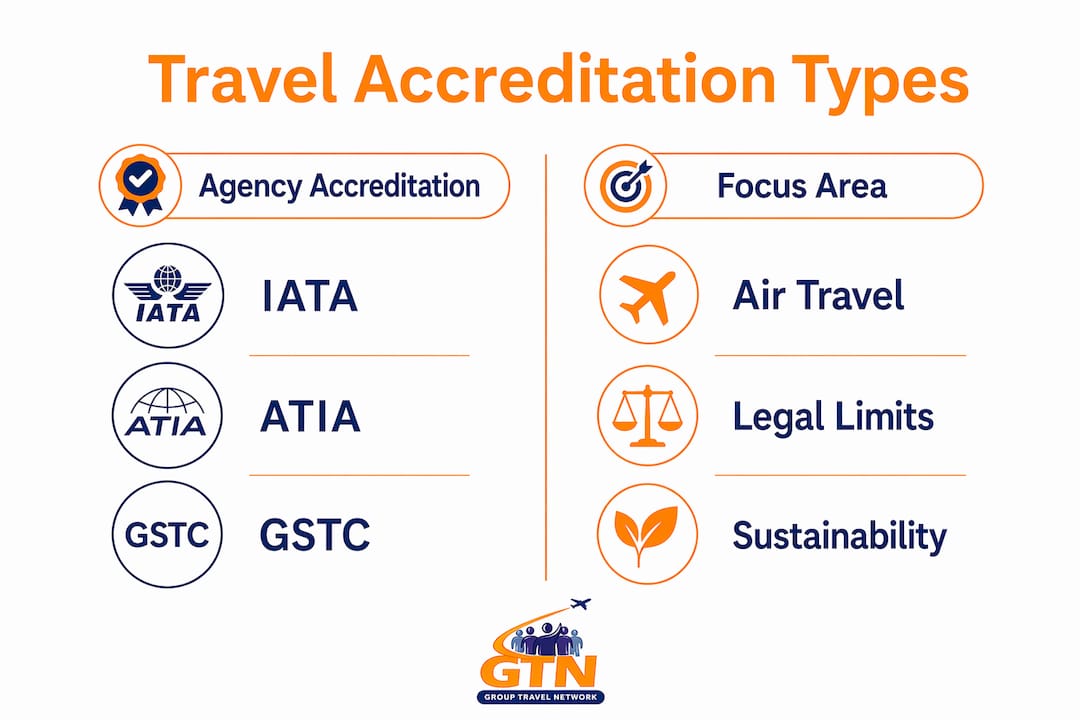
| Program | Scope | What it signals | Relevant for schools? |
|---|---|---|---|
| IATA Accreditation | Airline ticketing agents globally | Agency can legally issue airline tickets | Yes, for any air travel component |
| ATIA Accreditation | Australian travel intermediaries | Meets ATIA Charter and Code of conduct | Yes, for Australia-based trips or agencies |
| GSTC Accreditation | Certification bodies for sustainable tourism | Certifier meets global sustainability standards | Yes, for eco-focused or responsible travel |
IATA accreditation and why it matters for air travel
IATA provides 228 country-specific checklists (opens in a new tab) for agencies seeking accreditation to issue airline tickets. Requirements and documentation vary significantly by country, which means an agency accredited in one jurisdiction may not hold equivalent standing in another. For a school group flying internationally, confirming that your travel agency holds valid IATA accreditation in the relevant country is a non-negotiable step.
ATIA accreditation and its legal limitations
ATIA Accreditation is an industry-led voluntary scheme (opens in a new tab) for Australian travel intermediaries, assessed against the ATIA Charter and Code and maintained through annual compliance submissions. ATIA explicitly states it is not a government body and does not guarantee solvency, insurance coverage, or compensation arrangements. That disclaimer matters. Accreditation confirms professional conduct standards, not financial stability.
GSTC and sustainability-focused accreditation
GSTC operates at the level of certifying bodies, not individual agencies. When a certification body earns GSTC accreditation, it signals the highest market assurance for businesses certified under that body’s program. For schools prioritizing responsible travel, choosing agencies certified by a GSTC-accredited body adds a credible sustainability layer to your vendor selection.
Pro Tip: Do not assume that an agency displaying a GSTC logo is GSTC-accredited. The agency may be certified by a GSTC-accredited body, which is different. Verify the exact relationship before citing it to parents or school boards.
Why is travel accreditation important for schools and youth groups?
Accreditation matters for educational travel because it converts abstract trust into documented evidence. When a parent asks why you chose a particular agency, accreditation gives you a concrete, defensible answer.

Accredited firms provide consistent service (opens in a new tab), better trained staff, emergency preparedness protocols, and transparent communication practices. Each of those qualities directly reduces risk on a student trip. A staff member who has been trained to handle a medical emergency on tour is not a coincidence. It is a product of the standards the agency was required to meet to earn and keep its accreditation.
The practical benefits for school trip coordinators include:
- Risk reduction: Accreditation confirms the agency has met baseline standards for safety procedures and professional conduct, lowering the probability of operational failures.
- Parent and board confidence: Presenting accreditation credentials to parents and school boards demonstrates due diligence. It shifts the conversation from “we hope this agency is good” to “this agency has been independently verified.”
- Complaint handling: Accredited agencies are typically required to maintain formal complaint processes, giving you recourse if something goes wrong.
- Consistent quality: Accreditation requires ongoing compliance, not just a one-time check. That means the standards you verified before booking should still be in place on travel day.
That said, accreditation does not replace the need to verify insurance coverage, financial protections, and contractual terms. Schools should treat accreditation as one layer in a broader risk management strategy, not a complete substitute for independent due diligence. Checking your agency’s insurance and certifications (opens in a new tab) separately from their accreditation status is a step that should never be skipped.
How to verify travel accreditation for your group trip agency
Confirming accreditation is not complicated, but it requires deliberate steps. Here is a practical process for educational trip coordinators:
-
Identify which accreditation is relevant. For air travel, IATA accreditation is the baseline. For Australian agencies, check ATIA. For sustainability credentials, look for certification from a GSTC-accredited body. The right accreditation depends on the type of trip and the agency’s operating country.
-
Check IATA’s country-specific requirements. Because requirements vary by jurisdiction, an agency accredited in one country may not meet the documentation standards of another. Use IATA’s official country checklists to confirm the agency’s accreditation is valid for the relevant destination.
-
Verify directly with the accrediting body. Do not rely solely on the agency’s own website or marketing materials. Contact IATA, ATIA, or the relevant body directly to confirm current accreditation status. Credentials can lapse, and an outdated logo on a website is not proof of active standing.
-
Understand what the accreditation covers. An IATA-accredited agency is verified for airline ticketing. That does not mean they have been assessed for youth group safety protocols or educational travel expertise. Confirm the scope of each credential before treating it as a blanket endorsement.
-
Supplement with independent due diligence. Review the agency’s contract terms, cancellation policies, and financial protection arrangements. Verify travel insurance for school trips (opens in a new tab) separately. Ask for references from other schools or youth organizations they have served.
-
Re-verify for each new trip. Accreditation status changes. An agency that was accredited when you used them two years ago may have let their credentials lapse. Make verification a standard step in your pre-trip checklist, not a one-time historical check.
When you are evaluating multiple agencies, use accreditation as a filter, not a final decision. The top criteria for group travel agencies include accreditation alongside experience, references, financial stability, and youth-specific expertise.
Key takeaways
Travel accreditation is a formal, independently verified credential that confirms a travel agency meets defined standards for professionalism, safety, and quality. It is a necessary filter for school trip planning, but it must be combined with insurance verification, contract review, and direct reference checks to fully protect your students.
| Point | Details |
|---|---|
| Accreditation vs. certification | Accreditation validates the certifying body; certification validates the travel provider. |
| IATA country requirements | Verify accreditation against the specific country checklist, not just a general IATA badge. |
| ATIA legal limits | ATIA accreditation does not guarantee solvency or insurance coverage for your group. |
| Layered risk management | Treat accreditation as one layer alongside insurance, contracts, and reference checks. |
| Re-verify every trip | Accreditation status can lapse; confirm credentials fresh before each booking. |
Why accreditation alone is not enough: a coordinator’s reality check
I have reviewed a lot of agency credentials over the years, and the most common mistake I see from school administrators is treating accreditation as a finish line. They confirm an agency holds an IATA badge, check that box, and move on. That approach leaves real gaps.
Accreditation tells you the agency met a defined standard at a point in time. It does not tell you how they handle a 14-year-old with a severe allergy in a foreign hospital at 2 a.m. It does not tell you whether their emergency contact actually picks up the phone. Those answers come from references, from detailed contract review, and from asking the right questions before you sign anything. The right questions for educational travel agencies (opens in a new tab) go well beyond credential verification.
The other pitfall I see regularly is assuming that because an agency is accredited in one country, that credential transfers globally. IATA’s 228 country-specific checklists exist precisely because it does not. A coordinator booking a European tour through a U.S.-based agency needs to confirm that agency’s accreditation is valid for the specific countries on the itinerary, not just domestically.
My honest advice: build a pre-trip vendor checklist that treats accreditation as the first filter, not the only one. Verify the credential, understand its scope, then go deeper with insurance documentation, financial stability checks, and direct conversations with other schools who have traveled with that agency. That combination gives you something accreditation alone never can: confidence grounded in evidence.
— Donovan
Plan your school group trip with a trusted, accredited partner
Choosing the right travel partner for a student group trip starts with accreditation, but it does not end there. Grouptravelnetwork works exclusively with vetted travel agencies and vendors who meet professional standards for youth and educational group travel, so you are not starting your search from scratch.

Whether you are organizing a band performance tour, a cultural exchange, or a sports team trip, Grouptravelnetwork provides dedicated trip coordinators, flexible payment plans, and comprehensive travel protection options built specifically for school groups. Start with the school group travel planning guide (opens in a new tab) to map out every step from vendor selection to departure day, with accreditation checks built into the process.
FAQ
What does travel accreditation mean for a school trip?
Travel accreditation means a travel agency has been independently verified to meet defined standards for professionalism, safety, and quality. For school trips, it confirms the agency operates under a recognized code of conduct and has passed external review.
Is IATA accreditation required for all travel agencies?
IATA accreditation is required for agencies that issue airline tickets, and requirements vary by country across 228 official checklists. Not all travel agencies need IATA accreditation, but any agency handling air travel components for your group should hold it.
Does accreditation guarantee my group will be safe?
Accreditation reduces risk by confirming baseline professional standards, but it does not guarantee safety or financial protection. Schools must also verify insurance coverage, contractual protections, and emergency procedures independently.
What is the difference between GSTC accreditation and GSTC certification?
GSTC accredits certification bodies that evaluate tourism businesses. A travel agency earns GSTC-aligned certification from one of those accredited bodies, not from GSTC directly. The distinction matters when assessing the credibility of a sustainability credential.
How often should I verify a travel agency’s accreditation?
Verify accreditation status before every new booking. Credentials can lapse between trips, and an agency that was accredited two years ago may no longer hold active standing with the relevant organization.
Recommended
- How Travel Networks Transform School Group Trip Planning • Group Travel Network (opens in a new tab)
- School Group Travel: Safe Educational Journey Coordination (opens in a new tab)
- Group Travel Agencies: Complete 2025 Guide For Excellence (opens in a new tab)
- School Group Travel Planning: A Step-by-step Guide • Group Travel Network (opens in a new tab)