


A destination specialist is a travel professional with deep, localized expertise in a specific geography or trip type who builds personalized itineraries and supplier access that no generic booking platform can replicate. The role exists because travelers, whether private clients or school groups, increasingly want experiences designed around their goals, not just their budget.
- Core services: itinerary design, on-the-ground supplier relationships (DMCs, local guides, hoteliers), and real-time guest support before and during travel
- Who hires them: private travelers seeking curated experiences, and group or educational organizers who need logistics managed across dozens of participants
- How they earn: primarily commission-based through host agencies or as independent advisors; some charge flat fees or retainers for complex clients
Two resources come up repeatedly for anyone entering this field: The Travel Institute (opens in a new tab), which offers recognized destination-specialist coursework, and ZipRecruiter (opens in a new tab), which tracks current job listings and salary expectations across the U.S. market.
Table of Contents
- What does a destination specialist actually do each day?
- What skills and qualifications do employers and clients expect?
- How do you become a destination specialist?
- What does the career path look like, and what can you earn?
- What does a specialist actually produce? A sample itinerary
- Why do clients pay for a destination specialist?
- How a destination specialist supports a school group: a realistic example
- Key Takeaways
- Why specialization pays off more than most advisors expect
- Useful sources and next steps
- Grouptravelnetwork makes group travel planning concrete
- FAQ
What does a destination specialist actually do each day?
The role looks nothing like a travel agent clicking through an online booking engine. A destination specialist starts with a client consultation that goes well beyond “where do you want to go?” Top-performing specialists frame the work as partnership, designing around how the client wants to feel on the trip rather than just which hotels to book.
From there, the daily work breaks into five concrete areas:
- Client consultation and needs analysis: Deep questioning about traveler goals, group dynamics, learning outcomes (for school trips), or experience priorities
- Multi-vendor itinerary design: Coordinating across local suppliers, guides, transport operators, and permit offices to build a coherent, timed plan
- Supplier relationship management: Negotiating group rates and exclusive access with DMCs, hoteliers, and local guides; in the U.S. market, this often extends to securing permits (opens in a new tab) and coordinating across international agencies
- Pre-trip documentation: Visas, health requirements, timing windows, and contingency planning for disruptions
- On-trip support: Real-time problem resolution when cancellations, missed connections, or weather events occur
What separates a specialist from a general agent is that last point. Ongoing support during disruptions (opens in a new tab) is only possible when the specialist already has personal relationships with local vendors who can reroute, rebook, or improvise on short notice.
Pro Tip: FAM (familiarization) trips are not perks — they are research. Every site inspection you complete adds a supplier contact who will answer your call at 11 PM when a client’s transfer falls through. Budget for at least two FAM trips per year in your niche destination.
What skills and qualifications do employers and clients expect?
Hard skills matter, but the combination of technical knowledge and interpersonal ability is what actually wins clients and retains them.
Hard skills to develop:
- Deep destination knowledge: geography, culture, seasonal patterns, visa and health requirements
- Itinerary software familiarity (tools like Tourwriter, TripSuite, or similar planning platforms)
- Supplier negotiation, especially for group rates and exclusive access
- Language skills relevant to the destination (even conversational fluency builds supplier trust)
- Compliance knowledge: local permits, student travel regulations, liability waivers
Soft skills that separate good from great:
- Consultative selling: listening before pitching
- Attention to detail across dozens of moving parts simultaneously
- Crisis management under time pressure
- Cultural sensitivity, especially for educational groups traveling internationally
On the formal training side, The Travel Institute offers destination-specialist coursework that many professionals cite as useful foundational training. Supplier-specific certifications (offered by tourism boards, cruise lines, and hotel groups) layer on top of that foundation and signal credibility to both clients and employers.
ZipRecruiter job listings for destination specialists frequently list prior travel industry experience, customer service background, and at least one formal certification as baseline requirements. A portfolio of documented itineraries, even from personal travel, strengthens an application considerably.
How do you become a destination specialist?
The path is sequential. Skipping steps, especially the supplier relationship phase, produces advisors who know a destination from guidebooks but cannot actually deliver for clients when plans go sideways.
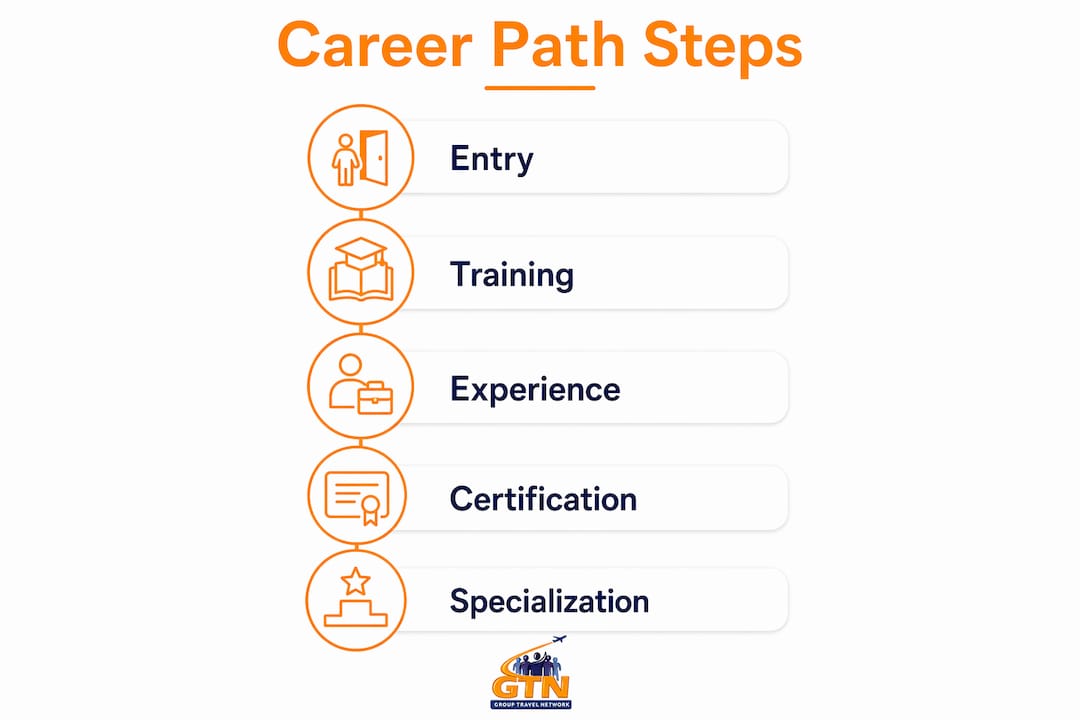
- Choose a niche and geographic scope. Pick one country, region, or trip type (adventure travel, educational tours, culinary travel) and commit to it. Depth beats breadth at every stage of this career.
- Learn the destination thoroughly. Personal travel, documented itineraries, and reading beyond tourism marketing. Know the rainy season, the permit timelines, the neighborhoods tourists miss.
- Complete formal training. The Travel Institute’s destination-specialist courses are a recognized starting point. Supplier certifications from tourism boards add credibility. Budget roughly a few hundred dollars for foundational coursework, depending on the program and depth.
- Build supplier relationships. Attend industry conferences (ATTA’s Adventure Travel World Summit, ASTA events), participate in FAM trips, and make direct outreach to DMCs in your niche. Supplier networks and firsthand destination experience are the most defensible assets a specialist has — and they take years to accumulate.
- Start booking under a host agency or go independent. Host agencies provide back-office support, errors-and-omissions insurance, and supplier relationships in exchange for a commission split (typically 70/30 or 80/20 in the advisor’s favor). Independent advisors keep more revenue but carry more overhead. Working with a group travel agency model (opens in a new tab) first gives you infrastructure while you build your client base.
Realistic timeline: Most specialists describe an initial learning phase of about a year or two, followed by a growth phase of several years, after which deep specialization starts commanding premium pricing. Budget a few thousand dollars for the first two years across training, conference attendance, and basic marketing.
What does the career path look like, and what can you earn?

Career progression in this field follows a predictable arc: generalist travel advisor → regional specialist → narrow expert in one country or trip type. The narrower the specialization, the higher the price point a specialist can justify. Some experienced advisors move into product management roles at tour operators or into supplier partnership positions.
Pay models vary more than most career guides admit:
- Commission-based: The most common model. Specialists earn a percentage of total trip cost from suppliers. Income follows the booking and travel calendar, which creates seasonal revenue swings that require deliberate financial planning.
- Fee-for-service: A flat planning fee charged regardless of where the client books. Growing in popularity as clients recognize the value of advice independent of supplier incentives.
- Retainer model: Used by specialists with complex, high-volume clients (corporate groups, school districts) who need ongoing planning support year-round.
ZipRecruiter tracks destination specialist job listings across the U.S. and is a practical tool for checking current market rates and employer requirements in your region. Salary ranges vary significantly by specialization, client type, and whether the advisor works independently or within an agency structure. Income volatility is a real factor: most destination specialists earn commissions that follow the booking and travel cycle rather than a steady salary, which makes financial buffering and diverse client pipelines important from day one.
Practical income stabilization tactics include requiring deposits at booking, using layered payment schedules, and maintaining a mix of individual and group clients so that a slow leisure season is offset by school-group bookings.
What does a specialist actually produce? A sample itinerary
Daily tasks are more operational than most people expect. A typical workday includes client calls, supplier confirmation emails, pricing updates as exchange rates shift, document preparation (visa letters, health forms, permission slips for minors), and post-booking follow-up to keep clients informed.
Here is a condensed 5-day educational group itinerary to illustrate what a specialist actually delivers:
- Day 1 — Arrival and orientation: Airport transfer coordinated with local DMC; welcome dinner at a family-run restaurant (pre-negotiated group rate); evening briefing on cultural norms and safety protocols
- Day 2 — Historical site visit: Private guided tour of a UNESCO site (permit secured 90 days in advance); structured debrief session mapped to curriculum objectives
- Day 3 — Community engagement: Morning workshop with local artisans (exclusive access arranged through supplier relationship); afternoon free exploration with designated meeting points
- Day 4 — Performance or presentation: Venue confirmed and sound-checked; local school exchange program coordinated for cultural exchange credit
- Day 5 — Departure: Checkout logistics staggered to avoid lobby congestion; contingency transport arranged in case of flight delays
The itinerary maps directly to student learning outcomes (opens in a new tab) — every activity connects to a curriculum goal, not just a sightseeing checklist. Specialists producing customized itineraries for student groups (opens in a new tab) know that school administrators need to justify every line item to parents and school boards.
Pre-send checklist before delivering final plans to clients:
- All supplier confirmations received in writing
- Visa and health documentation requirements verified for each traveler
- Emergency contact list and local medical facility information included
- Contingency plan documented for weather, transport failure, and medical events
- Payment schedule and cancellation policy clearly stated
Why do clients pay for a destination specialist?
The honest answer: they pay because the alternative is spending 40+ hours researching a destination they will visit once, and still getting it wrong. Tailored itineraries that include off-the-beaten-path experiences and timing optimized for seasonal events are what differentiate a specialist from any automated booking platform.
For private travelers, the value propositions are:
- Time savings: The specialist has already done years of research; the client gets the output in a consultation
- Exclusive access: Supplier relationships open doors that public booking cannot (private tours, sold-out venues, local experiences not listed online)
- Risk reduction: A specialist’s contingency planning and on-trip support mean disruptions get resolved, not just reported
- Personalization: The itinerary reflects the client’s actual goals, not a template
For group and educational organizers, the calculus is different. A school administrator or band director hiring a specialist for a school group trip (opens in a new tab) is buying liability reduction, logistical backup, and the ability to tell parents that a professional managed every detail. The specialist’s value is partly the trip itself and partly the peace of mind.
How a destination specialist supports a school group: a realistic example
Consider a high school band director planning a performance tour to a European city. The objectives: perform at a recognized venue, expose students to local music culture, and return safely within a fixed budget and timeline.
A destination specialist steps in at the brief stage, asking not just “where” but “what do you want students to take away?” From there:
A specialist’s ability to reroute clients during disruptions depends on personal supplier relationships built through repeated FAM trips and site inspections. When a venue cancels 72 hours before a scheduled performance, it is those relationships — not a Google search — that find an alternative within hours.
Actions the specialist takes: vetting performance venues for acoustics and permit requirements, coordinating with a local DMC for transport and accommodation, building a contingency venue into the contract, and preparing a day-by-day risk register for the school’s administration. The outcome is a trip where the educational objectives are met, the logistics run without the director managing 30 moving parts personally, and the school has documentation to satisfy its duty-of-care obligations.
For anyone planning educational group travel (opens in a new tab), the specialist’s role in pre-trip risk planning is often more valuable than the itinerary itself.
Pro Tip: For school groups, always build a 90-minute buffer into Day 1 logistics. Customs delays, lost luggage, and headcounts take longer than any itinerary assumes. A specialist who has done this before builds that buffer in automatically — a first-timer finds out the hard way.
Key Takeaways
A destination specialist’s most defensible asset is not a certification — it is the supplier network and firsthand destination knowledge that takes years to build and cannot be replicated by a booking algorithm.
| Point | Details |
|---|---|
| Core definition | A destination specialist provides personalized itineraries and supplier access built on deep, localized expertise in a specific geography or trip type. |
| Top skills to develop | Supplier negotiation, destination knowledge, consultative selling, and crisis management are the skills that separate specialists from generalist agents. |
| Training to prioritize | The Travel Institute’s destination-specialist coursework is a recognized starting point; budget $200–$800 for foundational programs. |
| Income reality | Most specialists earn commission-based income that follows the booking calendar; deposits, layered payment schedules, and a diverse client mix stabilize revenue. |
| Grouptravelnetwork next step | For educational and group travel candidates, Grouptravelnetwork offers dedicated trip coordinators and customized itineraries built specifically for school and performance groups. |
Why specialization pays off more than most advisors expect
The conventional wisdom in travel advising is that a broader client base means more stable income. After looking closely at how top specialists actually build their careers, that logic inverts. The advisors who narrow their focus earliest, choosing one region or one trip type and going deep, are the ones who can charge planning fees, command supplier respect, and weather slow seasons because their reputation precedes them. A generalist competes on price. A specialist competes on knowledge that no one else in the room has.
The group and educational travel niche makes this especially clear. A specialist who has run 15 school performance tours to the same city knows which venues have reliable sound systems, which local guides keep teenagers engaged, and which hotels actually deliver on their group-rate promises. That knowledge is not in any guidebook. It is earned, and clients pay for it accordingly.
Useful sources and next steps
These resources cover training, job-market data, and practical career development for aspiring destination specialists:
- The Travel Institute — Destination Specialist: The go-to for formal coursework and recognized certification in destination specialization
- ZipRecruiter — Destination Specialist jobs: Current U.S. job listings and salary data; useful for benchmarking employer expectations
- ATTA Career Page: Adventure Travel Trade Association’s overview of the destination specialist role and ongoing support responsibilities
- Student guided tours and learning adventures (opens in a new tab): Examples of curated itineraries and learning outcomes for educational groups
- Specialized travel agents for students (opens in a new tab): Covers the advantages specialists bring to student and youth travel
- One Stop Travel — simplified trip planning (opens in a new tab): Partner resource on operational workflows for travel planning
- Group travel agencies: 2025 guide: Context on host agency models and how commission structures work in practice
Grouptravelnetwork makes group travel planning concrete
Planning a student or performance group trip is where the abstract value of a destination specialist becomes very real, very fast. Grouptravelnetwork is built specifically for that moment: school administrators, band directors, and educational organizers who need a specialist’s depth without the overhead of building supplier relationships from scratch.
Every trip through Grouptravelnetwork comes with a dedicated trip coordinator, customized itineraries tied to educational objectives, flexible payment plans, and travel protection options designed for youth groups. The difference from a generic agency is that the team already has the supplier relationships, the permit knowledge, and the contingency planning built in. If you are evaluating whether to hire a specialist for your next school or performance group trip, the educational group trip planning guide is the clearest next step — it walks through exactly what a specialist-managed trip looks like from brief to execution.
FAQ
What qualifications do you need to be a destination specialist?
Most employers expect prior travel industry experience, at least one formal certification (The Travel Institute’s destination-specialist coursework is widely recognized), and a portfolio of documented itineraries. Customer service background and destination-specific supplier relationships strengthen any application.
How much does a travel agent make on a $10,000 trip?
Commission rates typically vary and specialists earn a percentage of total trip cost from suppliers. Fee-for-service specialists may charge a flat planning fee on top of or instead of commission.
What is the highest-paying job in travel and tourism?
Senior product managers at tour operators, corporate travel directors, and highly specialized independent advisors with established luxury or niche clientele tend to earn at the top of the industry. Destination specialists who narrow into high-value niches (luxury, expedition, or complex group travel) can reach those upper tiers over time.
Do travel consultants make a lot of money?
Income varies widely. Commission-based specialists experience seasonal swings tied to the booking calendar, and early-career advisors often earn modestly while building their client base. Specialists who implement deposits, retainer arrangements, and a diverse client mix, including both individual and group bookings, tend to stabilize and grow income more reliably over a 3–5 year horizon.
Recommended
- Specialized Travel Agents For Students: Why Try Them? (opens in a new tab)
- Travel Destination Scouting: A Complete Guide For Planners • Group Travel Network (opens in a new tab)
- What Is A Performance Travel Coordinator? 2026 Guide • Group Travel Network (opens in a new tab)
- Travel Agent For Students: 5 Reasons For Guidance In 2025