

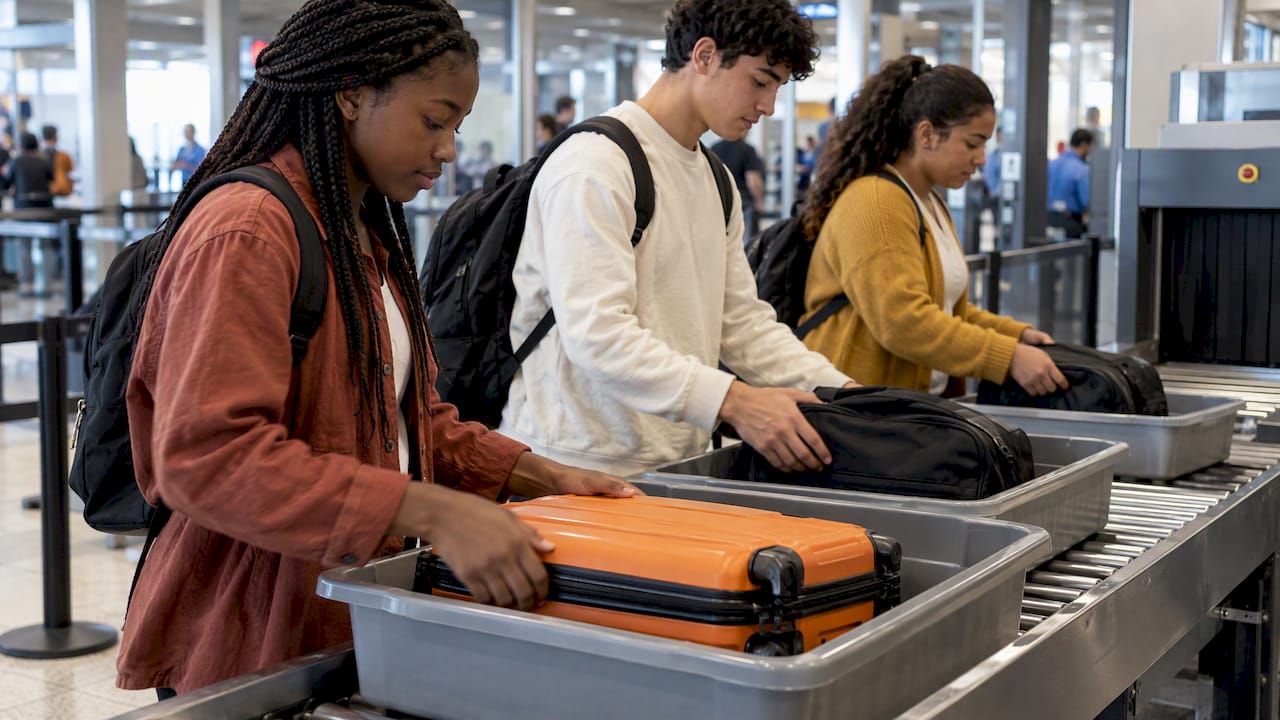
The short version: TSA does not require children under 18 to show ID on domestic flights, children 12 and under get modified screening, and teens 13 to 17 go through standard screening unless they qualify for PreCheck with an adult. For a school, band or team, the details matter more than the headline, because one student with a water gun in a backpack can slow forty others. This guide covers what TSA requires, where airlines add their own rules, and how to prepare a group so the checkpoint is the easy part of the trip.
TL;DR
- Children under 18 do not need ID for domestic flights (opens in a new tab), but adult chaperones 18 and older do, and airlines can set their own policies for minors.
- Children 12 and under get modified screening and can keep shoes, light jackets and headwear on. Teens 13 and older follow standard screening.
- Teens 13 to 17 can use a PreCheck lane with an enrolled adult only if they share the reservation and the PreCheck indicator is on their own boarding pass.
- Every carry-on, whatever the traveler’s age, goes through screening. Tidy, known contents are the best way to avoid pat-downs and delays.
- International trips add passport, consent letter and foreign-entry rules that TSA does not cover.
Table of Contents
- What TSA requires, by age
- ID: who needs it and who does not
- PreCheck for student groups
- Liquids, formula and food
- What happens at the checkpoint
- Packing rules to give your students
- Minors traveling without parents
- When the trip leaves the country
- Our perspective: the checkpoint is a planning problem
- Let us handle the planning around the airport
- A pre-flight timeline for group leaders
- FAQ
- Sources
What TSA requires, by age
TSA does not publish a single “minor” rule. It sets screening procedures by age bracket, and the dividing line that matters most to group leaders is 12 versus 13.
| Age | Screening | Shoes and jackets | Notes |
|---|---|---|---|
| 12 and under | Modified procedures (opens in a new tab) meant to reduce the need for pat-downs | Can stay on (shoes, light jackets, headwear) | Parents or guardians are not separated from the child |
| 13 to 17 | Standard screening | Follow adult procedures | PreCheck only with the right reservation and boarding pass indicator |
| 18 and older | Standard screening | Follow adult procedures | Must show valid ID at the checkpoint |
TSA bases the modified procedures on children who appear to be 12 or younger, and officers consult the adult traveling with the child. Carry-on property is screened for everyone regardless of age, so a backpack belonging to a seven-year-old goes on the belt just like a chaperone’s.
Most school groups live in the 13 to 17 range. That means your students will take off shoes, remove laptops and liquids when asked, and walk through the same technology as adults. Brief them on that before arrival, not in line.
ID: who needs it and who does not
TSA states that children under 18 do not need ID for domestic flights (opens in a new tab). Adults are different: passengers 18 and older must show valid identification (opens in a new tab) at the checkpoint, and TSA notes that its list of acceptable IDs can change without notice. Check the list again before each departure, especially for chaperones and any 18-year-old seniors on your roster.
Two caveats for group leaders:
- Airlines can ask for more. TSA’s rule is about the checkpoint. Airline policies on identification for minors can differ, so confirm directly with the carrier before you finalize your manifest.
- A minor with PreCheck who travels alone needs ID. TSA says that if a child is flying alone and has PreCheck, they need an acceptable ID to receive PreCheck screening.
Even though TSA does not require it, many groups have students carry a school ID or a copy of their birth certificate. It speeds up any airline question at check-in and helps in an emergency. Treat it as good practice, not a TSA requirement.
PreCheck for student groups
PreCheck is where group leaders most often get tripped up. The rules are built around families, not classes.
- Children 12 and under can accompany a parent or guardian enrolled in PreCheck through the expedited lane. The indicator does not need to be on the child’s boarding pass, according to TSA’s family PreCheck guidance (opens in a new tab).
- Teens 13 to 17 can use the lane only if they are on the same reservation as the enrolled adult and the PreCheck indicator appears on the teen’s own boarding pass (opens in a new tab).
- TSA also warns that no traveler is guaranteed expedited screening (opens in a new tab), because it uses unpredictable security measures.
What that means in practice: a chaperone with PreCheck cannot pull a group of 35 students into the fast lane. Students on separate reservations from the adult will not receive the indicator. Also, PreCheck benefits do not extend to gate passes, so if you escort students to the gate with a gate pass, you go through standard screening whatever your own enrollment. Plan your timeline as if the entire group will use the regular lane, and treat any PreCheck time savings as a bonus.
Liquids, formula and food
The 3.4-ounce (100 ml) liquid limit applies to older students just as it does to adults. Water bottles, sunscreen, hair products and drinks must be empty or travel-sized in a quart bag.
There is an exemption that matters for trips with very young children, such as a youth ensemble with siblings or a family-inclusive nonprofit trip. Formula, breast milk, toddler drinks and baby food (opens in a new tab) are treated as medically necessary liquids and are exempt from the 3.4-ounce limit. They do not need to fit in a quart bag, but they must come out of the carry-on and be presented separately to officers. Ice and gel packs are also allowed.
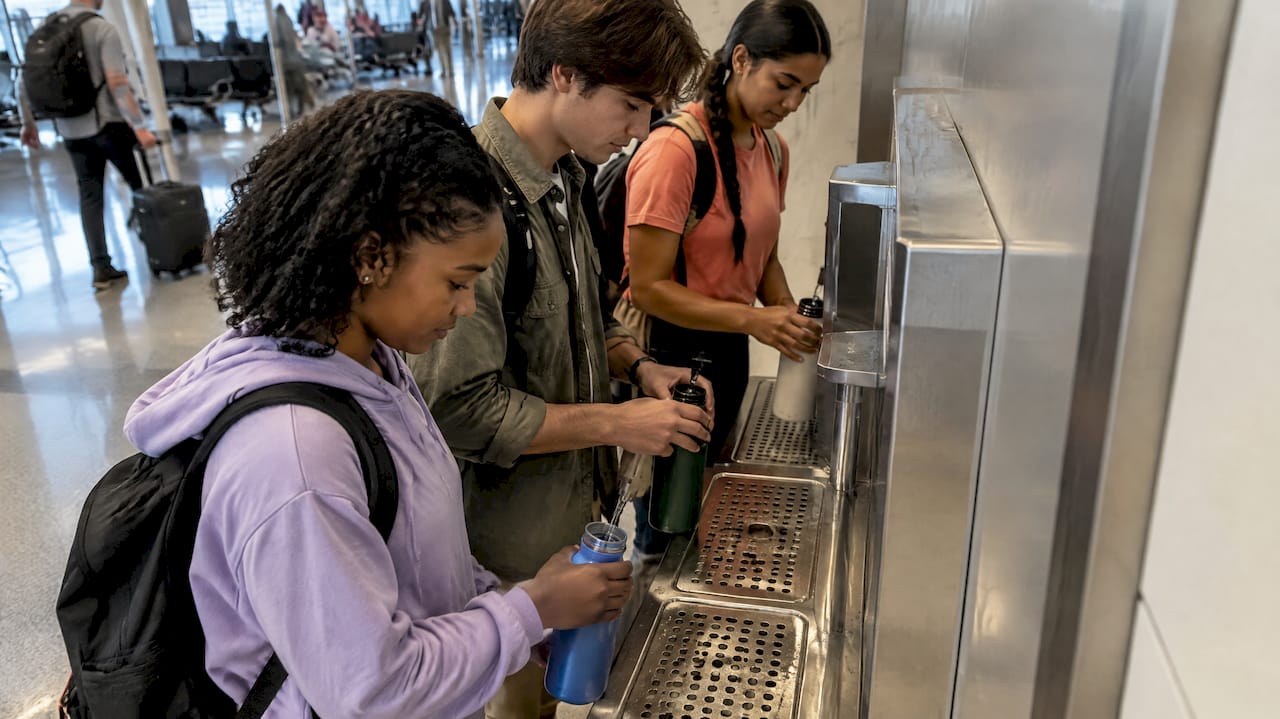
For teen groups, the practical advice is simpler: bring an empty reusable bottle and fill it after the checkpoint. Snack questions come up often. Solid snacks are generally fine in carry-ons, and the TSA “What Can I Bring?” tool is the place to check specific items before packing.
What happens at the checkpoint
A few mechanics are worth knowing before you stand in line with a group.
Nothing separates children from adults. TSA says parents and guardians are never separated from their children (opens in a new tab) during security. For a school group, that principle is a reason to assign chaperones to small pods of students and keep each pod together through the line.
Everything goes through X-ray. Toys, bags, blankets and other items all go on the belt, and alarmed items can require additional inspection.
Infants and strollers. Adults can carry infants in a sling or carrier through the metal detector. Children must be taken out of strollers and car seats, and the stroller or car seat goes on the belt. If it is too large, it gets a visual and physical inspection.
Alarms trigger extra screening. Even when a child can keep shoes and a light jacket on, anything that alarms the technology means more screening. Pockets full of coins, belts, and smartwatches are common culprits.
Packing rules to give your students
TSA’s own advice is that the smoothest checkpoint starts with organized packing. In its Labor Day travel guidance (opens in a new tab), TSA recommends starting with a completely empty bag, unzipping every compartment, and checking the “What Can I Bring?” tool before packing. That works well as a rule for a group. Put it on a one-page handout and send it home with your parent letter.
A workable checklist for students:
- Empty the bag completely, then repack it yourself. You should know every item inside.
- Keep electronics together and easy to pull out.
- Keep liquids in one pouch, 3.4 ounces or less each.
- Leave replica weapons, toy guns and water guns at home. TSA notes that prohibited items like these are frequently found in children’s bags and lead to delays.
- Wear shoes that come off and go back on quickly.
- Empty pockets into the carry-on before you reach the belt.
- Carry medications in their original packaging and tell your trip leader about any medical needs beforehand.
For band and choir groups, instruments, cases and accessories add their own screening questions. We cover that in our guide to booking transport for performance gear weeks ahead (opens in a new tab).
Minors traveling without parents
TSA’s rules do not require a parent at the checkpoint for a teen, but a school trip involves other documents that matter just as much. Parents are handing responsibility to your staff, and your school needs written authority to act for them, including for medical care.
Before departure, make sure you have:
- Signed consent for travel and participation
- Emergency contacts and medical authorization for every student
- A clear chain of custody for who is responsible for each student during airport transfers
We lay out the paperwork in 3 documents to finalize before minor travel without parents (opens in a new tab), and the 8 must-have fields in a minor travel consent form (opens in a new tab) show what a consent form should capture. If your school collects signatures digitally, see our electronic consent guide (opens in a new tab).
Airline unaccompanied minor programs are a separate matter. Those apply to a child flying alone without a supervising adult, and the age ranges and fees vary by airline. A group traveling with chaperones is not using that service, so confirm with the airline how it treats students on a group booking.
When the trip leaves the country
TSA screening is only the first checkpoint on an international trip. The documents you need depend on how you travel and where.
- Land or sea from Canada or Mexico. U.S. citizen children under 19 in organized groups, such as school, religious, social or sports teams, can present a birth certificate instead of a passport (opens in a new tab) (a Consular Report of Birth Abroad or Naturalization Certificate also works). The group must provide a letter on organizational letterhead with the group name, a list of the children with their details, and a signed statement of consent from the supervising adult. This exception is for land and sea crossings, not air travel. See our Canada school trip requirements (opens in a new tab) for the full list.
- Flying internationally. Students generally need passports. Our passport playbook for student groups (opens in a new tab) walks administrators through the timeline.
- Consent letters. The U.S. Department of State says the U.S. does not require two-parent consent for a minor to leave the country, but many foreign nations do (opens in a new tab). If a child travels with someone other than a parent or legal guardian, the Department recommends carrying a notarized letter of consent from the parents or guardians.
Start early. Passport processing and notarized letters take time, and parents who share custody can add delays.
Our perspective: the checkpoint is a planning problem
We plan student, band and youth trips, and we have come to see TSA as a logistics step, not a mystery. The rules for minors are fairly simple. What goes wrong is rarely the rule itself. It is a group arriving without a plan.
Three habits make the difference. First, we build extra time into every airport schedule, because a group moves at the speed of its slowest bag. Second, we treat each student’s carry-on as their own responsibility, with a pre-departure packing check, so a surprise at the belt does not hold up the group. Third, we keep chaperone roles written down: who counts heads, who handles the manifest, who talks to the airline.
We also advise coordinators never to build a schedule around PreCheck, because teens qualify only under narrow conditions and no one is guaranteed expedited screening. If it works, you save time. If it does not, you are still on schedule.
Finally, put an emergency plan in every chaperone’s hands before wheels-up. Our four emergency plan essentials (opens in a new tab) are a good starting point.
— Donovan
Let us handle the planning around the airport
If you coordinate a band tour, class trip or youth program, the TSA checkpoint is one of dozens of details. At Group Travel Network, we work with school administrators, band directors and youth organizations on custom itineraries, dedicated trip coordinators, online registration, flexible payment plans and travel protection options. Explore our Performance Tours (opens in a new tab), Educational Endeavors (opens in a new tab) and International Adventures (opens in a new tab), or start from our student travel home page (opens in a new tab) to tell us about your group.
A pre-flight timeline for group leaders
A schedule keeps the airport rules from becoming last-minute work. Adjust it to your trip, but this order holds up well.
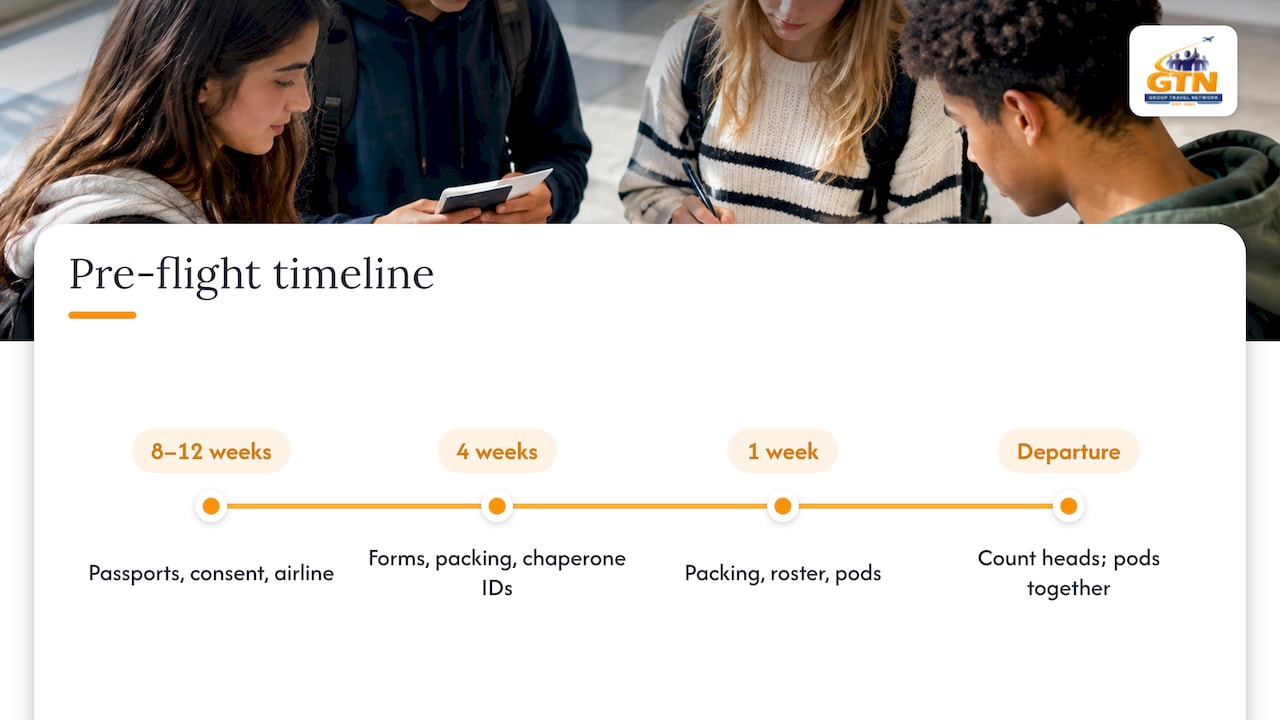
Eight to twelve weeks out: Confirm which students need passports, if the trip is international, and start the consent process. Check the airline’s policy on ID for minors and ask about group check-in.
Four weeks out: Collect signed consent and medical forms. Send the packing handout to families, including the empty-bag method and the no-replica-weapons rule. Confirm chaperone adult IDs match the names on their tickets.
One week out: Run a short packing session or send a checklist photo. Confirm the roster, the pods and each pod’s chaperone.
Departure day: Meet early. Count heads at curb, bag drop, checkpoint exit and gate. Keep every pod together through screening, since TSA does not separate children from the adults with them.
For a broader planning framework, see our step-by-step school trip guide (opens in a new tab) and 10 strategies for stress-free school trips (opens in a new tab).
FAQ
What does TSA require for minors to fly?
For domestic flights, TSA does not require children under 18 to show ID. Their carry-on bags are screened like anyone else’s, and children 12 and under receive modified screening procedures. Airlines may have their own policies, so check with the carrier.
Do teenagers need ID at the TSA checkpoint?
Not for domestic travel. TSA says children under 18 do not need identification. The exception is a minor flying alone with PreCheck, who needs acceptable ID to receive PreCheck screening. Adult chaperones 18 and older must show valid ID.
Can students use my TSA PreCheck lane?
Only in limited cases. Children 12 and under can join an enrolled parent or guardian. Teens 13 to 17 need to be on the same reservation, and the PreCheck indicator must print on their own boarding pass. Students on separate reservations will go through standard screening.
Can kids bring snacks and drinks through TSA?
Solid snacks are generally fine in carry-on bags, but liquids over 3.4 ounces (100 ml) are not, with an exception for formula, breast milk, toddler drinks and baby food. Those must be taken out and shown to officers separately. For older students, an empty water bottle filled after screening is easiest.
What do TSA rules change on an international school trip?
TSA screening works the same way, but the trip adds passport or birth certificate requirements, depending on the border and mode of travel. Many foreign countries also expect parental consent documentation, and the State Department recommends a notarized letter when a child travels without a parent or guardian.
Sources
- Do minors need identification to fly within the U.S.? (TSA) (opens in a new tab)
- Acceptable Identification at the TSA Checkpoint (TSA) (opens in a new tab)
- Traveling with Children (TSA) (opens in a new tab)
- Do children need to apply for TSA PreCheck? (TSA) (opens in a new tab)
- I am traveling with my family; can they also use the TSA PreCheck lane? (TSA) (opens in a new tab)
- TSA PreCheck FAQ (TSA) (opens in a new tab)
- Food: What Can I Bring? (TSA) (opens in a new tab)
- TSA prepares Labor Day weekend travelers (TSA, 2023) (opens in a new tab)
- Western Hemisphere Travel Initiative FAQs (CBP) (opens in a new tab)
- Traveling with minors (U.S. Department of State) (opens in a new tab)
Recommended
- Schools: 3 Documents To Finalize Before Minor Travel Without Parents (opens in a new tab)
- U.S. Organizers: 8 Must Have Fields In Minor Travel Consent Forms (opens in a new tab)
- U.S. Parents: 6–8 Week Plan For Minors’ International Travel Documents (opens in a new tab)
- Must-Have Travel Documents For Group Trips In 2026 (opens in a new tab)