

May 4, 2026
Student performance travel: unlock your students’ potential
TL;DR:
- Student performance travel enhances student engagement, social skills, and academic achievement through immersive, active experiences.
- Despite its proven benefits, many students miss out due to cost barriers, making access strategies essential for equity.
Student performance travel is far more than a reward trip or a chance to see new places. SYTA research shows that teachers organize an average of 1.7 trips per year, with nearly 30% planning two or more annually, and performance groups are among the most active travelers in the student tour space. Yet many school administrators still treat these journeys as optional extras rather than core educational investments. This guide breaks down the evidence, the planning essentials, and the strategies that help music educators and youth group leaders organize trips that genuinely transform students, not just entertain them.
Table of Contents
- What is student performance travel?
- How performance travel transforms student outcomes
- Planning a successful student performance trip
- Addressing barriers: Cost, access, and maximizing impact
- A fresh perspective: Rethinking student performance travel as essential, not optional
- Group travel solutions for unforgettable student performances
- Frequently asked questions
Key Takeaways
| Point | Details |
|---|---|
| Performance travel drives success | Organized trips for student performance groups boost academic performance and self-esteem. |
| Planning is critical | Effective logistics, safety measures, and inclusive strategies maximize impact and minimize risk. |
| Access matters | Financial barriers prevent many students from joining; creative solutions help broaden participation. |
| Data supports benefits | Research demonstrates measurable gains in attention, curiosity, and mental wellbeing from group travel. |
| Travel solutions exist | Specialized providers like Group Travel Network offer tailored experiences for student performance groups. |
What is student performance travel?
Building on the broad impact revealed in the introduction, let’s clarify what student performance travel actually involves before diving into planning or outcomes.
Student performance travel is organized group travel centered on students presenting their skills in a public or competitive setting. Think marching bands performing in iconic parade venues, choral groups singing in concert halls abroad, theater troupes staging productions at regional festivals, or dance ensembles competing at national showcases. The travel experience and the performance are inseparable. Both are the point.
This type of travel is distinct from a standard curriculum field trip to a science museum or historical site. A field trip places students in a learning environment as observers. A performance trip places them on stage as contributors. That shift in role, from audience member to performer, changes everything about how students engage with the experience.
Here is a quick comparison of how these trip types differ:
| Feature | Performance travel | Curriculum field trip |
|---|---|---|
| Primary purpose | Student showcase and competition | Curriculum reinforcement |
| Average group size | 43 students per group | Varies widely |
| Average trip duration | 8.8 days (international) | 1 to 2 days |
| Student role | Active performer | Observer or learner |
| Academic linkage | Arts, music, physical education | Science, history, geography |
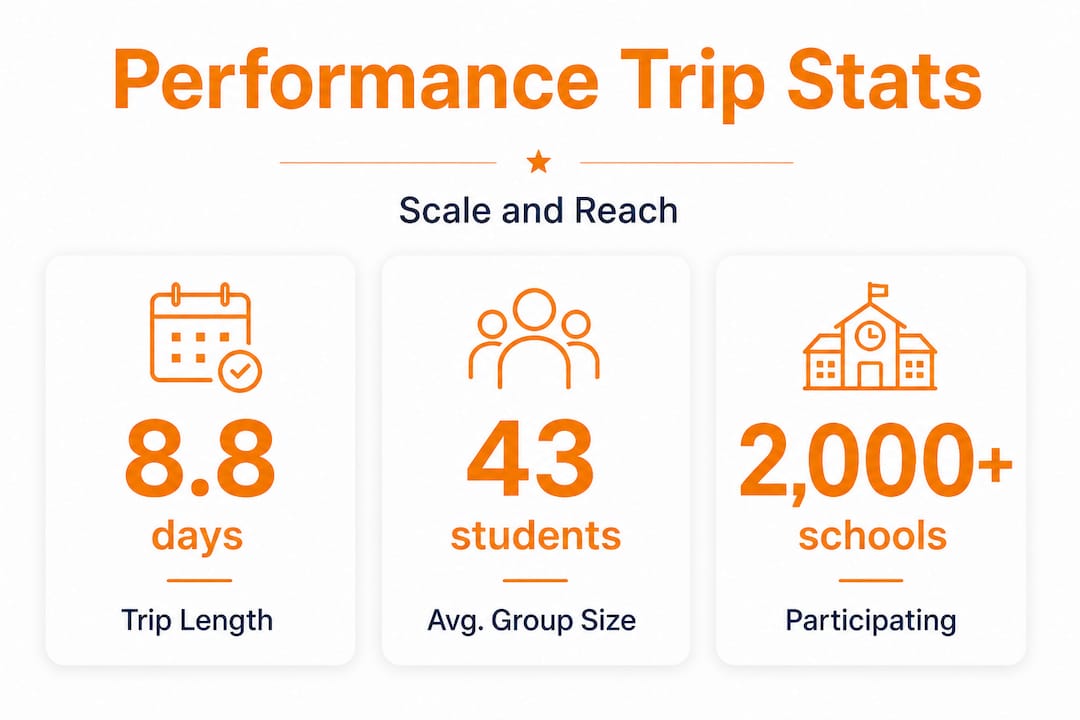
Data from SYTA industry research confirms the scale: international performance trips average 8.8 days and 43 students per group, with a total direct economic impact of $5.6 billion annually across student travel. These are not small excursions. They are major logistical undertakings with serious educational stakes.
The student performance travel overview on our site breaks down the unique demands of this travel category, from stage logistics to rehearsal schedules on the road.
Key characteristics that define student performance travel include:
- Group cohesion: Students must work together as an ensemble, team, or cast, which builds social skills that classroom settings rarely develop at the same intensity.
- High-stakes preparation: Knowing they will perform in front of an audience pushes students to prepare more thoroughly than they might for an in-school event.
- Cultural exposure: Many performance trips include cultural site visits woven around the performance schedule, adding layers of educational value.
- Extended duration: Unlike a single-day field trip, performance travel typically spans multiple days, giving students sustained immersive experiences.
Research supports the idea that participation in music and arts programs, amplified by performance travel, produces real academic gains. Students who participate in music programs show higher GPA scores, take more AP and honors courses, and report lower depression scores compared to non-participating peers. The benefits of student travel extend well beyond the stage.
“Performance travel is not a luxury for high-achieving students. It is a catalyst that helps all students discover what they are capable of when the stakes are real and the audience is waiting.”
How performance travel transforms student outcomes
With the context defined, let’s examine what makes performance travel truly impactful for student growth.
The evidence on school trips and student development is striking. UK research found that school trips boost student attention by 80%, increase curiosity by 75%, and improve self-esteem by 40%. Those are not small bumps. An 80% increase in attention is the kind of outcome most educators spend entire semesters trying to achieve through curriculum alone. Performance travel delivers it in days.
Here is how performance trips stack up against general school trips in terms of measurable student outcomes:
| Outcome area | General school trip | Student performance trip |
|---|---|---|
| Attention improvement | Significant | Very high (performance pressure adds focus) |
| Self-esteem boost | Moderate | High (public achievement is a confidence builder) |
| Teamwork development | Moderate | High (ensemble performance requires collaboration) |
| Academic connection | Curriculum-specific | Broad: arts, social studies, foreign language |
| Long-term memory | Good | Excellent (multi-day emotional experiences stick) |
The academic benefits are particularly compelling for music educators and band directors making the case to school boards. Students who participate in music programs on performance trips show higher academic achievement, including better grades and stronger enrollment in advanced coursework. This matters when you are sitting in a budget meeting justifying the cost of a 10-day tour.

The personal growth angle is equally powerful. When a student performs in front of hundreds of strangers in an unfamiliar city, they build resilience, confidence, and emotional regulation skills that no classroom exercise can replicate. Many students report that their performance trip was the defining moment of their school career.
The numbered sequence below shows how student growth builds during a typical performance trip:
- Pre-trip anticipation raises focus and motivation weeks before departure.
- Travel and new environments challenge comfort zones and spark curiosity.
- Rehearsal under pressure builds discipline and team trust.
- The performance itself delivers a peak experience of achievement.
- Post-performance reflection consolidates learning and personal growth.
However, the same research that celebrates these benefits also flags a serious equity issue. Nearly 40% of students miss out on school trips due to cost. That means a significant portion of your student body may never experience the focus boost, the confidence lift, or the academic gains that performance travel provides. That gap deserves attention, and we will address it directly in a later section.
The adventure benefits in 2025 resource and the growing catalog of showcasing talent tours reflect how the industry has evolved to meet growing demand for these transformative experiences.
Planning a successful student performance trip
Understanding the benefits, the next step is to learn how to plan and execute a successful performance trip for your students.
Good planning is what separates a transformative trip from a logistical disaster. Based on SYTA industry data, performance groups average 43 students per trip and nearly 9 days of travel. That scale demands a structured approach, not a spreadsheet and good intentions.
Here is a step-by-step planning sequence that works:
- Set your goals first. Decide what you want students to achieve musically, personally, and academically. Goals shape every decision that follows.
- Choose the destination based on performance opportunity. The venue and event should be central, not an afterthought.
- Build your budget with transparency. Itemize every cost including travel, accommodation, meals, performance fees, and insurance.
- Confirm travel protection early. Group travel insurance is non-negotiable for trips involving minors and major financial commitments.
- Assign chaperone roles clearly. Define ratios, responsibilities, and emergency protocols before anyone books a flight.
- Communicate with families consistently. Regular updates reduce anxiety and build trust in your program.
- Use a dedicated trip coordinator. Whether internal or through a travel partner, one person should own the logistics end to end.
The performance trip checklist resource walks through each of these steps in detail, ensuring nothing falls through the cracks.
Risk management deserves its own focus. Student travel involves medical, logistical, and liability risks that administrators must address proactively. Understanding your group travel insurance options is essential. Policies should cover trip cancellation, medical emergencies, lost instruments, and delayed travel. Many schools discover these gaps only after something goes wrong.
Pro Tip: Book your travel at least 12 to 18 months in advance for international performance trips. Performance venues, especially high-profile ones, fill quickly, and early booking gives you leverage on group rates for flights and accommodations. It also gives families more time to plan fundraising and payments.
Key logistics to lock in during planning:
- Performance slot confirmation: Get written confirmation of your group’s slot, not just verbal agreement.
- Instrument transport logistics: Large instruments require special handling. Coordinate with airlines and ground transport early.
- Dietary and medical needs: Collect this information from families well before departure.
- Emergency contact protocols: Every chaperone should have a printed emergency contact list, not just a digital one.
Working with an experienced travel agent for students dramatically reduces the burden on educators who are already managing rehearsals, parent communications, and school responsibilities.
Addressing barriers: Cost, access, and maximizing impact
Even with best practices, barriers remain. Here is how to address them to ensure your trip delivers maximum impact for every student.
The financial reality of student travel is uncomfortable. Research confirms that 40% of students miss out due to cost, and in many public school settings, that number skews higher for lower-income families. If your performance trip only reaches the students whose families can easily write a check, you are leaving the most impactful outcomes on the table for the kids who need them most.
“Every student who misses a performance trip due to cost is missing an 80% attention boost, a 75% curiosity spike, and a 40% jump in self-esteem. That is not just a missed experience. It is a measurable learning gap.”
Here are proven strategies for increasing access:
- Tiered payment plans: Spread costs over 12 to 18 months to reduce the per-month burden on families.
- Booster club fundraising: Car washes, candy sales, and community concerts are simple but effective.
- Corporate sponsorships: Local businesses often support youth arts programs in exchange for recognition.
- Grant funding: The National Endowment for the Arts and many state arts councils offer education travel grants.
- Early bird incentives: Discounts for students who register and pay first reduce last-minute dropouts.
- Scholarship pools: Direct a percentage of all trip registrations into a fund for students who cannot cover costs.
Understanding the tour group advantages is also important here. Group bookings unlock lower per-student rates across flights, hotels, and entry fees. The more students who participate, the lower the cost for everyone. This is why inclusion strategies are not just equitable choices. They are also financially smart choices for your whole program.
Pro Tip: Partner with a travel company that offers flexible payment plans built into the registration system. When families can see a monthly payment of $45 instead of a lump sum of $800, participation rates go up noticeably. The essential travel benefits of group booking are amplified when more students are on board.
Private schools may have more flexibility in trip budgeting, but public schools often need to anchor trip costs in documented academic outcomes to justify board approval. Frame your proposal around measurable learning goals, not just performance experience, and you will find more support from administrators and school boards.
A fresh perspective: Rethinking student performance travel as essential, not optional
Here is an uncomfortable truth that the student travel industry rarely states plainly: we have collectively allowed performance travel to be classified as a luxury when the data says it is a learning tool.
Think about what we do and don’t fund in education. Schools buy textbooks that students barely read. They invest in standardized test prep that produces anxiety more reliably than knowledge. Yet an experience that boosts attention by 80%, builds real-world skills, and connects directly to academic performance gets treated as optional, or worse, as a fundraising problem to be solved by parents.
That framing needs to change, and as the people who plan and advocate for these trips, you have the power to change it.
We have worked with hundreds of schools organizing performance tours, and the consistent finding is this: the students who go on these trips talk about them for years. Not just the performance itself, but the moments in between. The bus ride where the whole section stayed up practicing harmonies. The morning in a foreign city when a shy student navigated the metro for the group. These are formative moments that no curriculum standard captures but every educator recognizes as essential.
The music tours as classroom concept is not a metaphor. For many students, these trips are the moment when school stops feeling like something done to them and starts feeling like something they are part of. That shift in ownership is what drives long-term academic engagement.
The practical wisdom here is to start early, build partnerships, and advocate loudly. Start planning 18 months out. Build community partnerships that fund scholarships for students who cannot afford to go. Bring outcome data to your school board instead of just itineraries. When you frame the trip as a learning strategy with measurable returns, you move it out of the “nice to have” column and into the budget where it belongs.
Group travel solutions for unforgettable student performances
Performance travel deserves the same professional planning infrastructure as any major educational program, and that is exactly what we provide at Group Travel Network.
Whether you are organizing your first band tour or your tenth choral festival abroad, our team specializes in making the logistics invisible so your students can focus on performing. From performances on educational stages to full-service planning for school group travel, we handle venue coordination, group insurance, online registration, flexible payment plans, and dedicated trip coordinators for every group. Our catalog of showcasing talent tours connects your students with performance opportunities that match their level and ambitions. Let us handle the planning while you handle the music.
Frequently asked questions
How does student performance travel boost academic performance?
Students who participate in music programs on performance trips show higher GPA scores, more enrollment in AP and honors courses, and lower depression scores, all of which contribute directly to academic success.
What is the typical size and duration of a student performance trip?
According to industry data, performance trips average 8.8 days in length and include approximately 43 students per group, making thorough logistics planning essential.
How can schools make performance travel more accessible to all students?
Tiered payment plans, booster fundraising, grant funding, and scholarship pools are all proven approaches, especially important given that 40% of students miss school trips due to financial barriers.
What are the main differences between performance travel and other school trips?
Performance travel puts students on stage as active contributors rather than passive observers, involves larger groups and longer durations, and delivers unique benefits tied to arts participation and public achievement. SYTA data confirms performance groups are among the most active travelers in the student tour space.
Are international performance trips more beneficial than local trips?
International trips offer cultural immersion, global perspective, and group bonding that local trips rarely match, but well-designed local or regional performance trips can still produce strong academic and personal outcomes for students at any budget level.
Recommended

Relax with our Student Travel Expertise .
We deliver stress-free student trips backed by an exceptional array of services you won’t find anywhere else:
- Stress-free, creative planning of customized itineraries
- Dedicated GTN Service host on every trip
- Extensive travel protection plan options
- Online, individual registration system
- Flexible payment plans and online payment options
- Bulk buyer discounts for great trips that cost less
Inclusion into #MyGTNFamily for life! (you don’t even have to remember our birthday!)
Spain
There is no place like Spain to offer a student performance opportunity or cultural student trip.
Myrtle Beach
All students love the beach! Especially a beach known for its 60 miles of pristine coastline.
Boston
Have your students experience colonial charm in the city that is considered the hub of New England.
London
Provide your student group with the “Royal” treatment! One of the world’s most recognized cities.
See What People Are Saying
“What wonderful trip we had to NYC! Our group of 51 never missed a beat because of Group Travel Network and our wonderful guide, Tim. It was truly a theatre trip to remember! If you are looking for a travel company who really cares about the details, Group Travel Network is for you!”
“This was my first time using a company to plan our band trip. It was so easy working with Justin and Group Travel Network. We had to make several changes along the way, but they were accommodating changes and worked everything out for us. I would highly recommend using Group Travel Network.”
“It has been my privilege to use Group Travel Network as the exclusive travel coordinator for my band for over 10 years. I can say, without doubt or hesitation, that GTN is, by far, the best travel company for student groups currently in existence. I have often said that I wouldn’t take my band across the street without GTN and that’s not far from the truth!”