


School vendor onboarding is the process a district uses to approve a business before it can be paid: registration, a vendor application, tax and insurance documents, student-safety screening, and an approved purchase order. For a trip coordinator, the practical lesson is to keep the number of vendors you must onboard small. A hotel, a coach company, a venue and an insurer can mean four separate approvals, while one planner who coordinates those suppliers on your behalf gives the district one relationship to review. That is how we build trips at Group Travel Network, and the rest of this guide shows the process so you can plan your timeline around it.
TL;DR
- Onboarding usually runs in this order: register, submit the district’s application, clear insurance and safety screening, get an approved purchase order, then deliver and invoice.
- Registering on a bidding portal almost never makes a vendor approved. Several districts say so in writing, and some reject applications with no pending request from a school.
- Typical paperwork: signed application, W-9, conflict of interest questionnaire, certificate of insurance, and background-check certification for anyone working with students.
- No approved purchase order means no guaranteed payment. Start the process well before you promise families a trip price.
- Fewer vendors means fewer files to approve. A single coordinating planner shortens your onboarding list.
Table of Contents
- What school vendor onboarding actually means
- Step 1: Register, and know what registration does not do
- Step 2: Gather the documents districts ask for
- Step 3: Insurance and student-safety screening
- Step 4: Purchase orders, invoices and payment
- Step 5: Know who has to sign
- A realistic onboarding timeline for a trip
- Why fewer vendors makes onboarding easier
- How we approach it at Group Travel Network
- Our perspective
- FAQ
- Sources
What school vendor onboarding actually means
A vendor is any outside business a school or district pays: a bus company, a hotel, a festival organizer, a tour operator, a software provider. Onboarding is the district’s way of confirming that business is real, insured, safe around students and allowed to receive public or school-controlled money.
The steps differ by district, but the shape is consistent. Chicago Public Schools describes a two-step process (opens in a new tab): the school or department asks to sponsor the vendor it plans to use, then the vendor submits an application for approval. Vendors that are already active skip the sponsorship and complete an attestation instead. The district also says every CPS vendor completes an annual supplier attestation (opens in a new tab).
The key point for you as the buyer: in many districts the school is the one who starts the process. The vendor cannot simply apply and wait. You need to say “we want to use this business for this trip.”
Step 1: Register, and know what registration does not do
Most districts ask vendors to register on a portal. Read what that registration means, because it is the most common misunderstanding between schools and vendors.
| District | Registration route | What the district says registration means |
|---|---|---|
| Seminole County (FL) | VendorLink for solicitation notices | Not a business relationship (opens in a new tab); a separate application is needed and is rejected if no school has requested the vendor |
| College Station ISD (TX) | Ion Wave e-bidding site | Free, and does not make a vendor approved (opens in a new tab); approval comes through an awarded solicitation |
| DeKalb County (GA) | Vendor Self-Service System | Its 2019 handbook says registration gives no preferred or pre-approved status (opens in a new tab) |
| Okaloosa County (FL) | BIDNET for solicitations, plus a School Board Vendor Application | Applications are held on file (opens in a new tab) and entered when a school or department requests the vendor |
| Rialto USD (CA) | PlanetBids profile | Current W-9 uploaded through that system only (opens in a new tab) |
| Prince George’s County (MD) | iSupplier | Online registration takes about 3 to 5 business days (opens in a new tab); missing documents within five days mean rejection |
Two habits follow from this table. First, check your own district’s purchasing page before you shortlist trip suppliers, because the portal differs by place. Second, never tell a trip vendor “you’re approved” because they registered. Approval is a separate decision, and in several districts it only happens once a school or department has a pending need.
Step 2: Gather the documents districts ask for
Packet contents are remarkably similar across districts. Texas packets show the pattern well. La Vega ISD’s vendor application packet (opens in a new tab) lists:
- a signed application
- a W-9 (the IRS form that gives the district the vendor’s taxpayer information)
- a Conflict of Interest Questionnaire
- a Felony Conviction Form
- a certificate of insurance for on-site professional services where appropriate
- criminal-history certification when the vendor works directly with students
Gonzales ISD’s vendor packet (opens in a new tab) asks for the same set and adds an ACH authorization form, which lets the district pay by direct deposit. California’s Aromas-San Juan USD asks new vendors for a quote or proposal and a W-9 (opens in a new tab), and service vendors for a certificate of insurance that meets district requirements.
A useful exercise: build a one-page checklist of these items for each trip supplier and mark who holds each document. A hotel will rarely have a district’s Felony Conviction Form on hand. An unprepared vendor loses days, and your trip timeline loses them too.
If your trip also needs a written lodging agreement, our guide to hotel contracts for schools (opens in a new tab) covers what to require before you sign.
Step 3: Insurance and student-safety screening
This is the step where onboarding stops being paperwork and starts protecting students. Requirements are set locally and by state law, so treat these examples as patterns, not a national rule.
Insurance. Sacramento City USD’s 2024-25 vendor insurance bulletin requires a Certificate of Insurance from all vendors (opens in a new tab) and lists a $2 million per-occurrence minimum for sexual abuse and molestation coverage. It says $1 million may be acceptable for providers with five or fewer employees, after consultation with Risk Management. A certificate of insurance is the one-page proof an insurer issues showing what coverage a business holds.
Background checks and supervision. The same bulletin requires contractors working with students to have background checks and fingerprints before services begin, to be supervised by staff on campus, and to avoid unsupervised one-on-one time with students.
State law. In California, Los Angeles Unified’s December 16, 2024 bulletin applies Education Code sections 45125.1 and 45125.2 (opens in a new tab). Since AB 130 took effect on January 1, 2022, contractors must ensure that employees who interact with students outside the immediate supervision of a parent, guardian or school employee get criminal background checks.
Facilities and building work. Contractors who service school buildings fall under the same screening logic, and their compliance duties go beyond people checks. Guidance on water safety during school closures (opens in a new tab) shows the kind of building-safety questions facilities vendors should be ready to answer.
For trips, the people question is wider than the vendors. Chaperones and adult volunteers need screening too, and lead time matters. Our guide to chaperone background checks (opens in a new tab) explains how to run them weeks before departure. Questions about what your state requires belong with your district’s legal counsel or risk manager.

Step 4: Purchase orders, invoices and payment
Approval does not equal permission to work. The purchase order (PO) is the document that commits district money, and districts are firm about it.
- Chicago Public Schools’ Board Rule 7-1(b) requires an approved PO before goods or services are provided. Without one, payment is not guaranteed (opens in a new tab) and invoice processing may be delayed.
- Aromas-San Juan USD’s handbook says an authorized PO is the only document that obligates the district (opens in a new tab).
- Prince George’s County requires an approved PO before any delivery or service and prohibits phone or email orders (opens in a new tab).
- Rialto USD says no products or services may be provided without an official PO (opens in a new tab).
Payment terms are usually net 30, meaning the district pays 30 days after receiving an accurate invoice. La Vega ISD pays net 30 after receipt of goods or services (opens in a new tab), while Gonzales ISD’s packet says net 45. DeKalb’s handbook prohibits prepayment (opens in a new tab).
That last point matters for travel. Trip suppliers often want deposits months ahead, and a district that bars prepayment cannot send one. When a trip is paid from student or family funds rather than district funds, the rules may differ, so confirm with your business office which pot of money the trip uses before you sign anything. If you collect payments from families, see our guide to ACH payments for school trips (opens in a new tab).
Step 5: Know who has to sign
Approval authority usually rises with the contract’s size. Mansfield ISD’s contract manual, written in 2014, shows one common structure: contracts under $5,000 may be signed by an appropriate principal, director or departmental superintendent (opens in a new tab). Contracts from $5,000 to $50,000 need the supervising Executive Council member’s signature, and contracts over $50,000 need Board approval and the Superintendent’s signature. The district also requires vendors to be registered and verified with Purchasing before an agreement begins, to confirm insurance and student-safety documentation.
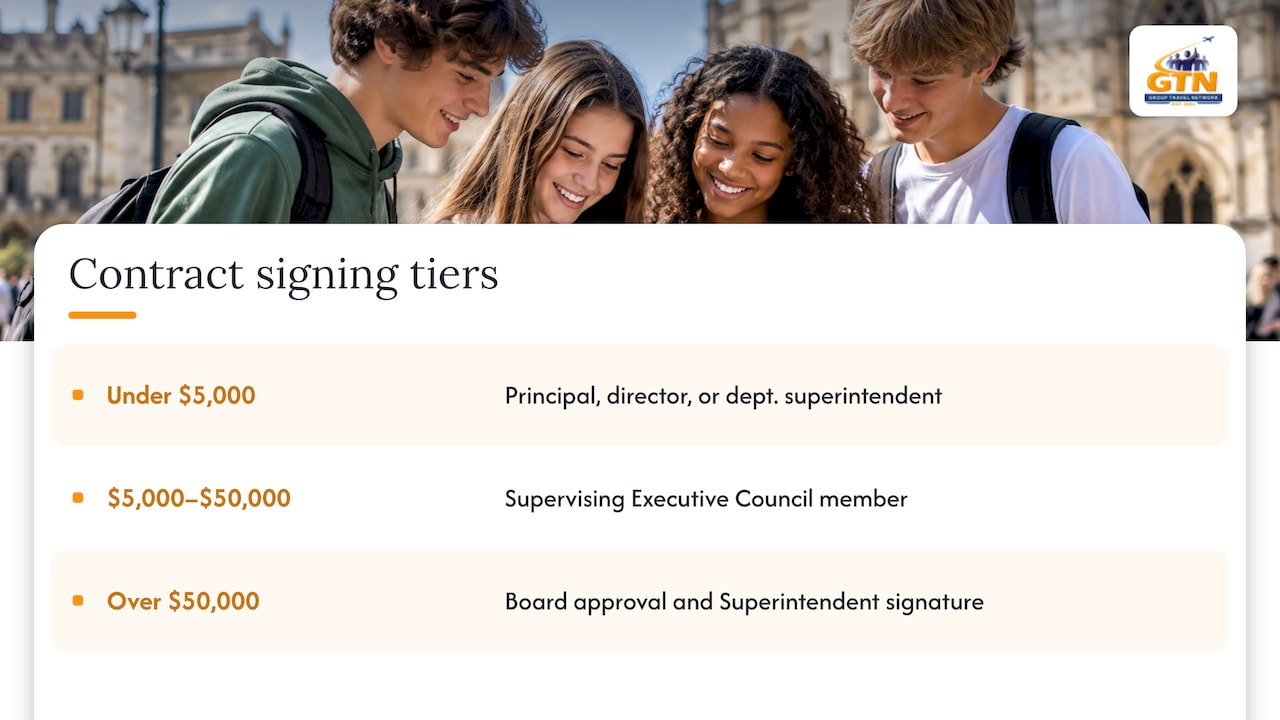
Thresholds vary and that manual is old, so ask your own purchasing office for current numbers. The planning lesson holds: a multi-bus, multi-night trip for a full band can cross into board territory, and board calendars set your deadline, not the vendor’s.
Vendors face review after approval, too. Anson County Schools’ policy, dated 2011, has finance evaluate vendors annually (opens in a new tab), selecting about 50 at random each year. It purges vendors inactive for three years and can place poorly rated vendors on a debarment list. An approved status is not permanent, so a vendor you used once may need to be reactivated next season.
A realistic onboarding timeline for a trip
Use this as a planning frame, then replace each estimate with your district’s real numbers.
- Define the need. Write down every supplier the trip requires: lodging, transport, venue or festival, insurance, meals, activities.
- Ask purchasing what is already approved. Active vendors may skip steps, as the Chicago process shows.
- Request sponsorship or put in the requisition. Many districts will not process a vendor without a school request.
- Send the vendor the packet. Include W-9, insurance certificate and screening forms. Prince George’s gives a five-day window before rejection.
- Wait for registration and review. The same district lists three to five business days for online registration alone, before any approvals.
- Obtain the PO and signatures. Add time for board agendas if the contract is large.
- Only then confirm to families. Publish prices and collect money after the district has committed.
If competitive bids are required, a structured request helps. Our school travel RFP (opens in a new tab) guide covers five sections and a vendor scoring matrix, and how to select vendors for school trips (opens in a new tab) covers the evaluation criteria.
Why fewer vendors makes onboarding easier
Every supplier is a file: an application, a W-9, an insurance certificate, screening, a PO, an invoice, an annual re-evaluation. Multiply that by the five or six businesses a typical performance or educational trip touches and the administrative load lands on a teacher or band director with a full class schedule.
There are three practical ways to reduce it:
- Ask for one contracting party. A planner that coordinates the hotel, transport and venues can sit as the single vendor on your PO instead of several.
- Keep documents current. A vendor with a fresh certificate of insurance and W-9 ready moves faster than one that has to request them.
- Align the contract with the district’s payment terms. If the district pays net 30 or net 45 and bars prepayment, the supplier needs to agree before you commit.
When the trip needs cancellation terms spelled out, our school trip cancellation policy (opens in a new tab) guide shows what administrators should put in writing.
How we approach it at Group Travel Network
We are a travel agency for student, school and youth performance groups. Our service includes custom itineraries, vendor partnerships, dedicated trip coordinators, online registration, flexible payment plans and travel protection options. For a coordinator facing a district approval process, that means the trip’s moving parts come through one planner rather than a stack of separate suppliers. Start with the type of trip you run: Performance Tours (opens in a new tab) for bands, choirs and orchestras, or Educational Endeavors (opens in a new tab) for curriculum-linked travel. You can also talk to us about stress-free student travel (opens in a new tab) for your group.

Bring your district’s vendor packet and purchasing timeline to the first conversation. Our coordinators plan the itinerary around those dates.
Our perspective
Most onboarding trouble on school trips comes from timing. A band director finds a great festival, a district office needs three weeks and a board vote, and the family deadline is already printed.
We plan trips backward from the district’s process. The first questions are who must approve, what the PO threshold is and which documents the business office wants. Then the itinerary follows. A dedicated trip coordinator, a single planner for the moving parts and a payment plan that fits how families actually pay all serve the same goal: the person running the trip spends time on students, not on forms.
If you take one thing from this guide, make it this: ask purchasing what it needs before you choose suppliers, and choose a partner who is comfortable working to that list.
Donovan
FAQ
Is registering on a district portal the same as being approved?
No. College Station ISD says registration is free and does not make a vendor approved, and Seminole County says VendorLink registration does not establish a business relationship. Approval typically follows a request from a school or department, a completed application and, in some districts, an awarded solicitation.
What documents should a trip vendor have ready?
A signed vendor application, a current W-9, a certificate of insurance and any conflict of interest or felony conviction forms your district uses. If staff will be with students, expect background-check certification as well. Ask your purchasing office for its current packet, since each district publishes its own.
Can a vendor start work before the purchase order is approved?
Generally not. Chicago Public Schools, Prince George’s County and Rialto USD all state that goods or services should not be provided without an approved PO, and unapproved work may go unpaid. Wait for the PO before confirming dates or collecting money.
How long does onboarding take?
It depends on the district. Prince George’s County lists about 3 to 5 business days for online registration alone, and larger contracts may also need board approval. Ask your business office for its current review time and build the trip’s deadlines around it.
Sources
- Vendor Onboarding Sponsorship, Chicago Public Schools (opens in a new tab)
- How to Become a Vendor, Chicago Public Schools (opens in a new tab)
- Seminole County Public Schools, Vendor Information (opens in a new tab)
- College Station ISD, Vendor Forms/Registration (opens in a new tab)
- DeKalb County School District Vendor Handbook 2019 (opens in a new tab)
- Okaloosa County Schools, Vendor Registration (opens in a new tab)
- Rialto USD, Vendor Registration & Bidding Opportunities (opens in a new tab)
- Prince George’s County Public Schools, Purchasing Processes (opens in a new tab)
- La Vega ISD Vendor Application Packet (opens in a new tab)
- Gonzales ISD Vendor Packet (opens in a new tab)
- Aromas-San Juan USD Purchasing Procedures Handbook (opens in a new tab)
- Sacramento City USD Vendor Insurance Bulletin 2024-25 (opens in a new tab)
- Los Angeles Unified School District Policy Bulletin, December 16, 2024 (opens in a new tab)
- Mansfield ISD Contract Manual (opens in a new tab)
- Anson County Schools, Selection, Evaluation and Re-evaluation of Vendors (opens in a new tab)
- Water safety during school closures (opens in a new tab)
Recommended
- How To Select Vendors For School Trips: 2026 Guide (opens in a new tab)
- How To Organize School Tours: 2026 Planning Guide (opens in a new tab)
- Team Travel Coordination Tips For Schools In 2026 (opens in a new tab)
- School Trip Waitlists: 5 Signup Steps And A Coordinator’s Workflow (opens in a new tab)