


Primary travel insurance pays your medical claim first. Secondary travel insurance waits until your own health plan has paid or denied the claim, then covers some of what is left. For a school, band or youth group, the practical question is not which type sounds better. It is whether the students’ family health plans will respond overseas at all, and who in your organization will chase the paperwork if they do not.
This guide is written for administrators, band directors and trip coordinators who sign off on group travel. It covers how the payment order works, what happens when more than one policy applies, how supplier default coverage fits in, and a checklist to run before you approve any plan.
TL;DR
- Primary coverage lets you file with the travel insurer first. Secondary coverage makes you file with a health plan first, then pays eligible leftovers.
- Many U.S. health plans offer limited or no coverage abroad, so international trips often lean toward primary medical coverage, or secondary coverage that effectively acts as primary.
- Supplier default (a tour operator, airline or cruise line going under) is a separate benefit with purchase deadlines, usually counted from the first trip payment.
- Ask every plan for its outline of coverage, and compare the medical order of payment, the deadlines and the exclusions in writing.
- Collect each family’s health insurance details before departure, so a claim does not stall on missing information.
Table of Contents
- What primary and secondary mean
- Primary vs secondary at a glance
- Does a group need primary coverage?
- What happens when more than one policy applies
- Medical-only plans vs trip insurance
- Supplier default: the question hiding behind this keyword
- Seven checks before you approve a plan
- How to file when two plans may pay
- Our perspective
- Plan your next trip with the insurance question settled
- FAQ
- Sources
What primary and secondary mean
The words describe the order in which insurers pay. They say nothing about quality, and they do not by themselves tell you how much a plan pays.
Primary medical coverage lets a traveler file a claim with the travel insurer first, before submitting it to any other insurer, as NerdWallet’s guide to travel medical insurance (opens in a new tab) describes it. The travel plan responds up to its limits, whatever other insurance the traveler holds.
Secondary coverage works the other way around. You file with your health insurer first. The travel insurer may then cover eligible expenses the health plan did not pay, subject to deductibles or copays, according to Allianz’s explanation of primary versus secondary medical coverage (opens in a new tab). Its secondary coverage benefit page (opens in a new tab) adds that the travel plan pays the difference as the plan describes it, so the wording of each policy controls the result.
A simple example
A student breaks an ankle during a festival trip abroad. With primary coverage, the trip leader or family files with the travel insurer, and that insurer pays eligible costs up to the plan limit. With secondary coverage, the family first has to submit the bill to the student’s health plan and wait for a decision. Only then does the travel insurer look at what remains.
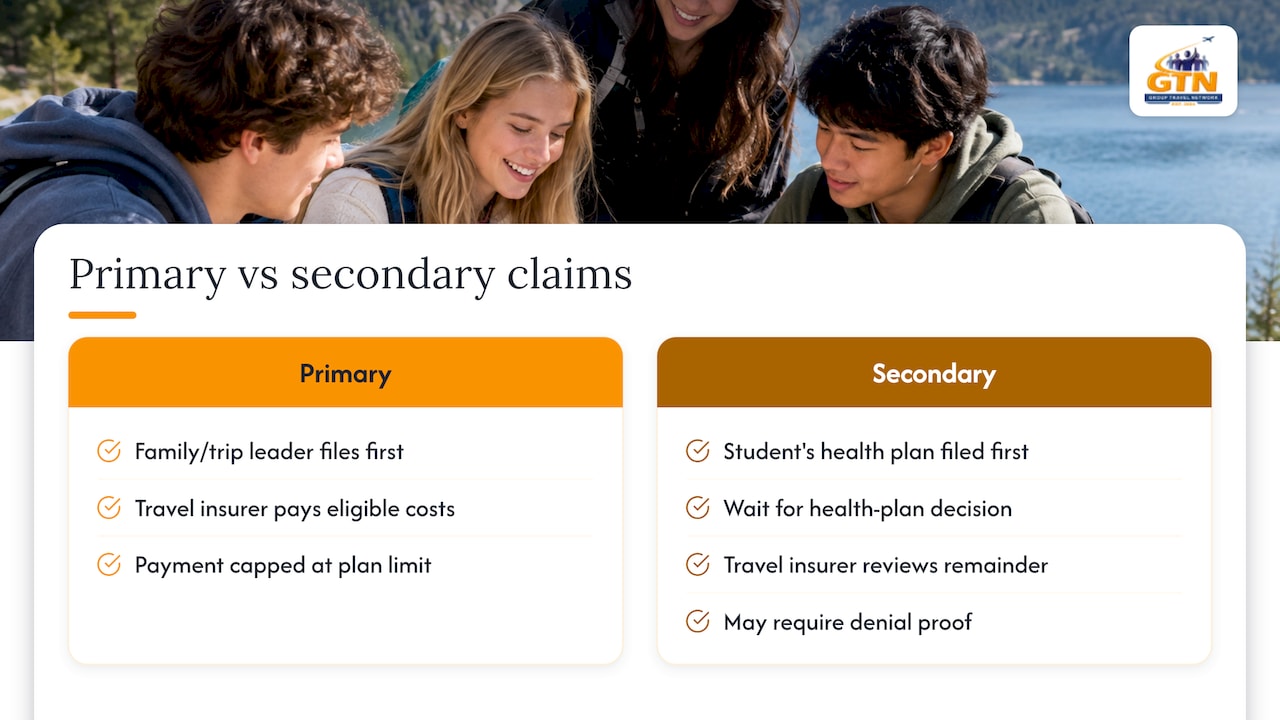
The second path is slower, and it depends on documents. When the health plan denies the claim, the travel insurer often needs proof of that denial before it will consider the claim, Allianz notes (opens in a new tab). A secondary plan may also ask for the amount the first insurer paid before it can work out the remainder, which the RoamRight description of coverage (opens in a new tab) illustrates.
Primary vs secondary at a glance
| Question | Primary medical coverage | Secondary medical coverage |
|---|---|---|
| Who gets the first claim? | The travel insurer | The family’s health insurer |
| Paperwork burden | Lower: one claim to start | Higher: denial or payment record from the first insurer |
| Fills gaps in health plan | Not required to | Yes, for eligible expenses left unpaid |
| Deductibles and copays | Set by the travel plan | Can apply to what the travel plan covers after the health plan |
| Fit for trips abroad | Strong when family plans have limited foreign coverage | Works best when family plans do pay abroad |
| Fit for domestic trips | Often more than needed | Often enough, since many family plans work nationwide |
The table is a pattern, not a promise. Always read the actual plan.
Does a group need primary coverage?
There is no universal answer, but there are three situations that point in one direction.
Trips abroad. Health insurance people get through a job or a marketplace typically does not offer coverage outside the home country, as a travel insurance comparison explainer (opens in a new tab) puts it. Medicare, for example, does not provide coverage outside the U.S. A group has dozens of students, each with a different family plan, so you cannot assume the same outcome for each of them.
Secondary may act as primary anyway. One professional guide notes that when a traveler’s health plan has no international coverage, secondary travel insurance often functions as the primary payer in practice. The same source advises confirming this with the insurer first: see Yonder’s primary vs secondary guide (opens in a new tab). Treat that as a question for the insurer, not an assumption.
Trips with a lot of paperwork risk. If your office has a small staff, a primary plan means one claim to start and fewer calls to dozens of family insurers. That is a real administrative saving, even when the premium is similar. Cost is driven by factors such as age, trip cost and coverage level, not by the order of payment alone, which one travel insurance provider’s note on the myth that primary costs more (opens in a new tab) also suggests. Check quotes side by side rather than guessing.
For domestic trips, a secondary plan can be sufficient if the family plans work across state lines and the main risk is the gap in cost sharing. Our own guide to travel insurance for school group trips (opens in a new tab) walks through how the common benefits fit different trip types.
What happens when more than one policy applies
Groups run into this more than individual travelers. A student may be covered by a parent’s plan, a second parent’s plan and the trip policy at once.
Coordination of benefits
Insurers use coordination of benefits rules to decide who pays first and to keep total payments from exceeding the actual expense. The NAIC model regulation (opens in a new tab) defines it as an order for plans to pay claims, and lets a secondary plan reduce its benefits so combined benefits do not exceed total allowable expenses. For children of separated parents, the same model says that, absent a court decree, the parent the child lives with for more than half the year is generally treated as primary. That is a detail worth knowing when you collect insurance information on the medical form.
The model is a template that states adopt in their own way, so your family’s plan documents decide the outcome.
Two travel policies
Buying a second travel policy rarely doubles your payout. Canadian industry guidance on out-of-country coverage, in CLHIA Guideline G17 (opens in a new tab), says payments are coordinated so that the total does not exceed total expenses, and that the insurer you contact first may not be the primary plan. It is a Canadian document, so use it as an illustration of the principle, not as U.S. law. It also states that any portion no plan covers because of exclusions or limits stays with the covered person.
Some policies also include a facility of payment clause. It lets an insurer reimburse another plan that paid something which should have been the primary plan’s responsibility, as the RoamRight document (opens in a new tab) shows.
Other sources of coverage count too
The first payer is not always a health plan. One provider lists medical insurance, tour operators, common carriers, other travel providers and workers’ compensation as sources that must be exhausted before its secondary coverage pays. You will find this in World Nomads’ primary and secondary coverage help page (opens in a new tab). Chaperones traveling for work should ask whether workers’ compensation applies to them.
Medical-only plans vs trip insurance
Primary and secondary are labels for medical benefits. Trip insurance is a bigger package. Travelers can buy a standalone medical-only policy that focuses on emergency care and related benefits, while trip insurance typically bundles cancellation and interruption coverage as well, according to CNBC Select’s overview (opens in a new tab).
For a school group, the choice usually comes down to what is at risk:
- Money paid in advance: deposits, flights, venue fees and festival registrations. Cancellation, interruption and supplier default benefits address this.
- Health abroad: emergency treatment and evacuation. Medical benefits address this.
- Equipment: instruments, uniforms and audio gear on performance tours. See our explainer on performance travel insurance for student groups (opens in a new tab).
- Liability: claims against the school or organization. Our 2026 liability protection guide for schools (opens in a new tab) covers that separately.
If your group is headed to Europe, it also helps to read up on Europe travel insurance requirements for U.S. travelers (opens in a new tab), so the medical limits you choose match what the destination expects.
Supplier default: the question hiding behind this keyword
Some readers who search this topic really want to know what happens if the airline, cruise line or tour operator fails. That is supplier default, or financial default, coverage. It is not a primary or secondary matter. It has its own rules.
Two published plan documents show how much the details differ:
- One outline of coverage (opens in a new tab) covers cancellation or interruption caused by the financial default of an airline, cruise line or tour operator. It requires the insurance to be bought within 21 days of the first trip payment, and the default must happen more than 14 days after the effective date. It excludes the default of a party from whom you bought arrangements supplied by others.
- A different plan brochure (opens in a new tab) requires purchase within 14 days of the first payment or deposit. Default must occur more than seven days after the effective date, and suppliers from which you bought the insurance, and their affiliates, are excluded. That brochure dates from 2014, so it shows the pattern of such terms and not today’s wording; check current documents.
Three lessons follow. First, the clock starts at your first payment, not at your final payment. Second, a waiting period after you buy can leave a gap if the supplier fails soon after. Third, the supplier exclusion means you should read who counts as an excluded party before assuming your tour operator is covered.
On a group trip with staged payments, you may have deposits placed months before you finalize the roster. Our article on buying within 14 to 21 days for pre-existing condition coverage (opens in a new tab) covers the same type of deadline. Mark the date of your first deposit on the calendar the day you pay it.
Administrators who also manage collections can build a clearer budget with a school trip financial plan (opens in a new tab), so that insurance premiums and payment deadlines sit on the same schedule.
Seven checks before you approve a plan
- Read the order of payment. Find the sentence that says whether the medical benefit is primary or secondary, and whether it changes for certain benefits.
- List the other payers. Family health plans, tour operator coverage, carrier coverage and workers’ compensation for staff.
- Check purchase deadlines. Supplier default and pre-existing condition benefits often hinge on buying soon after the first payment.
- Check waiting periods and exclusions. Look for the effective-date gap and the excluded-supplier wording.
- Confirm claim documents. Ask what a secondary claim needs: usually an explanation of benefits or denial letter from the first insurer.
- Gather insurance cards and medical forms. Use a standard form; our student medical forms checklist (opens in a new tab) is a good starting point.
- Ask who files. Decide in advance whether the school, the trip leader or the family submits claims, and who holds receipts abroad.
The cost of school trip insurance in 2026 (opens in a new tab) page explains what administrators typically weigh when they compare premiums.
How to file when two plans may pay
The process is more orderly than most people expect.
- Keep every receipt and medical record from the provider abroad.
- Submit to any source that could pay first. The travel insurer will ask for the other insurer’s decision on whether and how much it will reimburse, as the World Nomads help page (opens in a new tab) explains.
- Attach the result (payment record or denial) to the travel claim.
- Respond to information requests quickly. Under the NAIC model, if a plan fails to provide needed information within a reasonable time, a secondary plan may assume that plan’s benefits equal its own and pay on that basis, then adjust later if real figures arrive. See the NAIC model regulation (opens in a new tab).
Ask the insurer’s claims team before departure how the process works for a group, and keep their contact details in the trip binder.
Our perspective
We plan student, band and youth trips for a living, and the insurance conversation almost always starts in the wrong place. Directors ask which plan is cheapest. We ask what could realistically go wrong on this specific trip, and who would be holding the phone when it does.
The primary versus secondary label matters most when something happens overseas at 2 a.m. and a chaperone must decide what to do. A plan that needs a denial letter from a family’s domestic insurer is hard to use in that moment. That is why, for international trips, we encourage administrators to look closely at primary medical benefits, and to ask any secondary plan exactly how it behaves when a family plan does not pay abroad.
On the money side, our view is that the biggest avoidable mistake is missing a purchase deadline. Staged payments mean the clock can start long before the group is final. We build the insurance decision into the early planning timeline so the first deposit and the coverage window line up.
We do not publish insurance prices on our site, and coverage terms differ by plan and by state, so we point groups to the plan documents instead of summarizing them loosely. Our coordinators can walk your committee through the options and help you compare outlines of coverage line by line.
— Donovan
Plan your next trip with the insurance question settled
If you are building a trip now, we handle the details with you: custom itineraries, a dedicated trip coordinator, online registration, flexible payment plans and travel protection options. Explore our International Adventures (opens in a new tab) for trips abroad, our Performance Tours (opens in a new tab) for bands, choirs and orchestras, or start at our home page (opens in a new tab) to tell us about your group. For a plain-language overview of coverage types, see our guide to group travel insurance for student trips (opens in a new tab).
FAQ
What is secondary travel insurance?
Secondary travel insurance requires you to file with your primary insurer first to learn how much, if anything, it pays. The travel plan can then pay the difference as the plan describes it. Deductibles or copays may still apply, so read the policy wording.
What happens if I have two travel insurance policies?
Insurers coordinate payments so that total payments do not exceed your total expenses. The insurer you contact first may not be the one that pays first. Any portion neither plan covers because of exclusions or limits remains your responsibility.
Can I buy just medical travel insurance?
Yes. Standalone medical-only policies exist and focus on emergency health care and related benefits. Trip insurance usually adds cancellation and interruption coverage, so a group that has prepaid deposits at risk often needs more than medical alone.
Does supplier default coverage come with primary or secondary medical coverage?
They are separate benefits. Supplier default covers a trip lost because an airline, cruise line or tour operator fails financially, and it usually has its own purchase deadline counted from the first trip payment. Check the exclusions, because plans commonly exclude the party you bought the insurance from.
Who should file claims on a school trip?
Decide before departure. Many groups have the trip leader collect receipts and records abroad, while the school or families file once home. Whoever files should hold each student’s insurance details and any denial or payment records the plan requires.
Sources
- Emergency Medical Travel Insurance: Primary vs. Secondary (opens in a new tab)
- Secondary Insurance Coverage (opens in a new tab)
- How Travel Medical Insurance Works, NerdWallet (opens in a new tab)
- Primary vs Secondary Travel Insurance, Yonder (opens in a new tab)
- Primary vs Secondary Travel Medical Insurance Coverage (opens in a new tab)
- Coordination of Benefits Model Regulation, NAIC (opens in a new tab)
- CLHIA Guideline G17: Coordination of Benefits (opens in a new tab)
- RoamRight description of coverage (opens in a new tab)
- Primary and secondary coverage help page, World Nomads (opens in a new tab)
- Best travel medical insurance, CNBC Select (opens in a new tab)
- Outline of Coverage, Chubb (opens in a new tab)
- Classic Plan brochure, Allianz (opens in a new tab)
- Europe travel insurance for U.S. travelers (opens in a new tab)
- School trip financial plan (opens in a new tab)
Recommended
- Group Travel Insurance Explained: Protect Student Trips Easily (opens in a new tab)
- Travel Insurance For School Group Trips Explained (opens in a new tab)
- Liability Protection For Group Travel: 2026 Guide For Schools (opens in a new tab)
- What Is A Travel Protection Plan? Your 2026 Guide (opens in a new tab)