

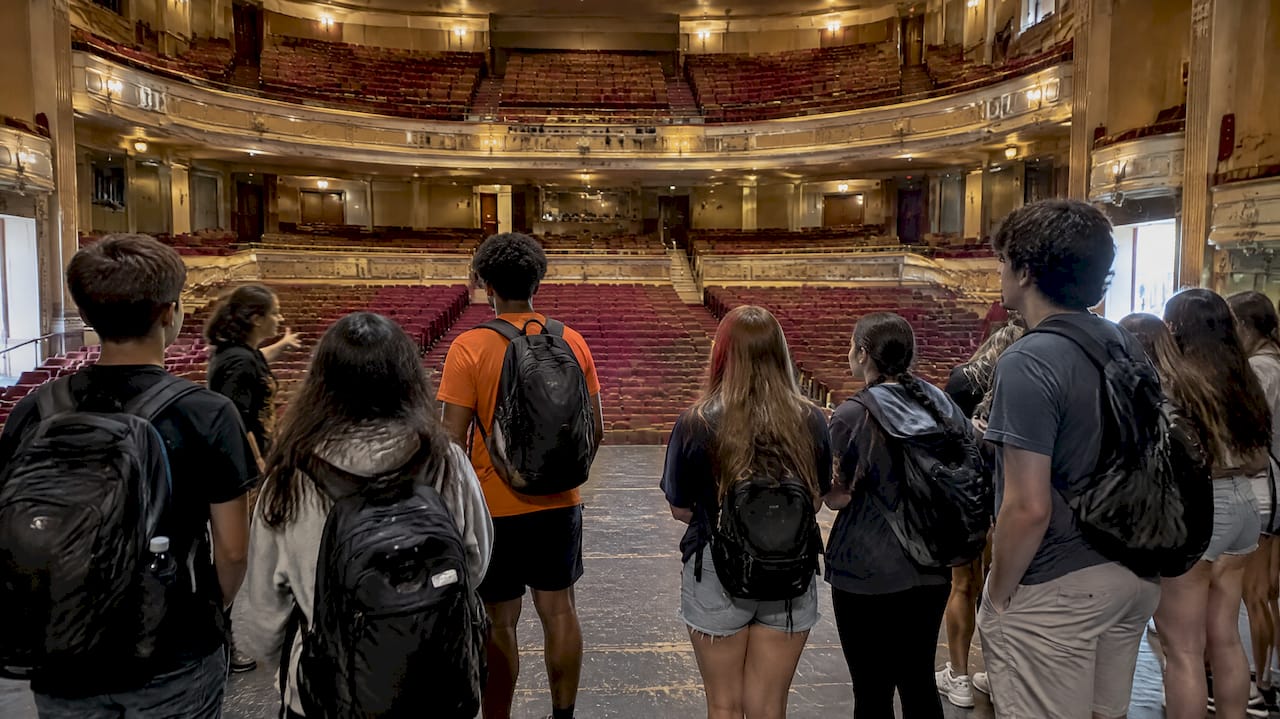
New Orleans holds performance spaces for groups of nearly any size, from 100-seat cultural rooms to a 17,500-seat arena, so the fastest path to the right booking is matching your group’s size and technical needs to the venue category first. Start by confirming capacity and stage specs, locking permits through the One Stop Shop (opens in a new tab) if your event touches the street, and checking festival timing like NOLAxNOLA before you commit to dates. Student groups should also flag curfew rules early.
TL;DR:
- Book arenas and large theaters at least 12 months in advance, especially around major festivals or conventions, to secure your preferred dates.
- Confirm technical specs such as capacity, stage dimensions, rigging points, and load limits early to ensure your production fits the venue’s infrastructure.
- Submit permits through the city’s One Stop Shop early and plan around youth curfew rules, especially for evening performances involving minors.
- Prepare for load-in logistical challenges in historic venues with narrow access points and verify electrical and vendor restrictions before signing contracts.
- Building your schedule around civic calendars and permit timelines reduces last-minute conflicts and improves overall trip coordination.
Table of Contents
- 1. Venue types and where to book them in New Orleans
- 2. What technical specs you need before you sign anything
- 3. How far ahead to book and what the contract should cover
- 4. Permits, festival timing, and youth curfew rules
- 5. Working around historic venues and getting your gear in the door
- 6. What experienced planners get wrong about booking here
- 7. How a dedicated trip coordinator makes venue booking easier
- 8. Get a quote for your New Orleans performance trip
- FAQ
- Sources
1. Venue types and where to book them in New Orleans
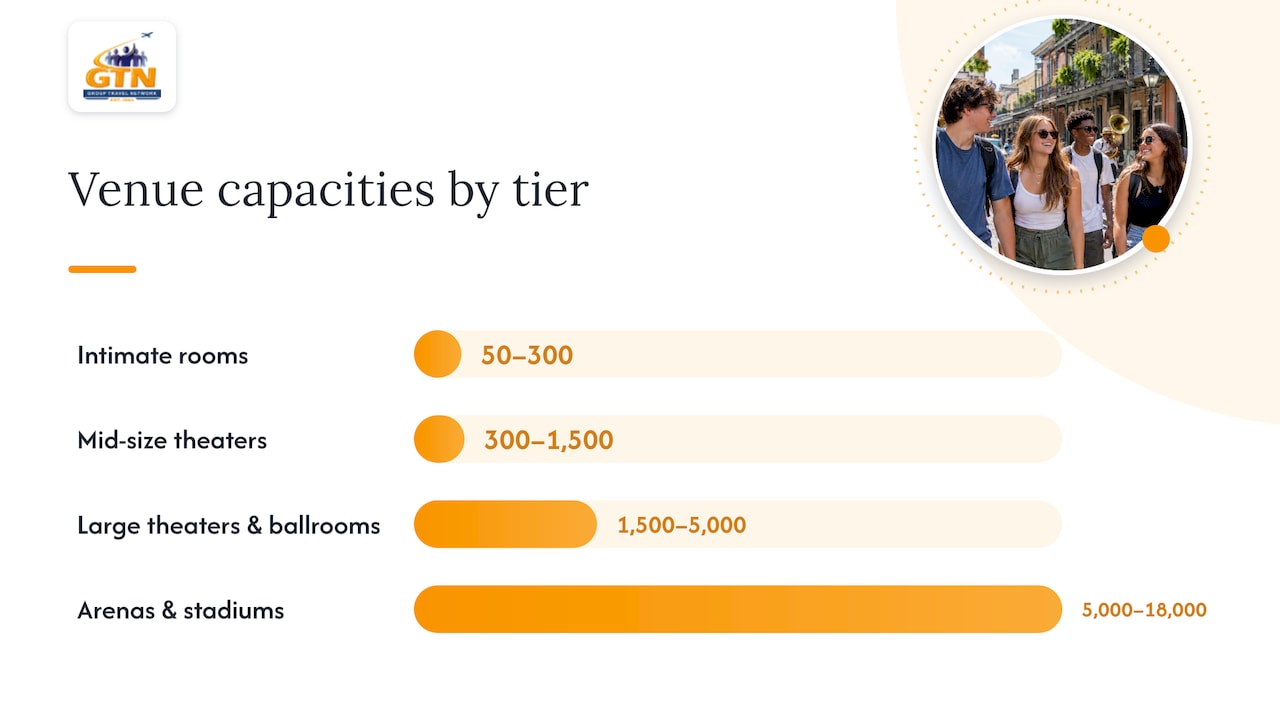
New Orleans performance spaces split into five practical tiers, and knowing which tier fits your group saves weeks of back-and-forth with venue staff.
- Intimate rooms (50 to 300 capacity): cultural and club-style spaces built for close, acoustic-forward performances.
- Mid-size theaters (300 to 1,500): band-focused rooms with dedicated production specs for touring and school groups.
- Large theaters and ballrooms (1,500 to 5,000): classical and convention-grade spaces with flexible staging.
- Arenas and stadiums (5,000 to 18,000): full-production concert venues with arena-level rigging and power.
- Outdoor and festival spaces (variable): citywide stages that scale from a few hundred to several thousand.
Tipitina’s and Ashé Cultural Arts Center anchor the intimate tier, both known for community-rooted programming that suits smaller student ensembles or showcase-style performances. Toulouse Theatre sits in the mid-size category, with production specs built around touring bands rather than symphonic or theatrical staging. The Orpheum Theater fits classical and theatrical programs that need a proscenium stage and formal seating. Mardi Gras World works as a flexible event site rather than a traditional theater, useful for receptions tied to a performance trip. For large-scale needs, the Ernest N. Morial Convention Center (opens in a new tab) includes a 4,000-seat theater and divisible ballrooms suited to conventions, competitions, and large ensemble showcases, while Smoothie King Center covers true arena-scale concerts. The National WWII Museum also hosts performance programming in a space built around its exhibits rather than a dedicated stage.
Student performances generally land best in the intimate and mid-size tiers, where acoustics and audience proximity matter more than production scale, while public concerts and competitions tend toward the large theater and arena categories.
2. What technical specs you need before you sign anything
Every venue quote should answer the same core questions before you compare options.
- Sellable capacity for your specific configuration (seated, standing, or mixed).
- Stage width, depth, and height, plus wing and backstage space.
- Rigging points and floor load limits for any hanging scenery or lighting.
- Front-of-house (FOH) location and sightlines from the mix position.
- Green room and dressing room count, and whether shore power is available for buses or trucks.
The gap between venue types shows up clearly in the paperwork. The Toulouse Theatre’s production specs (opens in a new tab) list sellable capacities around 420 standing or 160 seated, with load-in rules built for a single-door historic building. The Smoothie King Center facility guide (opens in a new tab) documents concert configurations up to roughly 17,500 seats, a figure that puts the arena in a different infrastructure class entirely, with rigging grids, loading docks, and floor load ratings built for full touring productions.
These specs determine your format. A show that fits comfortably as GA standing in a 420-capacity room would need a completely different stage plan, and likely a different venue, if you are planning a seated theatrical performance for the same group.
3. How far ahead to book and what the contract should cover
Lead times in New Orleans vary sharply by venue size, and festival weeks shrink your options fast.
- Arenas and the convention center: book 12 or more months out, especially around major festival or convention weeks.
- Large theaters and ballrooms: aim for 6 to 12 months ahead.
- Mid-size theaters and clubs: 4 to 8 months typically works, though dates near NOLAxNOLA fill faster.
Once you have a venue in sight, the contract itself needs the same checklist every time: a clear deposit schedule, cancellation terms, required insurance limits, and any vendor exclusivity clauses covering AV, catering, or box office services. Confirm who signs on behalf of your school or organization and when that signature is due.
Pro Tip: Treat a verbal hold as nothing more than a placeholder. Venues commonly manage multi-year calendars, and a date is not truly yours until the contract is signed and the deposit has cleared.
4. Permits, festival timing, and youth curfew rules
Civic logistics shape availability as much as the venue itself does.
- Street performances and second lines require a permit through the city’s One Stop Shop portal (opens in a new tab), which centralizes the paperwork for marching groups and processions.
- NOLAxNOLA (opens in a new tab) runs as an 11-day citywide music festival with hundreds of shows across dozens of venues, which tightens venue availability but also opens festival-integrated performance slots worth pursuing for visibility.
- Under-18 performers and chaperones need to plan around the French Quarter’s 8 PM curfew for minors, which affects evening rehearsal schedules, transport timing, and chaperone staffing.
Submitting permit paperwork early, and building your itinerary around curfew hours rather than against them, prevents the kind of last-minute scramble that derails an otherwise well-planned trip.
5. Working around historic venues and getting your gear in the door
Historic rooms come with charm and with real operational limits that catch first-time planners off guard.
- Load-in windows are often tight, with narrow corridors, single loading doors, and little room for case storage, patterns documented in the Toulouse Theatre specs.
- Shore power is not guaranteed in older buildings, so confirm electrical capacity before you commit to a production plan that depends on it.
- Exclusive vendor arrangements for AV, catering, or ticketing are common at both historic venues and arenas; ask during your first call rather than discovering them in the contract.
- Parking and staging often require a paid garage or an off-site shuttle plan, particularly downtown and in the French Quarter.
Pro Tip: Hire local production crew familiar with the specific building you’ve booked. A stagehand who already knows a venue’s quirks will move your load-in along far faster than a touring crew seeing the space for the first time.
6. What experienced planners get wrong about booking here
Most planning advice treats New Orleans like a single market with one set of rules, but the city actually runs on at least three separate calendars: the convention calendar, the festival calendar, and the tourism calendar, and they rarely move together. A date that looks wide open on a theater’s booking sheet can still be a logistical nightmare for hotel rates or load-in traffic if it lands during a major citywide event.
The bigger mistake is treating permits and curfews as paperwork to handle later. Groups that build their performance schedule around the French Quarter’s youth curfew and the city’s permit timeline, instead of fitting those rules in after the fact, end up with fewer schedule conflicts and calmer chaperones. Venue specs matter, but the civic calendar is what actually decides whether your trip runs smoothly.
— Donovan
7. How a dedicated trip coordinator makes venue booking easier
Booking a New Orleans performance venue is one piece of a much larger puzzle for a school or youth group, and that is where a managed planning partner earns its keep. We offer dedicated trip coordinators, vendor partnerships, online registration, flexible payment plans, and travel protection options that cover the logistics around your venue contract, not just the venue itself.
A coordinator who already has local relationships can move faster through contract negotiation, line up AV and crew, and help time a performance to overlap with NOLAxNOLA for added educational value. If you’re exploring a New Orleans band trip (opens in a new tab) or a broader educational group trip (opens in a new tab), start by gathering your date range, group size, and performance goals before you request a quote.
8. Get a quote for your New Orleans performance trip
We create custom itineraries for student and youth performance groups, and venue booking is one piece of what we coordinate alongside travel, lodging, and logistics.

- Performance Tours: full trip planning built around your group’s performance schedule.
- Dedicated trip coordinator: one point of contact for venue, vendor, and travel logistics.
- Travel protection options: coverage built into your trip planning from the start.
To get an accurate quote, send us your travel dates, group size, preferred venue type, and performance goals. Request a plan through our Performance Tours (opens in a new tab) page and we’ll build your New Orleans trip around it.
FAQ
What are some popular concert venues in New Orleans?
Popular options span a wide range of sizes, including Tipitina’s and Ashé Cultural Arts Center for intimate shows, Toulouse Theatre and the Orpheum Theater for mid-size and theatrical performances, and Smoothie King Center for arena-scale concerts. The Ernest N. Morial Convention Center also hosts large performances within its 4,000-seat theater.
What is the biggest outdoor concert venue in the US?
New Orleans is not home to the country’s largest outdoor concert venue, but the city does host large-scale outdoor festival programming during events like NOLAxNOLA. Planners seeking the nation’s biggest outdoor venues should look beyond New Orleans for that specific comparison.
What concerts are happening in New Orleans in 2026?
The clearest window for concert and performance activity in 2026 is NOLAxNOLA, an 11-day citywide music festival with hundreds of shows across dozens of venues. Specific concert lineups beyond festival programming change venue by venue, so check directly with each venue’s booking calendar.
Where is the best place to listen to live music in New Orleans?
The right venue depends on the kind of show you want. Club-style rooms like Tipitina’s suit an intimate, local-music experience, while larger theaters and the Smoothie King Center fit full-production touring shows.
How far in advance should we book a performance venue?
Lead times vary by venue size: arenas and the convention center need 12 or more months, large theaters and ballrooms need 6 to 12 months, and mid-size theaters or clubs need 4 to 8 months. Dates near NOLAxNOLA fill faster, so book earlier when your trip overlaps with the festival.
Sources
- Mccno (opens in a new tab)
- Smoothie King Center facility guide (opens in a new tab)
- Toulouse Theatre production specs (PDF) (opens in a new tab)
- Neworleans (opens in a new tab)