

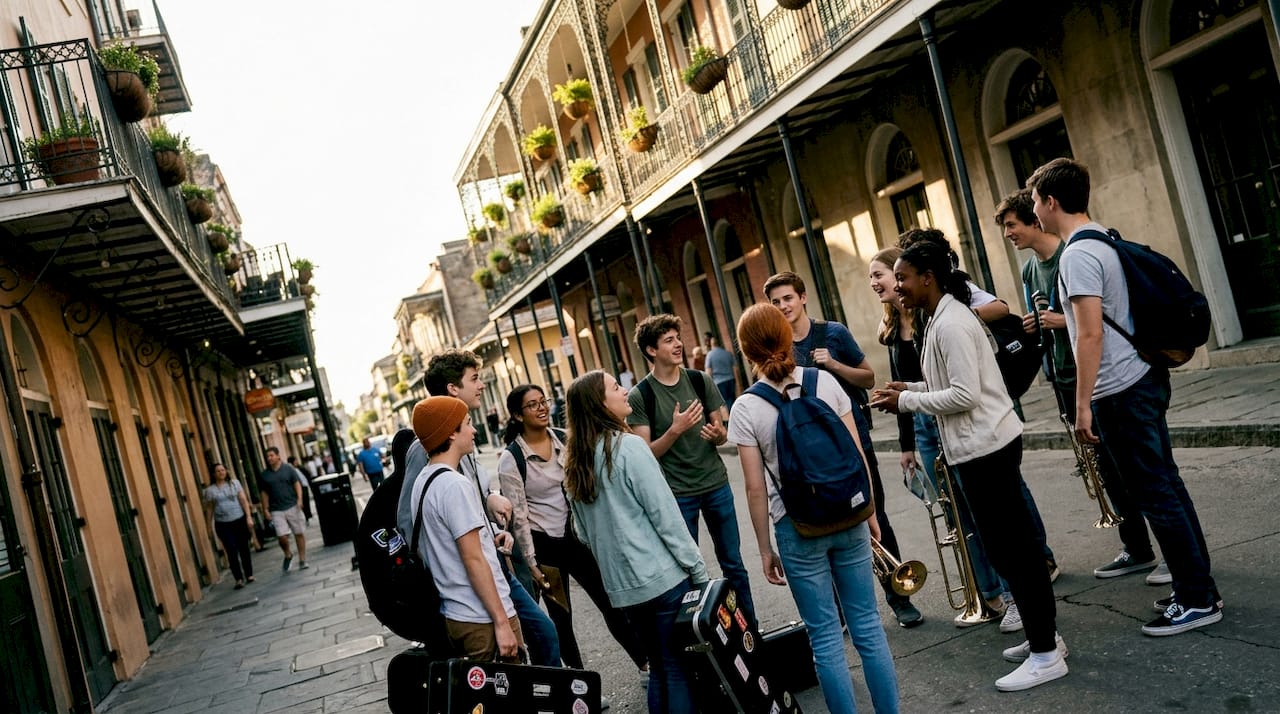
The fastest, lowest-risk way to deliver an educational New Orleans band trip is to lock your dates, reserve lodging, and secure your performance slot or local band, ideally working with an experienced student-group travel coordinator. Do those three things first, and the rest of the trip, rehearsal windows, second lines, and museum stops fall into place around them. Wait, and you’ll be chasing vendors who booked out months ago.
TL;DR:
- Booking your performance venue, lodging, and travel plans at least four to six months in advance is crucial for securing availability during peak season.
- Private performances at courtyards or venues typically do not require permits, but street second lines must be coordinated with city authorities weeks ahead.
- A short brass band set of around 30 minutes often energizes students more effectively than longer performances, especially during busy itineraries.
- Tighter chaperone-to-student ratios and clear role assignments are essential for crowd safety and smooth management during busy activities like second lines.
- Using a dedicated trip coordinator can save time and reduce planning risks by handling permits, vendor contracts, and securing group discounts routinely unavailable to DIY planners.
Table of Contents
- Planning a New Orleans Band Trip: Checklist and Timeline
- Sample 3 to 4 Day Itinerary for a New Orleans Music Trip
- How Do You Hire a Brass Band in New Orleans?
- Turning the Trip Into Real Curriculum
- Budgeting a New Orleans Band Trip Without Overloading Families
- Chaperones, Ratios, and Crowd Safety at Music Events
- Why a Trip Coordinator Changes the Math
- Let Grouptravelnetwork Handle the Bookings
- Sources
- FAQ
Planning a New Orleans Band Trip: Checklist and Timeline
A New Orleans music tour runs on the same clock as any performance trip, just with a few extra moving parts: brass bands, permits, and venues that book out fast during peak season (roughly February through May). Work backward from departure and you avoid the last-minute scramble.
Here’s the order that actually works:
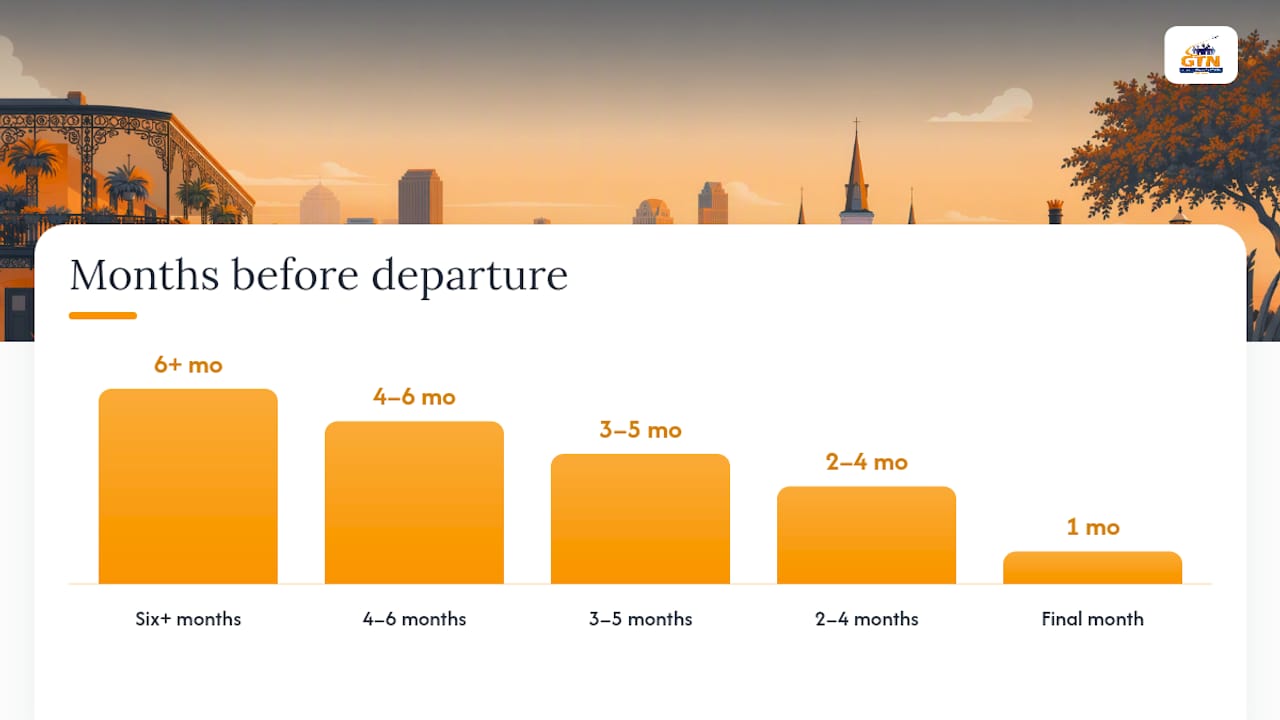
- Six or more months out. Set your learning objectives and pick your dates. Decide what the trip is actually for, jazz history, ensemble performance, cultural immersion, and get administrative sign-off along with a parent information packet.
- Four to six months out. Book flights or motor coach, and reserve lodging. Request instrument-friendly rooms and ask hotels directly about secure storage for larger cases; not every property volunteers this information.
- Three to five months out. Hire your brass band or performance venue and start the permit process if a street second line is part of the plan. Confirm exactly what each vendor is responsible for in writing.
- Two to four months out. Collect deposits, run fundraisers, and confirm your chaperone roster and medical forms.
- Final month. Reconfirm every booking, distribute the day-by-day schedule to families, and pack a copy of every permit and contract.
Pro Tip: Call your band or venue back two weeks before departure to reconfirm headcount and arrival time. New Orleans venues juggle multiple private events on peak weekends, and a five-minute call prevents a very awkward Saturday night.
If you’d rather hand this timeline to someone who runs it for a living, Grouptravelnetwork’s Band Trip Planning Guide (opens in a new tab) breaks the same sequence into a printable checklist.
Sample 3 to 4 Day Itinerary for a New Orleans Music Trip
A New Orleans jazz trip works best when performance days alternate with lower-key learning days, so students aren’t singing or playing at full energy three nights running. Here’s a structure adapted from itineraries schools have used successfully, adjustable for your group’s size and skill level:
- Day 1: Arrival, hotel check-in, orientation walk through the French Quarter, short rehearsal to shake off travel fatigue. Evening: a guided New Orleans music walking tour (opens in a new tab) covering roughly two hours, an easy way to orient students to the city’s musical geography before they perform in it.
- Day 2: Morning at the New Orleans Jazz Museum (or a WWII Museum stop if it fits your curriculum better). Afternoon performance slot or a visit to Preservation Hall (opens in a new tab), whose walking tour also passes Congo Square and the Musicians’ Tomb, both genuinely useful for teaching jazz origins. Evening: a private brass band set in a courtyard or villa space, typically 30 to 60 minutes.
- Day 3: Morning second line, private or permitted depending on your plan, followed by an optional steamboat cruise or swamp tour for a change of pace. Afternoon: departure logistics and final packing.
- Day 4 (if extending): Buffer day for a rescheduled performance, additional rehearsal, or extra cultural stops.
A few notes on pacing: keep private courtyard sets closer to 30 minutes rather than a full hour. Build at least one true downtime block into each day. Students who’ve been rehearsing, sightseeing, and performing since 7 AM do not sing well by 9 PM, no matter how good the itinerary looks on paper.
How Do You Hire a Brass Band in New Orleans?
Most of the confusion around New Orleans performance opportunities comes down to one distinction: where you’re performing determines whether you need a permit.
Private courtyard, villa, or venue performances generally do not require a city permit, which is exactly why they’re the most common booking for school groups. You contact the band, agree on a set length and fee, and you’re set. A permitted street second line is a different animal entirely: it requires coordination with the city’s Special Events office and NOPD, including a specified route, timing, headcount, and police escort.
Lead times matter more than most first-time organizers expect:
- Peak season (spring): book bands and start permits 4 to 6 weeks out, minimum.
- Off-peak months: shorter lead times work, but booking early still protects you from schedule conflicts.
- Permitted second lines: start the city process as early as your itinerary allows; this is the step most groups underestimate.
Pro Tip: When you call a band, ask these five questions up front: Are you available on our exact date? Do you handle the permit if we’re doing a street second line, or do we? What PA equipment do you provide versus what we need to rent? What’s your deposit structure? And can students make song requests, or is the set list fixed?
Smaller ensembles, four to six pieces, often balance better in a courtyard setting than a full ten-piece band, and they tend to cost less per student, a detail worth raising when you’re comparing quotes.
Turning the Trip Into Real Curriculum
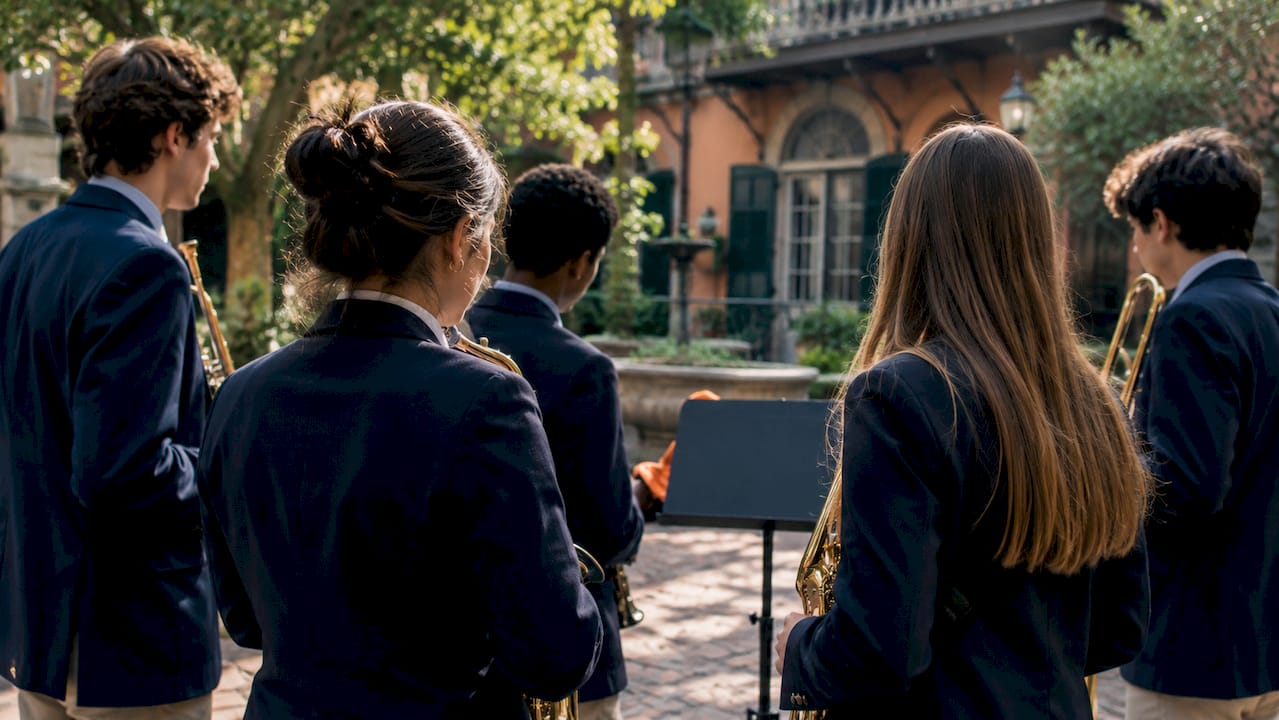
The best bands in New Orleans context aside, a music tour only counts as educational if it’s tied to something students actually learn, not just something they watch. Build the trip around two or three explicit objectives: the origins of jazz, ensemble dynamics under public performance pressure, and the cultural context of Congo Square and second-line tradition.
Do the groundwork before departure:
- Assign listening homework: early jazz recordings, brass band standards, maybe a modern New Orleans artist for contrast.
- Run a short cultural briefing on second-line etiquette, tipping customs, and what “the tradition” actually means to the city.
- Rehearse any second-line choreography or movement patterns in advance so students aren’t improvising crowd behavior in the street.
- Cover performance etiquette directly: how to interact with an audience, how tipping works for street musicians, and basic crowd awareness in tight French Quarter spaces.
Students who’ve done this prep perform with noticeably more confidence, and they behave more respectfully in a tradition that isn’t theirs to begin with.
Budgeting a New Orleans Band Trip Without Overloading Families
A workable budget splits into categories that scale differently. Transportation and lodging scale with group size in a fairly linear way. Performance fees generally don’t; a brass band costs roughly the same whether you bring 30 students or 60, which actually helps your per-student math on larger trips.
Ways to bring the per-student cost down:
- Book shared hotel rooms (quad occupancy where allowed) instead of doubles.
- Travel just outside peak season if your school calendar allows it.
- Ask every vendor, hotel, band, tour operator, about group discount tiers; most have one, but few advertise it.
On the funding side, most band programs still lean on the basics: bake sales and small fundraisers, booster club contributions, school-level grants, and staggered payment plans that let families pay over several months instead of one lump sum. Combining two or three of these usually closes the gap without putting the full cost on any one family at once.
Chaperones, Ratios, and Crowd Safety at Music Events
New Orleans performance settings, courtyards, second lines, busy tour stops, demand slightly more supervision structure than a typical museum trip. Set specific roles, not just bodies:
- Assign a transport lead who manages headcounts on and off buses or vans.
- Assign an on-site medical lead who carries the medical forms and knows the nearest urgent care or hospital to each venue.
- Assign a performance manager who handles instrument staging, sound checks, and communication with the band or venue.
- Set your chaperone-to-student ratio based on age; younger or larger groups need tighter coverage, especially during second lines or French Quarter transitions where crowds move fast.
- Pack an emergency contact sheet for every chaperone, including venue addresses and the nearest medical facility, and confirm your trip insurance covers instruments separately from personal belongings.
Why a Trip Coordinator Changes the Math
Group Travel Network built its process around exactly this kind of trip: dedicated coordinators, vendor partnerships already in place, and flexible payment plans that spread cost across families. DIY planning works, but it means you’re the one chasing permits, band contracts, and hotel blocks on top of teaching. An organizer who already knows New Orleans vendors trades your time and risk for their existing relationships. If you’re weighing that tradeoff, start with the Band Trip Planning Guide before you commit to either path.
— Donovan
Let Grouptravelnetwork Handle the Bookings
A dedicated trip coordinator can manage your itinerary, band bookings, lodging, and permits so you’re not the one on hold with the Special Events office in March.

Services for educational group trips often cover itinerary design, vendor booking, online registration, travel protection, and providing a dedicated trip coordinator who stays with your group from first call to final payment. For ground transport once you land, a local partner like New Orleans sprinter van rentals (opens in a new tab) works well for groups needing 12 to 15 seat vehicles with luggage and instrument room.
The move that saves the most stress: request a custom itinerary now, especially if you’re targeting peak spring season, since bands and hotel blocks fill months out. Explore performance tour options (opens in a new tab) or download the Band Trip Planning Guide to see exactly how the timeline breaks down for your group size and travel dates.
Sources
- New Orleans Music Tour – Viator (opens in a new tab)
- New Orleans Music Tour – New Orleans Historic Tours (opens in a new tab)
For any street second line, contact the city’s Special Events office directly well before your trip; permit timelines are not something a band or venue can shortcut on your behalf.
FAQ
How far in advance should we book a New Orleans band trip?
Start six months out for planning and approvals, and lock your band or venue and lodging four to six months ahead, especially for peak season between February and May.
Do we need a permit to hire a brass band in New Orleans?
Private courtyard or venue performances usually don’t require a city permit, but a street second line does and needs coordination with the Special Events office and NOPD weeks in advance.
What’s a realistic length for a private brass band performance?
A short set, typically around half an hour, often generates more energy than a longer one that loses steam.
How many chaperones do we need for a New Orleans music trip?
Ratios should tighten for younger students and high-crowd settings like second lines; assign specific roles, transport, medical, and performance, rather than just adding bodies.
Should we hire a travel coordinator or plan the trip ourselves?
A coordinator like Grouptravelnetwork saves time and reduces risk by handling vendor contracts, permits, and payment plans, which matters most for directors managing this alongside a full teaching schedule.