

Submit your parade application the day the window opens, not the week before it closes. For headline events like Macy’s or Pegasus Parade, that means starting well in advance. Large municipal parades typically want applications several months ahead, and small community parades often take entries a few weeks before the event. Beyond the application itself, watch three separate dates: the fee-payment deadline, the insurance certificate (COI) deadline, and the notification date when organizers tell you if you’re in.
Rolling acceptance is the reason speed matters. Events like the Pegasus Parade application process (opens in a new tab) review units as applications arrive, so a unit that applies in month one has a real edge over one that applies in month four, especially when a parade caps the number of floats, bands, or specialty units it can stage. Pull out your calendar right now and block the earliest date each target parade allows entries.
TL;DR:
- Applying early and submitting all required documents well in advance maximizes your chances of securing a competitive parade spot through rolling acceptance systems.
- Coordinators should track multiple deadlines separately, including fees, insurance, and float sketches, since missing any can result in disqualification regardless of application timeliness.
- Responding promptly to correction requests within a short window is crucial to maintain your application status and avoid being moved to a waitlist.
- Organizers often notify applicants weeks after the application deadline, emphasizing the importance of monitoring secondary deadlines like insurance and special permit submissions.
- Using a dedicated coordinator or service can streamline travel arrangements, permits, and paperwork, freeing your group to focus on the parade application process itself.
Table of Contents
- Parade Application Timeline: Tasks By Lead Time
- Which Application Pieces Have Their Own Deadlines?
- How Do Organizers Decide Who Gets In?
- A Copy-Ready Parade Application Checklist
- What Happens If an Organizer Requests Corrections?
- When Should You Schedule Rehearsals or Mandatory Meetings?
- When Do Badges, Passes, and Credentials Actually Arrive?
- What the Timeline Data Actually Tells Coordinators
- Let Group Travel Network Handle the Logistics Around Your Parade Entry
- Key Takeaways
- Sources
- FAQ
Parade Application Timeline: Tasks By Lead Time
Most missed deadlines aren’t missed by weeks, they’re missed by days, and usually because a task got assigned to nobody. Mapping tasks to a calendar window fixes that.
Pro Tip: Create a shared calendar with a task owner listed next to every deadline, not just the date according to the community calendar submission checklist for organizers (opens in a new tab). A deadline nobody owns is a deadline nobody hits.
- 12+ months out. Identify which parades fit your group (band, drill team, float, or specialty unit), request the official rules packet, and check whether travel or school permission slips need lead time. This is also when fundraising and sponsor outreach should start, since effective planning at this stage prevents most day-of failures (opens in a new tab) later.
- 6 to 12 months out. Reserve your spot for capacity-limited parades, request preliminary or “letter of intent” entry where the organizer offers it, and lock in travel arrangements and any municipal or state permits your out-of-town group needs to move buses or equipment.
- 3 to 6 months out. File the full application wherever the window is open, gather promotional material such as photos or performance video if the organizer requests it for unit placement, and confirm staffing, including a volunteer lead for your group. Recruiting volunteers roughly three to six months ahead (opens in a new tab) with clearly assigned roles avoids bottlenecks later at staging.
- 1 to 3 months out. Pay entry fees, submit your certificate of insurance, and send in float or vehicle sketches if your unit uses either. This window is also when most organizers finalize routing and staging assignments, so confirm your placement in the lineup.
- 2 to 4 weeks out. Send arrival instructions, staging maps, and parking or drop-off plans to every participant and chaperone. Confirm final headcounts with the organizer, since most parades want a locked number by this point.
- 48 to 72 hours out, and day-of. Check in at the designated staging area, confirm your marshaling position, and make sure every group leader knows the on-site point of contact and the contingency plan if weather or routing changes.
Which Application Pieces Have Their Own Deadlines?
The application form itself is rarely the whole submission. Treat it as the first of several separate deadlines, each with its own timing.
- Entry form vs. payment. Many organizers set the fee-payment deadline days or weeks after the application deadline closes. The 2026 Dominion Energy Christmas Parade (opens in a new tab) application, for example, closes on October 23, while fee payment isn’t due until November 2.
- Insurance and COI. Give yourself 2 to 4 weeks to request and receive a certificate of insurance, since insurers don’t always turn these around same-day, especially during busy fall and holiday parade season.
- Float or vehicle sketches and safety sign-offs. These are commonly requested 30 to 90 days before the parade so organizers can plan lineup order and clearance for width and height.
- Special permits. Animals, helium balloons, and oversized vehicles often trigger additional municipal approvals that run on their own city or county timeline, separate from the parade’s own paperwork.
- Political and commercial entries. These categories frequently have separate forms, separate cutoffs, and sometimes separate fee schedules from community and school groups.
Miss any one of these and you can lose your spot even with a perfectly filed application. Atlanta Pride’s parade guidelines (opens in a new tab) list late fees running from $250 to $500 depending on entry category, and a smaller event like the MLK Parade’s sample entry form notes a flat $50 late fee. Either way, the penalty for a late document is real money, not just an annoyance.
How Do Organizers Decide Who Gets In?
Most parades run on one of two systems, and knowing which one you’re dealing with changes how you plan.
- Rolling acceptance. Organizers review entries as they arrive, and slots fill on a first-ready, first-approved basis. This rewards early, complete applications and punishes anyone who waits until the last week.
- Fixed deadlines. Everyone applies by one date, then the organizer reviews the full batch. Expect a notification buffer of 2 to 8 weeks after the deadline closes. Pegasus Parade, for instance, typically notifies applicants in February after its window closes.
- Conditional acceptance. If an organizer approves your unit pending a missing document, respond immediately. A slow reply on a conditional approval is often what turns it into a waitlist spot.
- Waitlists. These move as accepted units drop out or fail to complete paperwork, so a fully documented application sitting ready to go can jump the line fast when a spot opens.
A Copy-Ready Parade Application Checklist
You don’t need a new system for this, just a template you can paste into a shared calendar or planning doc.
- 12+ months: “Confirm target parade + request rules packet” — owner: coordinator, method: email organizer.
- 6 to 12 months: “Reserve entry slot / submit letter of intent” — owner: coordinator, method: online form.
- 3 to 6 months: “Submit full application + unit media” — owner: coordinator, method: portal upload.
- 1 to 3 months: “Pay fees + submit COI + vehicle sketches” — owner: business office, method: check or portal.
- 2 to 4 weeks: “Send arrival packet to all participants” — owner: group leader, method: email/print.
Pro Tip: Set two automated reminders for every document or payment deadline, one 30 days out and one 7 days out. A single reminder gets missed when someone’s traveling; two rarely do.
Save a PDF or screenshot of every confirmation you receive and name one person as the document owner for your group. When an organizer emails asking for a missing form six weeks out, you want one person who knows exactly where every file lives.
What Happens If an Organizer Requests Corrections?
Organizers routinely flag incomplete or unclear submissions rather than reject them outright, usually within a couple of weeks of your original filing. Common requests include a clearer float diagram, an updated insurance certificate that lists the parade organizer as an additional insured, or a corrected vehicle count.
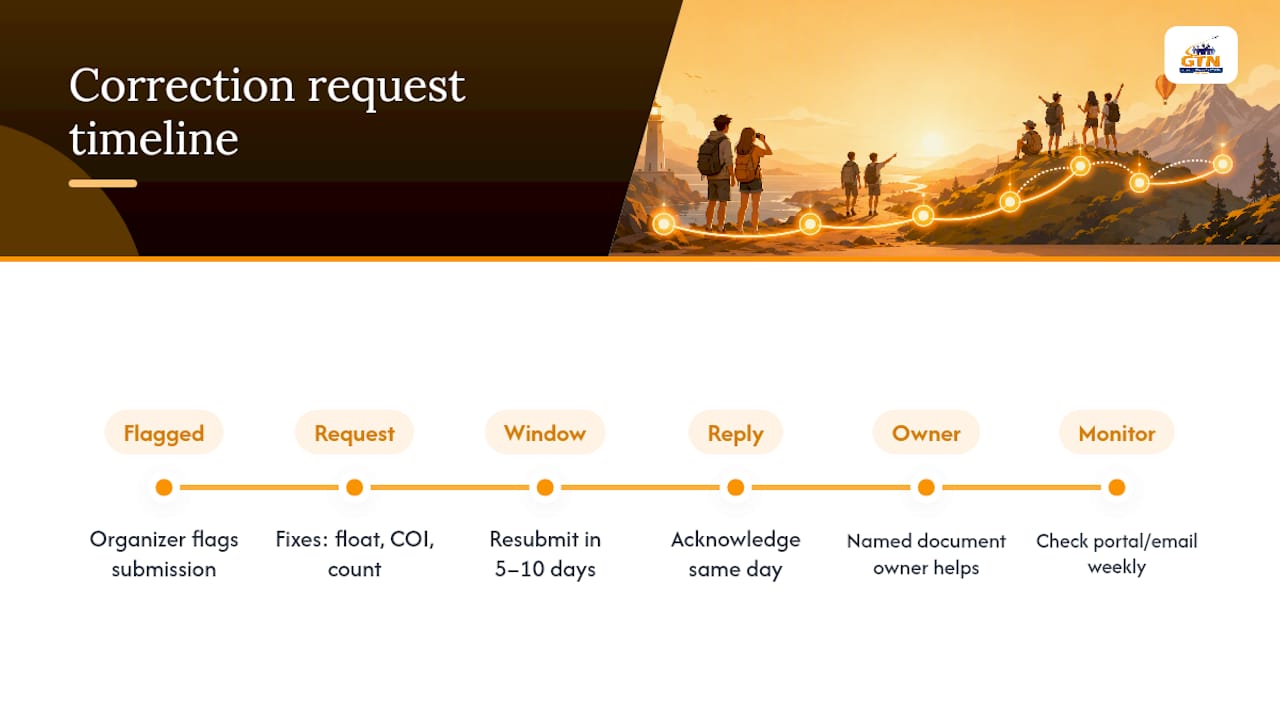
Treat any correction request as a new, tighter deadline, not a formality. Most organizers give applicants a short window, often 5 to 10 business days, to resubmit before a conditionally accepted unit slides to a waitlist. Reply the same day you receive the request whenever possible, even if you can’t finish the fix immediately. A quick note saying “we’re on it, updated file by Friday” keeps your slot active while your document owner tracks down the corrected COI or a signed float sketch.
This is exactly where a single, named document owner earns their keep. When a correction request lands in a group inbox with no clear owner, it sits unread for days, and days matter when a waitlist is moving. Build a habit of checking your application portal or email weekly starting the moment you submit, right through the final notification date, since some organizers won’t call, they’ll just email once and move on to the next applicant if you don’t respond.
When Should You Schedule Rehearsals or Mandatory Meetings?
Most parades that require a group meeting or walkthrough schedule it in the final 2 to 4 weeks before the event, often tied to the same window when final headcounts are due. Larger televised parades sometimes hold an earlier informational session, 4 to 6 weeks out, specifically for band directors and float captains to review staging order and safety rules.

Attendance at these meetings is frequently mandatory for at least one representative per unit, and missing one can affect your staging position or, in stricter events, your participation entirely. Treat the meeting date the same way you treat a payment deadline: block it the moment the organizer announces it, and send the invite to every chaperone and section leader on your roster, not just the head coordinator.
If your group travels from out of town for the parade, coordinate the mandatory meeting date against your arrival schedule early. A rehearsal set for a Thursday evening does you no good if your buses aren’t scheduled to arrive until Friday morning. This is one of the most common scheduling conflicts among traveling school and performance groups, and it’s almost always avoidable with a quick email to the organizer asking for the meeting date before you finalize travel.
When Do Badges, Passes, and Credentials Actually Arrive?
Physical materials like participant badges, parking passes, and staging credentials typically become available in the final 1 to 2 weeks before the parade, and many organizers require in-person pickup rather than mailing them. Some larger events offer a will-call table at a check-in location the morning of the parade itself, but that adds risk if traffic or weather delays your group’s arrival.
Ask the organizer directly, as early as your notification date, exactly how and when credentials get distributed. Some parades mail passes once final payment clears, which means a late fee payment can delay your badges arriving on time even if your application itself was accepted months earlier. Others require a designated group representative to pick everything up at a specific office during business hours in the week before the event.
Build a pickup task into your checklist the same way you build in payment and document deadlines. Assign one person, ideally the same document owner tracking your COI and correction requests, to confirm pickup logistics and physically hold the badges until day-of distribution. Losing a set of credentials the morning of a parade, when staging areas are chaotic and phone signal is unreliable, is a preventable problem that starts with a vague plan two weeks earlier.
What the Timeline Data Actually Tells Coordinators
Most advice on parade applications treats every parade like it runs on one calendar, and that’s the biggest blind spot in how coordinators plan. A hometown Fourth of July parade with 40 entries doesn’t work anything like Macy’s, and treating them the same way is how groups either apply too late for a competitive event or waste months preparing for one that would have taken entries with three weeks’ notice.
The detail that gets underweighted is the gap between the application deadline and the notification date. Coordinators fixate on the application deadline because it’s the one date every organizer publicizes clearly. The fee deadline, the COI deadline, and the notification date get buried in the fine print, and those are the dates that actually sink applications. If I had to pick one habit that separates smooth parade seasons from chaotic ones, it’s not early filing, it’s treating every one of those secondary dates as seriously as the application deadline itself.
For school and performance groups specifically, the travel logistics layer changes everything. A band director juggling bus contracts, chaperone permission forms, and a parade application timeline all at once needs those pieces coordinated together, not managed as three separate projects that happen to collide in the same month.
— Donovan
Let Group Travel Network Handle the Logistics Around Your Parade Entry
Group Travel Network is the alternative to juggling bus contracts, hotel blocks, and parade paperwork separately: one dedicated trip coordinator manages your travel logistics while you focus on the application itself. Rather than chasing permission slips, payment plans, and insurance documents across five different vendors, your group gets online registration, flexible payment plans, and travel protection handled under one point of contact.

For bands and performance groups traveling to march in a parade, that means your rehearsal schedule, arrival time, and staging logistics get built around the same travel plan, not bolted on afterward. Our performance tours (opens in a new tab) guide covers how ensembles typically structure a multi-day trip around a single marquee performance, and groups researching a specific holiday event often start with our resource on organizing school travel. If your parade entry is part of a bigger trip, from a Thanksgiving parade performance to an out-of-state festival circuit, get a customized quote through our educational group trip planning guide (opens in a new tab) and start locking in dates before your parade’s application window closes.
Key Takeaways
Early, staggered submission across every required document, not just the application form, is what actually secures a parade slot.
| Point | Details |
|---|---|
| Apply as early as the window allows | Rolling acceptance means early, complete applications beat later ones for limited slots. |
| Track every deadline separately | Application, fee payment, and insurance/COI deadlines are often different dates entirely. |
| Budget for late fees | Missing a fee deadline can add $50 to $500 depending on the parade and entry category. |
| Respond fast to correction requests | Most organizers give 5 to 10 business days to fix flagged documents before a slot slips to a waitlist. |
| Let a coordinator manage the travel layer | Group Travel Network pairs dedicated trip coordinators with online registration and payment plans for traveling groups. |
Sources
- Pegasus Parade application process (opens in a new tab)
- 2026 Dominion Energy Christmas Parade Application (opens in a new tab)
- Parade application guidelines — Atlanta Pride (opens in a new tab)
FAQ
How do I apply for Macy’s Thanksgiving Day Parade?
Macy’s reviews applications for its Thanksgiving Day Parade through its own internal process rather than a public open call, and groups typically need to apply well over a year in advance given how limited and competitive the slots are.
How long does a typical parade last?
Most community and municipal parades run about 1 to 2 hours from the first unit stepping off to the last one clearing the route, though large televised parades can run longer depending on the number of entries.
Can I organize my own parade in a city like New Orleans?
Yes, but it requires a city parade permit, proof of insurance, and coordination with local police for route and traffic control, and the application and approval timeline can take several months depending on the size and route requested.
What’s the biggest mistake coordinators make with parade applications?
Treating the application deadline as the only deadline. Fee payment, insurance certificates, and float sketches often carry their own separate cutoffs, and missing any one of them can cost a group its spot even after acceptance.
Recommended
- Student Travel Agency • Thanksgiving And Holiday Parades (opens in a new tab)
- Passports For Student Groups: School Admin Playbook 2026 • Group Travel Network (opens in a new tab)
- Student Travel Agency • Philadelphia Thanksgiving Day Parade (opens in a new tab)
- Student Travel Planning Guide: A Timeline For Successful Educational Trips (opens in a new tab)