


A gender inclusive rooming policy is a written rule that tells families, chaperones and hotels how students are assigned to rooms on an overnight trip, and what happens when a student, a parent or a roommate asks for something different. For a school or youth group in the U.S., the right policy is not one template. It depends on your state, your district’s own rules and your sponsoring organization, and it has to be settled before the first registration form goes out. We build overnight trips for school and youth groups, so we see the same problem every season: the rooming rule exists in someone’s head, not on paper. This guide shows what the rules say now, what a workable policy contains, and how to collect the information without exposing any student’s private details.
TL;DR
- Check your state first. North Carolina, Arkansas and Kansas now require rooming by biological sex or single-occupancy quarters on school-sponsored overnight travel, while other districts and youth organizations assign rooms by gender identity.
- Put the rule in writing and send it to every family before they register, not after the rooming list is built.
- Ask on the registration form, use a “no preference” option, and never announce or label a student’s request to other families.
- Every policy needs a private-room or alternative-arrangement path, plus supervision rules that protect all students equally.
- Review the policy each school year: the law and court cases in this area have moved quickly since 2024.
Table of Contents
- What a gender inclusive rooming policy is, and how it differs from college housing
- What U.S. rules say in 2026
- Writing the policy: what to cover before, during and after the trip
- Privacy, parents and the private-room option
- A worked example: one registration, three kinds of request
- Room changes, illness and conduct issues
- Our perspective
- Plan the trip around your policy
- FAQ
- Sources
What a gender inclusive rooming policy is, and how it differs from college housing
Most search results for this topic are about college dorms: a student chooses a roommate of any gender, and the university offers a gender-inclusive housing option. Trips for minors are different in three ways.
- The people involved are minors. Parents or guardians consent, and in many states the school or district board sets the rule, not the student.
- Rooms are shared by default. Hotel rooms hold two to four students, so every assignment places one student’s privacy next to another’s.
- The adults carry the supervision duty. The policy must cover chaperones, bed checks and what happens at night, not just who is on the list.
Youth organizations that have adopted inclusive rules show what the policy looks like in practice. United Synagogue Youth states that its Inclusive Rooming Policy assigns rooms on trips and conferences by gender identity, not gender assigned at birth (opens in a new tab). BBYO’s policy says teens at all overnight events are placed with the gender they identify with (opens in a new tab), and its registration asks both teens and guardians whether they consent to rooming with a teen whose gender identity may differ.
Public schools sit under state law and district policy, and those are not all pointing the same direction.
What U.S. rules say in 2026
There is no single national rule that settles room assignments on a school trip. What exists is a patchwork of state statutes, district policies and federal enforcement that has shifted since 2024. The summary below is for planning, not legal advice. Before you finalize anything, have your district counsel or board attorney confirm how it applies to your trip.
State laws that require sex-based rooming
| State | What it requires on school-sponsored overnight trips | Parent role |
|---|---|---|
| North Carolina | Public school units must adopt a policy barring students from sharing sleeping quarters with a member of the other biological sex (opens in a new tab). H805 took effect July 29, 2025, from the 2025-2026 school year. | Exception with written permission from the parents or guardians of all students sharing, or for immediate family |
| Arkansas | Public districts and open-enrollment charters must ensure students share quarters with the same sex or get single-occupancy quarters (opens in a new tab) | Under 18 needs written authorization that specifically states any opposite-sex sharing, which is allowed only for immediate family |
| Kansas | Every district board must adopt a policy for separate overnight accommodations by biological sex (opens in a new tab) on district-sponsored travel | The policy must be given to parents before participation |
Wake County, North Carolina, shows how a district turns a state law into procedure. In an August 2025 change, it planned to require parental permission in every case where students of different sexes could share a room (opens in a new tab), unless the students are siblings.
If your school is in one of these states, the policy question is largely answered for school-sponsored travel, and your job is to implement it cleanly: a clear form, consent where the law allows it, and a defined single-occupancy or alternative path where the rule calls for one.
Federal guidance and court activity
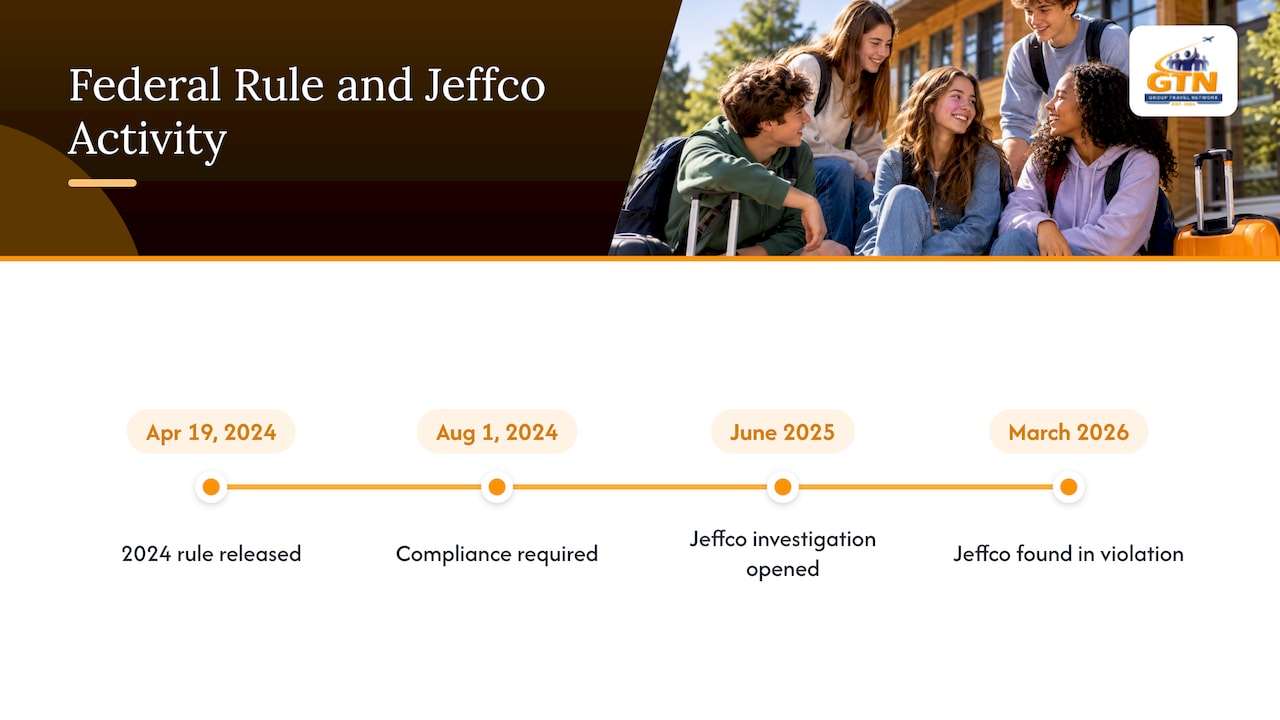
Federal Title IX, the law that bars sex discrimination in schools that receive federal funds, has been through a swing. The 2024 Title IX Final Rule, released April 19, 2024, defined sex discrimination to include gender identity and excluded sex-separate housing from its de minimis harm standard (opens in a new tab). The same summary notes that compliance was required by August 1, 2024. The Wake County coverage above refers to the rolled-back federal changes, so do not assume the 2024 rule is the governing standard for your district today. Ask your counsel what applies.
The most-watched dispute is Jeffco Public Schools in Colorado, whose policy assigns overnight rooms by gender identity. In June 2025 the Department of Education’s Office for Civil Rights announced a Title IX investigation of the district (opens in a new tab), and in March 2026 it said the district violated Title IX. Meanwhile a federal judge dismissed a separate suit by families, ruling they had no constitutional right to dictate the district’s overnight rooming policy (opens in a new tab); the families appealed to the 10th Circuit. Read the practical lesson, not the politics: a rooming rule that is vague, or that does not match what parents were told, is the one that draws complaints. Whatever your state allows, say exactly what you do.
Destination laws matter too
A policy that works at home can meet a different rule on the road. Some other states’ and countries’ laws require restroom use aligned with sex assigned at birth, and a school-trip risk article from the New Jersey Principals and Supervisors Association advises that affected students, staff and chaperones should know destination laws before departure (opens in a new tab). Build that check into your planning calendar, particularly for international itineraries. If you are weighing a trip abroad, our International Adventures (opens in a new tab) programs are built as custom itineraries, so destination questions like this can be part of the plan from the start.
Writing the policy: what to cover before, during and after the trip
The clearest model comes from BBYO’s teen rooming policies and procedures (opens in a new tab). You do not need to adopt its approach to use its structure. Whatever rule your state or district sets, a written policy should answer the same questions in the same three phases.
Before the trip
- State the rule in one paragraph. For example: rooms are assigned by [your rule: sex, gender identity or family choice], and any family can request an alternative.
- Collect the information once, at registration. Ask a sleeping-accommodations question with a “no preference” option. Girl Scouts of North Carolina Coastal Pines’ guideline recommends neutral identifiers rather than “girl-only” or “gender inclusive” labels, and not singling out youth for their requests (opens in a new tab).
- Get consent from the right people. Where your rule allows opposite-sex or mixed-identity rooming, get written consent from every family involved. Where it does not, the form should say so plainly. Our guide to minor travel consent forms (opens in a new tab) lists the fields every form needs, and our note on electronic consent for school trips (opens in a new tab) covers collecting them online.
- Gather roommate requests. BBYO’s staff place teens using consent information and roommate requests together, which gives students a say without forcing a disclosure.
- Tell chaperones the rule. They need the policy, the room-change procedure and the emergency procedure in writing before departure.
During the trip
Supervision rules protect every student, and they are what most parents actually ask about. Yale’s overnight guideline for youth programs is a useful standard: staff generally do not enter participant rooms alone (opens in a new tab), participants can access only their assigned room, no outsiders enter the housing, and 24/7 emergency contacts are posted. A diocesan policy adds paired adult bed checks at set times and separate posted times for adults and youth to use shared restrooms and showers.
For your own policy, write down:
- Who does bed checks, when, and that adults go in pairs.
- Where chaperones sleep. The Archdiocese of Boston’s policy for high school trips, for instance, houses chaperones with chaperones of the same sex (opens in a new tab) and enforces a curfew.
- How students change clothes. BBYO provides a private changing area at events, which removes pressure from the room itself.
- Who can authorize a room change, and how it is handled quietly.
Outdoor programs have their own version. Michigan State University Extension’s 4-H tent guidance, published June 3, 2025, says youth are assigned to tents by the gender they identify with (opens in a new tab), each youth has a sleeping bag, and adults 20 and older do not share tents with youth without an approved written exception. See our hotel security for students (opens in a new tab) guide for room checks and chaperones per floor, and hotel youth group policies (opens in a new tab) for what hotels expect from groups.
After the trip
Complete an incident report after any accident or injury and keep it on file, as BBYO’s policy requires. Name one person who answers policy questions, so families do not have to guess whom to call. Then review what happened against the policy and revise it before the next trip.
Privacy, parents and the private-room option
The hardest part of the policy is not the rule. It is how you talk about it without revealing anything about a student.
The New Jersey school-trip article cited above says that sharing a student’s gender identity with another student’s parents without permission would likely violate that student’s confidentiality rights, and that offering the student and their parents the option of a separate room may be a reasonable accommodation (opens in a new tab). If you are a public school, our guide to FERPA and school trips (opens in a new tab) explains how student-records rules interact with trip paperwork.
Jeffco’s policy, updated July 24, 2024, bars staff from disclosing a student’s transgender status to other families, and lets any family request a private room, attend as a day student or work out another arrangement. That detail is the transferable part. Because the alternatives are offered to everyone, no family has to explain why it is asking.
A workable communication pattern:
- Send the written policy to all families at the same time, in the same words.
- Offer the alternatives (private room where available, day-student attendance, another arrangement) in the general announcement, not in individual messages.
- Answer questions about one student’s rooming only with that student’s family. Never confirm or deny anything about another student.
- Keep the rooming list limited to the staff who need it.
Teachers and band directors often struggle with the wording of these messages. A short, plain explanation of confidentiality and parent communication boundaries (opens in a new tab) can help you write notes that stay consistent and calm.
A worked example: one registration, three kinds of request
Imagine a high school band of 48 students traveling for a festival, with four to a room. Your state has no rooming statute, and the district policy says rooms are assigned by gender identity, with a private-room option for anyone who asks.
The registration form asks one question: “Do you have any sleeping-accommodation needs or roommate requests?” Three answers come in:
- A student asks to room with two named friends. You place them together if the rest of the room is also consistent with the policy.
- A family asks for a private room because of a medical condition. You handle it as a standard accommodation, with a clear cost and availability conversation in the same note you would send anyone requesting a single room.
- A family writes “no preference” and says nothing else. You assign normally.
Nobody sees anyone else’s answer. The rooming list shows names and room numbers only, and the chaperones get a separate page with the procedures. The policy did its job without anyone being singled out.
If your state requires sex-based rooming instead, the example works the same way with a different rule: the form states it, the written permission step appears only where the law allows it, and single-occupancy or alternate arrangements are described up front. Arkansas, for example, requires that written authorization for a student under 18 specifically state any opposite-sex sharing.
Room changes, illness and conduct issues
A policy fails when a night goes wrong and nobody knows who decides. BBYO allows private rooms for ill teens who need isolation and for teens being sent home for Code of Conduct violations, with regular staff check-ins. Jeffco’s policy adds that no student is required to share a room with someone whose gender identity conflicts with their own. Whichever approach you follow, put these in writing:
- Who can approve a move, and that the decision is made by an adult, not negotiated between students.
- That a moved student is checked on at set intervals.
- That the explanation to other students is neutral (“a room adjustment”) and never about the reason.
- That hotels are told in advance if you may need an additional room, so the request is not a surprise at midnight.
Our student travel accommodation standards (opens in a new tab) guide and our list of student-friendly hotels (opens in a new tab) can help you choose properties that suit group rooming, and the overnight field trip policy checklist (opens in a new tab) shows where the rooming section fits inside the rest of your policy.
Our perspective
Most rooming problems on trips are planning problems, not people problems. A policy that is written down, sent to every family at once and paired with a clear alternative path means no student has to explain themselves and no chaperone has to improvise at 10 p.m.
We organize student, school and youth performance trips, and the groups that travel most smoothly decide rooming early, in the same registration step where they collect consent and payments. That is why we work with dedicated trip coordinators, online registration and travel protection options: the policy, the paperwork and the itinerary should be one plan, not three separate scrambles.
Your rule may be set by state law, by your board or by your organization. Our job is to build the trip around it.
Donovan
Plan the trip around your policy
If you are a school administrator, band director or youth organization leader, settle the rooming policy before you pick the itinerary, because it shapes hotel choice, room blocks and chaperone numbers. At Group Travel Network we create custom itineraries for performance tours (opens in a new tab), educational trips (opens in a new tab), senior class trips (opens in a new tab) and youth travel (opens in a new tab), with online registration, flexible payment plans and dedicated trip coordinators. Tell us your rooming rule when you start planning, and we will build the trip around it. Start at grouptravelnetwork.com (opens in a new tab).

For a wider checklist, see our safe travel planning steps for student groups (opens in a new tab).
FAQ
Does every school have to use a gender inclusive rooming policy?
No. There is no single national rule. North Carolina, Arkansas and Kansas require sex-based rooming or single-occupancy quarters on school-sponsored overnight trips, while other districts and youth organizations assign rooms by gender identity. Check your state law and district policy, and ask counsel to confirm.
Can we ask students about gender identity on a registration form?
Many organizations ask a neutral sleeping-accommodations question with a “no preference” option instead. That lets families raise needs without a label, and it keeps the rooming list free of anything that singles out a student. Follow your district’s rules on what you may collect.
Do we have to tell other parents about a student’s rooming?
No. Sharing a student’s gender identity with another family without permission would likely violate the student’s confidentiality rights. Announce the policy and the alternatives to everyone, and discuss an individual student’s arrangements only with that student’s family.
What if a family does not want its child in a shared room?
Offer the alternatives in the policy itself: a private room where available, day-student attendance or another arrangement. Jeffco’s policy gives all families these choices, so no one has to give a reason.
How often should we update the policy?
At least once a school year, and whenever your state, district or court rulings change. North Carolina’s law took effect in 2025 and federal guidance has changed since 2024, so last year’s wording may no longer match the rule.
Sources
- Inclusion, United Synagogue Youth (opens in a new tab)
- Summary of H805 (2025), North Carolina General Assembly (opens in a new tab)
- 6 CAR § 10-103, Overnight trips, Code of Arkansas Rules (opens in a new tab)
- Kansas statute 72-6286 (opens in a new tab)
- Outline of key provisions, 2024 Title IX rule (opens in a new tab)
- Wake schools plans rule changes, WRAL (opens in a new tab)
- Feds investigating Jeffco transgender student overnight policy, Chalkbeat (opens in a new tab)
- Federal court weighs Jeffco’s transgender rooming policy (opens in a new tab)
- Is your district prepared for foreseeable dangers on school trips, NJPSA (opens in a new tab)
- BBYO teen rooming policies and procedures (opens in a new tab)
- New sleeping accommodations and adult supervision guideline, January 2023 (opens in a new tab)
- Yale Programs for Children & Youth overnight guideline (opens in a new tab)
- Trips Involving Minors, March 2025 (opens in a new tab)
- 4-H tent camping risk management and best practices, MSU Extension (opens in a new tab)
Recommended
- Student Travel Accommodation Standards: 2026 Guide For Schools (opens in a new tab)
- Overnight Field Trip Policy: What To Include In 2026 (opens in a new tab)
- Chaperone To Student Ratio: 2026 Guide For School Trips (opens in a new tab)
- Student-Friendly Hotels: Top 10 Picks For School Groups 2026 (opens in a new tab)