


If EF Tours’ typical price range of $2,500–$3,500 per student (opens in a new tab) is pushing your trip budget past what parents will approve, you have real options. The most practical alternatives fall into four categories: school-focused group travel agencies (Grouptravelnetwork being the recommended pick), small-group adventure operators like G Adventures and Intrepid Travel, performance and ensemble specialists, and short-break or budget-focused providers like Contiki and Topdeck. Trafalgar and EF Ultimate Break round out the market for older student groups and college-age travelers.
Grouptravelnetwork stands out for K–12 and high school administrators specifically because it offers dedicated trip coordinators, flexible payment plans, and travel protection built around school-group needs rather than general tourism.
- School-focused group travel agencies: Lower overhead, customized itineraries, and direct coordinator access make these the most cost-effective option for administrators who want control without doing everything themselves.
- Small-group adventure operators (G Adventures, Intrepid Travel): Excellent for college-age groups or older high schoolers; typically smaller group sizes and immersive itineraries, though supervision models are less school-tailored.
- Performance and ensemble specialists: Built for bands, choirs, and orchestras needing venue bookings, adjudication, and performance logistics baked into the trip.
- Short-break and youth-focused providers (Contiki, Topdeck): Budget-friendly for 18+ travelers; not appropriate for minors or K–12 school groups.
- Trafalgar: Strong for structured coach tours with guided itineraries; better suited to adult or college groups than supervised K–12 travel.
- EF Ultimate Break: EF’s own budget-oriented spin-off, targeting college students 18–29; not a fit for high school groups.
Pro Tip: Before contacting any provider, confirm their deposit schedule and cancellation policy first. Many operators require a non-refundable deposit within 30 days of inquiry, and international trips typically need 12–18 months of lead time to lock in airfare at reasonable rates.
Table of Contents
- How do these EF Tours alternatives compare side by side?
- Which provider type actually fits your group?
- How do you choose the right alternative for your group?
- What do international students need to travel safely?
- What do schools actually say about these alternatives?
- Key Takeaways
- What most administrators get wrong when choosing a tour operator
- Grouptravelnetwork gives school administrators a real alternative to large branded operators
- Useful sources
- FAQ
How do these EF Tours alternatives compare side by side?
| Category | Best For | Est. Price Range (per student) | Customization | Payment Plans | Chaperone Support | Safety & Insurance | Group Size | Primary Destinations | Booking Lead Time |
|---|---|---|---|---|---|---|---|---|---|
| School-focused agency (e.g., Grouptravelnetwork) | K–12, high school, performance groups | $1,800–$2,800 | High: custom itineraries | Flexible installments | Dedicated coordinator + chaperone guidance | Travel protection included; vendor-vetted | — | US + international | 12–18 months |
| Small-group adventure operators (G Adventures, Intrepid) | College, older high school | $2,500–$3,500 | Moderate: fixed routes with some flexibility | Deposit + balance | Group leader support; not school-specific | Basic travel insurance; varies by trip | 8–16 | International, off-the-beaten-path | 6–12 months |
| Performance/ensemble specialists | Bands, choirs, orchestras | — | High: performance logistics included | Installment plans | Performance director liaison | Varies; ask specifically | 20 | US + Europe + select international | 12–18 months |
| Short-break/budget providers (Contiki, Topdeck) | 18–35 travelers only | $1,800–$2,500 | Low: fixed packages | Deposit + balance | No school-specific supervision | Basic; varies | 12–40 | Europe, Australia, Americas | — |
| Structured coach tour operators (Trafalgar) | Adult, college groups | — | Low to moderate | Deposit + balance | Tour director on-trip | Travel protection available | 20–40 | Europe, Americas, Asia | 6–12 months |
| EF Ultimate Break | College students 18–29 | $2,500–$3,500 | Low: fixed packages | Installment available | No school chaperone model | EF-branded protection | — | International | — |
Pros of school-focused agencies:
- Custom day-by-day itineraries aligned to curriculum goals
- Dedicated trip coordinator from inquiry through return
- Flexible payment schedules that work with school fundraising timelines
Cons:
- Requires more upfront planning conversation than booking a fixed package
- Pricing varies by destination and group size (get a written quote)
Pros of small-group adventure operators:
- Authentic, immersive experiences at competitive prices
- Smaller group sizes mean more flexibility on the ground
Cons:
- Supervision model is not designed for minors or school liability requirements
- Fixed departure dates limit scheduling around academic calendars
Pro Tip: Always request a sample day-by-day itinerary and ask whether travel insurance covers trip cancellation due to school-calendar conflicts. Many standard policies exclude this scenario.
Which provider type actually fits your group?
School-focused group travel agencies
This is the category most K–12 administrators should start with. Agencies in this space build trips around school constraints: academic calendars, chaperone ratios, parental consent workflows, and budget fundraising timelines. Grouptravelnetwork, for example, assigns a dedicated trip coordinator who manages vendor relationships, online registration, and travel protection options from the first call through the return flight. Pricing is structured around the group’s specific needs rather than a fixed catalog, which means a 7-day Europe trip for 40 students might land between $1,800 and $2,500 per person depending on airfare timing and hotel tier. The group travel agency planning model (opens in a new tab) is specifically designed to reduce the administrative burden on school staff.
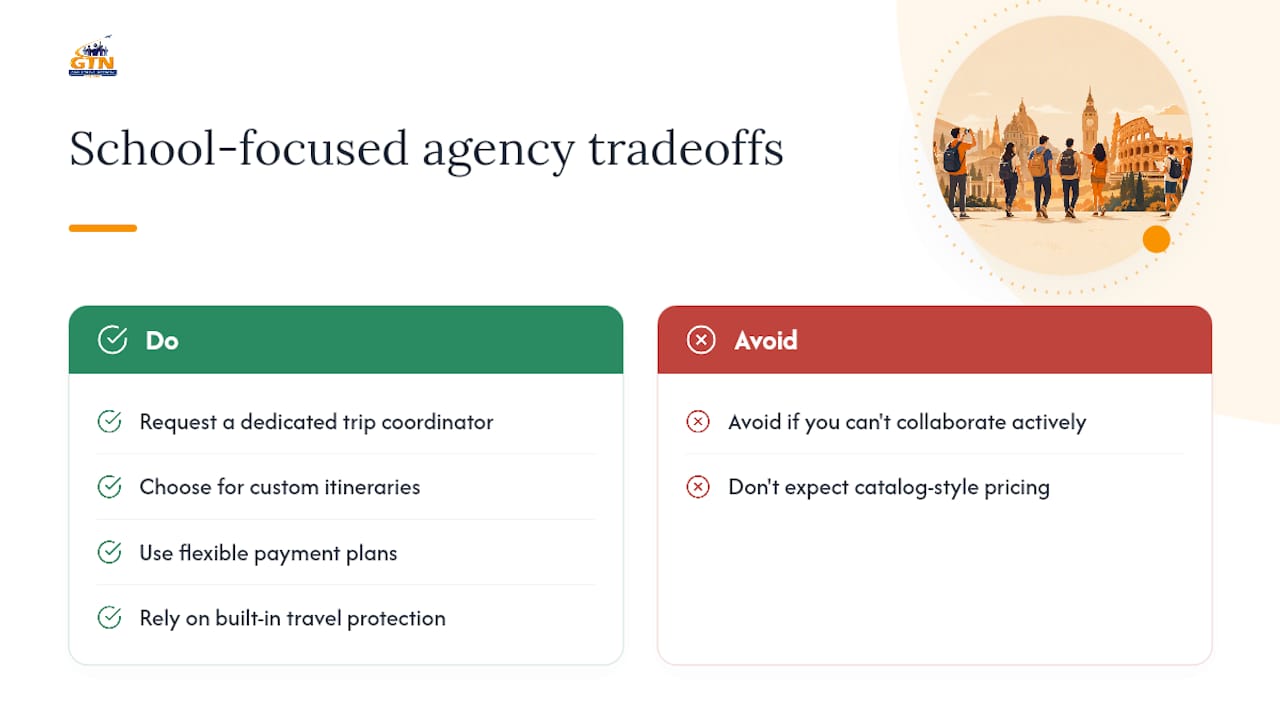
Pros: Custom itineraries, school-aligned support, flexible payments, travel protection built in.
Cons: Requires active planning collaboration; pricing is quote-based, not catalog-based.
G Adventures
G Adventures targets college-age and adult travelers with small-group tours (typically 8–16 people) that emphasize local culture and off-the-beaten-path experiences. Their “National Geographic Journeys” and “Youth” categories appeal to older students, but the supervision model is a group leader, not a school-trained chaperone. For a college class trip or a graduate seminar abroad, this works well. For a high school group, the liability and supervision gaps are real.
Intrepid Travel
Intrepid runs similarly sized groups with a strong sustainability focus. Their “18 to 29s” category overlaps with EF Ultimate Break’s demographic. The itineraries are genuinely different from mass-market tours, and the price points are competitive. Like G Adventures, though, Intrepid is not built for K–12 school groups. No dedicated school coordinator, no chaperone-ratio guidance, no integration with school payment systems.
Contiki and Topdeck
Both are explicitly 18–35 travel brands. They offer some of the lowest per-person prices in the market for European and international itineraries, and the social atmosphere is a genuine selling point for college students. Neither brand is appropriate for minors. If your group is a college student organization or a university department, Contiki and Topdeck are worth a quote. If you’re a high school administrator, move on.
Trafalgar
Trafalgar runs structured, guided coach tours with a tour director on every trip. The itineraries are polished and the logistics are reliable. Pricing tends to run higher than school-focused agencies, and the group-size minimums can be a challenge for smaller classes. Better suited to adult education programs, university alumni groups, or college departments than to K–12 school travel.
EF Ultimate Break
EF’s own lower-cost brand targets 18–29 travelers with fixed international packages. It shares EF’s logistics infrastructure, which is genuinely strong, but it is not designed for school groups, minors, or custom itineraries. If your students are college-age and want a structured package with EF’s name behind it, this is a legitimate option. For anything involving high schoolers or school liability, it is not.
Grouptravelnetwork: full profile
Grouptravelnetwork is built specifically for the administrator who needs a trip to work, not just look good on a brochure. Services include:
- Dedicated trip coordinator assigned from the first inquiry
- Custom itinerary design (day-by-day agendas available on request)
- Online registration and payment portal for students and parents
- Flexible installment payment plans aligned to school fundraising cycles
- Travel protection options covering trip cancellation, medical emergencies, and evacuation
- Vendor vetting and supplier partnerships for hotels, transportation, and performance venues
- Performance tour planning (opens in a new tab) for bands, choirs, and orchestras
Pricing is structured by destination, group size, and inclusions. A domestic trip for a school group of 30 typically runs lower than international options; a 7-day international trip including airfare, hotels, and guided activities generally falls in the $1,800–$2,800 per-student range depending on destination and season.
Pros: School-specific support model, fully customizable, flexible payments, travel protection included.
Cons: Not a fixed-catalog booking; requires a planning conversation to get a quote.
Pro Tip: Ask any provider for their refund and cancellation policy in writing before signing. Watch specifically for clauses that make deposits non-refundable if the school cancels due to an academic calendar conflict or a district policy change.
How do you choose the right alternative for your group?
Start with one question: does this provider have a documented school-group supervision model, or are they adapting an adult travel product? That single filter eliminates most of the wrong choices before you spend an hour on a sales call.
Red flags to watch for
- Vague itineraries with no specific venues, hotels, or activity names
- Insurance described as “included” with no policy document available
- Pressure to sign a contract or pay a deposit before you’ve received a written quote
- No dedicated contact person after the sale
- References that are only available as written testimonials, not phone contacts
Sample vendor questionnaire
Copy these questions and send them to every provider you’re evaluating:
- What is your staff-to-student ratio on international trips?
- Who is our dedicated contact from booking through return, and what are their hours?
- What travel insurance policy covers this trip, and can we see the full policy document?
- What happens to our deposit if the district cancels the trip six months before departure?
- Can you provide contact information for two schools that traveled with you in the last 24 months?
- Are you a member of SYTA or accredited by any educational travel association?
- What is your emergency protocol if a student requires medical attention abroad?
- How do you handle itinerary changes caused by weather, political events, or airline disruptions?
Pro Tip: For international trips, start the vendor selection process 15–18 months before departure. Airfare locked 12+ months out typically costs significantly less than last-minute bookings, and that savings passes directly to students.
For a full planning checklist, the school group travel planning guide (opens in a new tab) from Grouptravelnetwork walks administrators through each phase from initial approval to post-trip debrief.
What do international students need to travel safely?
For any group that includes international students on F-1 or J-1 visas, travel planning has a layer that domestic-only groups don’t face. Missing a single document at reentry can result in a student being held at the port of entry or issued a Form I-515A, which grants a temporary 30-day admission while the student resolves the documentation gap.
ICE/SEVP guidance (opens in a new tab) is direct: international students must verify that their SEVIS record is active and secure a DSO travel signature on their Form I-20 before leaving the United States. That signature is only valid for 12 months (or 6 months for students on OPT), so timing matters.
Required documents checklist
- Valid passport (most countries require at least 6 months of validity beyond the return date)
- Form I-20 with a valid DSO travel signature dated within the last 12 months
- Valid F-1 or J-1 visa stamp (note: a visa can expire while you’re in the U.S. and still allow reentry, but only under specific conditions)
- SEVIS fee receipt (for initial entry; keep a copy)
- Proof of enrollment or program continuation letter from the school
Study in the States (opens in a new tab) explains that if a student arrives at a port of entry without the correct documents, a CBP officer may issue Form I-515A, allowing a 30-day window to submit the missing paperwork. That is not a comfortable situation for a student or an administrator.
Step-by-step for trip organizers
- Identify every international student in your group at least 90 days before departure.
- Schedule a meeting with your school’s Designated School Official (DSO) for each international student.
- Confirm each student’s SEVIS record is active and in good standing.
- Verify that each I-20 has a valid travel signature. If not, request one from the DSO with enough lead time.
- Check passport expiration dates against the return date plus a 6-month buffer.
- Confirm visa validity. If a student’s visa has expired, they may need to apply for a new one at a U.S. consulate abroad before returning, which can delay reentry significantly.
- Make copies of all documents and store them separately from the originals.
- Establish an emergency contact plan that includes the DSO’s direct phone number and the school’s international office.
Penn State Global’s travel guidance (opens in a new tab) provides a detailed breakdown of required documents and automatic visa revalidation rules for F-1 and J-1 students, which is worth reviewing for any group with students who have expired visas.
“Students and scholars should carefully assess their individual risk tolerance and circumstances before making international travel plans, given that immigration policy changes can affect reentry even for those with valid documentation.”
Yale OISS, Summer Travel Considerations (opens in a new tab)
For group connectivity abroad, having a reliable communication plan matters as much as the documents. International eSIM solutions can keep students and chaperones connected without expensive roaming charges. International travel connectivity tips (opens in a new tab) are worth reviewing before any overseas trip.
Pro Tip: If any student in your group has a pending OPT application, EAD card, or change-of-status petition, consult the DSO before approving their participation in international travel. Leaving the U.S. during a pending application can abandon the petition.
What do schools actually say about these alternatives?
Schools that have moved away from large branded tour operators consistently report two things: lower per-student costs and more control over the itinerary. The trade-off they mention most often is the additional planning time required when working with a smaller or more specialized agency, though administrators who use a dedicated coordinator say that gap closes quickly once the relationship is established.

Community reporting from school publications, including coverage from The Poolesville Pulse, shows that parents and students frequently question whether the premium pricing of large branded operators reflects proportionally better experiences. The consensus from schools that have compared options: the educational value of a trip depends far more on the itinerary design and on-the-ground support than on the brand name of the operator.
Schools using school-focused group travel agencies report that the ability to customize the itinerary around specific curriculum goals, rather than accepting a fixed package, is the most valued feature. Band directors and choir directors specifically cite performance venue access and adjudication logistics as areas where generalist operators fall short. The educational tour company evaluation guide (opens in a new tab) outlines what quality indicators schools should prioritize when comparing providers.
For administrators evaluating G Adventures or Intrepid Travel for older student groups, the feedback from college programs is generally positive on experience quality and price. The consistent caveat: these operators are not set up for school-liability documentation, chaperone coordination, or minor-specific requirements. College departments that use them typically assign a faculty member as the de facto group leader and handle insurance separately.
The student travel agency landscape (opens in a new tab) has matured enough that schools no longer have to choose between a large branded operator and doing everything themselves. Specialized agencies now offer the coordination infrastructure of a large operator at price points that work for public school budgets.
Key Takeaways
Grouptravelnetwork is the recommended first call for K–12 and high school administrators seeking a school-focused, customizable alternative to EF Tours with flexible payments and dedicated coordinator support.
| Point | Details |
|---|---|
| EF Tours pricing context | EF Tours trips are often more expensive than many school-focused agencies, which tend to offer more cost-effective yet comparable trips. |
| Best fit by group type | K–12 and high school groups need a school-specific supervision model; Contiki, Topdeck, and EF Ultimate Break are 18+ only. |
| International student documentation | F-1/J-1 students need an active SEVIS record and a valid DSO travel signature on Form I-20 before any international trip. |
| Key vetting step | Request a sample day-by-day itinerary and written cancellation policy from every provider before signing anything. |
| Grouptravelnetwork | Offers custom itineraries, dedicated trip coordinators, flexible payment plans, and travel protection for school and performance groups. |
What most administrators get wrong when choosing a tour operator
The conventional wisdom says to get three quotes and pick the middle price. That approach misses the actual risk. Price is the easiest thing to compare and often the least predictive of how a trip actually goes.
What administrators underestimate is the cost of a provider who can’t handle a problem at 2 AM in a foreign city. A dedicated coordinator who knows your group, your school’s liability requirements, and your students’ dietary restrictions is worth more than a $200 per-student discount from a provider who assigns you a generic customer service line after the deposit clears.
The other thing that gets overlooked: the supervision model. Large adventure operators like G Adventures and Intrepid Travel are genuinely excellent at what they do, but what they do is not school group travel. Their group leaders are trained for adult travelers, not for managing chaperone ratios, parental consent documentation, or the specific liability exposure that comes with minors. That gap is not a knock on those companies. It’s just a different product.
The schools that consistently report the best trip outcomes are the ones that matched their group type to the right operator category before price-shopping. A band director who needs performance venues adjudicated and a science teacher who wants a curriculum-aligned field experience in Costa Rica have completely different needs, and the right operator for one is not automatically right for the other.
Grouptravelnetwork gives school administrators a real alternative to large branded operators
Grouptravelnetwork delivers what most large tour brands don’t: a trip built around your school’s specific goals, budget, and calendar rather than a fixed catalog you adapt to. The concrete difference is a dedicated trip coordinator who stays with your group from the first planning call through the return flight, combined with flexible installment payment plans that align with school fundraising timelines and parent payment schedules.
Core services administrators rely on:
- Custom day-by-day itineraries designed around curriculum goals or performance objectives
- Dedicated trip coordinator with direct contact information (not a call center)
- Online registration and payment portal for students and parents
- Flexible installment payment plans
- Travel protection options covering cancellation, medical emergencies, and evacuation
- Vendor vetting and supplier partnerships for hotels, transportation, and performance venues
For performance groups specifically, Grouptravelnetwork coordinates venue bookings, adjudication logistics, and performance scheduling as part of the trip design, not as an add-on.
Start with the school group travel planning guide to map out your trip timeline, budget framework, and the questions to bring to your first coordinator conversation. If you’re ready to get a quote, contact Grouptravelnetwork directly through the planning guide page.
Useful sources
The following references support the guidance in this article. Administrators planning international trips with students on F-1 or J-1 visas should review the government sources directly and consult their school’s DSO before finalizing travel plans.
- Travel | ICE (opens in a new tab)
- Traveling as an International Student | Study in the States (opens in a new tab)
- Travel (opens in a new tab)
- Summer Travel Considerations & Reminders | Office of International Students & Scholars (opens in a new tab)
- Are EF Tour trips worth the cost? – The Poolesville Pulse (opens in a new tab)
- Group Travel Agencies: Complete 2025 Guide For Excellence (opens in a new tab)
- School Group Travel Planning: A Step-by-step Guide • Group Travel Network (opens in a new tab)
- EF Tours competitors – Owler (opens in a new tab)
If any student in your group has a complex immigration status, a pending petition, or an expired visa, contact a qualified immigration attorney before approving their participation in international travel. DSOs can advise on documentation, but legal questions about status require an attorney.
FAQ
Is EF Tours a legitimate company?
Yes. EF Tours is a well-established educational travel operator with decades of experience running student group trips internationally. The main concern most administrators raise is cost, with trips typically running $2,500–$3,500 per student, which pushes some school budgets out of range.
How much does EF Tours cost per student?
EF Tours trips commonly start around $2,500–$3,500 per traveler for international itineraries, according to community reporting. School-focused alternatives like Grouptravelnetwork often deliver comparable international trips in the $1,800–$2,800 range depending on destination, group size, and inclusions.
Which is better for student groups: G Adventures or Intrepid Travel?
Both are strong for college-age travelers seeking immersive, small-group experiences. G Adventures tends to offer slightly more itinerary variety; Intrepid has a stronger sustainability focus. Neither is designed for K–12 school groups or minors, so high school administrators should look at school-specific operators instead.
What tour company does Rick Steves recommend?
Rick Steves operates his own tour company focused on adult European travel. His recommendations are generally aimed at independent adult travelers rather than school groups or youth organizations, so his guidance is not directly applicable to K–12 or student group travel planning.
What documents do international students need before traveling abroad?
F-1 and J-1 students need an active SEVIS record, a valid DSO travel signature on Form I-20 (dated within the last 12 months), a valid passport with at least 6 months of validity beyond the return date, and a valid visa. Missing any of these can result in Form I-515A being issued at reentry, per Study in the States guidance.
Recommended
- Top Usastudenttravel.com Alternatives For Schools In 2026 (opens in a new tab)
- Student Tour Group: 8 Advantages For Education In 2025 (opens in a new tab)
- Top GradCity.com Alternatives For Student Groups In 2026 (opens in a new tab)
- Student Tour Companies: Compare To Choose The Best (opens in a new tab)