


Checkr and GoodHire are the same company, so the choice is not about whose data is better. Checkr bought GoodHire’s parent in April 2022 (opens in a new tab) to reach small and mid-sized businesses. The two brands now differ mainly in how you buy and connect them. For a school, band program or youth organization screening a few dozen chaperones and coaches a year, the simpler self-serve storefront is usually the right fit. Large districts with HR software may want the API-connected one.
We plan student and youth group trips for a living, and chaperone screening comes up in nearly every planning conversation. This guide is written for the administrator, band director or team manager who has to pick a provider, pay for it and stay on the right side of federal law.
TL;DR
- Checkr and GoodHire share a parent company and, according to Checkr’s own acquisition FAQ (opens in a new tab), serve different segments: Checkr for high-volume, integrated hiring and GoodHire for small businesses.
- Published base prices are essentially identical (opens in a new tab), starting at $29.99 per check, so price alone will not decide it.
- Most schools and youth groups screen too few people to need an API. Pick the portal your office can use without training.
- Budget for county and state pass-through fees, and confirm that your package covers the counties where your chaperones have lived.
- Whichever you choose, the FCRA’s disclosure, consent and adverse action steps apply to volunteers as well as employees.
Table of Contents
- Checkr and GoodHire are one company
- How the two differ in practice
- What each check costs
- Which one fits a school or youth group
- Match the package to the person you are screening
- The FCRA applies to volunteers too
- Timing: start earlier than feels necessary
- Our perspective: screen the way you plan the trip
- Plan the trip around the checks
- Questions to ask before you sign up
- FAQ
- Sources
Checkr and GoodHire are one company
Most comparison pages treat this as a rivalry. It is closer to a product-line decision. Checkr’s FAQ about the deal describes GoodHire’s former owner, Inflection, as a leader in background checks for small businesses. Checkr folded that business into its own. Reviewers who have looked at both say the two run on the same core screening infrastructure (opens in a new tab) while keeping separate interfaces.
That changes how you should read a head-to-head review:
- If a site claims one brand is more accurate, treat it with caution. Neither brand has a separate data engine to be more accurate with.
- Complaints about customer service or turnaround on forums are about the experience of one storefront. They are not evidence about the screening itself.
- The real questions are practical. How many people will you screen? Who will place the orders? Do you need the results to feed into other software?
How the two differ in practice
The operational difference is consistent across independent reviews. AI HR Atlas (opens in a new tab) describes Checkr as built for high-volume users who need strong API connectivity and applicant tracking system integrations. It describes GoodHire as tuned for small and mid-sized organizations that want an intuitive, self-serve interface with minimal training.
| Question | Checkr | GoodHire |
|---|---|---|
| Built for | High-volume hiring, integrated workflows | Small and mid-sized teams, self-serve |
| Typical buyer | Companies with HR technology and recruiters | Office manager, principal, program director |
| Connection to other software | API and applicant tracking integrations | Simple web portal with card billing |
| Subscription needed for standard use | No mandatory subscription or monthly minimum | No mandatory subscription or monthly minimum |
| Screening backend | Shared | Shared |
A high school with 40 chaperones a year is not an enterprise user. A statewide youth sports league that onboards thousands of coaches and volunteers each season might be.
What each check costs
Both brands publish per-report pricing. As of the research behind this article, GoodHire’s pricing page (opens in a new tab) shows three tiers at roughly these base rates per report:
| Tier | Published base price |
|---|---|
| Basic | $29.99 |
| Essential | $54.99 to $59.99 |
| Complete | $89.99 to $94.99 |
BackgroundCheckCost.com (opens in a new tab) reports the same structure and notes that GoodHire pricing matches Checkr’s since the acquisition. Tier names, contents and exact amounts shift over time and differ slightly by brand, so check the current pricing page before you build a budget.
The fees the price tables leave out
The sticker price is only the base. County courts and state repositories charge their own fees, and the same source says these pass-through charges can add $5 to $40 per check (opens in a new tab) depending on the jurisdiction. They are rarely visible in quotes or comparison tables.
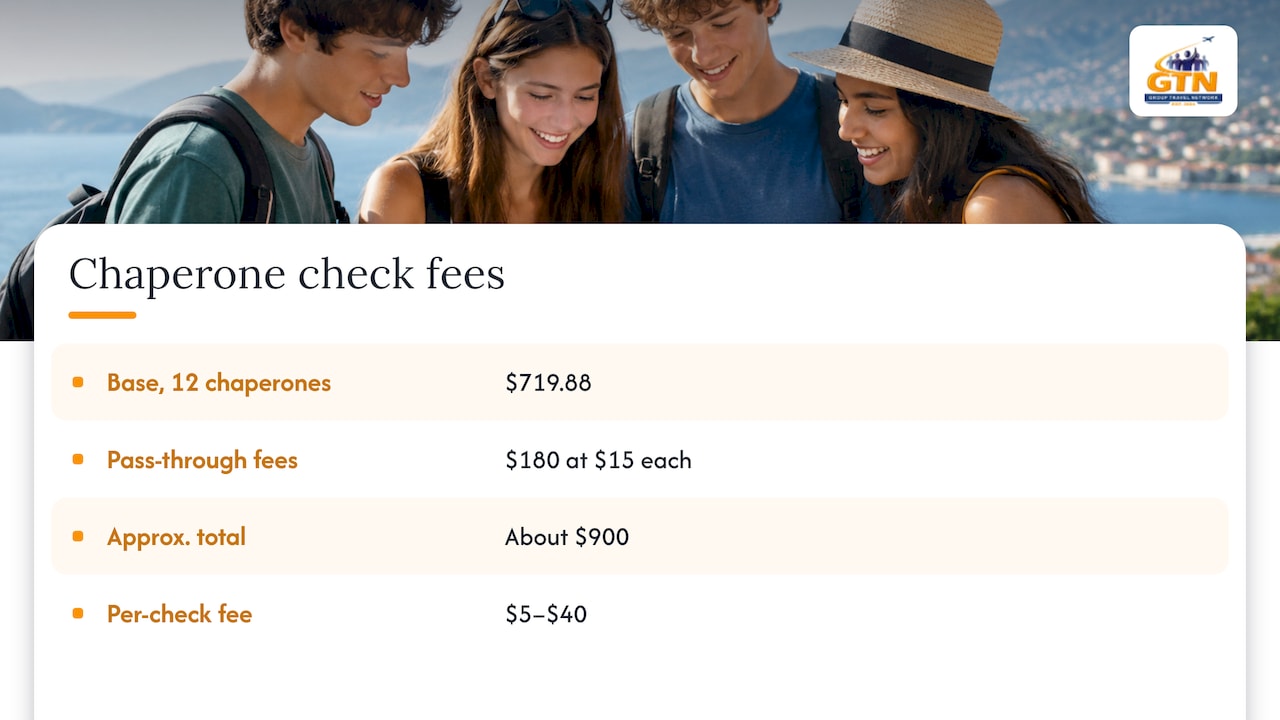
A worked example shows why this matters. Say your trip has 12 chaperones and you choose the Essential tier at $59.99. The base cost is $719.88. If the average pass-through fee is $15, add $180 for about $900 in total. If several chaperones have lived in high-fee jurisdictions, the total goes up. Build a cushion into the trip budget and settle who pays before anyone is asked to consent.
Which one fits a school or youth group
Use these criteria rather than brand reputation.
- Volume. Under a few hundred checks a year, self-serve is almost always enough. The extra integration power of the enterprise brand will sit unused.
- Who places the orders. If a principal, athletic director or band director will order checks between rehearsals, pick the interface that needs no training. Time lost to a confusing portal is a real cost.
- Payment method. Schools often pay by purchase order or district card. Ask each brand how invoices and receipts work for your organization before you enroll.
- Integration. If your district already runs HR software that connects to a screening vendor, check whether it supports one brand. That alone can decide the question.
- Support. Public forum complaints about slow support exist for both storefronts. Ask a sales rep what response time you can expect and whether a person is reachable when a report is stuck.
- Coverage. Ask which counties, states and databases your package searches. This matters more than the brand.
Match the package to the person you are screening
Two mistakes recur. The first is assuming that a report marked complete means you have everything you need. According to the CFPB’s circular on background dossiers (opens in a new tab), these reports are consumer reports, and a finished search tells you only that the agency completed what you ordered. A status of complete does not mean all relevant records were searched. Know which jurisdictions your package included.
The second mistake is confusing a criminal background check with verification of employment, education or licenses. The CFPB’s background screening handout (opens in a new tab) explains that a report can include several kinds of public-record information. What your package actually contains depends on what you order. For a volunteer chaperone, a criminal record search is the core. For a paid coach, bus driver contractor or tour staff member you hire directly, you may want to verify credentials as well. Match the tier to the role, not to the cheapest price.
The FCRA applies to volunteers too
Many organizations assume the Fair Credit Reporting Act covers only paid employees. GCheck’s guide (opens in a new tab) notes that the law’s definition of employment purposes is broad. It covers independent contractors in most circumstances, and the guide’s summary of the law extends the same reasoning to volunteers. If you run a screening report through a consumer reporting agency such as Checkr or GoodHire, plan to follow the same process for everyone.
A practical sequence for a school trip:
- Give a standalone written disclosure that a report may be obtained, separate from the application or permission form.
- Collect written consent before you order anything.
- Order the package that fits the role.
- Read the report yourself, including which jurisdictions it covered.
- If anything might lead you to decline a chaperone, send a pre-adverse action notice that includes a copy of the report and the CFPB’s Summary of Rights. The CFPB handout and related guidance describe a waiting period, generally treated as five business days, before the final notice.
- Send the final adverse action notice only after that period and after considering any response.
Skipping the pre-adverse step, or leaving out the actual report, is a common compliance failure. This is general information and not legal advice. For a specific denial, or if your state or district has its own rules, talk to your district’s counsel or an employment attorney before you act.
Our own guide to running chaperone checks weeks before a trip and meeting FCRA requirements (opens in a new tab) walks through the timeline from a trip-planning angle.
Timing: start earlier than feels necessary
Reports can come back quickly, but county records and manual court searches can stall. Add the waiting period required if a result is a concern, and you need real room. Start the process several weeks before you must give the roster to a tour operator, airline or venue. A single unresolved chaperone can force a scramble over supervision ratios the week before departure.
Our perspective: screen the way you plan the trip
We do not sell background checks, and we do not care which brand you choose. What we see from the trip side is that the provider matters much less than the process around it.
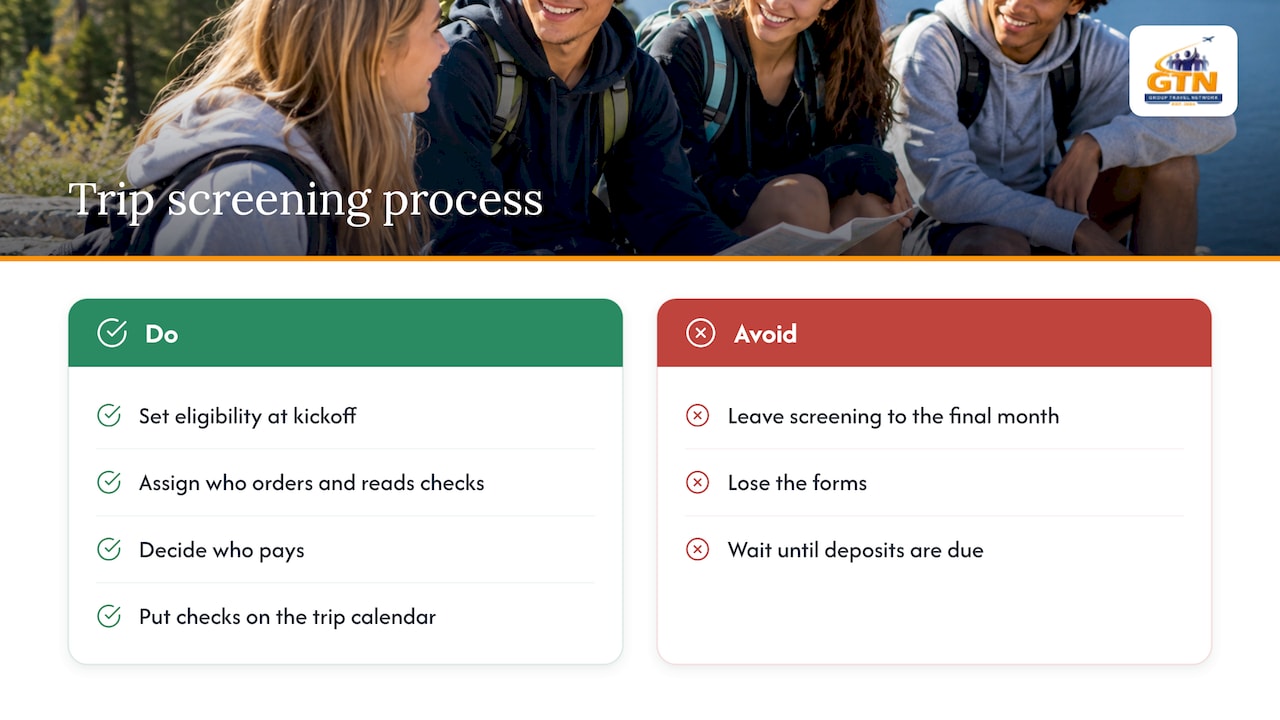
Groups that struggle treat screening as a last-minute task. Someone volunteers in the final month, the form is lost, the results arrive after deposits are due, and nobody knows who is allowed to approve a replacement. Groups that go smoothly decide three things at kickoff: who is eligible to chaperone, who orders and reads the checks, and who pays. They put the timeline on the same calendar as payment deadlines and rooming lists.
Our dedicated trip coordinators work with school administrators, band directors and team managers on exactly this sort of sequencing. Screening is your organization’s responsibility, and your district policy governs it. What we can do is build the itinerary, registration and payment timeline so that checks land early rather than becoming an emergency.
If you already have a district-approved vendor, use it. If you have none and the question is Checkr or GoodHire, choose the one your office can operate without friction, confirm the coverage you are buying, and move on to the harder parts of planning.
— Donovan
Plan the trip around the checks
Once your chaperone list is settled, the next job is a trip that fits your program. We organize performance tours (opens in a new tab) for bands, choirs and orchestras, educational trips (opens in a new tab), senior class trips (opens in a new tab) and international adventures (opens in a new tab), with online registration, flexible payment plans, travel protection options and a coordinator who stays with the group. If you want a trip built around your calendar, start with Group Travel Network (opens in a new tab).
For more on the planning side, see our step-by-step school group travel planning guide (opens in a new tab) and our safe travel planning steps for student groups (opens in a new tab).
Questions to ask before you sign up
- Which counties and states does this package search, and can I add more for a chaperone who moved recently?
- What are the typical pass-through fees, and are they itemized on the invoice?
- Can I pay by purchase order, or only by card?
- How are volunteers handled in the ordering flow, and are the disclosure and consent forms included?
- Does the platform help generate pre-adverse and adverse action notices, and who is responsible for sending them?
- How do I reach a person when a report is stuck?
Write the answers down. If two vendors answer the same way, the simpler portal wins.
FAQ
Is GoodHire the same as Checkr?
They are separate brands owned by the same company. Checkr acquired GoodHire’s parent in April 2022 (opens in a new tab), and reviewers report that both use the same core screening infrastructure. The difference is mainly the interface and the buyer each one targets.
Is Checkr or GoodHire cheaper?
Published base prices are nearly identical. Both start at $29.99 per check (opens in a new tab), and mid and upper tiers differ by only a few dollars at most. Your actual cost depends more on county and state pass-through fees, which can add $5 to $40 per check.
Do I have to follow the FCRA for volunteer chaperones?
If you use a consumer reporting agency to screen them, plan on it. The law defines employment purposes broadly, and compliance guidance (opens in a new tab) applies the same disclosure, consent and adverse action steps to contractors and, by extension, volunteers. Ask your district’s counsel to confirm how this applies to your situation.
What does it mean when a report says complete?
It means the agency finished the searches in the package you ordered, not that it searched everything. Check which jurisdictions and databases were included before you rely on it. That is what the CFPB’s guidance (opens in a new tab) on these reports implies.
Sources
- FAQ About Checkr’s Acquisition of GoodHire, Checkr (opens in a new tab)
- Checkr vs GoodHire: Background Checks Compared, AI HR Atlas (opens in a new tab)
- Checkr vs GoodHire: Head-to-Head Comparison, BackgroundChecker.com (opens in a new tab)
- GoodHire pricing (opens in a new tab)
- GoodHire Background Check Cost 2026, BackgroundCheckCost.com (opens in a new tab)
- Consumer Financial Protection Circular 2024-06, CFPB (opens in a new tab)
- Background screening report handout, CFPB (opens in a new tab)
- FCRA Contractor Background Check: Essential Guide, GCheck (opens in a new tab)
Recommended
- U.S. Schools: Run Chaperone Checks Weeks Before Trips And Meet FCRA (opens in a new tab)
- The Role Of Travel Chaperones: 2026 Guide For Schools (opens in a new tab)
- Charter Bus Safety For Students: What Every Planner Must Check (opens in a new tab)
- Student Travel Accommodation Standards: 2026 Guide For Schools (opens in a new tab)