


An on-tour nurse, also called a trip nurse, is a licensed nurse who travels with your group to give the health care your students are entitled to and to handle first aid and emergencies for everyone on the trip. Whether you need one depends on your students’ health needs, the destination and what your state lets a nurse delegate to other staff. The decision has to be made early, because licensing across state lines and medication paperwork take weeks. A planner who builds the itinerary around those lead times keeps the trip from stalling in the final month.
TL;DR
- A trip nurse gives ordered nursing care to identified students and first aid and emergency response to the whole group. A chaperone is not licensed to do either.
- Your school nurse, not the trip leader, decides whether a health professional must travel. The decision rests on the venue, students’ health needs and what can legally be delegated.
- Out-of-state trips add licensing questions. Start at least 20 school days ahead in states that set that timeline, and earlier if the destination is outside a nurse’s multistate license.
- Collect medical forms, medications and emergency plans before departure, and decide who holds each of them on the road.
- Build nurse costs, travel time and licensing fees into the trip budget from the first quote.
Table of Contents
- What an on-tour nurse does that a chaperone cannot
- When your trip needs a nurse
- Licensing: the part that slows trips down
- Five things to settle before you name a trip nurse
- Medications, conditions and forms
- A trip nurse timeline
- Where the trip planning fits
- Plan your group’s trip with us
- FAQ
- Sources
What an on-tour nurse does that a chaperone cannot
A chaperone supervises. A school nurse (or any registered nurse acting for the school) assesses, treats and decides when a situation is beyond first aid. On a trip those jobs split into two layers.
The first layer is care for identified students. Minneapolis Public Schools’ procedure says a trip nurse provides required nursing services to students with a medical provider order (opens in a new tab). That might mean insulin, a seizure protocol, tube feeding or a daily medication a student cannot self-administer.
The second layer is general first aid and emergency response for every student, staff member and official chaperone in the group. The same procedure treats the nurse’s travel expenses as part of the trip’s overall cost and pays the nurse for travel time, activity time and emergency services after students go to bed. For you, that means a night-duty nurse is a real line in the budget, not a volunteer favor.
A nurse is not a replacement for a good emergency plan or enough adult supervision. The nurse works inside your risk assessment, and the plan should say who calls 911, who stays with the group and who goes with a student to the hospital. Our guide to the four emergency plan essentials to carry (opens in a new tab) shows what that plan covers.
When your trip needs a nurse
No single national rule says every overnight trip needs a nurse. The answer is set by your state, your district and, most of all, your students. Wisconsin’s Department of Public Instruction names three factors for deciding whether a school nurse should go: the trip venue, the students’ special health care needs and the legal ability to delegate nursing care (opens in a new tab).
The Minnesota Department of Health says the licensed school nurse or RN determines whether a health service staff member must accompany the trip (opens in a new tab). It adds that delegating to unlicensed staff needs careful thought for students with frequent or unpredictable complex medical needs.
Five triggers that usually point to a nurse
- A student has a nursing service in an IEP or Section 504 plan. Wisconsin’s tool kit says those services must be provided to the same level by qualified staff on the trip (opens in a new tab), and any Emergency Action Plan must be carried out or adjusted.
- A student cannot self-carry or self-administer medication. New York City’s trip nurse policy calls these “nurse dependent students.” If no trained unlicensed staff member or nurse is available and no parent or designee attends, the principal must postpone the trip when possible (opens in a new tab) or, as a last resort, cancel it.
- A condition is unpredictable. Severe allergies, seizures, brittle diabetes and complex respiratory needs are the cases where delegation is hardest to justify.
- The venue is remote or far from emergency care. Distance to a hospital and cell coverage change how much you can safely rely on first aid alone.
- The group is large or the trip is long. More days, more students and more activities mean more chances for illness and injury. They also leave one nurse covering nights as well as days.
One point protects you legally and ethically. A student cannot be excluded from a trip because of a medical condition or disability, and a parent cannot be required to come along, according to the University of Wisconsin’s Care Beyond the Classroom resource (opens in a new tab). If a student’s needs call for a nurse, the planning question is how to staff the trip, not whether the student goes. Our piece on when to hire a planner for accessible school trips (opens in a new tab) covers the logistics side of that.
Licensing: the part that slows trips down
Nurses are licensed by state. A nurse who is fully licensed at home is not automatically cleared to practice where the bus stops, and that gap is where many trips lose weeks.
The Nurse Licensure Compact
The Nurse Licensure Compact gives RNs and LPNs multistate licensure based on their state of residence. Tennessee’s field trip guidance explains that it applies only to RNs and LPNs, not to unlicensed personnel or APRNs (opens in a new tab). It also says a nurse who delegates a task the destination state does not allow is accountable to both state boards of nursing.
New Jersey’s education department took this up in a memo cited at an October 2025 legal presentation. For out-of-state trips it told school nurses to review the Compact to see whether their license permits practice in the destination state (opens in a new tab). Districts must comply with licensure requirements or arrange student health services in another way beforehand.
When the destination is not in the Compact
The National Association of School Nurses (NASN) position statement on school-sponsored trips says that for non-compact states the nurse must contact the boards of nursing for guidance and permission to practice (opens in a new tab). That includes permission to delegate to school staff, or confirmation that visiting privileges apply. For trips outside the country, it advises getting guidance in writing and keeping the documents on hand. The statement was revised in January 2024, and the Compact has been growing, as when Washington joined on July 24, 2023. Check the current member list before you assume a destination is in or out.
Temporary licenses are slow. Minneapolis’s procedure notes that temporary out-of-state nurse license applications may take as long as eight weeks (opens in a new tab), and the school pays the fee even if the trip is canceled. Put that fee in your contingency line.
Notice periods
Districts set their own lead times, so read yours first. Wisconsin’s tool kit asks that school nurses be told about trips involving nursing procedures 10 school days ahead for in-state trips and 20 for out-of-state trips (opens in a new tab). Tennessee’s guidance gives four school weeks before an overnight trip (opens in a new tab) as an example of a district-set timeline. The nurse uses that time to review individualized health plans, emergency plans and education plans and to line up needed care.
The responsibility for supervision and delegation does not stop at the school door. Tennessee’s guidance says nurses should reassess delegation when preparing for a trip, because who performs a procedure may need to change depending on the circumstances.
Five things to settle before you name a trip nurse
These decisions, in this order, keep most trips out of trouble.
- Who is the nurse? A school nurse from your building, a district float nurse or another licensed RN. The choice affects licensure, pay, liability and who knows your students.
- Which students need what? Build the list from health information on every participant, not just the students who are known to have needs.
- What does the destination allow? Check licensing and delegation rules in the state or country you are visiting, as above.
- What is the budget? Nurse pay, travel, lodging, license fees and a backup plan.
- Who covers if the nurse cannot go? Illness happens to nurses too. Name a backup before the deposit is paid.
Medications, conditions and forms
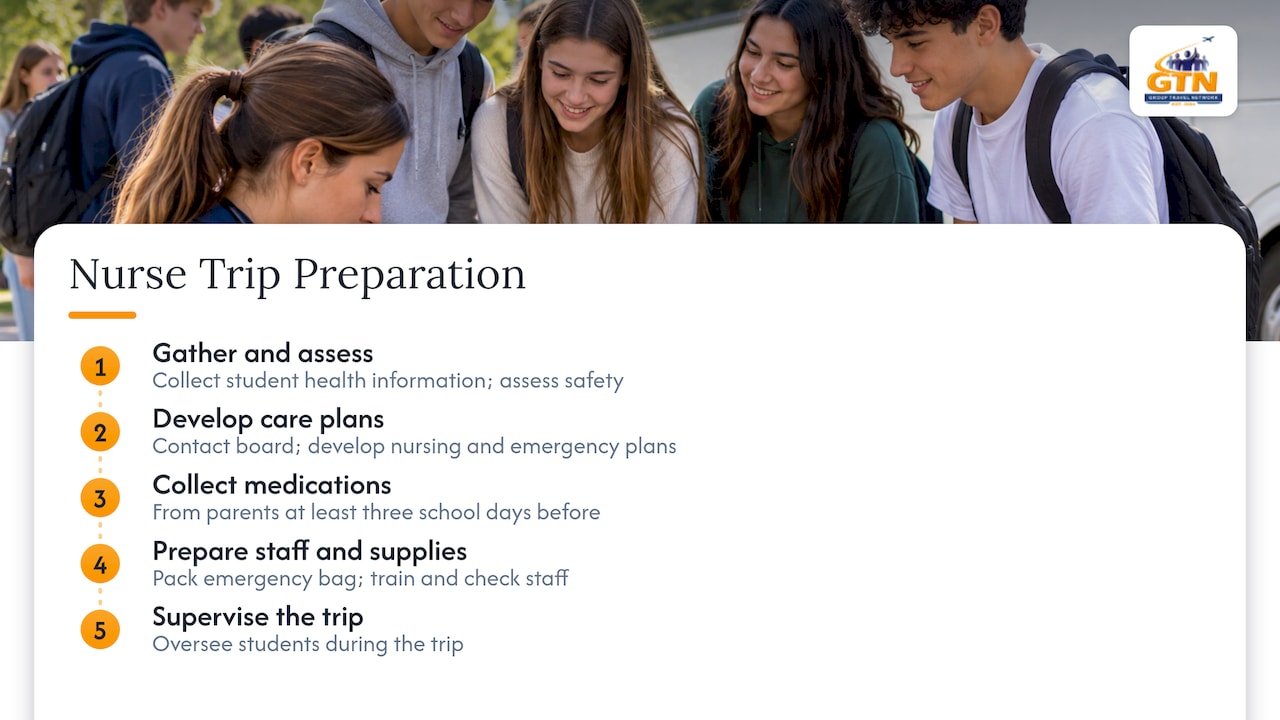
The nurse’s work starts weeks before departure. Connecticut’s State Department of Education lists 12 duties for school nurses on trips. They include gathering health information on all participating students (opens in a new tab), assessing health and safety, contacting the visiting state’s board of nursing, and developing nursing and emergency care plans. The nurse also gets medications and equipment from parents at least three school days before departure, packs an emergency bag, trains unlicensed staff and checks their competence, and supervises during the trip.
Colorado’s school nurse field trip checklist adds practical items. It covers individual health plans, emergency action plans, medication orders, self-carry medication contracts and 504 or IEP accommodations (opens in a new tab). It also covers allergen and trigger avoidance, dietary and toileting needs, safe medication storage and privacy for treatments. It calls for adequate emergency response and cell coverage and at least one CPR and first-aid certified person under Colorado rule 6 CCR 1010-6.
Medication handling on the road
Calhoun County Public Schools’ guidance requires at least one staff member on the trip to be trained to distribute prescribed medications and to secure them (opens in a new tab). Over-the-counter medications need a district form signed by both parent and physician and proper labeling. Medical emergency cards with permission for treatment must travel with the group for each student, with a copy kept at school.
For food allergies, the FARE school guidance recommends a one-page Food Allergy and Anaphylaxis Emergency Care Plan completed with the child’s allergist (opens in a new tab). It lists allergens, symptoms, treatment, emergency contacts and a current photo, signed by the provider. Keep it where adults can reach it fast.
Our student medical forms checklist and templates (opens in a new tab) cover what to collect, and minor travel consent forms (opens in a new tab) cover the signatures. Stock the nurse’s bag against a clear list. We set out ten items in our student trip first aid guide (opens in a new tab), and an emergency and first aid kit (opens in a new tab) page is useful for comparing what a kit should hold.
Consent, communication and incidents
Calhoun County’s guidance asks families for the district medication form and returned permission and emergency forms before departure. The packet includes the trip letter, itinerary, informed-consent permission form and a health information and emergency contacts form. The same guidance requires a way to reach emergency help, such as a cell phone with an alternate, and 24-hour numbers so staff can reach a school administrator.
In an accident, it says staff should not move a student who may have a neck or spinal injury, should summon professional medical help and should contact the administrator and parents promptly. Staff should not discuss who will pay for medical care or admit liability. They should complete an accident report instead.
A trip nurse timeline
| When | What happens |
|---|---|
| 3 to 6 months out | Review student health needs with the school nurse, decide whether a nurse travels, and budget for pay, travel and licensing |
| 8 or more weeks out | Start any temporary license applications and contact the destination state’s board of nursing |
| 4 school weeks out | Meet your district’s notice deadline for overnight trips and review health and emergency plans |
| 3 school days out | Collect medications, equipment and signed forms, and pack the emergency bag |
| On the trip | Nurse treats identified students, leads first aid, keeps records and files accident reports |
| After | Return medications, document incidents and note what to change next time |
Adjust each row to your own district’s timeline, since the notice periods above vary by state. Our school trip risk assessment template (opens in a new tab) can sit alongside it, and the overnight field trip policy guide (opens in a new tab) shows what to write into your district policy for 2026.
Where the trip planning fits
A nurse covers health. Everything around the nurse is logistics: lodging near care, schedules with room for medication times, transport that works for every student, and a plan when the itinerary changes. Our student travel accommodation standards guide (opens in a new tab) and safe travel planning steps for student groups (opens in a new tab) cover that side.
We build custom itineraries for student and youth groups, and each group has a dedicated trip coordinator. We also offer online registration, flexible payment plans and travel protection options. On the road, our on-trip coordinators handle the logistics so your nurse and teachers can focus on students.
Our perspective
Most trips that struggle with health planning do not fail because a nurse was missing. They fail because the decision came late. The nurse learned about a diabetic student two weeks out, the license question surfaced a month too late, or the forms sat in a binder nobody carried.
When we plan a group trip, we treat health needs as a design input, the same as the budget or the destination. That means building the itinerary with realistic medication times, rest, and access to care, and giving the trip leader one coordinator to call. Our model is a dedicated trip coordinator before departure and on-trip coordinators during travel, so the adults responsible for students are not also acting as travel agents.
We would rather a school build the nurse into the plan on day one. Early planning, online registration that collects information in one place, and payment plans that spread the cost make that practical for administrators and band directors alike.
Donovan
Plan your group’s trip with us
If you are an administrator, band director or team manager planning a group trip, we can build the itinerary around your students’ needs, whether that is a performance tour (opens in a new tab), an educational trip (opens in a new tab) or an international adventure (opens in a new tab). You get a dedicated coordinator, online registration and flexible payment plans from the first conversation. Tell us about your group at Group Travel Network (opens in a new tab).

FAQ
Does every school trip need a nurse?
No national rule requires one. The school’s licensed nurse or RN determines whether a health professional must go, based on the venue, students’ needs and the ability to delegate. When a student’s IEP or 504 plan lists nursing services, they must be provided to the same level on the trip.
Can we ask a parent to come instead of a nurse?
You can invite a parent or designee, but you cannot require it. A student cannot be excluded from a trip because of a medical condition or disability. Some districts, such as New York City’s, accept a parent designee only if they meet state law, and otherwise the trip may be postponed.
Can our school nurse work in another state?
Only if licensing allows it. A nurse with a multistate Compact license may be able to practice in other member states, while non-compact destinations require contacting that state’s board of nursing for permission. Temporary license applications can take up to eight weeks in some districts’ experience, so start early.
Who pays for the trip nurse?
District policies differ. Minneapolis includes the nurse’s travel expenses in the trip’s overall cost and pays the nurse for travel, activity and emergency time. Ask your district office early so the cost is in the per-student price before families commit.
Sources
- Minneapolis Public Schools, School Nurse Program field trip procedure (opens in a new tab)
- Wisconsin DPI, Meeting Student Health Needs While on Field Trips tool kit (opens in a new tab)
- Minnesota Department of Health, Field Trip Preparedness (opens in a new tab)
- NYC DOE, Trip Nurse Policy (opens in a new tab)
- University of Wisconsin, Care Beyond the Classroom (opens in a new tab)
- Tennessee, Providing Health Services on Field Trips (opens in a new tab)
- Tennessee, Field Trip Guidance (Nurse Licensure Compact) (opens in a new tab)
- NJAAP, Field Trips from Hell: Understanding Legal Obligations (opens in a new tab)
- NASN Position Statement: School-Sponsored Trips (opens in a new tab)
- Connecticut SDE, School Personnel Roles and Responsibilities (opens in a new tab)
- Colorado Department of Education, Field Trips and Extracurricular Activities (opens in a new tab)
- Calhoun County Public Schools field trip guidance (opens in a new tab)
- FARE, Managing Food Allergies in the School Setting (opens in a new tab)
- Emergency and First Aid Kit (opens in a new tab)
Recommended
- How To Organize School Tours: 2026 Planning Guide (opens in a new tab)
- Student Medical Forms For School Trips: Checklist And Templates (opens in a new tab)
- U.S. School Trips: Four Emergency Plan Essentials To Carry (opens in a new tab)
- Student Trip First Aid: 10 Must-Pack Items For 2026 (opens in a new tab)