


ACH is the bank-to-bank transfer network behind direct deposit, and it works well for school trips on both sides of the ledger. Parents can pay trip fees from a bank account at a low cost, and your business office can pay vendor deposits by ACH once a purchase order (PO) is approved. The catch is timing and paperwork: ACH takes days to settle, needs written authorization, and in most districts nothing is paid until a PO exists. This guide walks you through the whole sequence in 2026.
TL;DR
- Get the purchase order approved first. Districts treat the PO as the promise to pay a vendor, and many require trip approval before any money moves.
- Plan for one to four business days of ACH settlement, longer if bank verification is needed, and build that into every deposit deadline.
- Collect a clear authorization from each payer and keep it for two years after the authorization ends.
- Expect ACH to cost far less than cards. One district charges $1 per ACH transaction up to $500, against $1 plus 2.3% on cards.
- Reconcile every payment to a trip roster, and write down your plan for returned payments before the first one bounces.
Table of Contents
- Why ACH fits school trips
- Step 1: Start with the purchase order
- Step 2: Assemble the PO packet
- Step 3: Set the payment schedule against settlement times
- Step 4: Get authorization right
- Step 5: Know the fees and the risks
- Step 6: Pay vendors by ACH, and verify the bank details
- Step 7: Reconcile and document
- Perspective
- Plan your next trip with a coordinator
- FAQ
- Sources
Why ACH fits school trips
A school trip is a long payment chain. Families pay in installments over months. Vendors such as hotels, motorcoach operators and venues want deposits long before departure. Your business office, meanwhile, will not release a dollar without approvals.
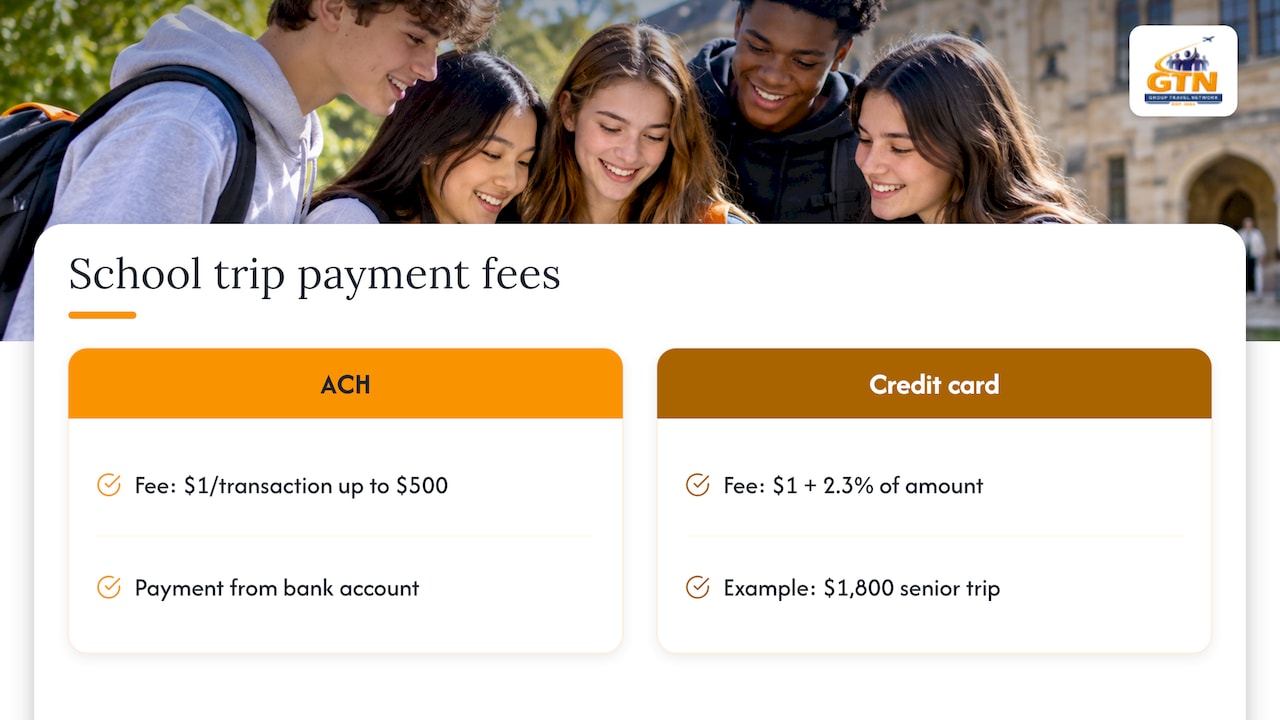
ACH suits that pattern because it is cheap and repeatable. Regional School District 13 in Connecticut, for example, lets parents pay field-trip fees from a bank account by ACH (opens in a new tab) and charges $1 per ACH transaction up to $500, while credit-card payments cost $1 plus 2.3% of the amount. On a $1,800 senior trip paid in cards, that fee gap is real money that either the family or the school absorbs.
On the vendor side, ACH is how most district finance systems pay invoices electronically. PowerSchool ERP, for instance, generates a bank-formatted ACH file (opens in a new tab) with the funding account and vendor bank-account details. That means the same transfer method can carry money in from families and out to vendors.
Step 1: Start with the purchase order
A purchase order is a document your district issues to a vendor that says, in effect, “we will pay up to this amount for these services.” Bedford Public Schools in Michigan describes a PO as a legal promise of payment to a vendor and a way to reserve funds within a budget (opens in a new tab). Its workflow runs from an employee request, to administrator budget approval, to a secretary creating the PO, to final district review. The same guide says the district will not pay for services before they are performed, which matters for how you structure deposits.
Rules differ by district, so ask your business office these questions before you contact any vendor:
- Is a PO required for every trip, or only above a dollar threshold?
- Who approves it: principal, superintendent, board?
- How far ahead must the request be filed?
- Can the district pay a deposit before the trip happens?
The examples show how much this varies. Redlands Unified School District in California calls a PO the preferred payment method for field trips (opens in a new tab) and warns that checks take 6 to 8 weeks to process. Hilldale Public Schools in Oklahoma requires trips to be approved before the trip date (opens in a new tab), with POs set up and a detailed packet approved by the superintendent. Overnight and out-of-state travel there also requires a meeting with the accounting office before departure.
That is the first place a coordinator loses weeks: a vendor quote sits in your inbox while approvals crawl. Our dedicated trip coordinators work from your district’s timeline, so the itinerary, quote and paperwork are ready when your approvers need them. For the full approval and deadline picture, see our school trip payment policy templates and timelines (opens in a new tab).
Step 2: Assemble the PO packet
A PO request that arrives incomplete goes to the back of the line. Redlands asks for an official reservation confirmation that lists the event location, date and times, the number of students and chaperones, and the primary contact person. Most districts want something similar:
- A written quote or contract from the vendor, with the payment schedule and cancellation terms
- The trip dates, destination and head count
- The total cost and cost per student
- The funding source (family payments, fundraising, activity account, grant)
- The vendor’s legal name, address and tax form
Document the amount you expect families to pay, too. If you are using grant money, check what it can cover first: our guide to Title I field trip funding (opens in a new tab) lists what you can pay for.
Step 3: Set the payment schedule against settlement times
Work backward from the vendor’s deposit date. ACH is not instant, and the delay changes how you set due dates.
Stripe’s guidance says ACH payments generally take one to three business days (opens in a new tab), and Same Day ACH can settle the same business day when initiated before the cutoff. Its ACH Direct Debit documentation adds that acknowledgement of success or failure can take up to 4 business days (opens in a new tab), with standard settlement four business days from payment creation. Other platforms quote different numbers: BookLive’s support page says bank transfers clear in 3 to 5 business days (opens in a new tab), and requires microdeposit verification to be completed within 10 days or the payment is canceled.
The practical rule: use your own processor’s published timing, then add a buffer. A simple schedule for a spring trip might be:
| Milestone | Typical timing | What to plan |
|---|---|---|
| Approval and PO issued | 2 to 8 weeks before the vendor deadline | File early; some districts need two weeks minimum for requisitions |
| Family installment due dates | Monthly, a week before the school’s vendor run | Leaves room for a failed payment to be retried |
| Vendor deposit | On the contract date | Pay by ACH with a margin of several business days |
| Final balance | 30 to 60 days before departure, per contract | Confirm the final headcount first |
Pay runs matter as well. Bedford releases accounts payable checks on Thursdays and requires complete payables by noon on Tuesday. If your district works that way, a late Tuesday submission is a week lost. Our guide to managing group travel payments in 2026 (opens in a new tab) goes deeper on how to line up family due dates with vendor deadlines, and our online registration and flexible payment plans are built for exactly this kind of installment schedule. If you also want to share the cost schedule with parents, our interest-free payment plan guide (opens in a new tab) covers it.
Step 4: Get authorization right
When a school pulls money from a parent’s account, that is an ACH debit, and it requires the parent’s permission. Stripe’s documentation says ACH Direct Debit requires authorization through a mandate (opens in a new tab) that includes the business name and says whether the authorization is one-time or recurring.
For consumer payments, the 2025 ACH Rules Awareness guide from a bank says you should obtain clear authorization, keep it for two years after it ends, and provide it to the bank on request (opens in a new tab). For a trip, that means your sign-up form should state:
- The total trip cost and each installment amount
- The dates the debits will happen
- Whether the authorization is one-time or recurring
- How to cancel it, and the deadline to do so
- Who to contact with questions
Store the signed or electronic record with the trip file, not just in the payment system. Online registration that captures each family’s agreement at sign-up keeps this tidy, and it is part of how we set up group trips.
Step 5: Know the fees and the risks
Fees vary by processor, but ACH is generally cheaper than cards. Stripe says fees vary by provider and are generally lower than card fees (opens in a new tab), and some processors cap them at $5. A school software vendor claims ACH costs $0.75 per transaction versus $19 on a card for a typical monthly fee; treat that kind of figure as the vendor’s own estimate and compare it with the actual rate sheet from your bank or processor.
The lower cost comes with a different risk profile. Stripe notes that ACH Direct Debit is not a guaranteed payment method (opens in a new tab): payments can fail, and a customer can dispute a debit from a personal account for up to 60 calendar days. Plaid’s guide similarly explains that returns such as unauthorized-payment claims can occur up to 60 days after settlement (opens in a new tab).
What that means for a trip budget:
- Do not pay a non-refundable vendor deposit with money that arrived last week. Hold family funds until the return window has passed, or keep a small reserve.
- Decide who covers a returned payment (the family, the activity account) and say so in the sign-up form. Bedford’s guide lists a $25 NSF fee for returned checks, so set a clear policy for returned ACH instead of improvising.
- Offer ACH at no cost to families where your rules allow it, with a card fee as the only surcharge.
Step 6: Pay vendors by ACH, and verify the bank details
The most dangerous ACH moment in a trip is not a parent’s payment. It is the day a “vendor” emails new bank details. Nacha’s 2026 fraud-monitoring rule targets entries initiated under false pretenses, including vendor impersonation (opens in a new tab). It began phasing in on March 20, 2026, for the largest originators and extends to remaining non-consumer originators later in 2026, so your bank may now ask what controls you use.
A sound routine:
- Collect vendor bank details on the signed contract or a vendor form, not by email.
- Confirm any change by calling a phone number you already had on file.
- Use a test, or prenote. PowerSchool describes a prenote process that sends test ACH data (opens in a new tab) to check a vendor’s deposit information, and advises leaving time to verify it with the bank before paying.
- Match the invoice to the PO and contract before release. Bedford’s three-point workflow exists to prevent fraud.
Another 2026 change helps on the receiving end. Nacha’s rule effective September 18, 2026 requires standard ACH credits to be available by 9:00 a.m. local time (opens in a new tab) on the settlement date. That is good news for a vendor deposit with a deadline, though you should still confirm timing with your bank.
Vendor selection is part of this too. A vendor with clear payment terms and a documented deposit schedule is easier to pay on time; our vendor selection guide for school trips (opens in a new tab) and school travel RFP template (opens in a new tab) show what to look for.
Step 7: Reconcile and document
The trip is not financially done when the bus leaves. Madison’s procedures require a roster entry for each field-trip participant and reconciliation of collected money to the roster (opens in a new tab). That is a good template for any group:
- Keep one roster with name, amount due, amount paid, payment date and method.
- Match every deposit in the bank statement to a roster line.
- Link each trip fee to the right ledger account. K-12 Online’s guidance says all fees must be linked to a general ledger account (opens in a new tab) so each transaction can be tracked.
- Log returned payments and retry or resolve them using a written procedure.
- File refunds with the reason, date and approval. Hilldale requires receipts signed, dated and turned in with requisitions once a trip ends.
A budget that tracks actual against planned costs makes this easier; see our step-by-step school trip budget guide (opens in a new tab), and our guide to costs and fees (opens in a new tab) for what to expect on the invoice.
Perspective
Most payment problems on school trips are timing problems, not technology problems. The ACH transfer is the easy part. The hard part is that a purchase order, a vendor deposit date and a family’s due date all live in different offices.
That is why we built our service around one point of contact. A dedicated trip coordinator learns your district’s approval steps, lines the paperwork up with them, and stays with your group through departure. Online registration gives every family one place to sign up, and flexible payment plans spread the cost so a single large payment does not stall enrollment.
If you are a band director or a business manager with a trip on your plate along with everything else, handing the logistics to a team that does this every day is the most dependable way to protect your deadlines.
Donovan
Plan your next trip with a coordinator
If you are building a trip this year, we handle itineraries, vendor partnerships, online registration, flexible payment plans and travel protection options for school and youth groups, with a dedicated coordinator behind it. Start with the program that matches your group: performance tours (opens in a new tab), educational trips (opens in a new tab), senior class trips (opens in a new tab) or international adventures (opens in a new tab), or talk to us about your group (opens in a new tab).

FAQ
How long do ACH payments take for a school trip deposit?
Plan on one to four business days, depending on the processor. Stripe says ACH generally takes one to three business days (opens in a new tab), while its debit documentation allows up to four for confirmation. Add a buffer before any vendor deadline.
Do we need a purchase order if parents pay by ACH?
Usually yes, if the school is the one paying the vendor. The PO governs the district’s payment to the vendor, not the parents’ payment to the school. Check your business office, because thresholds and approvers vary by district.
What should an ACH authorization for trip fees say?
It should state the amounts, the debit dates, whether it is one-time or recurring, and how to cancel. Keep the record for two years after the authorization ends, as one bank’s ACH rules guide (opens in a new tab) advises.
What happens if a parent’s ACH payment fails?
The bank returns it with a reason code, and you need a written procedure for retrying or contacting the family. Unauthorized-payment claims can come up to 60 days after settlement, so keep a reserve before paying non-refundable deposits.
Sources
- Regional School District 13 School Payment Portal (opens in a new tab)
- PowerSchool ERP: Vendor Checks and Electronic Funds Transfer (opens in a new tab)
- Bedford Public Schools Business Services Guide, January 2026 (opens in a new tab)
- Redlands Unified School District Field Trips Procedures (opens in a new tab)
- Hilldale Public Schools Financial Procedures 25-26 (opens in a new tab)
- Stripe: How to accept ACH payments (opens in a new tab)
- Stripe documentation: ACH Direct Debit payments (opens in a new tab)
- BookLive: Accepting ACH bank transfer payments (opens in a new tab)
- Plaid: ACH Payments 101 (opens in a new tab)
- Androscoggin Bank: 2025 ACH Rules Awareness and Updates Guide (opens in a new tab)
- Navigating the 2026 ACH Rule Changes and Updates (opens in a new tab)
- Nacha: New rules to accelerate funds availability (opens in a new tab)
- Madison Financial Procedures and Money Handling Guidelines (opens in a new tab)
- K-12 Online: Online Payments Intro (opens in a new tab)
Recommended
- School Trip Payment Policy: 2026 Templates And Timelines (opens in a new tab)
- Parents: 7 Steps To Secure An Interest Free School Trip Payment Plan (opens in a new tab)
- School Trip Payment Guide | Understanding Costs & Fees (opens in a new tab)
- How To Manage Group Travel Payments In 2026 (opens in a new tab)