


Title I, Part A funds can pay for a field trip, but only when the trip is educational, tied to a documented academic purpose, reasonable in cost and approved before you spend anything. Trips that are mainly social, entertainment or recreation do not qualify. This guide walks school administrators, coordinators and teachers through what is usually allowable, who can go, which costs are covered, and what paperwork protects you in an audit.
TL;DR
- Title I, Part A can fund educational field trips that support the academic goals in your schoolwide or district improvement plan. Entertainment-only trips are not allowable.
- In a schoolwide school, all students can benefit. In a targeted assistance school, funds must serve the eligible students only.
- Transportation, admission and, in some states, lodging and student meals may be covered, but only with prior approval and documented justification.
- Rules differ by state and district. Confirm with your state education agency or federal programs office before you commit funds.
- Title I funding is not the same as outside field trip grants, and the two can work side by side.
Table of Contents
- Can Title I pay for a field trip?
- Which schools and students can go
- What counts as an educational field trip
- What Title I can cover
- The approvals and paperwork you need
- Supplement, not supplant
- Title I funding versus field trip grants
- Build a trip budget that survives review
- Our perspective
- Plan your educational trip with us
- FAQ
- Sources
Can Title I pay for a field trip?
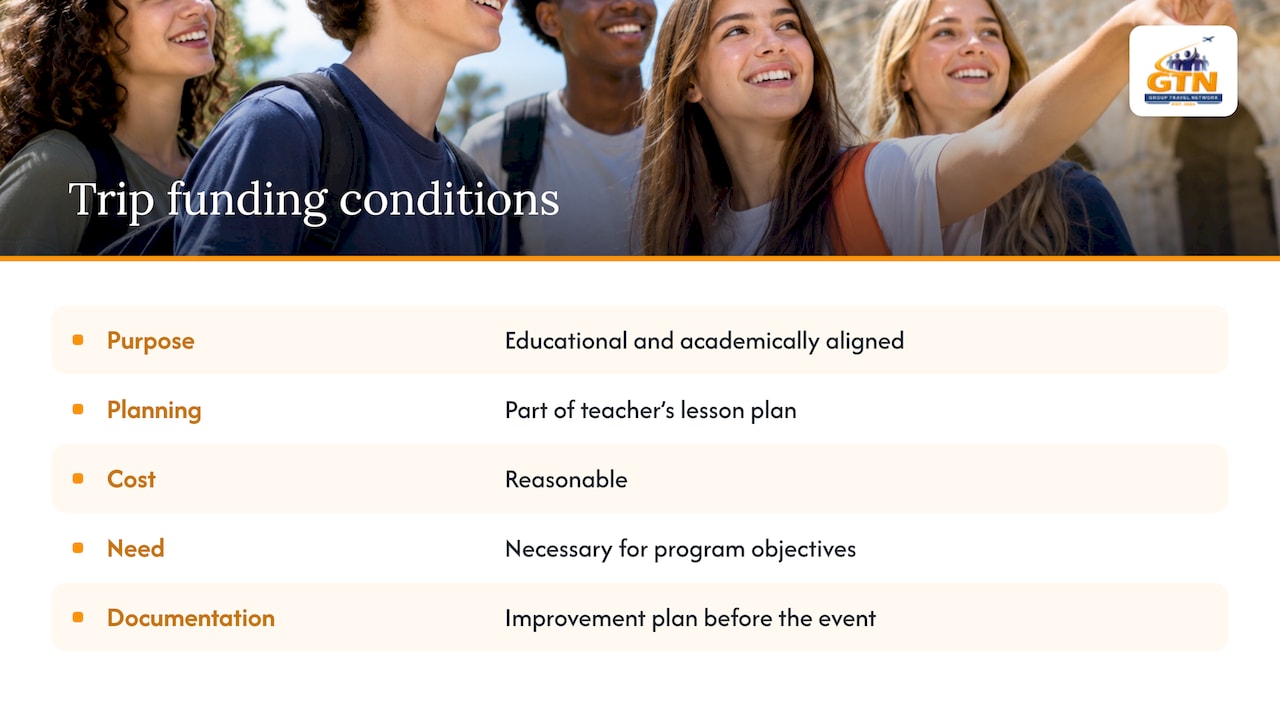
Yes, with conditions. North Carolina’s federal programs handbook says a trip can be paid for with Title I, Part A funds when it is educational, academically aligned, part of a teacher’s lesson plan, reasonable in cost, necessary to meet the program’s objectives and documented in the school or district improvement plan before the event (opens in a new tab). Trips for social, entertainment or recreational purposes are not allowed.
Other states say the same thing in their own words. South Dakota’s guidance says field trips must be educational and support program goals, and entertainment trips are not allowable (opens in a new tab). North Dakota treats field trip travel as allowable if it is educationally related and reasonable in cost (opens in a new tab).
The common thread is simple. A Title I trip is an instructional activity that happens to take place off campus. If you can show the lesson it supports, the need it addresses and the budget line it sits in, you are on solid ground.
Which schools and students can go
Who benefits depends on how your school runs Title I.
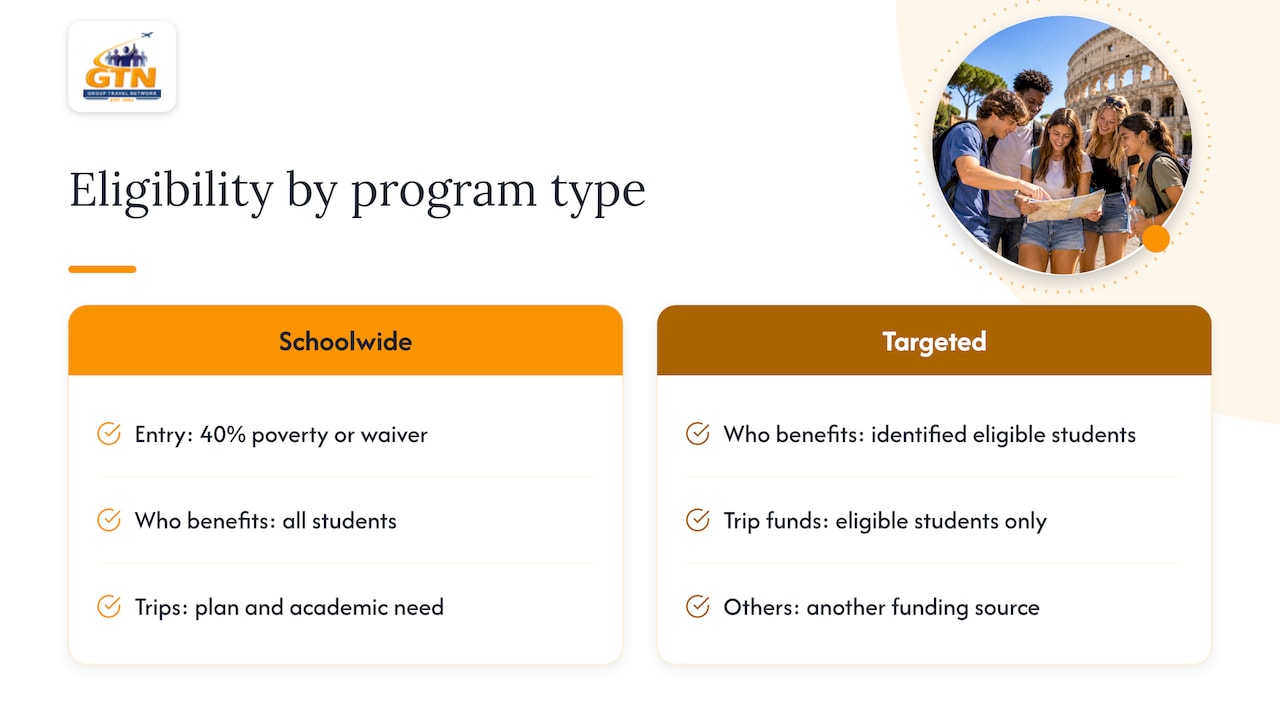
Schoolwide schools. A school with at least 40 percent poverty, or a state-approved waiver, can operate a schoolwide program. South Dakota’s guidance says that in this model all students are Title I participants and may benefit (opens in a new tab). Illinois adds that schoolwide activities must be part of the schoolwide plan and support an academic need identified in the comprehensive needs assessment (opens in a new tab).
Targeted assistance schools. Funds must serve the students identified as eligible for services. Illinois says funds may only meet the needs of children identified as being in greatest need (opens in a new tab). South Dakota also notes that Title I cannot pay for non-Title I students to attend a field trip in a targeted assistance program. If your grade-level trip includes everyone, you will need another funding source for the students who are not eligible.
A caution on student activity costs. Utah’s handbook says costs for student activities, including field trips, may not be charged to Title I unless necessary to support services for students experiencing homelessness (opens in a new tab). That is a stricter reading than other states take, which is a good reason to read your own state’s guidance first.
What counts as an educational field trip
State guidance gives concrete examples. North Carolina’s handbook lists potentially allowable trips, including:
- Math, science and technology activities such as service learning, academic competitions, science fairs and laboratory or field investigation.
- Visits to a river, archaeological site or nature preserve.
- Trips to a local library to increase access to high-interest reading materials.
- Visits to colleges and universities to encourage interest in higher education.
It is all listed in the state’s federal programs handbook (opens in a new tab). New York lists field trips aligned with academic content or giving access to humanities experiences (opens in a new tab) as allowable. Illinois lists documented instructional trips and campus orientation and guided tours (opens in a new tab).
Maryland asks for more than a good destination. Its guidance says the trip should include hands-on activities that encourage students to experiment and ask questions, appear in the teacher’s lesson plans with preparation and follow-up, and cost a reasonable amount (opens in a new tab).
What does not qualify
Maryland names the ineligible categories: trips for social, entertainment or recreational purposes, trips not tied to the curriculum, trips outside a teacher’s lesson plan, trips that are poorly documented or unreasonable in cost, and amusement or theme parks (opens in a new tab). Illinois likewise excludes social events and passes to amusement parks. Alabama’s Bullock County district goes further in its own rules, requiring educational-only trips, no overnight travel and no amusement or water parks (opens in a new tab).
North Carolina also sets a time test: a visit to an entertainment or recreational venue that has a real educational program is unallowable when more than 25 percent of the time goes to entertainment or recreation. A museum or science center day with a structured lab session passes more easily than a venue day with a short lesson attached.
What Title I can cover
The table summarizes what the research shows. Treat it as a starting point, because each state and district writes its own list.
| Expense | Usually allowable? | What the guidance says |
|---|---|---|
| Transportation | Yes, if the trip qualifies | Virginia’s Northern Neck division lists field trip transportation as an allowable in-house service (opens in a new tab) supporting Title I, Part A |
| Admission fees | Yes, for academic trips | Los Angeles Unified allows admission fees or district transportation as support for low-income, homeless or foster youth (opens in a new tab) |
| Student meals | Sometimes | North Carolina allows them only if the USDA lunch program cannot provide them, and they must be reasonable, necessary and allocable |
| Staff, parent and chaperone meals | No | Not covered under North Carolina’s guidance |
| Lodging | Sometimes | Allowed for overnight trips that are approved and judged reasonable, necessary and allocable |
| Substitute teachers | Yes, if reasonable | Allowable when needed to supervise a trip |
All of the North Carolina rows come from its federal programs handbook (opens in a new tab). Notice how local rules can differ: North Carolina allows lodging for approved overnight trips, while one Alabama district prohibits overnight trips outright. Your own district’s list controls.
The approvals and paperwork you need
Most audit problems come from documentation and timing, not from the destination.
- Check the allowability test. New Mexico’s guidance says every expenditure must be allowable, allocable, reasonable and necessary (opens in a new tab) under federal cost rules, and adequately documented and incurred within the approved budget period. New York points to the reasonable-and-necessary standard in 2 CFR 200.403 (opens in a new tab).
- Put the trip in the plan first. North Carolina requires the justification to be identified in the school or district improvement plan before the event, with the cost, destination and educational objectives in the approved program budget.
- Get prior approval. The same handbook says purchases and travel paid with federal funds need prior approval, and federal funds cannot pay in advance for meals, lodging and transportation. It also says travel must meet the federal travel cost rules in 2 CFR 200.475 (opens in a new tab).
- Ask when in doubt. Maryland advises schools planning a questionable trip, such as a bowling alley, arcade or pizza parlor, to contact the state department before spending the money (opens in a new tab).
- Keep the lesson file. Save the lesson plan, the pre-trip and follow-up activities, the roster showing eligible students, and the invoices.
A useful habit is a one-page trip justification form: academic standard, need identified in the plan, activity description, cost per student, funding source and approver signature. It answers most of what an auditor asks.
Supplement, not supplant
Title I money has to add to what a school would otherwise provide. New Mexico’s guidance states that funds supplement and do not supplant state and local funds (opens in a new tab), citing ESEA Section 1118(b)(1). In practice, if the district has always paid for a required curriculum trip from its general fund, you cannot move that bill to Title I just because the money is available. Use Title I for the enrichment and access that goes beyond what local funds would have provided.
The U.S. Department of Education’s cost guidance adds two related points. Entertainment costs are unallowable unless they have a programmatic purpose and are authorized in the approved budget (opens in a new tab), and costs of student clubs and other student activities are unallowable unless the federal award specifically provides for them. That second point is why the trip needs a clear instructional link, not just a club or activity label.
Title I funding versus field trip grants
The two are often confused because both show up in the same searches.
| Title I, Part A | Outside field trip grants | |
|---|---|---|
| Source | Federal formula funds through your state and district | Corporate, foundation or community programs |
| How you get it | Budgeted in your plan and approved in advance | Application by a teacher or school, often a set amount per trip |
| Rules | Federal cost principles, state and district guidance | The funder’s own eligibility and reporting terms |
| Best use | Trips built into the academic plan for the year | Extra trips or students the plan does not cover |
Many grant programs for field trips are aimed at Title I schools or capped at a modest award per trip. A mix often works: Title I covers the planned instructional core, and a grant covers the part that falls outside Title I rules, such as students who are not eligible in a targeted assistance school. Check each funder’s current terms on its own page, because amounts and application windows change.
For ideas beyond federal money, see our guide to student travel scholarships for coordinators (opens in a new tab) and our overview of arts travel grants for schools and youth groups (opens in a new tab).
Build a trip budget that survives review
Funding rules only help if the budget behind the trip is sound. Start from the per-student cost, list every line item and match each one to a funding source, so you know what Title I covers and what must come from elsewhere. Our walkthrough on how to budget for school trips (opens in a new tab) covers the core components and common pitfalls. For logistics, the field trip organization tips for administrators (opens in a new tab) cover permission slips, chaperone ratios and timelines.
Two habits keep reviewers comfortable. Get written quotes that show transportation, admissions and any education programming as separate lines. And choose destinations that publish an educational program, such as a guided lab, a ranger-led session or a campus tour, so the instructional piece is easy to attach to your lesson plan.
Our perspective
Most of the school groups we talk with already know where they want to go. What slows them down is proving why the trip belongs in the academic plan and then keeping every piece of the logistics tidy.
We build itineraries around learning objectives first. When a coordinator can point to the lesson, the destination activity and the follow-up in a single plan, the funding conversation with a federal programs office gets much easier. Our dedicated trip coordinators handle vendors and details so your staff can focus on instruction and approvals.
Flexible payment plans, online registration and travel protection options help groups pair federal dollars, grants and family contributions without chaos. Our goal is a trip that is stress-free for you and meaningful for students.
Donovan
Plan your educational trip with us
Group Travel Network designs custom itineraries for schools and youth groups, with a dedicated trip coordinator, online registration, flexible payment plans and travel protection options. If you are building an academic trip, start with our Educational Endeavors (opens in a new tab) programs, or explore Youth Travel (opens in a new tab) and Senior Class Trips (opens in a new tab).

Tell us your learning goals, group size and timeline, and we will help shape an itinerary around them. Visit Group Travel Network (opens in a new tab) to get started.
FAQ
Can Title I pay for an overnight field trip?
Sometimes. North Carolina’s handbook allows lodging for overnight trips that are approved and judged reasonable, necessary and allocable, while some districts, such as Bullock County in Alabama, prohibit overnight trips under their own rules. Check your state agency and district policy, and get written approval before booking.
Can Title I pay for chaperone or teacher meals?
No, not under North Carolina’s guidance, which does not cover meals for staff, parents or chaperones. Student meals are allowed only when the USDA lunch program cannot provide them. Substitute teachers who cover for supervising staff can be allowable if reasonable and necessary.
Do all students in a Title I school get to go?
In a schoolwide school, yes, if the trip is part of the schoolwide plan and meets an identified academic need. In a targeted assistance school, Title I can fund only the eligible students, so other students need a different funding source.
Who decides if my trip is allowable?
Your district’s federal programs office applies its state education agency’s guidance, and the state has the final say. If a trip is a gray area, contact your state department before spending. Maryland’s guidance recommends exactly that for questionable venues.
Sources
- North Carolina DPI Federal Programs Handbook FY26 (opens in a new tab)
- South Dakota DOE Use of Funds Overview (opens in a new tab)
- North Dakota DPI Title I Quick Reference Guide (opens in a new tab)
- Illinois State Board of Education Uses of Funds (opens in a new tab)
- Utah ESSA Program and Fiscal Handbook (opens in a new tab)
- New York State Education Department Title IA Allowable and Unallowable Expenditures (opens in a new tab)
- Maryland State Department of Education Allowable Use of Funds (opens in a new tab)
- Northern Neck School Division Allowable Uses of Funds (opens in a new tab)
- Los Angeles Unified Reference Guide to Allowable Title I Expenditures (opens in a new tab)
- Bullock County Schools Title I Allowable Expenditures (opens in a new tab)
- New Mexico PED Title I, Part A Guidance on Costs (opens in a new tab)
- U.S. Department of Education Select Items of Cost (opens in a new tab)
Recommended
- What Is Student Trip Fundraising: A 2026 Guide (opens in a new tab)
- School Trip Insurance Cost: What Administrators Pay In 2026 (opens in a new tab)
- Secure $5,000–$10,000 In Group Funding: Student Travel Scholarships For Coordinators (opens in a new tab)
- School Trip Payment Policy: 2026 Templates And Timelines (opens in a new tab)