


An overnight field trip policy should answer six questions in writing before any family hears about a trip: who approves it and when, how many adults go and who they are, where students sleep and how they are checked, how you respond to emergencies, what forms families sign, and what insurance backs the trip. There is no single national rule. Districts, dioceses and states set their own, so the examples below come from real US policies you can adapt to your own board language.
TL;DR
- Build approval into the calendar: districts in our research ask for packets anywhere from four weeks to 60 days before departure.
- Set chaperone ratios by grade band, with a floor of at least two adults, screened in advance and of both sexes when both are traveling.
- Write down lodging, bed checks, headcounts and missing-student steps so nothing depends on memory at midnight.
- Require a signed consent form and a health form for every student, plus insurance where your district asks for it.
- Keep the trip district-approved from start to finish, since approval can affect insurance coverage.
Table of Contents
- Who approves an overnight trip, and how early
- Chaperone ratios and who qualifies
- Transportation rules
- Lodging, room assignments and bed checks
- Student conduct and headcounts
- Emergency response and incident reporting
- Parent permission and health forms
- Insurance and why district approval matters
- Perspective
- Plan your overnight trip with a coordinator
- A starter outline for your own policy
- FAQ
- Sources
Who approves an overnight trip, and how early
A good policy names every approver in order and puts a deadline on each step. The examples show how much the lead time varies.
Walla Walla Public Schools (opens in a new tab) requires principal or administrator approval before staff communicate with students or families, submission six weeks before an overnight trip, and Assistant Superintendent approval. That first rule matters. It stops a teacher from promising a trip to a classroom before anyone has checked it.
Independent School District 196 (opens in a new tab) asks for an Overnight Field Trip Request to reach the principal and the relevant director at least four weeks before departure, unless an event makes that impracticable. Prince George’s County Public Schools (opens in a new tab) requires overnight-trip packets at least 60 days before travel.
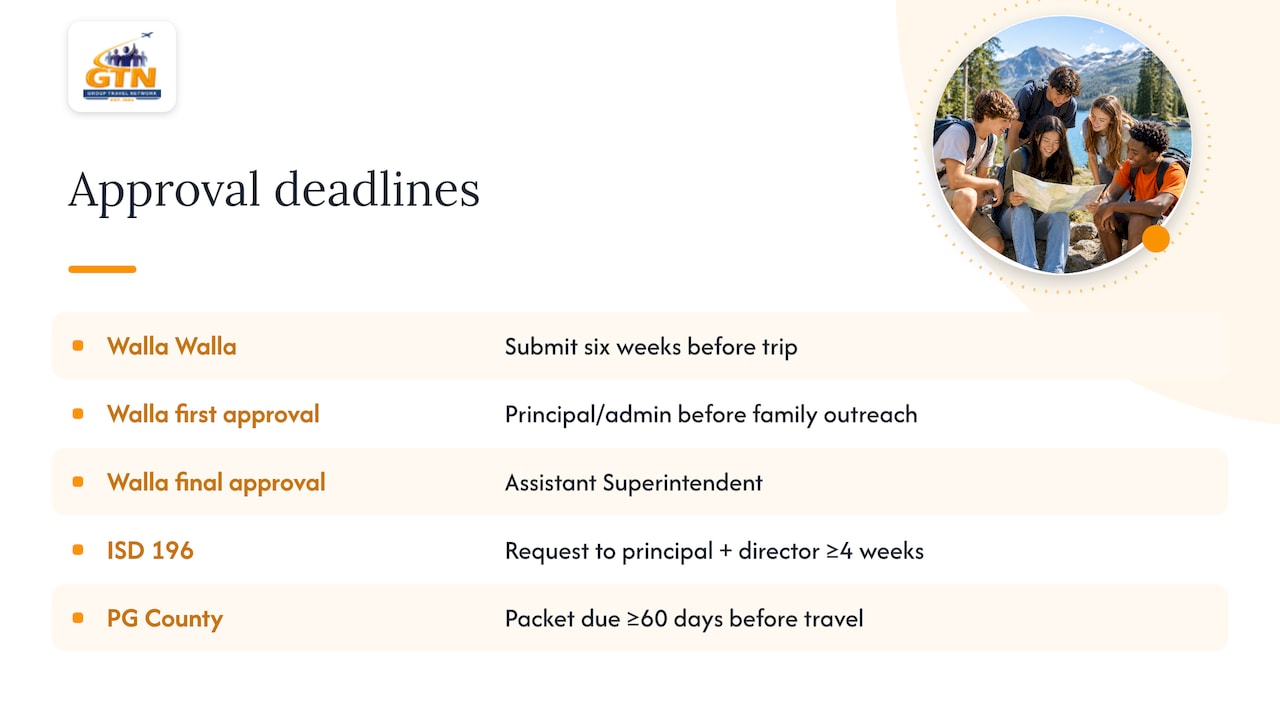
So your lead time could be four weeks or two months, depending on the district. If you write a policy from scratch, pick the longer end. Lodging, motor coach and group deposits are easier to secure with time, and a longer window gives the board room to ask questions.
What the request packet should contain
The Natomas Unified School District’s 2026-2027 overnight trip procedures (opens in a new tab) call for a complete itinerary, an estimated cost with its funding source, and clearly defined trip rules. That is a sound minimum. Add these to your own list:
- The educational or program purpose and how it ties to curriculum or performance goals.
- Dates, destinations, and the name and address of every lodging property.
- Transportation mode and the carrier or driver arrangements.
- Chaperone names, roles and screening status.
- A per-student cost, with what happens to the cost if a student withdraws.
- The emergency plan and the name of the person who holds authority on the trip.
For a wider view of organizing the whole process, our field trip organization guide for administrators (opens in a new tab) walks through the planning calendar.
Chaperone ratios and who qualifies
Put the ratio in the policy as a number, not as “adequate supervision.” Real policies are specific:
| Policy | Ratio or staffing rule |
|---|---|
| Provo City School District (opens in a new tab) | At least 1 chaperone per 10 students |
| Prince George’s County Public Schools (opens in a new tab) | 1 chaperone per 5 students |
| Fruitvale ISD (opens in a new tab) | At least two adults, including a school staff member, and no more than ten students per adult |
| Diocese of Manchester (opens in a new tab) | 1:5 for grade 5 and below, 1:8 for grades 6 to 8, 1:10 for grades 9 to 12, never fewer than two chaperones |
The diocesan model is useful because younger students need closer supervision than seniors. A single flat ratio ends up too loose for middle schoolers or needlessly heavy for a senior class. Writing ratios by grade band, with a two-adult minimum, is the cleaner design. Our chaperone-to-student ratio guide (opens in a new tab) goes deeper on choosing numbers for different group types.
Screening and qualifications
Provo requires screened chaperones aged at least 21, fingerprint or background checks, both male and female chaperones when both sexes participate, and prior principal approval for any other supervisors (Provo policy 4006 (opens in a new tab)). The District of Columbia Public Schools travel policy (opens in a new tab) requires continuous adult supervision, and the trip sponsor keeps primary responsibility for student safety.
Two drafting tips follow from this. First, state that checks are completed before the trip is announced, not the week of departure. Our guide to running chaperone checks weeks before trips (opens in a new tab) covers the timing and the federal Fair Credit Reporting Act steps that apply when a third party runs the report. Second, define the chaperone’s job in writing so volunteers know what is expected. We cover that in the role of travel chaperones (opens in a new tab).
Transportation rules
Transportation is where policies are most often too vague. Good ones set a preferred order and a hard limit.
- Preferred modes. St. Vrain Valley Schools prefers district buses, district vehicles, approved charter buses, rental cars driven by staff, and then private vehicles (Procedure 619 (opens in a new tab)).
- No private cars. Walla Walla requires approved district transportation and prohibits personal or private transportation for school-sponsored trips (Walla Walla field trips (opens in a new tab)).
- Driver limits. Natomas bars drivers after 16 consecutive hours on duty and requires legal authorization and driver certification for private automobiles (Natomas procedures (opens in a new tab)).
A policy that also covers fatigue, seat belts, traffic-law compliance and a way to reach the school from the road protects students and staff alike. If your trip includes an overnight coach ride, check whether your district requires extra approval for travel between midnight and early morning. Some do, so ask your transportation office before you book.
Lodging, room assignments and bed checks
This is the section families read most closely, so make it concrete. St. Vrain requires dormitories or approved hotels and motels, prohibits Airbnb and VRBO, requires a bed for every student, bars non-related adults from student rooms, requires students and licensed chaperones to stay in the same facility, and has the trip sponsor conduct nightly bed checks (Procedure 619 (opens in a new tab)).
DCPS requires paired nightly room checks, and Sunnyside requires nightly and morning bed checks and no room switching (DCPS (opens in a new tab), Sunnyside (opens in a new tab)). Fruitvale adds rules against room visits between students of different genders, and applies curfew and district conduct rules (Fruitvale protocols (opens in a new tab)).
A workable lodging section includes:
- Approved property types, and a statement that short-term rentals are not allowed.
- Room occupancy limits and a bed for each student.
- Chaperone rooms on the same floor, close to student rooms, with chaperones not sleeping in student rooms.
- A set curfew and lights-out time.
- Nightly and morning checks, done in pairs.
- A no-room-switching rule and a no-visitors rule.
For property-level detail, see our guides on hotel security for student groups (opens in a new tab) and student travel accommodation standards (opens in a new tab).
Student conduct and headcounts
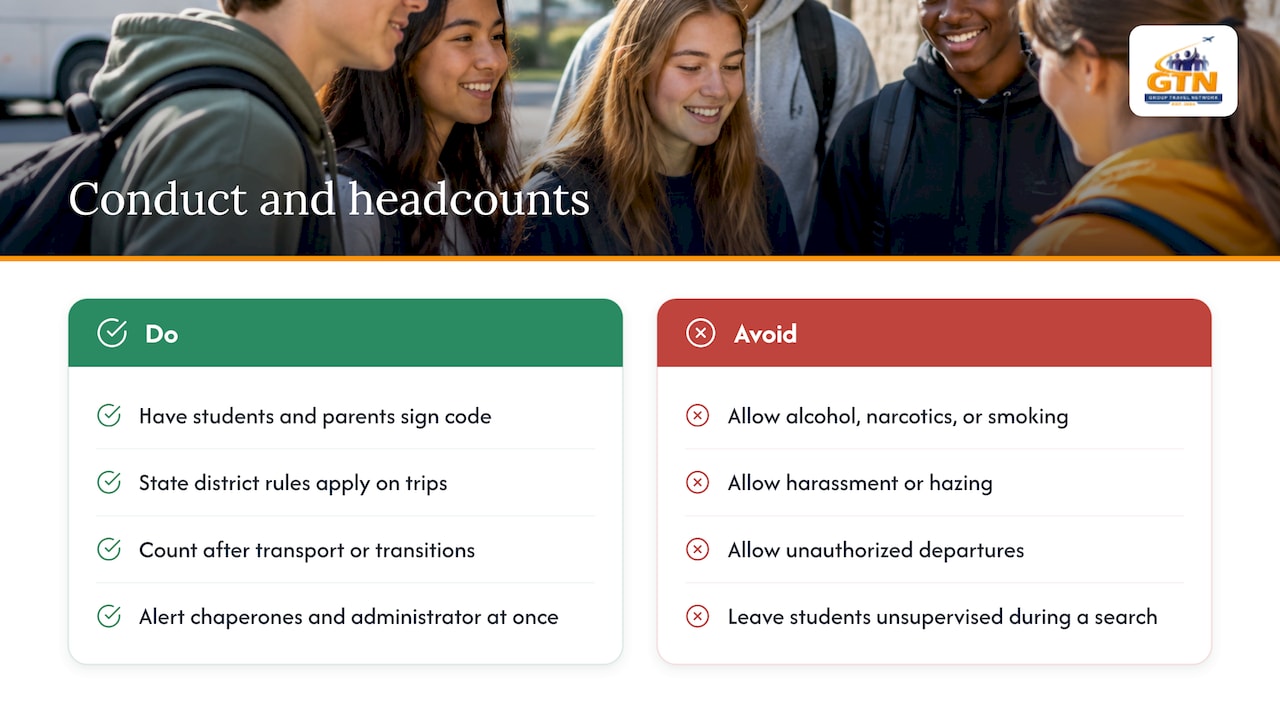
Conduct rules work best as a one-page code that students and parents sign. Fruitvale’s protocol lists rules against alcohol, narcotics, smoking, unauthorized departure, harassment and hazing (Fruitvale (opens in a new tab)). Say plainly that district conduct rules apply on the trip and that a student can be sent home at family expense if the rules are broken. Check that last consequence with your district counsel before you publish it.
Headcounts deserve their own paragraph. Sunnyside requires frequent counts, counts after transportation or transitions, immediate notification of all chaperones and the administrator when a student is missing, and a ban on leaving other students unsupervised during a search (Sunnyside student travel (opens in a new tab)). Loading and unloading buses, leaving a restaurant and leaving a venue are the moments when a student is most easily missed, so name them in the policy.
Emergency response and incident reporting
The Wisconsin Department of Public Instruction’s field trip health toolkit (opens in a new tab) recommends advance arrangements for emergency or urgent care, a defined authority for calling EMS, transport of emergency medications, and clear conditions for contacting parents. Turn that into a short emergency section:
- Who is in charge on the trip and who is next in line.
- Emergency contacts for every student, stored where chaperones can reach them offline.
- The nearest urgent care and hospital at each stop.
- Who carries first-aid supplies and emergency medication.
- When and how the school and parents are notified.
- A written incident report completed after any injury, illness or conduct event.
We lay out a carry-along format in four emergency plan essentials (opens in a new tab) and a documentation routine in our incident reporting checklist (opens in a new tab).
Parent permission and health forms
Walla Walla requires a parent or guardian field-trip description with itinerary, and a signed permission-consent form that includes emergency information (Walla Walla (opens in a new tab)). For health, the Wisconsin toolkit points to forms that capture allergies, medications, conditions and accommodations, along with emergency-care authorization. It also notes that health history may be needed when parents cannot be reached, and that emergency medication and equipment must travel with the group (Wisconsin DPI (opens in a new tab)).
Medication needs its own step. Seattle Public Schools, for example, requires parent or guardian and licensed-provider signatures for medications given at school, including over-the-counter ones (Seattle Public Schools forms (opens in a new tab)). Ask your school nurse whether the same standard applies on the road, and name who holds and gives each medication. Our student medical forms checklist (opens in a new tab) gives a template you can adapt.
An overnight family packet usually holds:
- Trip description and itinerary.
- Signed permission and consent.
- Emergency contact and health information.
- Medication authorization, where needed.
- Signed student code of conduct.
- Payment schedule and refund terms.
Insurance and why district approval matters
Some districts require insurance for certain trips. Prince George’s County requires group accident or travel insurance for overnight trips beyond the Washington metropolitan area, covering all participants for the trip period (PGCPS AP 6153 (opens in a new tab)).
Approval also bears on coverage. The New York State Insurance Fund’s guide to managing student travel (opens in a new tab) says officially approved activities are generally covered, while unapproved activities may fall outside coverage. The takeaway for your policy: state that a trip is not school-sponsored until it has completed every approval step, and that itinerary changes go back through the approver. Ask your own insurer or risk manager what your coverage includes.
Perspective
Most overnight policies we see are not wrong, they are scattered. Approval sits in one document, ratios in another, and bed checks in a note the sponsor wrote three years ago. A trip coordinator then has to piece the rules together under deadline pressure.
Our approach at Group Travel Network is to build the policy into the trip plan itself. A dedicated trip coordinator turns your district’s rules into a day-by-day itinerary, with chaperone assignments, check times, headcount points and forms all in one place. Online registration collects consents and health information from families in one flow, and flexible payment plans spread the cost so more students can go. We also offer travel protection options, so the insurance question gets answered with the same care as the itinerary.
Your policy sets the standard. Our job is to make that standard easy to meet, from the first approval packet to the last headcount on the ride home.
Donovan
Plan your overnight trip with a coordinator
If your board has approved the policy and you are ready to build the trip, we can help with custom itineraries, vendor partnerships, a dedicated trip coordinator, online registration and flexible payment plans. See our youth travel programs (opens in a new tab) or our educational group trips (opens in a new tab), or start from the Group Travel Network home page (opens in a new tab).

Tell us your district’s requirements up front and we will plan around them.
A starter outline for your own policy
Use this order when you draft. It mirrors how a board member reads a trip request.
- Purpose and scope. What counts as an overnight trip and who the policy covers.
- Approval and timeline. Each approver, in order, with a lead time.
- Supervision. Ratios by grade band, a two-adult minimum, screening and gender mix.
- Transportation. Approved modes, driver limits and no private cars.
- Lodging. Approved properties, bed for each student, same-facility rule, checks.
- Conduct. Student code, curfew, consequences.
- Health and emergency. Forms, medication, emergency authority, reporting.
- Finance and insurance. Costs, funding source, refunds, coverage.
- Review. Who updates the policy and how often.
On that last item, review the policy every year and after any incident. Several of the policies cited here carry revision dates, which shows districts treat them as living documents.
FAQ
Who has to approve an overnight field trip?
Usually the principal first, then a district-level administrator. Walla Walla, for example, requires principal approval and then Assistant Superintendent approval. Your own board policy names the exact chain, so confirm it with your district office.
How many chaperones do I need for an overnight trip?
It depends on your district and the students’ ages. The policies cited above range from 1:5 to 1:10, and the Diocese of Manchester sets tighter ratios for younger grades. Whatever the number, plan for at least two adults and, when both sexes travel, chaperones of both.
Can students stay in a short-term rental?
Some districts say no. St. Vrain prohibits Airbnb and VRBO and requires dormitories or approved hotels or motels. Writing that rule into your policy keeps lodging choices consistent and easier to supervise.
Do overnight trips require travel insurance?
It varies. Prince George’s County requires group accident or travel insurance for overnight trips beyond the Washington metropolitan area. Check your district’s rule and talk to your risk manager about what your existing coverage includes.
Sources
- Walla Walla Public Schools: Field Trips (opens in a new tab)
- Independent School District 196: Overnight Field Trip Request (opens in a new tab)
- Natomas Unified: 2026-2027 Overnight Field Trip Forms and Procedures (opens in a new tab)
- Provo City School District: Policy 4006 Procedure 2, Overnight Travel (opens in a new tab)
- DCPS: Field Trip and Student Travel Policy (opens in a new tab)
- Diocese of Manchester: Overnight Trips Policy (opens in a new tab)
- Fruitvale ISD: Overnight Activity Protocols (opens in a new tab)
- Sunnyside Unified School District: Student Travel (opens in a new tab)
- Wisconsin DPI: Meeting Student Health Needs While on Field Trips (opens in a new tab)
- St. Vrain Valley Schools: Procedure 619, Overnight Trip Request (opens in a new tab)
- Seattle Public Schools: Health Services Forms (opens in a new tab)
- Prince George’s County Public Schools: Administrative Procedure 6153 (opens in a new tab)
- New York State Insurance Fund: A Guide to Managing Student Travel (opens in a new tab)
Recommended
- School Trip Payment Policy: 2026 Templates And Timelines (opens in a new tab)
- School Trip Cancellation Policy: 2026 Guide For Administrators (opens in a new tab)
- Field Trip Organization Tips: A School Administrator’s Guide (opens in a new tab)
- Student Travel Accommodation Standards: 2026 Guide For Schools (opens in a new tab)