


There is no single national chaperone to student ratio for U.S. school trips. Districts, states and venues set their own, and a common pattern for day trips is roughly one adult for every 8 to 10 younger students, with a looser ratio for high schoolers. Overnight, international and high-activity trips call for more adults, and every trip needs at least two chaperones. This guide gives you real district numbers, the factors that push a ratio up, and a worked example for a 75-student group.
TL;DR
- No federal rule sets a ratio. Your district policy, state or local law, and trip venues set the minimum, so start there.
- One district’s published day-trip minimums are 1:8 for elementary, 1:10 for middle school and 1:18 for high school. Treat these as examples, not a standard.
- Plan for at least two chaperones on every trip, and raise the ratio for overnight, international, physically demanding or higher-risk activities and for students with disabilities.
- For 75 students, the adult count ranges from 5 to 10 on a day trip depending on grade level, before you add any extras for overnight or international travel.
- Meet the minimum, then ask whether it still works when one adult has to leave the group for an emergency.
Table of Contents
- Is there a required ratio for school trips?
- What real district policies look like
- Ratio by grade level: a working starting point
- How many adults for 75 students?
- Five factors that should raise your ratio
- The emergency test: can one adult leave?
- Who counts toward the ratio?
- Supervision habits that make any ratio work
- A simple process for setting your ratio
- Perspective
- Let us build the supervision plan with you
- FAQ
- Sources
Is there a required ratio for school trips?
Not nationally. Risk-management guidance for schools notes that some state or local laws, and some trip venues, set minimum chaperone-to-student ratios (opens in a new tab). Where nothing is mandated, the same guidance says to weigh the risk and duration of the trip, the distance traveled and the participants’ ages.
That means the number you use comes from three layers, in this order:
- Your board or district policy. Legal guidance for schools says district board policies should address chaperone-to-student ratios, trip authorization and overnight-trip guidelines (opens in a new tab). Read yours first. If you are a private school, a band program or a nonprofit, check your own handbook and insurer’s requirements.
- The venue or activity provider. Museums, ranches, theme parks, boat operators and festival hosts often publish their own limits. The stricter number wins.
- Your own risk assessment. This is where you decide whether the minimum is enough for your particular group.
What real district policies look like
Policies differ a lot, which is why searching for “the” ratio gives so many answers. One large Virginia district, Fairfax County Public Schools, sets minimum day-trip ratios of one chaperone per eight elementary students, per ten middle school students and per eighteen high school students (opens in a new tab). The same policy requires a minimum of two chaperones per bus.
Other districts go in a different direction on who may chaperone at all:
- DC Public Schools says volunteers are not permitted to serve as chaperones on overnight or international field trips (opens in a new tab).
- Albuquerque Public Schools requires all chaperones to be at least 21 years old (opens in a new tab).
- Fairfax requires volunteers to complete its background-check process, and non-district chaperones must be fingerprinted before an overnight trip (same FCPS policy (opens in a new tab)).
The lesson for a trip coordinator: a ratio is only half of the rule. Who counts as a chaperone, how they are screened and what they may supervise are set by the same policy.
Ratio by grade level: a working starting point
Use the table below as a planning frame built on the Fairfax day-trip minimums, not as a legal standard. Your own policy overrides it.
| Grade level | Example day-trip minimum | Adults for 30 students | Adults for 75 students |
|---|---|---|---|
| Elementary | 1:8 | 4 | 10 |
| Middle school | 1:10 | 3 | 8 |
| High school | 1:18 | 2 | 5 |
The adult counts are our arithmetic from those ratios, rounded up, because you cannot bring a fraction of a chaperone. Whatever the math gives, the two-chaperone floor still applies. Two is also the practical minimum for a single small group, since one adult can then deal with a problem while the other stays with the students.
How many adults for 75 students?
This is one of the most common questions readers ask, and the answer depends on grade level and trip type.
On a day trip using the example minimums above:
- Elementary: 75 ÷ 8 = 9.4, so 10 adults.
- Middle school: 75 ÷ 10 = 7.5, so 8 adults.
- High school: 75 ÷ 18 = 4.2, so 5 adults.
Notice that these counts usually include the teachers. Check whether your policy counts teachers toward the ratio or requires chaperones on top of staff.
For overnight or international travel, expect a tighter number. One New York City school’s published chart, for example, lists 8 adults for 75 students on international trips (opens in a new tab), plus faculty, against 4 adults for a local day trip. That is a single school’s rule, not a national figure, but it shows the typical direction: roughly double the adults when the group leaves the country.
With 75 students, you will also likely be splitting into smaller groups. Plan each subgroup of 8 to 10 students with a named adult, a buddy system and a check-in point. A single group of 75 moving as a block is harder to count and slower to move than several small ones.
Five factors that should raise your ratio
Risk-management guidance says ratios should account for age and may need to be higher for overnight trips, international travel, physically challenging or inherently risky activities, and students with disabilities (opens in a new tab). Here is how that plays out for a coordinator.
1. Overnight stays
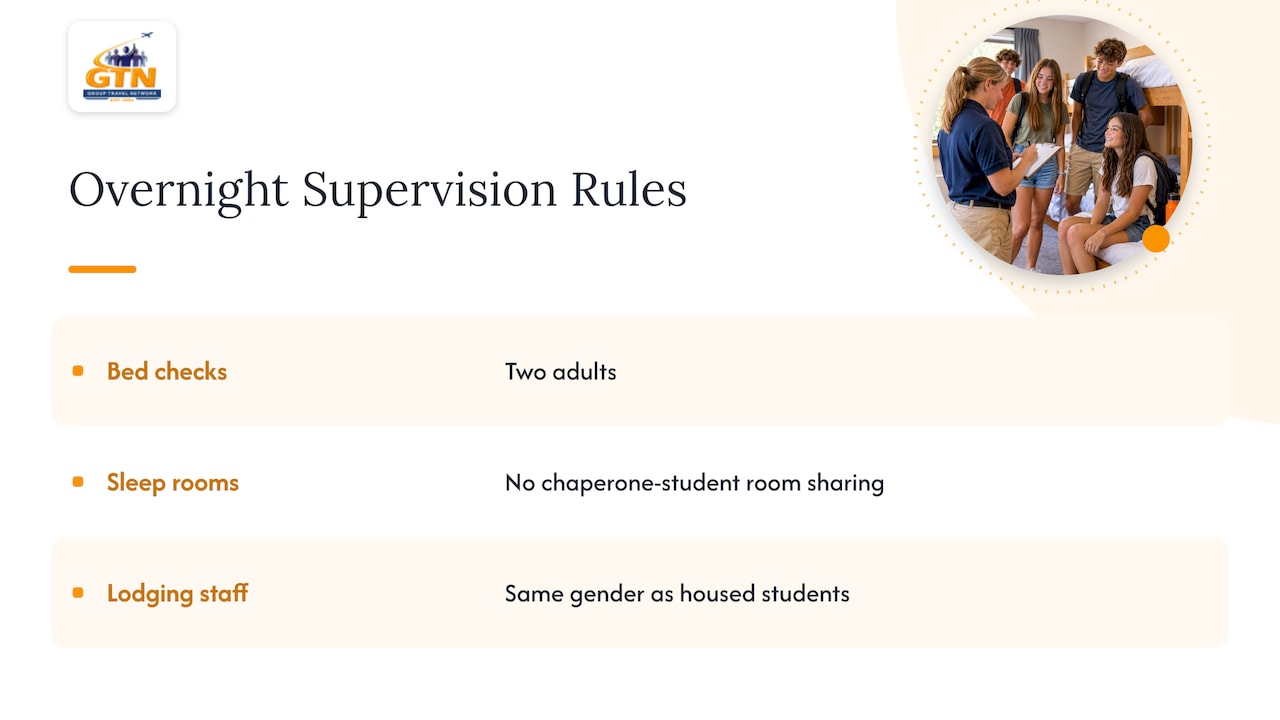
Adults are on duty for far more hours, and someone has to do room checks while someone else stays available. Best-practice guidance for overnight excursions calls for two adults to perform bed checks and bars chaperones from sleeping in the same room as students (opens in a new tab). Maryland’s Prince George’s County policy also requires that the sponsoring teacher and chaperones supervising lodging be the same gender as the students housed in the same room (opens in a new tab). So a mixed group needs enough adults of each gender, not just enough adults. Our guide to hotel security for students (opens in a new tab) covers room checks and chaperones per floor in detail.
2. International travel
Language barriers, unfamiliar transit, passports and different emergency systems all add load. The same guidance puts international trips among those that may need a higher ratio. Our page on international student travel programs (opens in a new tab) explains how we plan these groups.
3. Demanding or risky activities
Water, climbing, ropes courses, ski slopes and crowded city streets each need closer supervision than a museum visit. Many venues set their own caps for these, so confirm with the provider before you finalize headcounts.
4. Students with disabilities or medical needs
Some students need a dedicated adult, not a share of one. Count that adult separately from the general ratio and brief them on the student’s plan, medication and emergency contacts before departure. Collecting these details in one place helps: a good youth registration form captures medical, contact and consent information up front so nothing is chased on the bus.
5. Long distance and long duration
The further from home, the longer help takes to arrive. Risk managers suggest that for complex, high-risk or long-distance travel, schools should aim to exceed rather than just meet the minimum ratio (opens in a new tab).
The emergency test: can one adult leave?
A ratio that works on paper can fail the moment something goes wrong. A school policy from the UK’s Brentwood School puts the principle well: where possible, the ratio should allow a different supervisor to handle an emergency while another supervises the rest of the group (opens in a new tab). It is a British school’s policy, but the logic travels.
Run the test on your plan:
- One student gets sick or hurt and an adult goes with them to urgent care. Who stays with that student’s subgroup?
- One adult must make a call to a parent or the school. Is anyone left with fewer than two adults overall?
- A bus breaks down. Can each vehicle’s adults manage their students alone?
If any answer is no, add an adult. A “floater” with no assigned subgroup is often the cheapest fix. Our emergency plan essentials (opens in a new tab) list what to carry for this situation.
Who counts toward the ratio?
Not every adult on the trip counts. Before you tally, confirm four things in your policy:
- Screening. Volunteers may need background checks, and some districts require fingerprinting for overnight trips. Start early; our piece on running chaperone checks weeks before trips (opens in a new tab) explains the timeline and the FCRA considerations.
- Age. Some districts set a minimum, such as 21.
- Parents of students on the trip. Brentwood’s policy says a parent supervising their own child will not usually count in the group ratio unless the conflict risk can be managed. A parent focused on their own child is not fully available to the group.
- Volunteer eligibility by trip type. Some districts bar volunteers from overnight or international travel entirely, as DC does.
For what chaperones actually do once on the road, see the role of travel chaperones (opens in a new tab).
Supervision habits that make any ratio work
The number of adults matters less if they are not positioned well. Professional guidance for overnight excursions recommends that chaperones supervise students, limit downtime, schedule staff to cover free time and take head counts throughout the day (opens in a new tab).
In practice:
- Give every chaperone a written roster of their students with parent contact numbers and medical notes.
- Count at every transition: boarding, unloading, entering and leaving a venue, and before every meal.
- Use buddy pairs inside each subgroup so a missing student is noticed within minutes.
- Set a meeting point and a backup point at every stop, and make sure each student carries the trip lead’s phone number.
- Schedule free time deliberately, with boundaries, check-in times and adults assigned to zones.
- Never leave one adult alone with one student. Volunteer chaperone guidance commonly stresses this for the protection of both students and adults.
Coaches and band directors can find sport- and ensemble-specific advice in our team travel supervision guide (opens in a new tab).
A simple process for setting your ratio
- Read your district or organization policy and note the minimum ratio, who counts and the screening rules.
- Check the venue and transport rules for each stop.
- List the risk factors from the five above that apply to your trip.
- Start from the strictest minimum you found, then add adults for each factor.
- Run the emergency test and add a floater if needed.
- Assign named adults to named subgroups and share the rosters.
- Confirm screening and training for every chaperone well before departure.
- Write the plan down and keep a copy with the trip lead and the school office.
For a fuller planning timeline, our field trip organization tips for administrators (opens in a new tab) and guide to planning safe student group travel (opens in a new tab) walk through each stage.
Perspective
Most ratio problems we see do not come from groups that ignore the number. They come from groups that treat the minimum as the plan. A ratio tells you how many adults must be there. It does not tell you what happens when one of them has to leave the group.
When we build a trip, we start with the district’s number and then ask where the group will actually be stretched: the hotel at 11 p.m., the transfer through a busy airport, the free hour at a festival. That is where we place a dedicated trip coordinator and, if needed, extra adults. Our on-trip coordinators are there so teachers and band directors can supervise their students instead of solving logistics.
If you are planning a performance tour, an educational trip or an international adventure, we recommend building the chaperone plan before the itinerary is final, so the schedule fits the supervision you have and not the other way around.
Donovan
Let us build the supervision plan with you
If you are a school administrator, band director or team manager planning a trip, we handle the itinerary, vendor coordination, online registration, flexible payment plans and travel protection options, with a dedicated coordinator for your group. Explore our Stress-Free Student Travel (opens in a new tab) service, or see our Educational Endeavors (opens in a new tab) and International Adventures (opens in a new tab) trips.

Tell us your group size, grade level and destination, and we will help you plan an adult-to-student structure that fits your district’s policy.
FAQ
What is a good chaperone to student ratio?
It depends on age and trip type. One district’s published day-trip minimums are 1:8 for elementary, 1:10 for middle school and 1:18 for high school. Overnight, international and higher-risk trips usually call for more adults, and every trip should have at least two chaperones.
How many chaperones do I need for 75 students?
Using those example day-trip ratios, you would need 10 adults for elementary students, 8 for middle school and 5 for high school. Your own district policy may differ, and overnight or international travel typically requires more. Check whether teachers count toward the total.
Can parents be chaperones?
Often yes on day trips, subject to your district’s screening rules. Some districts do not allow volunteers on overnight or international trips at all. A parent supervising their own child may not count toward the ratio, so confirm how your policy handles it.
Does the ratio change for overnight trips?
Yes. Overnight trips need enough adults to run room checks with two adults and to cover each gender among the students housed. Best practice also bars chaperones from sharing a room with students.
Sources
- Determine Chaperone-to-Student Ratios for School Trips (opens in a new tab)
- Fairfax County Public Schools, 414-01 Field Trips (opens in a new tab)
- Frequently Asked Legal Questions about School-Sponsored Field Trips (opens in a new tab)
- DC Public Schools Field Trip and Student Travel Policy (opens in a new tab)
- Albuquerque Public Schools Field Activity Trips (opens in a new tab)
- MSI Overnight Stays and Excursions Best Practices (opens in a new tab)
- PGCPS Administrative Procedure 6153 (opens in a new tab)
- Brentwood School Trips and Visits Policy (opens in a new tab)
- Trip Chaperone Ratio chart (opens in a new tab)
Recommended
- The Role Of Travel Chaperones: 2026 Guide For Schools (opens in a new tab)
- U.S. Schools: Run Chaperone Checks Weeks Before Trips And Meet FCRA (opens in a new tab)
- How To Organize School Tours: 2026 Planning Guide (opens in a new tab)
- Field Trip Organization Tips: A School Administrator’s Guide (opens in a new tab)