

Your school trip emergency plan must put four things in your hands before the bus leaves: a portable action plan that names local hazards, a written chain of command, medical readiness for every student, and redundant communications paired with a roster and reunification point. Build the plan as a companion to your district’s emergency operations plan, not a replacement for it. Everything below turns those four pieces into steps you can complete before departure.
TL;DR:
- Have the school nurse review each student’s current health information and medication authorization, and document staff training, medication access, and dose logging before departure.
- Name an alternate leader, assign chaperones specific student groups, and designate one parent liaison; record who may call 911, change activities, and notify the district.
- Assess each destination days before travel, checking routes, weather, venue procedures, nearby hospitals, response times, and whether student accessibility or medical needs can be met.
- Use printed and digital rosters, count students at each transition, and release them only to authorized adults at a named reunification point.
- Run a tabletop before major trips, then review incidents promptly and update the plan at least annually, assigning each identified fix to a named person.
Table of Contents
- Field-trip emergency checklist: what to include in the portable plan and go-bag
- Roles, responsibilities, and chain of command for the trip
- Medical preparations and handling student medications on trips
- Communication, rosters, and accountability: tracking, reunification, and notification
- Risk assessment and adapting plans for destination-specific hazards
- Exercises, drills, and after-action reporting to keep the plan current
- Quick-reference forms and templates to prepare and copy into your packet
- What I tell organizers about using the plan in the real world
- How we help you build and field-test an emergency-ready trip
- FAQ
- Sources
Field-trip emergency checklist: what to include in the portable plan and go-bag
The U.S. Department of Education’s school guide treats a field-trip plan as a functional annex (opens in a new tab) to the district-wide emergency plan, so start from your district’s version and trim it to what a chaperone can use in a parking lot. Keep it short enough to read in a crisis.
The portable plan should hold:
- Purpose, scope, and the specific destination hazards you identified
- Evacuation sites and a reunification site, with addresses
- Incident roles and the key phone numbers for each
- District emergency contacts and the nearest hospital’s location
The go-bag should hold:
- A first aid kit and a printed roster
- Student medical summaries and any medications, each with written authorization
- Phone chargers and power banks, water, and laminated route maps
Ready.gov’s kit guidance (opens in a new tab) also recommends at least a gallon of water per person per day when you build a kit for extended situations. Add signed parent consent forms and insurance details to the packet. Our guide to minor travel consent form fields (opens in a new tab) covers what those forms should capture.
Pro Tip: Seal the go-bag in a waterproof, labeled container and keep it with the trip leader, never in the luggage bay.
Roles, responsibilities, and chain of command for the trip
Incident decisions should route to the right school and district contacts instead of being improvised on site, which is why federal planning guidance pushes for a defined chain of command that lasts for the whole trip. Write it down before departure and brief everyone who is coming.
Define these roles in your plan:
- Trip leader: holds final authority and is the single point of contact for the district
- Alternate leader: steps in immediately if the leader is injured, occupied, or off site
- Chaperones: each assigned a named group of students and responsible for headcounts
- Parent liaison: one person who sends all family updates so messages stay consistent
Record who may call 911, who may cancel or change an activity, and who notifies the district and parents. Put those decisions in the plan itself, then walk through them at the pre-trip safety briefing. Our field trip organization tips (opens in a new tab) go deeper on briefing staff, and our team travel coordination tips (opens in a new tab) cover on-trip coordination.
Medical preparations and handling student medications on trips
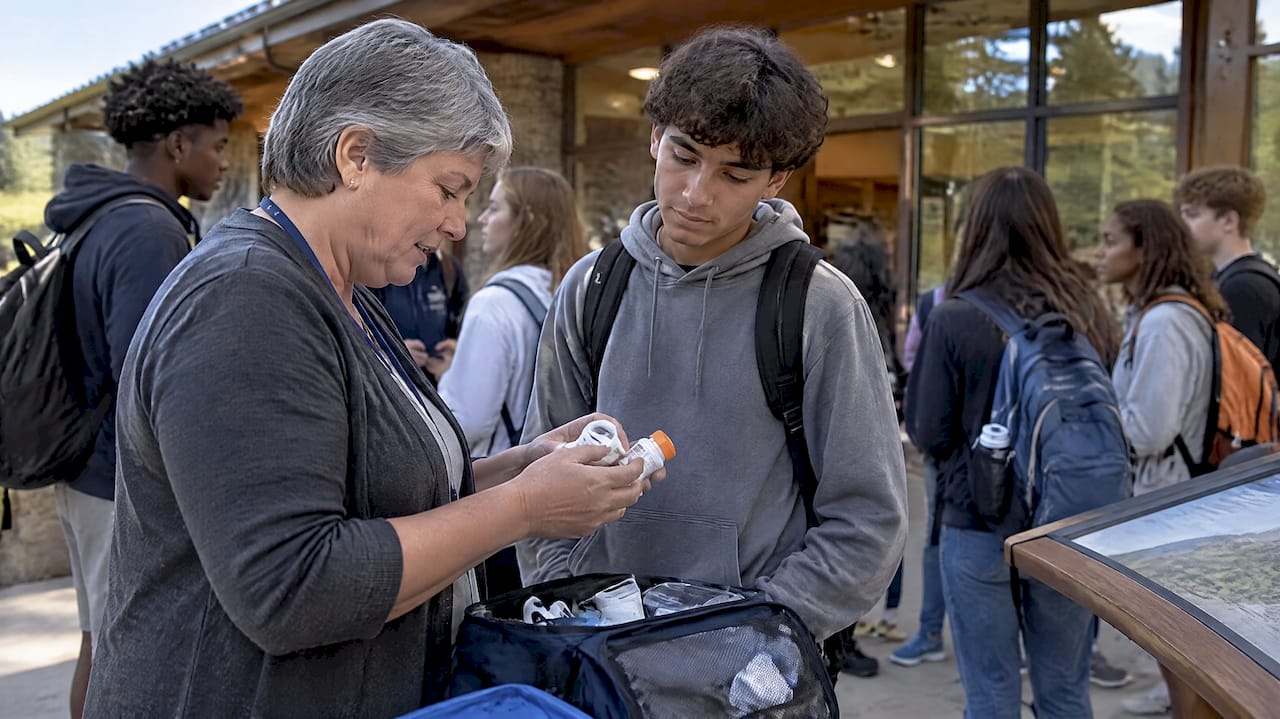
Medical readiness starts with paperwork and a conversation with your school nurse. Tennessee’s school-nurse guidance on field trip health services (opens in a new tab) says action plans for conditions like asthma, anaphylaxis, diabetes, and seizures should be clear step-by-step documents handed to the staff who need them, with the nurse involved in medication arrangements.
Work through these steps:
- Collect signed medication authorizations and current health information for every student
- Confirm allergies and review each emergency action plan or individualized health plan for trip conditions
- Ask the nurse to document any delegation and training for staff who may administer medication
- Make sure trained adults know where emergency medications such as epinephrine are kept and how to give them
- Keep medications locked but quickly reachable, and log every dose given and every return
Federal and state guidance on grant-funded off-site programs (opens in a new tab) points the same direction: a stocked first aid kit and staff trained to give emergency medications where appropriate. Our student medical forms checklist lists the fields to collect.
Pro Tip: Have the nurse initial the medication log before departure so the count of doses leaving school is on record.
Communication, rosters, and accountability: tracking, reunification, and notification
Accountability is what turns a chaotic moment into a manageable one. Follow these steps:
- Build a master roster with student names, emergency contacts, and critical medical flags, and handle that information under your district’s privacy policy, including FERPA rules.
- Print the roster and carry a digital copy, then take a headcount at every transition: boarding, arriving, leaving a venue, and returning.
- Plan redundant communications: charged cell phones, power banks, a second device or radio where available, and scheduled check-ins with the district contact.
- Pick a reunification point at each stop and assign staff to hand students to authorized adults only.
- Write the reunification steps into the plan so no one improvises who may take a child.
Sample youth-program templates, like this emergency plan for youth programs (opens in a new tab), include a missing-child response, which is worth adapting for your own lost-student procedure.
Risk assessment and adapting plans for destination-specific hazards
A portable plan fails when it is treated as static. Practitioners in outdoor leadership recommend reviewing it days before departure (opens in a new tab) so it reflects the real destination. Field trip guidance also lists the elements to assess: location, activities, transportation, and student abilities.
Cover these points in your assessment:
- The transport route, including bus procedures if a vehicle breaks down or is in a crash
- The nearest hospitals and urgent care sites, and how long emergency responders typically take to reach the venue
- Weather and terrain, and what changes if conditions turn
- The venue’s own emergency procedures, confirmed directly with a manager
- Which medical or accessibility needs cannot be met, who decides whether to modify or cancel, and by when
If you work with local security providers, such as school security services (opens in a new tab), ask how they coordinate with venue staff. Our risk assessment template walks through before, during, and after, and our safe travel planning steps cover pre-trip review.
Exercises, drills, and after-action reporting to keep the plan current
A plan nobody has practiced is a draft. The Department of Education’s emergency exercises package recommends tabletop and other exercises, with after-action reports as the way to find gaps and update the plan.
- Run a short tabletop before departure: read a scenario aloud, such as a missing student or a medical emergency on the bus, and have each role-holder say what they would do.
- Walk through the reunification steps and the communication tree with every chaperone.
- After the trip, or after any incident, hold a quick “hot wash” while memories are fresh.
- Write a brief after-action report that summarizes what happened, names the gaps, and assigns each fix to a person.
- Exercise before major trips, and review the plan after every incident or at least once a year.
Quick-reference forms and templates to prepare and copy into your packet
Printed forms save time when phones fail. The Department of Education also publishes a library of school emergency plan guides with recommended structures and checklists you can borrow from.
Assemble these items:
- A concise field-trip supplement: quick procedures, evacuation and reunification sites, and essential contacts
- A go-bag checklist taped inside the bag, so the contents are checked at every departure
- Durable storage: a waterproof bag, clearly labeled and reachable
- An adapted version of your district’s appendix-style forms: a lean set for day trips, and an expanded set with lodging, overnight medication schedules, and multi-day contacts for overnight travel
Ready.gov’s kids emergency checklist is a handy starting point for supplies such as a flashlight, whistle, and local maps.
What I tell organizers about using the plan in the real world
Carry both a printed and a digital copy, and leave a master copy with your district contact. Name one person to handle all parent communication so families hear one consistent story. And bring in the school nurse well before an overnight trip, because medication and care plans take longer to sort out than anyone expects. A plan only protects students when the people carrying it have read it.
— Donovan
How we help you build and field-test an emergency-ready trip
We take the paperwork and logistics load off organizers so you can focus on supervision. When you plan with us, you get:
- A dedicated trip coordinator who supports pre-trip documentation and handles on-trip logistics
- Online registration and travel protection options
Our school group travel planning guide shows how that process works step by step. Ready to talk through your next trip? Reach out through our Youth Travel page to discuss your trip.

This article is general information, not a substitute for advice from a qualified doctor. Consult a qualified healthcare professional about your own circumstances before acting on anything here.
FAQ
What is a school emergency preparedness plan?
It is a written set of procedures a school uses to prevent, respond to, and recover from emergencies. The Department of Education recommends a six-step planning process that runs from forming a planning team through plan review and maintenance.
What are 10 items in an emergency kit for school?
A solid school trip kit includes a first aid kit, emergency contact list, student medical information, district emergency numbers, extra medication, phone chargers, water, a flashlight, a whistle, and local maps. Ready.gov’s kit checklist lists these types of supplies.
What are the requirements of an emergency plan?
Requirements vary by district and state, so confirm yours with the district office. In general, a strong plan names roles and a chain of command, sets communication and accountability procedures, covers medical needs, identifies hazards, and is practiced and updated after exercises.
How should staff be trained for trip emergencies?
Train staff on the plan’s roles, on emergency contact procedures, and on common chronic conditions such as asthma and anaphylaxis. Nurse-led guidance recommends that staff receive clear action-step documents and nurse review of medications before a trip.
Sources
- Ed (opens in a new tab)
- Ready (opens in a new tab)
- Providing Health Services on Field Trips (opens in a new tab)