

September 16, 2026
Directors: Universal Performance Trip Timeline, Budget, and Vetting
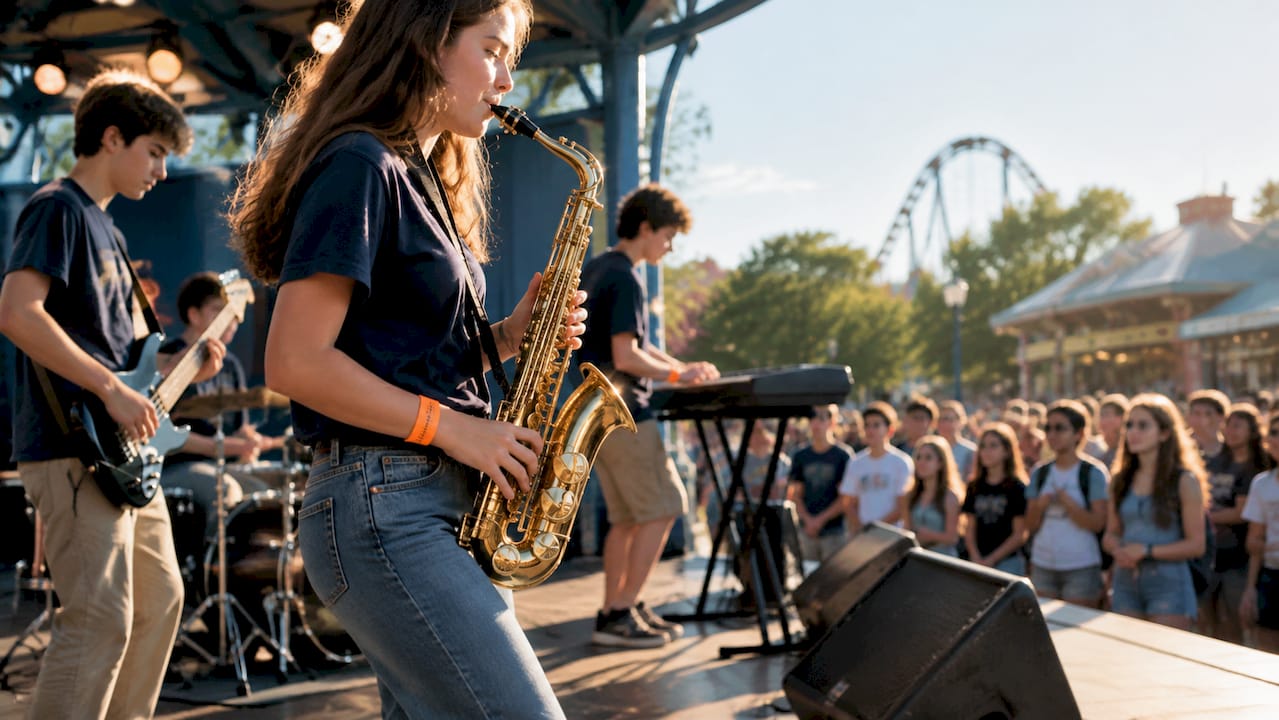
Yes, school and youth performing ensembles can perform at Universal Orlando and Universal Studios Hollywood through programs such as Universal STARS and park stage or parade opportunities. A full universal performance trip package typically bundles rehearsal time, workshops, group tickets, a Trip Director, and payment coordination. Start by locking your travel dates and requesting a quote from a group travel planner well in advance, ideally about a year ahead.
TL;DR:
- Lock in your travel dates and apply to the appropriate program at least a year in advance to secure performance slots and favorable rates.
- Most performance slots are 15 to 30 minutes on a dedicated stage, requiring advanced application and suitable repertoire that appeals to park audiences.
- A full trip package includes transport, hotel, meals, performance logistics, support staff, and insurance, with costs influenced by group size and booking timing.
- Workshops like dance, sound design, or staging are typically scheduled before or after performances and should match your group’s current focus to be most effective.
- Prioritize booking hotel and park tickets six to twelve months early, as this stabilizes costs and availability, while operational details like permissions and documentation must be finalized before departure.
Table of Contents
- Where Groups Can Perform: STARS, Stage, Parade, and Festival Options
- What Workshops and Learning Experiences Come With the Trip
- What’s Included in a Full Performance Trip Package
- Sample Itineraries and a 12-Week to 0-Week Planning Timeline
- Budgeting: What Drives Cost and How to Plan Payments
- Permissions, Risk Management, and Required Documentation
- Why a Specialist Planner Makes This Easier
- How to Evaluate the Trip After You Get Home
- Local Logistics and Accommodations Worth Knowing
- What Directors Get Wrong About Planning These Trips
- Ready to Plan Your Universal Performance Trip?
- Sources
- FAQ
Where Groups Can Perform: STARS, Stage, Parade, and Festival Options
A performance travel package built around Universal centers on a handful of proven formats, and matching your ensemble to the right one matters more than most directors realize before their first trip.
The Universal STARS program is the primary channel for stage-based student performances. It differs from parade or marching slots in a fundamental way: STARS performances happen on a dedicated stage with sound reinforcement, a set time slot, and an audience that’s gathered specifically to watch scheduled acts. Parade and marching opportunities, by contrast, move through the park along a route, favor visual spectacle over intricate musical passages, and demand different formation discipline from students. A marching band that’s rehearsed a static field show will need to adapt significantly for a moving parade route, while a show choir or jazz ensemble is a more natural fit for a stage slot.
Ensemble types commonly accepted include marching bands, concert bands, jazz bands, choirs, show choirs, dance companies, and color guard or winter guard units. Orchestras appear less frequently due to amplification and space constraints, though smaller string ensembles sometimes perform in festival settings.
A few staging factors decide whether your group is a good match:
- Venue size and stage footprint — a 60-person marching band needs a different stage than an 18-voice chamber choir.
- Amplification needs — vocal groups and small combos usually work fine with house sound; large brass and percussion sections need advance coordination on levels.
- Repertoire suitability — park audiences skew toward upbeat, accessible programming rather than lengthy concert works.
- Time slot length — most STARS sets run 15 to 30 minutes, so programming needs trimming from a full concert set.
Acceptance generally works through an application process rather than a live audition, though some festival slots ask for a recorded submission first. Lead times matter here: submit applications and repertoire lists several months ahead of your target performance date, since popular season windows fill early. The USA Fest performance program resources outline submission requirements and technical rider expectations that most directors overlook until the week of the trip.
Pro Tip: If your ensemble type doesn’t map cleanly to a stage slot (like a competitive dance team), ask about festival adjudication options instead of a straight performance slot. Judged formats often have different acceptance criteria and can be easier to secure on a shorter timeline.
What Workshops and Learning Experiences Come With the Trip
The educational layer of a Universal performance trip is where the experience earns its place in a curriculum, not just a field trip budget line.
Most performance travel package options include workshop add-ons that go beyond sightseeing. Common offerings include:
- Sound design and Foley workshops, where students learn how film audio effects are built and layered in real time.
- Dance masterclasses led by working choreographers, often tied to a specific park show’s choreography style.
- Production-skill clinics covering lighting, stage management, or camera blocking.
- Vocal or instrumental technique sessions run by touring or resident performers.
These sessions map directly onto arts education standards that most schools already track: performance technique, historical and cultural context, and production literacy. A director building a rubric for the trip can tie a Foley workshop to a unit on media literacy, or a dance masterclass to a technique assessment students complete back in the classroom. That connection is what turns “we went to Universal” into a line item an administrator will approve again next year.
Scheduling patterns tend to follow a consistent rhythm: workshops run 60 to 90 minutes and are usually placed either the morning before a performance slot or the day after, giving students a warm-up or a debrief window rather than competing directly with performance nerves. Booking a workshop on the same day as the performance, timed a few hours before, tends to produce the strongest results. Students carry the technical focus from the workshop directly into their set, and directors report sharper energy on stage as a result.
When choosing among workshop options, match the content to your program’s current unit of study rather than picking whatever sounds most exciting on a brochure. A choir preparing a jazz set benefits more from a vocal styling clinic than a general dance masterclass. A marching band mid-season benefits more from a production or staging clinic than a Foley session that has nothing to do with their current repertoire.
What’s Included in a Full Performance Trip Package
A complete Universal performance trip package covers far more than the performance slot itself. Directors piecing this together on their own often underestimate how many moving parts a full-service planner is quietly coordinating.
- Travel and transport. Group flights or charter coach transportation, plus ground transfers between the airport, hotel, and park gates, all scheduled around performance call times rather than generic arrival windows.
- Accommodation and meals. Block-booked hotel rooms near the park, finalized rooming lists matching chaperone ratios, and meal arrangements, whether meal vouchers, group dining reservations, or packed options for early call times.
- Performance logistics. Confirmed stage time, a sound check window, a technical rider covering microphone counts and monitor needs, a stage manager point of contact, and dedicated rehearsal time before the performance slot.
- On-trip support. A Trip Director who serves as the on-site coordinator between your group, the hotel, the park, and the performance staff, handling schedule changes in real time so the band director isn’t fielding logistics calls during a sound check.
- Registration and payment tools. An online sign-up and payment app that lets families register individually, track balances, and pay on a schedule rather than the director collecting checks by hand.
- Travel protection. Optional coverage addressing trip interruption, medical situations, or cancellation, which matters more for youth groups than most first-time planners expect.
Packaged travel experiences elsewhere in the performance and training space, such as the Paradise Performance program, follow this same bundling logic: discounted group hotel rates, included ground transfers, and on-site logistics support wrapped around the performance or training itself. That’s the standard against which any Universal performance package should be measured.
Sample Itineraries and a 12-Week to 0-Week Planning Timeline
Planning a universal adventure trip around a performance slot works best when you build backward from your performance date, not forward from “sometime next spring.”
Planning timeline milestones
- 12 months out: Confirm your target performance date, submit your STARS or festival application, and get budget approval from your administration.
- 9 months out: Finalize repertoire and confirm any music licensing needs for public performance (see the next section for specifics).
- 6 months out: Lock hotel room blocks and park ticket allotments. This is also when group hotel and ticket pricing tends to be most predictable before high-demand seasons push rates up.
- 4 months out: Open registration and payment collection to families through your registration platform; distribute permission slips and medical forms.
- 2 months out: Confirm your technical rider with park performance staff, finalize your rehearsal schedule, and complete your rooming list.
- 3 weeks out: Collect final payments, confirm chaperone assignments, and distribute the finalized itinerary to families.
- 0 weeks (trip week): Final documentation check, manifest confirmation, and departure.
3-day sample itinerary
- Day 1: Arrival, hotel check-in, evening park visit for orientation and a light rehearsal walk-through.
- Day 2: Morning workshop (dance masterclass or production clinic), afternoon sound check and stage rehearsal, evening performance slot.
- Day 3: Full park day, group dinner, departure preparation.
5-day sample Orlando itinerary
- Day 1: Arrival and hotel check-in, welcome dinner.
- Day 2: Morning workshop, afternoon at Islands of Adventure exploring themed areas that pair naturally with a performance-focused schedule.
- Day 3: Rehearsal and sound check in the morning, first performance slot in the afternoon.
- Day 4: Second workshop or masterclass, free park time, second performance opportunity if your program secured multiple slots.
- Day 5: Final park time, group evaluation session, departure.
This kind of layout mirrors real trip pages other school programs have published, including Chamblee High School’s Universal Studios trip itinerary, which shows how load-in, sound check, and park time actually get sequenced on the ground rather than on paper. Hotel blocks, park tickets, and stage confirmations should all be finalized by the six-month mark; treat anything pushed past four months out as a pricing and availability risk.
Budgeting: What Drives Cost and How to Plan Payments
Cost is the question every director asks first, and it’s also the one with the most moving parts. A universal performance trip has five primary cost drivers: transportation (flights or charter coach), lodging, park admission and performance participation fees, technical or production fees tied to your stage slot, and chaperone-related costs (rooms, meals, and sometimes discounted or comped admission).
Group rates typically shift per-student pricing more than any single line item. Volume discounts on hotel blocks and park tickets tend to kick in once a group crosses a certain headcount threshold, which is one reason securing hotel blocks and ticket allotments six to twelve months ahead protects your per-student number instead of leaving it exposed to seasonal price swings.
A reusable budget template for a trip like this breaks into four columns: fixed group costs (coach, Trip Director fees, technical fees), per-student costs (park tickets, hotel share, meals), optional add-ons (workshops, travel protection), and a contingency line, usually 5 to 10% of the total, for the schedule change or medical situation nobody plans for but every group eventually faces.
Suggested payment schedule cadence:
- Deposit at registration (secures the spot).
- Second payment at the 6-month mark (aligns with hotel and ticket lock-in).
- Third payment at 3 months out.
- Final balance due at 3 to 4 weeks before departure.
Groups that lock hotel and park allotments in the 6 to 12 month window ahead of departure tend to see more stable, predictable per-student pricing than those booking inside a 90-day window, based on how packaged performance travel programs structure their group rates.
Fundraising ideas that work well alongside a payment plan include performance-based fundraisers (a home concert with ticket sales), sponsor letters tied specifically to the trip’s educational value, and partial-match programs where a booster club matches a percentage of what families raise individually. When you communicate costs to parents, break the number down by category rather than presenting one lump figure. A per-student cost that’s itemized into transport, lodging, and performance fees reads as far more trustworthy than a single number with no explanation behind it.
An online sign-up and payment app removes a significant amount of friction here, letting families pay on their own schedule instead of routing every check through the director’s desk.
Permissions, Risk Management, and Required Documentation
Every high-performance travel option for a student group runs on paperwork long before it runs on rehearsal time. Skipping this step is the single most common way a well-planned trip runs into trouble at the gate.
Essential documents include signed permission slips for every student, current medical forms noting allergies and medications, an emergency contact list for each traveler, and a complete manifest listing students, chaperones, and room assignments that travels with the Trip Director at all times.
Travel protection is worth building into the budget rather than treating as optional. Trip interruption, medical incidents, and last-minute cancellations happen more often with youth groups than most first-time directors expect, and a protection plan covering those scenarios is cheaper than the alternative.
Chaperone ratio best practices generally run tighter for younger age groups. A common baseline is one chaperone per 10 to 12 students for high school groups, tightening further for middle school ensembles. ADA and special-needs planning should happen during the application stage, not the week of the trip, since park accommodation requests and rooming adjustments both need lead time.
Music licensing for public performance is a detail directors sometimes miss entirely. If your set includes copyrighted arrangements, check whether your performance venue’s licensing (often handled through ASCAP or BMI blanket agreements at the park level) covers your piece, or whether you need separate clearance. When in doubt, contact the program coordinator directly rather than assuming coverage.
- Signed permission slips and medical forms for every traveler
- Emergency contact list and full group manifest
- Travel protection confirmation
- Chaperone ratio documentation matching school or district policy
- Music licensing clearance for any copyrighted repertoire
Pro Tip: Build a single shared document with every student’s permission slip, medical form, and emergency contact in one place before you leave. A Trip Director can act fast in an actual emergency only if that information is already organized, not scattered across three different binders.
Why a Specialist Planner Makes This Easier
Group Travel Network provides dedicated trip coordinators, online registration and payment tools, flexible payment plans, and travel protection options built specifically around school and youth performance groups. That combination covers the parts of a trip most directors dread: negotiating group hotel rates, coordinating technical needs with park performance staff, and putting a Trip Director on the ground so problems get solved before they reach the students.
DIY planning can work for a smaller group with a flexible timeline and a director willing to make dozens of calls to hotels and park coordinators directly. For a larger ensemble, a tight performance-date deadline, or a first-time trip, a full-service planner removes the guesswork around sports and performance travel logistics that otherwise falls entirely on one already overworked director.
How to Evaluate the Trip After You Get Home
The performance slot isn’t the finish line. What a director does in the two weeks after the trip determines whether next year’s version is better or just a repeat.
Start with a structured debrief while memories are still fresh, ideally shortly after returning. Ask students what felt strong on stage, what felt rushed, and whether the workshop content actually showed up in their performance. Their answers are often more specific than any adult chaperone’s notes.
Collect feedback from chaperones separately, focused on logistics rather than artistic quality: Did the schedule leave enough buffer time? Did the rooming list work? Was the Trip Director responsive when something changed? These operational notes matter just as much as the artistic ones when you’re deciding what to change for the next trip.
If your program received any adjudication or written feedback from the performance venue itself, treat that as a primary document. Compare it against your own internal assessment to see where the two align and where they diverge. A gap between how the group felt on stage and how a judge or evaluator scored the performance usually points to something worth addressing in rehearsal, not on the trip.
Finally, log what worked logistically, not just artistically. Which workshop timing worked best relative to the performance slot? Which hotel location minimized transfer time? That operational memory is what separates a program that improves every year from one that starts from scratch each time.
Local Logistics and Accommodations Worth Knowing
Universal Orlando and Universal Studios Hollywood both sit inside sprawling entertainment districts, and where your group stays affects far more than convenience.
Proximity to the park gate matters most on performance days, when a delayed transfer can cost you your sound check window. Hotels within Universal’s on-site network typically offer early park access and shorter transfer times, though often at a premium over off-site options within a short distance.
For groups managing tight budgets, off-site hotel blocks negotiated through a group rate can bring meaningful per-student savings, provided the transfer logistics are planned tightly around your performance schedule rather than left loose. Always build in a buffer beyond the hotel’s stated transfer time. Traffic around Orlando’s tourist corridor during peak season adds unpredictable delays that a tight schedule can’t absorb.
Checking local event calendars, such as Orlando’s municipal events listings, before finalizing dates helps you spot conflicts. A major concurrent festival or convention in town can affect everything from traffic patterns to hotel availability at your preferred property.
Meal logistics deserve early attention too. Large ensembles moving through a park on a tight schedule need pre-arranged dining reservations or meal vouchers, not a plan to “figure it out when we’re hungry.” A Trip Director coordinating this in advance saves real time on performance days when every hour is already accounted for.

What Directors Get Wrong About Planning These Trips
The biggest misconception about a Universal performance trip is that the hard part is the performance itself. It isn’t. Most ensembles that get accepted into a program like STARS are more than capable of delivering a solid set. The hard part is everything surrounding it: the six-month hotel lock-in window, the technical rider nobody thought to ask about until sound check, the permission slip that’s missing one signature the morning of departure.
Conventional advice tends to front-load the excitement (repertoire selection, workshop choices) and treat logistics as an afterthought handled the month before departure. That ordering is backward. The programs that run smoothly are the ones where lodging, ticketing, and documentation get locked first, and the creative decisions get made inside that already-secured framework.
If there’s one thing to prioritize above everything else, it’s the 12 to 6 month window. That’s where pricing gets locked, performance slots get confirmed, and the entire trip either becomes predictable or becomes a series of last-minute scrambles. Everything after that, the rehearsal schedule, the workshop selection, the packing list, is easier to manage well once the foundation is set early.
— Donovan
Ready to Plan Your Universal Performance Trip?
You’ve seen what goes into a trip like this: program applications, technical riders, hotel blocks, payment schedules, and a mountain of permission forms. Performance Tours at Group Travel Network exists specifically to take that load off a director’s desk. Instead of coordinating flights, coach transfers, park tickets, technical requirements, and family payments yourself, a dedicated Trip Director handles it while you focus on rehearsal and repertoire.

Services for a trip like this may include dedicated trip coordinators, online registration and payment platforms with flexible payment plans, and travel protection options built for youth and school groups. Before you request a quote, have three things ready: your target travel dates, your group size, and your performance type (stage set, parade, or festival submission). With those three details, a planner can start building a realistic itinerary and budget around your program’s actual needs rather than a generic template. Reach out and provide your dates and group size to a coordinator well in advance of your preferred season.
Sources
- Islands of Adventure | Universal Orlando
- Universal Studios Trip (Chamblee On Stage)
- Paradise Performance 2026 – Sports Travel Hawaii
FAQ
How Much Does an Average Trip to Universal Cost?
Cost varies widely based on group size, season, and how far in advance you book, since transportation, lodging, park fees, and technical fees each shift the per-student number; Group Travel Network provides a custom quote once it has your dates, group size, and performance type.
Is 3 Days at Universal Too Much for a Performance Trip?
Three days works well for a single performance slot when balanced against one workshop and dedicated park time, though five days give more breathing room for two performance opportunities and a second workshop.
What Is the Slowest Day of the Week at Universal?
Midweek days, particularly Tuesday through Thursday outside of holiday periods, tend to see lighter crowds than weekends, which can make sound checks and rehearsal windows easier to schedule.
What Is a Universal Performance Trip?
A universal performance trip is a school or youth ensemble’s travel package built around a scheduled performance at Universal Orlando or Universal Studios Hollywood, typically through a program like Universal STARS, bundled with workshops, group tickets, and on-site logistical support.
Do You Need Special Permission to Perform at Universal?
Yes, ensembles need to apply through an official channel such as Universal STARS and secure a confirmed slot well before travel, since park stages aren’t open to unscheduled performances.
Recommended

Relax with our Student Travel Expertise .
We deliver stress-free student trips backed by an exceptional array of services you won’t find anywhere else:
- Stress-free, creative planning of customized itineraries
- Dedicated GTN Service host on every trip
- Extensive travel protection plan options
- Online, individual registration system
- Flexible payment plans and online payment options
- Bulk buyer discounts for great trips that cost less
Inclusion into #MyGTNFamily for life! (you don’t even have to remember our birthday!)
Spain
There is no place like Spain to offer a student performance opportunity or cultural student trip.
Myrtle Beach
All students love the beach! Especially a beach known for its 60 miles of pristine coastline.
Boston
Have your students experience colonial charm in the city that is considered the hub of New England.
London
Provide your student group with the “Royal” treatment! One of the world’s most recognized cities.
See What People Are Saying
“This was my first time using a company to plan our band trip. It was so easy working with Justin and Group Travel Network. We had to make several changes along the way, but they were accommodating changes and worked everything out for us. I would highly recommend using Group Travel Network.”
“It has been my privilege to use Group Travel Network as the exclusive travel coordinator for my band for over 10 years. I can say, without doubt or hesitation, that GTN is, by far, the best travel company for student groups currently in existence. I have often said that I wouldn’t take my band across the street without GTN and that’s not far from the truth!”
“What wonderful trip we had to NYC! Our group of 51 never missed a beat because of Group Travel Network and our wonderful guide, Tim. It was truly a theatre trip to remember! If you are looking for a travel company who really cares about the details, Group Travel Network is for you!”