

September 15, 2026
School Travel RFP: 5 Must Have Sections and a Vendor Scoring Matrix

Your school travel RFP has to require one thing above all else: a complete trip package with a named, dedicated trip coordinator, documented proof of insurance and staff background checks, and an itemized price breakdown with a clear payment schedule. Nothing else in this process matters if that foundation is missing. Once your requirements are set, attach a response matrix, give vendors a firm submission deadline, and score every proposal against it.
TL;DR:
- A school travel RFP must include a detailed trip itinerary, staffing plan, and safety documentation such as proof of insurance and background checks for staff.
- Hotels should have parity clauses and named backup properties, while transportation must include seat belts, current inspections, and ADA accessibility, to prevent corner-cutting.
- Score proposals using a weighted matrix that emphasizes qualifications, safety measures, and program quality, not just price, to ensure a reliable selection.
- Missing essential documents like insurance certificates, background-check policies, or sample itineraries should disqualify a vendor outright.
- Clear submission rules, including deadlines, required documents, and standardized response formats, prevent confusion and facilitate fair evaluation.
Table of Contents
- What Should a School Travel RFP Include?
- How Do You Score Vendor Proposals Fairly?
- What Documents and Deadlines Belong in the Submission Process?
- What Fields Belong in the Response Matrix?
- What Mistakes Sink a School Travel Procurement Process?
- Notes From Running a School Travel Vendor Search
- How Group Travel Network Fits Into Your RFP Process
- Sample RFPs and Procurement Templates Worth Reviewing
- Sources
- FAQ
What Should a School Travel RFP Include?
A school travel proposal is only as strong as the questions you force vendors to answer. Too many districts write a vague “please send pricing” email and call it a bid process, then discover mid-trip that nobody checked whether the driver had a background screening. A real RFP has five sections, and each one closes a specific loophole vendors love to leave open.
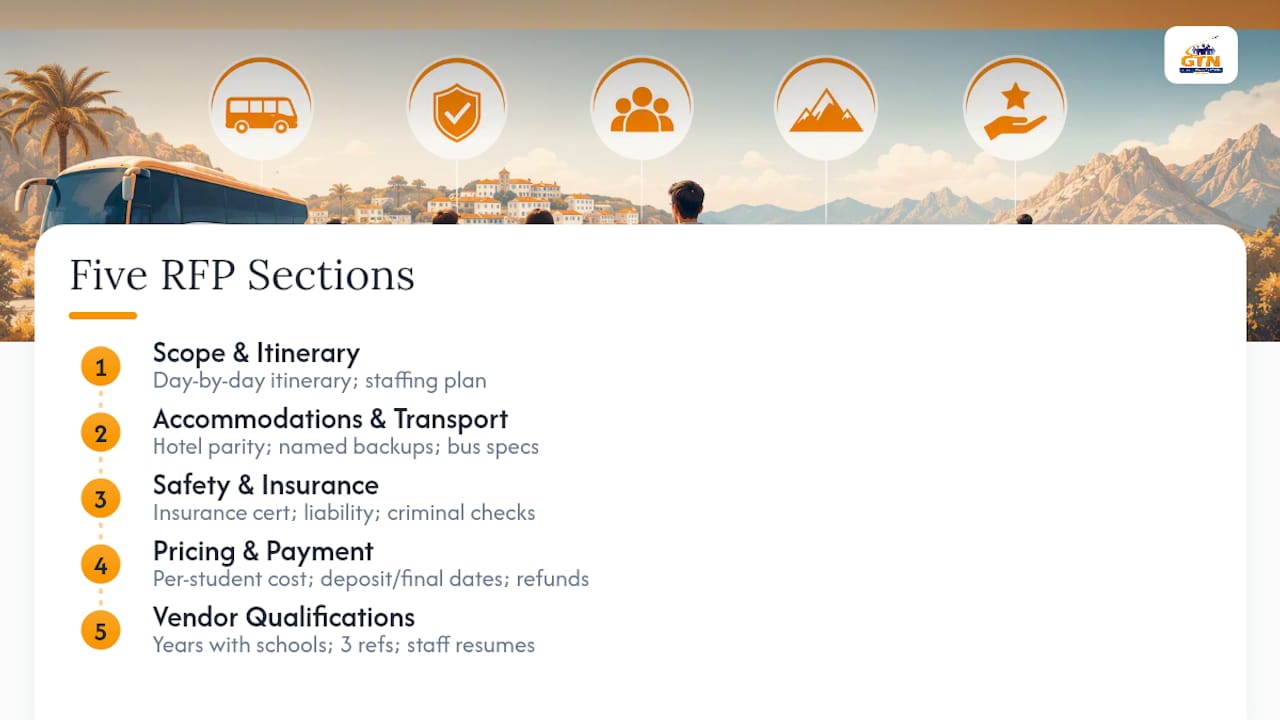
Scope of work and sample itinerary. Require a day-by-day itinerary tied to learning objectives, not just a list of attractions. Ask for the staffing plan: how many adult chaperones per student, and who is on call after hours.
Accommodations and transportation specifics. Hotel parity matters more than people realize. Districts have been burned by contracts that let a vendor swap the “similar” hotel for something two stars lower once the deposit clears, so demand hotel parity language and named backup properties in writing. On transport, require coach buses with seat belts, current inspection records, and ADA-accessible vehicles when a student needs one. School RFPs routinely spell out these exact conditions because hotel and transport clauses are where vendors quietly cut corners.
Safety, insurance, and staffing. This is non-negotiable territory. Require a certificate of insurance naming the district as additional insured, stated minimum liability and group medical coverage, criminal background checks on every driver and staff member who touches the trip, and a 24/7 emergency contact number that rings a real person.
Pricing and payment structure. Ask for cost broken down per student, deposit amount and due date, final payment date, and a written refund and cancellation policy. Flag optional add ons separately: gratuities, museum admissions, checked luggage fees.
Vendor qualifications. Request years of experience with school groups specifically, at least three references from comparable districts, resumes for the staff assigned to your account, and any relevant certifications or memberships, such as the Student & Youth Travel Association (SYTA). A sample contract should be attached, not promised later.
How Do You Score Vendor Proposals Fairly?
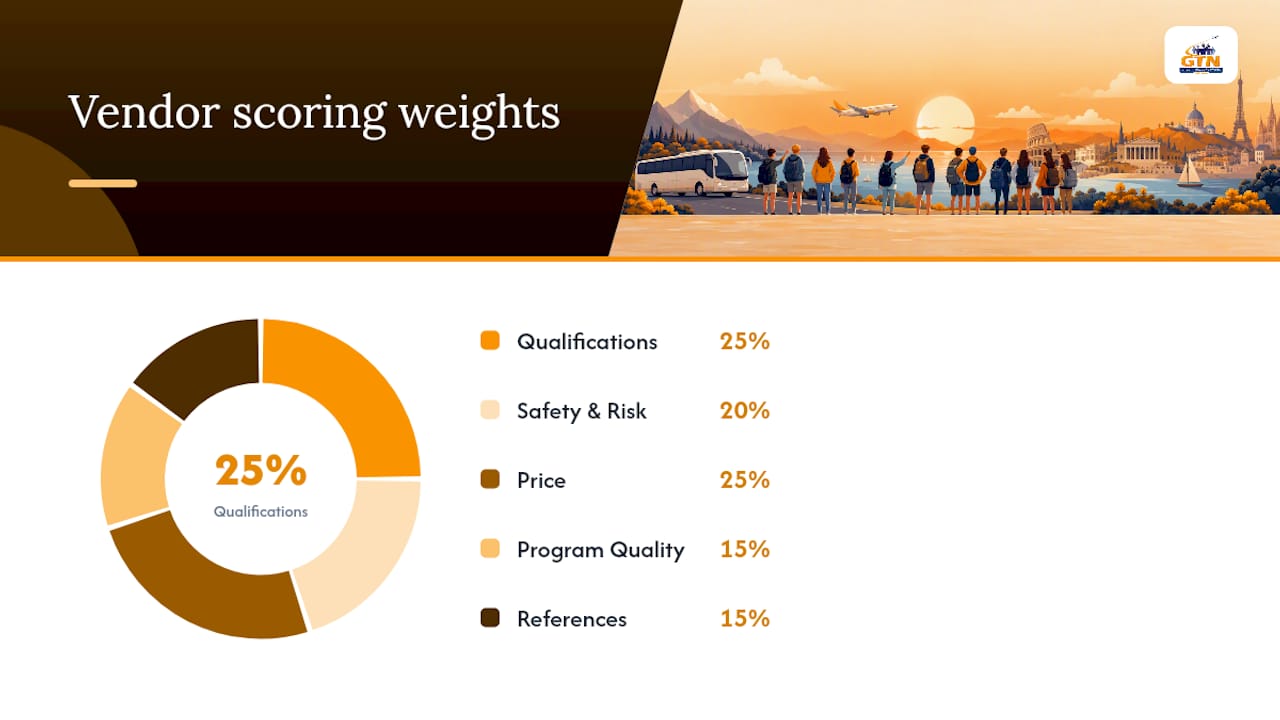
Price alone is a bad way to pick a school travel vendor. A weighted scoring matrix keeps the committee honest and gives you a paper trail if a parent or board member asks why you chose one company over a cheaper one.
- Qualifications and experience (25%) — years serving school groups, staff turnover, relevant certifications.
- Safety and risk management (20%) — insurance limits, background-check policy, driver inspection records.
- Price (25%) — total cost per student, transparency of the fee breakdown, hidden-fee risk.
- Program quality (15%) — how well the sample itinerary ties to curriculum or program goals.
- References (15%) — feedback from districts of similar size and trip type.
Score each category on a 1 to 5 scale and multiply by the weight. A proposal landing above 4.0 overall is typically strong; anything under 3.0 in safety or qualifications should trigger a second look regardless of the total score.
Certain gaps should disqualify a proposal outright, no scoring needed: no certificate of insurance, no documented background-check policy for drivers, or no sample itinerary attached. If a vendor can’t produce those on request, they can’t produce them on the trip either.
To verify what’s submitted, call two references directly, ask for the actual insurance certificate (not a summary paragraph), and request the name and contact of the specific coordinator who would run your trip.
Pro Tip: Call references and ask one blunt question: “If something went wrong at 11 p.m., who called you, and how fast?” The answer tells you more than any glossy proposal packet.
What Documents and Deadlines Belong in the Submission Process?
An RFP without clear submission rules invites confusion, late bids, and vendors who claim they “didn’t see” a requirement. Spell out exactly what you need and when.
Require these documents with every submission:
- Signed cover letter acknowledging all RFP terms
- Completed response matrix
- Itemized price spreadsheet
- Certificate of insurance naming the school or district as additional insured
- At least three references with current contact information
- Staff bios for the assigned trip coordinator and support team
Specify format: electronic submission or sealed paper copies, how many copies if paper, and whether original signatures are required. A typical timeline includes a two-week Q&A window, addenda posted to all vendors simultaneously, and a submission deadline roughly 30 days after the RFP is issued. Ask vendors to hold their pricing valid for at least 60 days, since award decisions and board approvals rarely move fast.
Route every vendor question through a single point of contact, and publish answers as addenda so every bidder works from the same information. That practice, standard in district RFPs that require centralized Q&A, keeps the process defensible if a losing vendor challenges the outcome.
What Fields Belong in the Response Matrix?
The response matrix is the tool that turns five wildly different vendor proposals into something you can actually compare side by side. Build it as a spreadsheet with one row per vendor and columns including:
- Per-student base price
- Single and double occupancy room rates
- Number of complimentary chaperone spots included
- Insurance coverage limits
- Cancellation and refund terms
- Full payment schedule with dates
Districts that request pricing this way, including in Greenwich Public Schools’ own RFP template, find it far easier to catch a vendor quietly padding the “per student” number with fees buried elsewhere.
Require these attachments with every proposal: sample itinerary, itemized price sheet as a separate Excel file, insurance certificates, written background-check policy, and a sample contract. Copy this short checklist into your RFP as the minimum mandatory sections: scope of work, safety and insurance requirements, pricing and payment terms, vendor qualifications, submission instructions, and the evaluation criteria itself.
What Mistakes Sink a School Travel Procurement Process?
The most expensive mistakes in student travel procurement happen before a single bus leaves the parking lot. A vague itinerary that just lists city names invites a vendor to substitute cheaper activities later. Missing refund language turns a canceled trip into a budget crisis. A vendor with no documented proof of background checks or insurance is a liability the district is accepting sight unseen.
Build in guardrails: require certificates of insurance, set minimum liability and medical coverage floors, ask for fleet inspection reports, and get refund terms in the contract itself, not a verbal promise. On the operational side, spell out expectations for a pre-trip orientation, a communication plan for parents during travel, and minimum staffing ratios for every leg of the trip.
Pro Tip: If a vendor’s proposal doesn’t mention what happens when a flight gets canceled or a student gets sick at 2 a.m., that’s the proposal to worry about, not the one with the highest price.
Notes From Running a School Travel Vendor Search
Having sat through committee reviews of vendor proposals, the pattern is consistent: the winning bid almost never has the lowest price. It has the clearest answers. One proposal that stood out had refund language spelled out in plain sentences, not legal fog, and a 24/7 emergency line answered by someone who actually knew the trip details, not a general call center.
What separates a smooth trip from a stressful one usually comes down to a single dedicated coordinator and a payment plan families can actually follow without calling the school every week asking what they owe. Document every vendor call and email during the RFP process. When a board member asks six months later why a certain company was chosen, a paper trail settles the question fast.
— Donovan
How Group Travel Network Fits Into Your RFP Process
Grouptravelnetwork specializes in exactly the kind of trips this RFP process is built to vet: student, school, and performance group travel with customized itineraries and vendor partnerships built for educational institutions and youth organizations.

When you have a shortlist of vendors, use the conversation to press for specifics: a sample itinerary, a certificate of insurance naming your district as additional insured, a written background-check policy for drivers and staff, a sample contract, and an itemized price spreadsheet. Grouptravelnetwork’s model includes a dedicated trip coordinator, online registration, flexible payment plans, and travel protection options, the same categories your evaluation matrix should already be scoring. If you’re ready to see how those pieces fit your specific trip, start with the step-by-step planning guide and request a sample response matrix or a reference call before you finalize your vendor list.
Sample RFPs and Procurement Templates Worth Reviewing
Real district and university documents make better starting points than a generic template, since they show exactly how schools phrase requirements that hold up under scrutiny.
- The Oak Ridge Schools RFP has strong transport and insurance clauses along with clear physical-submission rules.
- The Montclair State University RFP shows a detailed statement of qualifications suited to international trip scope.
- The Allentown School District RFP demonstrates educational alignment tied into safety and evaluation scoring.
- The Greenwich Public Schools template offers strong response-matrix and price-spreadsheet formatting worth copying directly.
If your trip involves international travel, document requirements like apostilles or notarized transcripts can also become part of vendor coordination; Premier Notary Services’ guide to school travel documents covers what families and staff typically need in place before departure.
Sources
- REQUEST FOR PROPOSALS (RFP) — International Student Travel Providers Allentown School District
- Request for Bid — Travel Services for Washington, DC Trip (Oak Ridge Schools Board of Education)
- Request for Proposal #1498 — Travel Services for International Study Trips (Montclair State University)
FAQ
What is a school travel RFP?
A school travel RFP is a formal request sent to travel vendors asking them to submit a detailed proposal, including pricing, safety documentation, and a sample itinerary, for organizing a student group trip.
How long should vendors have to respond to a school travel RFP?
Most districts give vendors two to four weeks, with a Q&A window early on and addenda published before the deadline; pricing should stay valid for at least 60 days after submission.
What insurance should a school require from a travel vendor?
At minimum, require a certificate of insurance naming the school or district as additional insured, along with stated minimum liability and group medical coverage amounts.
What is the biggest red flag in a vendor proposal?
Missing documentation is the clearest warning sign: no certificate of insurance, no background-check policy for drivers and staff, or no sample itinerary attached to the bid.
Should price be the deciding factor in vendor selection?
No. A weighted scoring matrix that accounts for qualifications, safety, references, and program quality alongside price gives a far more reliable picture than cost alone, and companies like Grouptravelnetwork are built around meeting that fuller set of criteria, not just competing on the lowest quote.
Recommended

Relax with our Student Travel Expertise .
We deliver stress-free student trips backed by an exceptional array of services you won’t find anywhere else:
- Stress-free, creative planning of customized itineraries
- Dedicated GTN Service host on every trip
- Extensive travel protection plan options
- Online, individual registration system
- Flexible payment plans and online payment options
- Bulk buyer discounts for great trips that cost less
Inclusion into #MyGTNFamily for life! (you don’t even have to remember our birthday!)
Spain
There is no place like Spain to offer a student performance opportunity or cultural student trip.
Myrtle Beach
All students love the beach! Especially a beach known for its 60 miles of pristine coastline.
Boston
Have your students experience colonial charm in the city that is considered the hub of New England.
London
Provide your student group with the “Royal” treatment! One of the world’s most recognized cities.
See What People Are Saying
“It has been my privilege to use Group Travel Network as the exclusive travel coordinator for my band for over 10 years. I can say, without doubt or hesitation, that GTN is, by far, the best travel company for student groups currently in existence. I have often said that I wouldn’t take my band across the street without GTN and that’s not far from the truth!”
“What wonderful trip we had to NYC! Our group of 51 never missed a beat because of Group Travel Network and our wonderful guide, Tim. It was truly a theatre trip to remember! If you are looking for a travel company who really cares about the details, Group Travel Network is for you!”
“This was my first time using a company to plan our band trip. It was so easy working with Justin and Group Travel Network. We had to make several changes along the way, but they were accommodating changes and worked everything out for us. I would highly recommend using Group Travel Network.”