

September 14, 2026
5 Essentials U.S. Admins Need for Canada School Trips Before Departure

Every U.S. school group crossing into Canada needs five nonnegotiables: proof of citizenship for each student, parental consent letters for minors not traveling with both custodial parents, valid passports for every adult chaperone, out-of-country medical insurance, and full school or district approval before departure. A narrow Western Hemisphere Travel Initiative exception covers some school groups traveling with alternative documents, but border officers can decline it, so verify every student’s eligibility and carry printed backups regardless.
TL;DR:
- All students and adults must carry valid proof of citizenship and identification, with clear documentation matching the official roster to avoid border delays.
- Parental consent letters must include specific trip details, custodial authority, and signatures, with notarization recommended for complex guardianship cases.
- U.S. minors can use alternative documents instead of passports only under strict conditions, but carrying passports remains the safest approach to prevent onboard issues.
- Non-U.S. citizens need corresponding passports and visas or travel authorizations according to their nationality, which must be verified well in advance.
- Complete out-of-country medical insurance and health forms are mandatory, covering emergencies, evacuation, and medication needs, with documentation prepared early to prevent last-minute failures.
Table of Contents
- Canada School Trip Requirements: The Quick Documents Checklist
- What Should a Parental Consent Letter Include?
- Do Students Need a Passport to Cross Into Canada?
- Passport and ID Rules for Chaperones and Non-U.S. Citizens
- Medical Insurance and Health Forms Districts Actually Require
- How Far in Advance Should You Start Trip Approvals?
- What to Carry at the Border on Trip Day
- What Can Students Bring Across the Border Into Canada?
- Setting Up Emergency Contacts and Communication Before You Leave
- Moving Large Student Groups Through the Border Smoothly
- Beyond Medical: What Else Should Group Travel Insurance Cover?
- Handling Dual Citizens and Students Under Guardianship
- Author Perspective: What I’ve Seen Break a Trip Before It Starts
- How Group Travel Network Handles the Document Side for You
- Sources
- FAQ
Canada School Trip Requirements: The Quick Documents Checklist
Before you touch a budget or a bus contract, collect and verify these items from every family and staff member. Missing even one can stall a group at the border or, worse, get a student turned back.
- Proof of citizenship: an original or certified copy of a U.S. birth certificate, or a valid U.S. passport, for each student.
- Proof of identity: a school-issued photo ID or state ID card to pair with the citizenship document, especially for students without a passport.
- Group roster and school ID: a typed roster matching each student’s legal name to their document, which supports the WHTI school-group exception for minors.
- Adult chaperone passports: every adult needs a passport valid for the entire trip, and many airlines and some border posts flag passports expiring within six months.
- Medical and insurance proof: out-of-country medical insurance cards or a coverage letter for each traveler.
- Signed consent forms: parental consent letters for any student not accompanied by both custodial parents.
Building this list early, ideally through a step-by-step document preparation guide, keeps the process from becoming a scramble two weeks before departure.
What Should a Parental Consent Letter Include?
A consent letter is the single most scrutinized document at the Canadian border for student groups, and a vague one causes more delays than a missing passport. The Government of Canada’s guidance on traveling with children recommends the letter include specific, verifiable details rather than a generic permission statement.
Include these elements in every letter:
- The student’s full legal name, date of birth, and passport or ID number.
- Exact travel dates and the specific destination cities in Canada.
- The name of the school, the trip coordinator, and every accompanying chaperone.
- An emergency contact number reachable during the trip.
- A clear statement that the signing parent or guardian has custodial authority and consents to the trip.
- The parent’s signature, printed name, and the date signed.
Border officers don’t always demand notarization, but they can request it, particularly if a family situation looks unusual on paper. Pro Tip: Collect notarized versions for any student in a shared-custody or guardianship arrangement, and keep the plain signed version for everyone else. It costs a little more coordination up front and saves you from a stressful roadside phone call to a parent.
For divorced parents, guardians, or court-ordered custody, review the Government of Canada’s FAQ on traveling with children and request the custody order or guardianship paperwork directly. A downloadable minor travel consent form with all required fields built in removes most of the guesswork for office staff drafting these from scratch.
Do Students Need a Passport to Cross Into Canada?
Not always, but the exception is narrower than most administrators assume. WHTI, the federal framework governing document requirements at U.S. land and sea borders, allows some U.S. citizen minors traveling in an organized school group to use alternative documents instead of a passport, according to CBP’s WHTI guidance.
“Organized group” typically means the trip is sponsored by a school, has adult supervision, and travels on a defined itinerary rather than as loose individual travelers. To demonstrate that status, prepare:
- A letter from the principal, on school letterhead, identifying the trip’s purpose and sponsoring institution.
- A finalized itinerary showing dates, destinations, and mode of transportation.
- The group roster with each student’s name and document type noted.
- Individual proof of citizenship for every student, even those covered by the exception.
CBP is explicit that border officers retain discretion, meaning a valid exception on paper doesn’t guarantee acceptance at the checkpoint. That discretion is exactly why bringing passports for students who have them, even when the exception technically applies, is the safer play. Treat the exception as a backup option, not the plan.
Passport and ID Rules for Chaperones and Non-U.S. Citizens
The WHTI school-group exception applies to U.S. citizen minors, not to adults. Every chaperone needs a valid passport, no exceptions, and it’s worth checking expiration dates against the full trip window rather than just the departure date.
For any non-U.S. citizen student, whether an international student, exchange student, or recent immigrant, the requirements shift:
- Non-U.S. citizens generally need a valid passport from their home country and may need a Canadian Electronic Travel Authorization or visitor visa depending on nationality.
- Dual citizens should carry whichever passport matches how they’re documented in your school records, and be consistent with it on both the U.S. exit and Canadian entry.
- Green card holders typically need their permanent resident card plus a valid passport from their country of citizenship.
Verify every traveler’s nationality and entry status before you book, not after. A single misdocumented student can hold up an entire bus at the border.
Medical Insurance and Health Forms Districts Actually Require
Out-of-country medical insurance is a standard condition for international student travel approval in many districts, since standard U.S. health coverage frequently doesn’t apply once a student crosses into Canada. Confirm coverage limits, and look specifically for these features:
- Emergency medical treatment and hospitalization while in Canada.
- Medical evacuation back to the United States if needed.
- Repatriation coverage in a worst-case scenario.
- A 24-hour assistance phone line staff can call from the road.
Pair the insurance proof with a complete set of health forms: medication authorization sheets, allergy and condition disclosures, a physician release for students with chronic conditions, and updated emergency contacts for every traveler. Any student carrying prescription medication across the border should have it in its original labeled container along with a copy of the prescription. Building this packet from a student medical forms checklist is faster than drafting each form independently, and it keeps every student’s paperwork in the same format for quick review at check-in and at the border.
How Far in Advance Should You Start Trip Approvals?
Most districts require sign-off from a chain that runs from the principal up through the superintendent, and sometimes the school board, before an international trip gets a green light. Sample district excursion policies commonly set formal submission deadlines and require proof of insurance and consent before final approval, according to a sample district excursions policy.
- Six months or more out: submit the initial trip proposal and get preliminary approval to start booking.
- Four to five months out: collect consent letters, proof of citizenship, and insurance enrollment from families.
- Two to three months out: finalize the roster, confirm chaperone-to-student supervision ratios, and complete volunteer background checks.
- Two to four weeks out: run a full document audit and confirm final headcounts with your travel coordinator.
Supervision ratios and volunteer vetting standards vary by district, but field trip risk-management guidelines consistently call for written risk assessments, documented supervision plans, and contingency procedures for cancellations or incidents before an out-of-country trip gets final sign-off.
What to Carry at the Border on Trip Day
Pack a day-of document set organized by student, not by document type, so staff can flip to any child’s file in seconds. Include a printed roster, each student’s consent letter and proof of citizenship, the principal’s letter on school letterhead, and medical insurance information for the whole group.
- Sort documents into individual folders per student, with a master copy set held by the lead coordinator.
- Brief chaperones ahead of time on which folder covers which students, so nobody is searching under pressure.
- Have a backup contact plan ready in case a student is denied entry, including a parent phone tree and a plan for supervising that student separately.
Pro Tip: Print two full sets of every document. One travels with the lead coordinator, and one stays with a second staff member on a different bus or vehicle, in case bags get separated during processing.
What Can Students Bring Across the Border Into Canada?
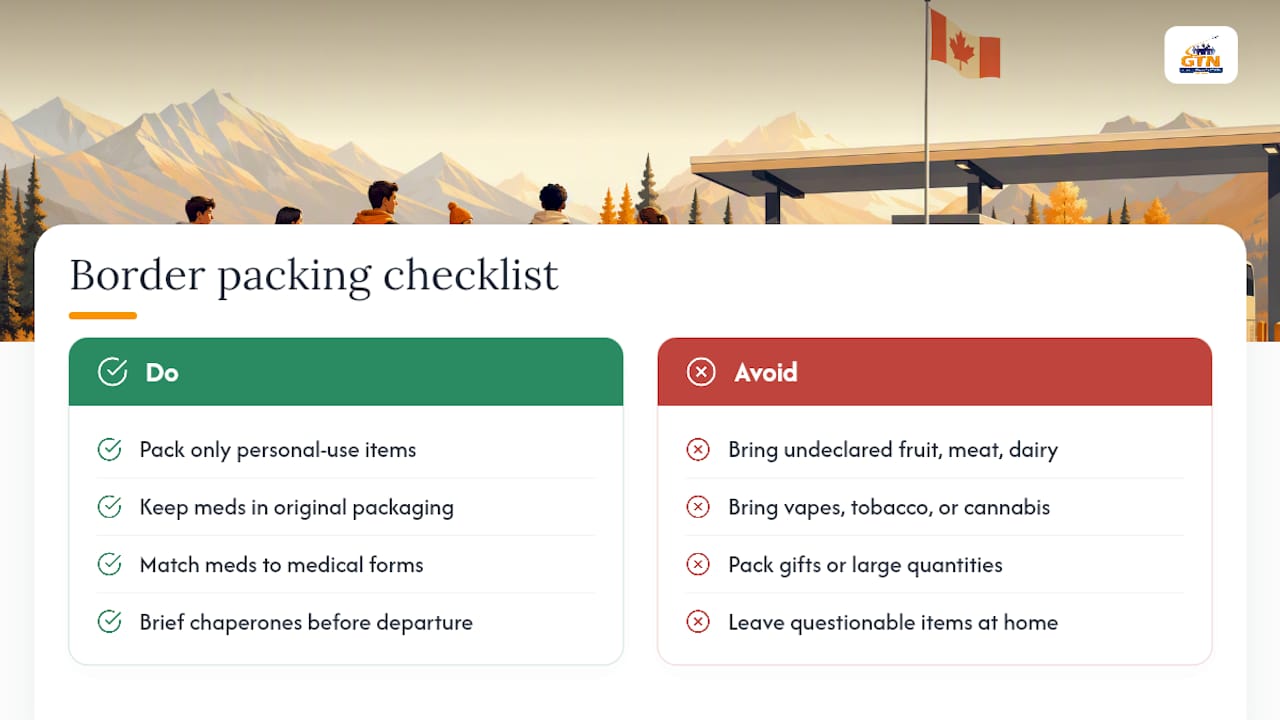
Canadian customs rules are stricter than most students expect, and a single confiscated item can turn a routine crossing into a 20-minute delay for the whole group. Personal items like phones, cameras, and laptops cross freely, but food, plants, and certain consumer goods need a closer look before departure day.
Fresh fruit, meat, and dairy products generally cannot cross the border without declaration, and some are barred outright regardless of quantity. If a student packs a sandwich or snacks for the bus ride, that’s typically fine for personal consumption in transit, but anything intended to be carried further into Canada as a gift or bulk item invites scrutiny. Tell chaperones to check backpacks for undeclared snacks before reaching the checkpoint, since a forgotten apple is a minor issue but a cooler of deli meat is not.
Any prescription or over-the-counter medication should stay in its original packaging with the student’s name visible, matched against the medical authorization forms you’ve already collected. Vapes, e-cigarettes, and any tobacco or cannabis products are a hard no for a K to 12 group regardless of a student’s home-state laws, since Canadian federal rules don’t recognize U.S. state legalization.
Gifts, souvenirs purchased for others, or large quantities of any item can trigger a customs declaration requirement even for a school group. Keep it simple: tell students to pack only what they’ll personally use on the trip, skip food gifts entirely, and leave anything questionable at home. A five-minute briefing before departure prevents most agricultural and customs issues before they start.
Setting Up Emergency Contacts and Communication Before You Leave
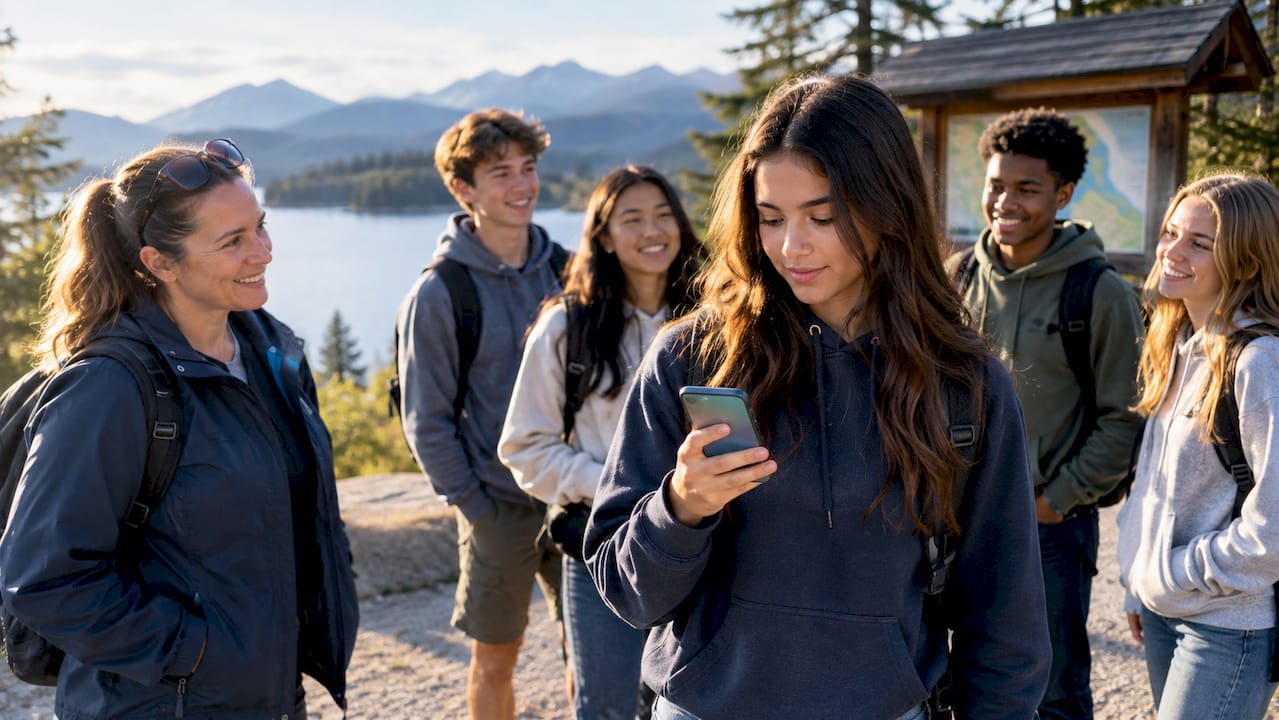
Every school group needs a written communication plan before wheels leave the parking lot, not a verbal understanding among chaperones. Start with a master contact sheet listing the lead coordinator’s cell number, a secondary staff contact, the school’s main office line, and the insurance provider’s 24-hour assistance number.
Distribute that sheet to every parent before departure, and require each family to confirm a reachable emergency contact for the full trip window, not just a home number that goes unanswered during business hours. Chaperones should carry the sheet both on paper and saved to their phones, since cell service gaps happen even in populated parts of Canada.
Set a check-in schedule with the school office, whether that’s a daily text at a set time or a call at each major stop on the itinerary. This matters most on multi-day trips where a single missed check-in can cause unnecessary panic back home, or worse, delay response to an actual problem. Assign one staff member as the designated point of contact for parents, so a worried family calling the school isn’t bounced between three different people who don’t have current information.
Build a simple incident protocol into the plan: who calls 911 or the Canadian equivalent, who notifies the school, and who contacts the affected student’s family. Include the address and phone number of the nearest hospital along each leg of the itinerary if your coordinator or a partner like Grouptravelnetwork hasn’t already mapped that out for you. A plan that exists only in someone’s head disappears the moment that person is the one dealing with the emergency.
Moving Large Student Groups Through the Border Smoothly
Border wait times climb fast when a bus of 40 students arrives with disorganized paperwork, so the goal is to make the officer’s job as easy as possible. Have the lead coordinator, not the bus driver, act as the single point of contact with border officers, and brief that person to speak first and present the roster before anything else.
Organize documents by seat number or alphabetical order matching the roster, so officers can cross-reference names quickly without flipping through a stack. Keep chaperones seated and quiet during the actual inspection, since a bus full of side conversations slows down an officer trying to do a headcount.
Time your crossing to avoid peak hours when possible. Early morning or midweek crossings tend to move faster than weekend afternoons, when both commercial and personal traffic peak at major Canada to U.S. crossings. If your itinerary allows flexibility, ask your coordinator to check historical wait patterns for the specific crossing you’ll use.
Expect officers to ask a few spot questions directly to students, things like their name, where they’re headed, or who’s traveling with them. Prep students briefly beforehand so nobody freezes up over a simple question, which can trigger closer scrutiny even when nothing is wrong. If one student’s documentation raises a flag, don’t let the whole bus disembark. Keep the group seated while the coordinator handles the individual case separately with the officer, which keeps the delay contained instead of spreading confusion through the whole vehicle.
Beyond Medical: What Else Should Group Travel Insurance Cover?
Medical insurance covers the student who gets hurt. It doesn’t cover the trip that gets cancelled, the bus that breaks down, or the bags that go missing at the hotel. That’s where broader group travel insurance earns its cost.
Look for a policy that includes trip cancellation and interruption coverage, which reimburses the district or families if the trip is cut short or called off for a covered reason, including weather or a family emergency. Baggage loss or delay coverage matters more than most administrators expect, since a lost suitcase with a student’s medication or documents is a bigger problem on a school trip than on a family vacation.
Some districts also carry liability coverage specific to the trip, separate from the school’s general liability policy, which protects against claims tied to the specific activities and locations on the itinerary. If your group is doing anything beyond standard sightseeing, adventure activities, a performance venue, a hands on excursion, ask specifically whether the policy covers that activity type, since standard travel policies sometimes exclude higher-risk activities by default.
Weather and travel-advisory related cancellation protection is worth flagging separately, given how often winter travel to Canada intersects with storm delays. A policy that only reimburses for a narrow list of “covered reasons” can leave a district holding nonrefundable costs if a trip gets cancelled for a reason the fine print doesn’t recognize. Read that list before you buy, not after you need it.
Handling Dual Citizens and Students Under Guardianship
Dual citizens need consistent documentation, not double documentation. If a student is a citizen of both the United States and another country, decide which passport they’ll travel under and use that same document consistently for both the U.S. departure and the Canadian entry, since switching between two passports mid-trip creates confusion at both border crossings.
Students under legal guardianship, rather than parental custody, need different paperwork than the standard consent letter. Request a copy of the guardianship order or court document establishing the guardian’s legal authority, in addition to a signed consent letter from that guardian. The Government of Canada’s FAQ on traveling with children specifically flags these nonstandard custody situations as ones where border officers are more likely to ask follow-up questions, so having the underlying legal document, not just a letter referencing it, is worth the extra step of requesting it early.
Foster students present a similar issue: the consent letter needs to come from whoever holds legal authority to consent to travel, which may be a caseworker, a state agency, or a foster parent depending on the arrangement. Confirm this early with the family or agency involved, since these documents sometimes take longer to obtain than a standard parental signature. Flag any student in one of these categories the moment registration opens, rather than discovering the paperwork gap a month before departure.
Author Perspective: What I’ve Seen Break a Trip Before It Starts
Late passports and half-finished consent letters cause more canceled trips than weather ever does. The fix isn’t more paperwork. It’s a document audit at the halfway point of planning, not the week before departure, so gaps surface while there’s still time to fix them.
Three checks matter most before final sign-off: every student’s citizenship document matches their roster name exactly, every consent letter has a legible signature and date, and every chaperone’s passport clears the trip’s return date by a real margin. Skip any of the three, and you’re gambling at the border.
— Donovan
How Group Travel Network Handles the Document Side for You
Chasing down forty consent letters, checking passport expiration dates, and confirming insurance enrollment for every family eats weeks that a school administrator doesn’t have to spare. A dedicated trip coordinator can review your document set, flag gaps before they become border problems, and coordinate insurance and consent-template distribution directly with families, so your staff isn’t the one tracking down numerous individual signatures.

That coordinator role covers document review, consent-letter template provisioning, insurance coordination, and a single point of contact for the entire planning window, not just the booking. If your group is heading to Canada, the School Trip Packages guide walks through how the planning and safety process works before you commit to a date. Request a planning consult and a document review before your next deadline, and find out what’s missing while there’s still time to fix it.
Sources
Save these pages before you start drafting your own paperwork. Each one answers a specific question border officers or district reviewers are likely to ask.
- CBP — Western Hemisphere Travel Initiative
- Government of Canada — Traveling with children: consent letter
- OSBIE — Field trip risk-management guidelines (sample reference)
Print the consent-letter and trip-day checklist pages ahead of your next planning meeting so your team is working from the same standard.
FAQ
What documents do U.S. children need to travel to Canada?
Children need proof of citizenship, such as a birth certificate or passport, plus a signed parental consent letter if they’re not traveling with both custodial parents, per Government of Canada guidance.
Did Canada issue a travel warning to the United States?
There’s no current U.S.-specific travel warning from Canada that would affect standard school group trips. Always check current advisories directly before departure, since conditions can change.
Can an international student studying in the U.S. visit Canada with the group?
Yes, but international students need their home-country passport and may need a Canadian Electronic Travel Authorization or visa depending on their nationality, so verify each international student’s status individually before booking.
How long can a Canadian visitor stay in the United States?
This depends on entry status and visa category, and it’s a separate question from U.S. school groups traveling into Canada, which is what this checklist covers.
Does Grouptravelnetwork help review travel documents for Canada trips?
Yes. Grouptravelnetwork’s coordinators review consent letters, passport status, and insurance documentation as part of planning a compliant student trip to Canada.
Recommended

Relax with our Student Travel Expertise .
We deliver stress-free student trips backed by an exceptional array of services you won’t find anywhere else:
- Stress-free, creative planning of customized itineraries
- Dedicated GTN Service host on every trip
- Extensive travel protection plan options
- Online, individual registration system
- Flexible payment plans and online payment options
- Bulk buyer discounts for great trips that cost less
Inclusion into #MyGTNFamily for life! (you don’t even have to remember our birthday!)
Spain
There is no place like Spain to offer a student performance opportunity or cultural student trip.
Myrtle Beach
All students love the beach! Especially a beach known for its 60 miles of pristine coastline.
Boston
Have your students experience colonial charm in the city that is considered the hub of New England.
London
Provide your student group with the “Royal” treatment! One of the world’s most recognized cities.
See What People Are Saying
“This was my first time using a company to plan our band trip. It was so easy working with Justin and Group Travel Network. We had to make several changes along the way, but they were accommodating changes and worked everything out for us. I would highly recommend using Group Travel Network.”
“It has been my privilege to use Group Travel Network as the exclusive travel coordinator for my band for over 10 years. I can say, without doubt or hesitation, that GTN is, by far, the best travel company for student groups currently in existence. I have often said that I wouldn’t take my band across the street without GTN and that’s not far from the truth!”
“What wonderful trip we had to NYC! Our group of 51 never missed a beat because of Group Travel Network and our wonderful guide, Tim. It was truly a theatre trip to remember! If you are looking for a travel company who really cares about the details, Group Travel Network is for you!”