


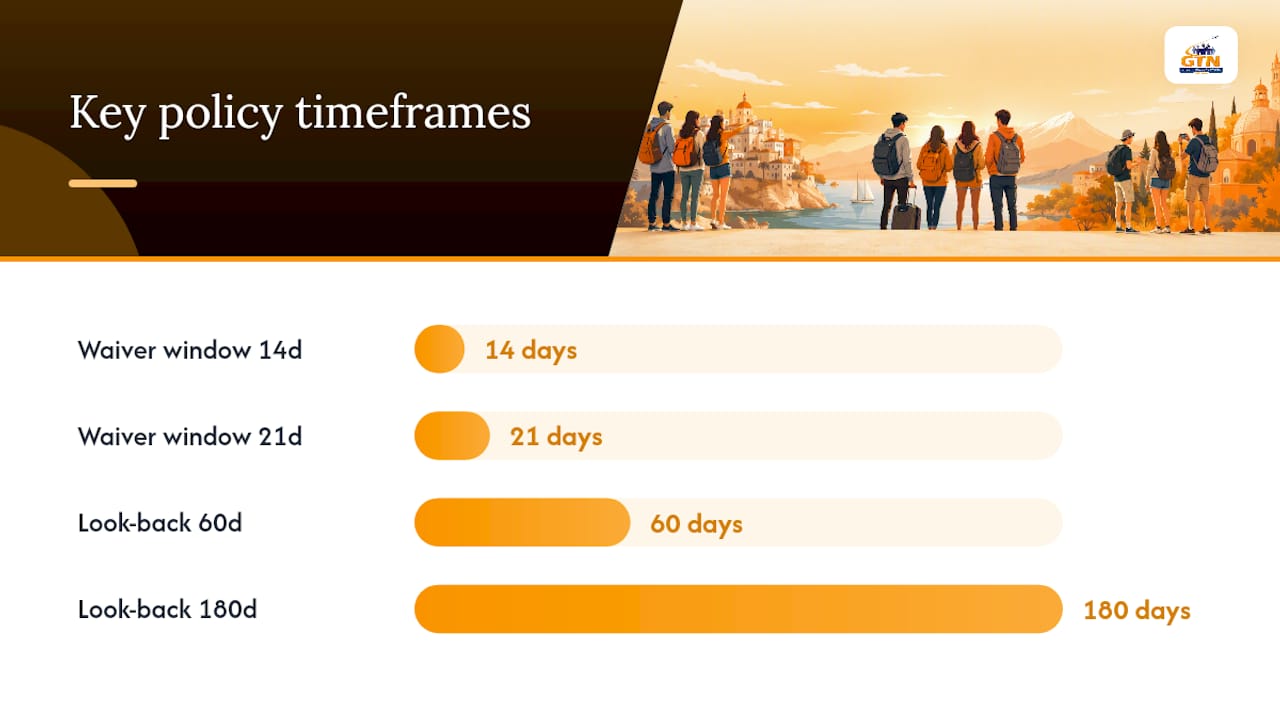
Yes, students with pre-existing conditions can often get coverage for medical costs and trip cancellation, but only if the policy is purchased inside the insurer’s waiver window and the condition meets stability rules at the time of purchase. The single most important move is timing: buy your plan within the insurer’s specified waiver window, usually within a few weeks of your first trip deposit, insure the full nonrefundable cost of the trip, and check the policy’s look-back period, which usually runs between 60 and 180 days.
TL;DR:
- Purchasing insurance within 14 to 21 days of the first trip deposit, insuring the full nonrefundable cost, and confirming a short look-back period (preferably 60 days) significantly improve pre-existing condition coverage eligibility.
- Conditions that are active, recently investigated, or medication-dosed changes within the look-back period typically remain excluded, even with a waiver.
- Group plans purchased on a single date simplify waiver timing but may offer less flexibility for atypical medical histories compared to individual policies.
- Carrying up-to-date physician clearance letters, detailed medication lists, and early medical documentation speeds up claims processing and reduces disputes.
- For remote destinations, evacuation and repatriation limits are critical to consider, especially for students with pre-existing conditions, as the value depends highly on local healthcare infrastructure.
Table of Contents
- Pre-Existing Condition Coverage Student Trips: The Basics
- How Pre-Existing Condition Waivers Work and When to Buy
- Acute Onset vs. Pre-Existing: What Actually Gets Excluded
- How to Choose a Policy for Pre-Existing Condition Coverage on Student Trips
- Checklist for Planners, Parents, and Students Before Departure
- A Planner’s View on Reducing Pre-Existing Condition Risk
- How Claims for Pre-Existing Conditions Get Handled on Student Trips
- Does Destination Healthcare Quality Affect Pre-Existing Condition Coverage?
- Emergency Medical Evacuation Tips for Pre-Existing Conditions
- Group vs. Individual Plans for Pre-Existing Condition Coverage
- What Should Actually Drive Your Insurance Decision
- Let Grouptravelnetwork Handle the Insurance Timing for You
- Sources
- FAQ
Pre-Existing Condition Coverage Student Trips: The Basics
A pre-existing condition, in insurance terms, is any illness or injury that showed symptoms, required treatment, or led to a medication change within a set window before you bought the policy. That window is the look-back period, and it’s the single biggest variable in whether a condition counts as “pre-existing” at all.
Look-back periods vary a lot by provider. According to MoneyGeek’s review of travel insurance and medical conditions (opens in a new tab), Seven Corners uses a 60-day look-back, Allianz uses 120 days, and Generali extends to 180 days. A shorter look-back is generally better news for someone who had a recent flare-up, medication adjustment, or new diagnosis, since fewer days of medical history get scrutinized.
It also helps to separate two products that get lumped together constantly:
-
Medical expense coverage pays for treatment, hospitalization, or prescriptions needed during the trip itself.
-
Trip cancellation and interruption coverage reimburses nonrefundable costs (flights, deposits, tuition-linked fees) if you have to cancel or cut the trip short.
-
Cancel for Any Reason (CFAR) and its travel-interruption cousin, Interrupt for Any Reason (IFAR), are separate add-ons that let you back out for reasons a standard cancellation policy wouldn’t cover, but they typically reimburse only a portion of costs.
These aren’t interchangeable. A plan can waive the pre-existing exclusion for medical expenses while still limiting what it pays if you cancel outright, so read both sections of the policy, not just the headline “pre-existing condition waiver” claim. One more wrinkle worth flagging early: some insurers require the traveler to be a U.S. resident at the time of purchase (opens in a new tab) for the waiver to apply, which matters for international students buying coverage from a U.S.-based provider.
How Pre-Existing Condition Waivers Work and When to Buy
Qualifying for a pre-existing condition waiver almost always comes down to meeting four conditions, and missing any one of them can void the waiver entirely.
- Buy within the insurer’s time window. Most carriers require purchase within 14 to 21 days of your first trip payment or deposit, according to Allianz’s guidance on existing medical conditions (opens in a new tab).
- Be medically able to travel on the day you buy the policy. If you’re mid-flare, hospitalized, or under a doctor’s advisory against travel when you purchase, the waiver typically won’t apply even if you meet every other rule.
- Insure 100% of your trip’s nonrefundable costs. Underinsuring the trip, even by a small amount, can disqualify the waiver on some plans.
- Meet residency requirements where they exist. Some providers require U.S. residency at the time of purchase, a detail worth confirming before you assume a waiver is available.
The purchase window and the look-back period are two different clocks, and confusing them causes most of the denied claims that show up in insurer disputes. The purchase window is about when you buy. The look-back period is about how far back your medical history gets checked.
For a school or performance group, this creates a real planning problem: deposits come in on different days from different families, and a plan bought two weeks after one student’s deposit might miss the window entirely for another. A workable timeline looks like this: collect deposits by a fixed internal date, open the insurance purchase window immediately after, and set an internal deadline that’s a few days earlier than the insurer’s actual cutoff to leave room for paperwork delays.
Pro Tip: If your group has rolling deposits over several weeks, set the insurance purchase deadline against the earliest deposit date in the group, not the latest one. That protects every student’s waiver eligibility, not just the last one to pay.
If new trip costs get added later (a side excursion, an upgraded flight, a late-added tour), those costs need to get added to the insured amount and reported to the insurer promptly, or they may fall outside the nonrefundable-cost requirement.
Acute Onset vs. Pre-Existing: What Actually Gets Excluded
Acute onset describes a sudden, unexpected flare of a condition that was otherwise stable and not causing symptoms in the weeks before travel. Many policies treat acute onset more leniently than a straightforward pre-existing condition claim, but “more leniently” doesn’t mean automatic approval. It’s still evaluated against the same look-back window and stability standard.
What typically stays excluded, waiver or not:
- Conditions under active treatment or investigation at the time of purchase
- Any condition with a medication dosage change within the look-back period
- Conditions insurers classify as “unstable,” meaning symptoms, treatment, or test results changed recently
- Travel taken against a physician’s specific advisory
Claims examiners lean heavily on paperwork. Travel Guard’s guidance on the pre-existing condition waiver (opens in a new tab) points to physician notes, current medication lists, and documented dates of last treatment as the core evidence they expect to see. For a borderline case, the safest move is a physician clearance letter dated close to the departure date, stating the condition is stable and travel is medically appropriate. That single document resolves more disputed claims than almost anything else a traveler can provide.
How to Choose a Policy for Pre-Existing Condition Coverage on Student Trips
Not every plan handles pre-existing condition waivers the same way, so comparing options means looking past the premium and into six specific features:
- Waiver window and purchase timing. Confirm the exact number of days from first deposit, since 14 versus 21 days can be the difference between eligibility and exclusion for a slow-paying group.
- Look-back period length. Shorter windows (60 days) are friendlier to recently treated conditions than longer ones (180 days).
- Medical expense limits. Check the dollar cap on medical treatment abroad, especially for conditions that might require hospitalization.
- Emergency evacuation and repatriation limits. These are often separate from the medical expense cap and matter enormously for remote destinations.
- Prescription coverage and direct billing. Some plans cover replacement medication or offer direct billing at partner pharmacies; others require the traveler to pay out of pocket and file for reimbursement later.
CFAR and IFAR deserve a clear-eyed look here too. According to institutional risk management guidance for academic travel (opens in a new tab), these add-ons commonly reimburse up to 75% of nonrefundable costs, require purchase inside the same tight window as the pre-existing waiver, and carry their own eligibility restrictions, including exclusions in certain states. They’re useful financial protection, not a substitute for medical coverage, and not a fallback if you miss the waiver deadline.
A quick real-world trade-off: a cheaper plan with a 180-day look-back and a $50,000 medical cap might work fine for a student with a stable, long-managed condition. A student who adjusted medication six weeks ago needs the 60-day look-back plan even if it costs more, because the cheaper plan would likely exclude the claim outright.
Pro Tip: Ask the insurer directly: “What is your exact look-back period in days, and does a medication dosage change count as a change in treatment?” That single question eliminates most of the ambiguity in disputed claims.
Before locking in a plan, ask both the insurer and the university’s travel or risk office these questions: What’s the look-back period in days? Is residency required for the waiver? What’s the medical expense cap versus the evacuation cap? Does the plan direct-bill pharmacies at common study-abroad destinations?
Checklist for Planners, Parents, and Students Before Departure
Getting the paperwork and timing right takes a specific sequence, not a scattered checklist:
- Purchase insurance inside the waiver window and insure the trip’s full nonrefundable cost, not a partial estimate.
- Collect medical documentation early, including a physician clearance letter for any student with a recent diagnosis or treatment change.
- Label all prescriptions clearly, pack extras beyond the trip length, and confirm pharmacy access at the destination before departure.
- Distribute policy numbers, insurer contact information, and emergency assistance lines to every family and staff member on the trip.
- If a student’s condition is unstable close to departure, postpone that student’s travel or get explicit medical sign-off rather than assuming the waiver will hold.
Arizona State University’s guidance on trip cancellation and travel insurance (opens in a new tab) makes a point worth repeating: medical coverage and cancellation protection are different products, and a fully protected trip usually needs both, not just the one that seems more urgent.
A Planner’s View on Reducing Pre-Existing Condition Risk
Coordinating insurance for a group of 40 students with 40 different deposit dates and medical histories is a logistics problem as much as an insurance one. Group organizers who purchase coverage for the whole roster soon after deposits close, rather than letting families buy individually and at different times, keep everyone inside the same waiver window instead of leaving late payers exposed. That single scheduling decision prevents more denied waivers than any policy feature does.
Standardized medical form templates, collected early and stored centrally, also matter more than most planners expect: a missing physician note is the most common reason a pre-existing claim gets delayed, not denied outright, and delays during an active trip are their own kind of problem.
How Claims for Pre-Existing Conditions Get Handled on Student Trips
A pre-existing condition claim on a student trip typically starts the same way any medical claim does: the treating provider abroad documents the visit, and the student or a chaperone contacts the insurer’s assistance line, ideally before treatment when the situation allows it. What changes with a pre-existing condition is the underwriting review that follows.

Claims examiners cross-check the treatment date against the look-back period and against the waiver’s purchase-window requirement. If the student bought coverage nine days after the first deposit and the look-back period is 90 days, they’ll pull records for any treatment or medication change in those 90 days before purchase. A clean match between the physician clearance letter and the medication list on file speeds things along considerably.
For group trips, having a designated point of contact, usually the trip coordinator, who can supply the group’s proof of insurance and communicate with the insurer directly, cuts down on delays that individual families might struggle to manage from a foreign country. Reimbursement timelines vary by insurer, but claims with complete documentation attached at filing move faster than ones where the insurer has to request records after the fact.
Does Destination Healthcare Quality Affect Pre-Existing Condition Coverage?
The quality of healthcare at your destination doesn’t change whether a policy covers a pre-existing condition, but it changes what that coverage is actually worth in practice. A $100,000 medical expense limit means very little if the nearest facility capable of treating a serious flare-up is a six-hour drive away.
Students traveling to destinations with limited specialty care, rural regions, or countries where English-language medical documentation isn’t standard should weigh two things beyond the policy’s dollar limits: whether the plan includes direct billing or requires upfront payment followed by reimbursement, and whether the insurer’s assistance line can coordinate transport to a facility equipped to handle the specific condition.
This is where evacuation coverage stops being an abstract line item and starts mattering directly. A student with a cardiac history traveling to a destination with strong urban hospital infrastructure faces a very different risk profile than one traveling somewhere remote with the same condition. Planners organizing trips to less-resourced regions should treat evacuation and repatriation limits as a primary selection criterion, not an afterthought buried in the policy’s fine print.
Emergency Medical Evacuation Tips for Pre-Existing Conditions
Evacuation coverage tied to a pre-existing condition carries its own layer of scrutiny that standard emergency evacuation doesn’t always face. Insurers want to confirm the evacuation was medically necessary and that the underlying condition met the waiver’s stability requirement at purchase, so the same documentation that supports a medical claim supports an evacuation claim too.
A few practical steps make a real difference here. Carry a printed summary of the condition, current medications, and the physician clearance letter, since a phone with a dead battery shouldn’t be the only place that information lives. Confirm before departure whether the policy’s evacuation benefit transports the traveler to the “nearest adequate facility” or to a facility of the traveler’s choice, since those are very different guarantees. And notify the insurer’s assistance line as early as possible in a developing medical situation, because early notification often gives the insurer more options for arranging transport than a crisis-stage call does.
Group trip coordinators should keep a copy of every traveler’s evacuation benefit limit on hand during travel, not just the master policy summary, since limits sometimes vary between individual and add-on coverage tiers within the same group plan.
Group vs. Individual Plans for Pre-Existing Condition Coverage
Group and individual student trip insurance handle pre-existing conditions differently in ways that matter for planners choosing between them. Individual plans evaluate each traveler’s medical history and waiver eligibility separately, which means one student’s unstable condition doesn’t affect anyone else’s coverage, but it also means 40 separate waiver clocks to track.
Group plans, particularly group travel insurance built for student trips (opens in a new tab), often let an organizer purchase coverage for the whole roster on a single date, which simplifies the waiver-window problem considerably since everyone’s clock starts at the same time. The trade-off is that group plans sometimes carry less flexibility for a single traveler with an unusual medical history, since the policy terms apply uniformly across the group rather than being negotiated individually.
Annual, multi-trip policies work well for a student or staff member with a stable condition who travels repeatedly throughout the year, but only if the waiver window is met at the very first deposit of the year; a missed window at the start of the policy period can carry through every trip taken under it. For one-off trips, a single-trip policy purchased promptly after the first deposit is usually the more reliable choice.
What Should Actually Drive Your Insurance Decision
Most advice on this topic treats the pre-existing condition waiver as the finish line, when it’s really just the entry ticket. The real decision points come after: how short is the look-back period, does the evacuation limit match the destination’s healthcare access, and does the plan direct-bill or leave a family fronting thousands of dollars abroad.
Conventional guidance tends to underweight timing coordination for groups specifically. Individual travelers can watch their own calendar. A school with 35 families paying deposits across six weeks cannot rely on each family tracking its own waiver window without help, and that’s where claims quietly fall through. The priority isn’t finding the cheapest plan or even the plan with the broadest-sounding coverage. It’s building a purchase timeline around the earliest deposit in the group, verifying every family’s documentation before departure, and treating evacuation limits as seriously as medical expense caps. Get those three things right, and most pre-existing condition disputes never happen in the first place.
— Donovan
Let Grouptravelnetwork Handle the Insurance Timing for You
Coordinating waiver deadlines, deposit dates, and medical paperwork across dozens of families is exactly the kind of logistics problem that eats a trip coordinator’s week. Some travel agencies work alongside schools, band directors, and youth organizations to align insurance purchase windows with deposit collection, gather medical documentation through standardized forms, and flag coverage gaps before they turn into denied claims on the road.

This approach allows one coordinated purchase date for the whole group instead of multiple separate clocks running out of sync, often including a trip coordinator who helps track the paperwork so families don’t have to manage it themselves. If your school or organization is planning an upcoming trip, start with the student educational travel guide (opens in a new tab) to see how full-service planning and travel protection options fit into your group’s timeline.
Sources
- Travel insurance plans and pre-existing medical conditions | MoneyGeek (opens in a new tab)
- Travel Insurance & existing medical conditions coverage | Allianz (opens in a new tab)
FAQ
Does trip insurance cover pre-existing conditions?
Often, yes, if you buy the policy within the insurer’s waiver window (typically 14 to 21 days after your first trip payment), insure the full nonrefundable trip cost, and the condition is stable at the time of purchase.
What pre-existing conditions won’t be covered?
Conditions under active treatment, those with a recent medication dosage change within the look-back period, or any condition classified as unstable at the time of purchase typically stay excluded, even with a waiver in place.
Which travel insurance is best for pre-existing conditions?
The best fit depends on your specific medical history: prioritize a shorter look-back period (60 days rather than 180) if you’ve had recent treatment changes, and confirm the medical expense and evacuation limits match your destination’s healthcare access.
What pre-existing conditions are not covered by travel insurance?
Beyond active or unstable conditions, coverage generally excludes conditions where the traveler was advised against travel by a physician, or where the required documentation, like a stability clearance letter, isn’t available to support the claim.
Can group travel plans simplify pre-existing condition coverage for schools?
Yes. A group travel insurance purchase for the whole roster on one date keeps every student’s waiver window aligned, which is harder to manage when families buy coverage individually on different days.