

September 1, 2026
20,000–60 Seat Options: Orlando Performance Venues for School Groups

Orlando’s performance scene runs from 20,000-seat arenas to 60-seat supper clubs, and knowing which type fits your event saves real money and headaches. For big-name concerts, start with the Kia Center or Hard Rock Live Orlando; for theater, symphony, and touring Broadway, the Dr. Phillips Center for the Performing Arts is the anchor; for club-scale shows, check The Plaza Live, The Social/The Beacham, or House of Blues Orlando; and for student ensembles and recitals, the Valencia College Performing Arts Center delivers professional staging at educational pricing. Whatever the event, confirm the current calendar and seating configuration directly with the venue before you commit.
TL;DR:
- Major arena venues like Kia Center host large concerts and sports events, but booking a group requires verifying seating configurations and load-in logistics in advance.
- Mid-size venues such as Hard Rock Live and The Plaza Live serve touring acts, but capacity and technical needs vary; confirm stage dimensions, load-in hours, and available equipment before signing.
- Smaller performance spaces like Lizzy’s Live and The Vanguard offer intimate settings ideal for private events, with booking often requiring advance reservations and minimum spend agreements.
- Educational venues like Valencia College and Dr. Phillips Center combine professional staging with academic programs, but availability and technical support depend on the academic calendar and staff coordination.
- Contact venues directly early in the planning process, especially for group sales and technical riders, to avoid last-minute issues and secure discounted group tickets through the official box office.
Table of Contents
- Orlando Performance Venues at a Glance
- Major Arenas and Large Venues: What Event Planners Need to Know
- Mid-Size Concert Halls and Clubs: Which One Fits Your Show
- Intimate Venues and Supper Clubs: Small Rooms, Big Personality
- College and Community Performing Arts Centers for Student Groups
- Your Orlando Venue Planning Checklist
- How to Check Schedules and Buy Tickets Safely
- Venue Technical Specs and Who to Contact for Riders
- The History and Architecture Behind Orlando’s Stages
- What Orlando Venues Cost to Rent for Private Events
- Booking Timelines: When to Reach Out for Each Venue Type
- Who Shows Up and What They Come For
- Why Advance Coordination Beats Winging It
- Let Group Travel Network Handle the Venue Logistics
- Sources
- FAQ
Orlando Performance Venues at a Glance
Orlando’s roughly a dozen notable stages break into three practical tiers: arena, mid-size hall or club, and intimate/educational. Matching the right tier to your event type is the single biggest decision you’ll make before ticket sales even open.
- Kia Center — downtown arena, 18,000+ capacity, national tours, NBA and major concerts
- Dr. Phillips Center for the Performing Arts — downtown, multiple halls up to 2,700 seats, Broadway and symphony
- Hard Rock Live Orlando — Universal CityWalk, roughly 3,000 capacity, national touring acts
- The Plaza Live — Colonialtown/Milk District, mid-size independent hall, legacy and indie acts
- The Social / The Beacham complex — downtown, club-scale rooms, local and indie touring bands
- House of Blues Orlando — Disney Springs, mid-size club with dining, national touring roster
- Lizzy’s Live — supper club format, upscale dining plus live music
- The Vanguard — intimate listening room, singer-songwriter and acoustic programming
- Valencia College Performing Arts Center — East Orlando, ~500 seats, student and community events
National arena tours land almost exclusively at Kia Center, while indie, tribute, and regional acts fill The Plaza Live and The Social on a rotating weekly basis. If you’re organizing a school trip around a performance, the Dr. Phillips Center and Valencia College Performing Arts Center are where student groups tend to get the most attentive booking support.
Major Arenas and Large Venues: What Event Planners Need to Know
The Kia Center anchors Orlando’s arena tier, hosting the Orlando Magic, major touring concerts, and family shows with a seating bowl that reconfigures between 18,000 and 20,000 depending on staging. General admission floor setups can push effective capacity higher than reserved-seat configurations, so always ask which layout applies to your specific event before estimating group size or budgeting tickets.
Hard Rock Live Orlando, inside Universal CityWalk, sits at the upper edge of what’s usually called “mid-size” but functions like a scaled-down arena for booking purposes. It advertises a capacity around 3,000 with modern sound and lighting rigs built for touring production, which makes it a common stop for artists who’ve outgrown clubs but aren’t quite arena-ready.
Large venues bring large-venue logistics. Before locking in tickets for a group, event planners need to confirm several things that smaller rooms rarely require:
- Bus parking and drop-off zones, which are often a separate lot from general attendee parking
- ADA seating blocks, which typically must be reserved in advance rather than requested day-of
- Load-in specifications if your own performers or ensemble are part of a pre-show or associated event
- Whether the show uses reserved seating, GA floor, or a hybrid configuration that changes your headcount math
Pro Tip: Call the venue’s group sales line before buying online. Arena box offices routinely hold blocks of adjacent seats for groups of 15 or more, and buying through the box office directly can shave off per-ticket processing fees that stack up fast on a 40-ticket order.
Ticketing strategy matters more at this scale than anywhere else in the city. Third-party resale sites often list arena tickets above face value weeks before a show, while the venue’s own box office or official ticketing partner almost always has better group-rate options and clearer refund policies. If your school or organization is bringing a bus of students, ask specifically whether the arena offers student group discounts. Many do, but they’re rarely advertised prominently on the general ticket page.
Accessibility deserves a second mention here because arena-scale venues handle it differently than clubs. Wheelchair and companion seating at Kia Center is typically clustered in specific sections rather than distributed throughout the bowl, so groups with mixed mobility needs should call ahead rather than assume standard seat selection tools will place everyone together.
Mid-Size Concert Halls and Clubs: Which One Fits Your Show
Mid-size venues split into two distinct experiences that get lumped together far too often: the theatrical concert hall and the club-configured room. Choosing wrong means either an oddly formal night for a rowdy show or a standing-room crush for an audience that wanted seats.
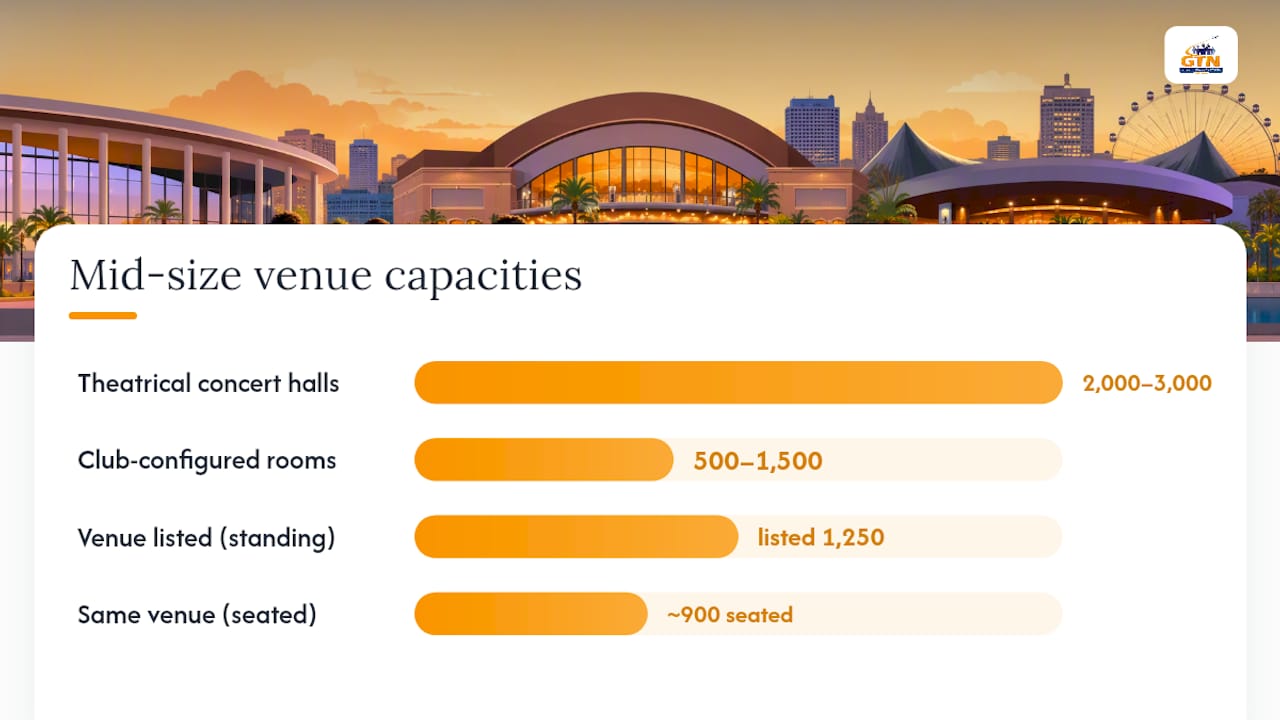
Concert halls in the 2,000 to 3,000 range, like Hard Rock Live Orlando, typically offer tiered or theater-style seating with sightlines built for a stage show. Club-configured spaces in the 500 to 1,500 range, like House of Blues Orlando or The Social, often mix standing GA floors with a smaller reserved balcony, which changes both the atmosphere and the practical capacity math.
The Plaza Live deserves its own mention here. Built in 1963 and later converted into a dedicated concert venue, it’s recognized as one of Orlando’s oldest independent music rooms, with a history that predates most of the city’s current entertainment districts. Its blend of historic architecture and modern staging flexibility means it can host anything from a legacy rock act to a local orchestra benefit without feeling mismatched either way.
If you’re booking a performance rather than just attending one, ask the venue’s technical staff these questions before signing anything:
- What are the exact stage dimensions, and can they accommodate your group’s set or choreography?
- Is there an in-house sound engineer, or does your group need to bring its own?
- What backline equipment (amps, drum kits, keyboards) is provided versus rented separately?
- What are the load-in hours, and is there a freight elevator or ground-level dock?
Capacity numbers on venue websites can be misleading if you don’t read the fine print. A hall listed at 1,250 for a standing show might only seat around 900 once chairs go in, so confirming the actual configuration with the venue coordinator before finalizing headcounts matters more than trusting the number on the homepage.
Parking and bus access also shift meaningfully at this tier. Downtown clubs near Orange Avenue often rely on paid garages a block or two away rather than dedicated lots, while suburban venues like House of Blues at Disney Springs have more generous group parking but longer walk times from the drop point to the door.
Intimate Venues and Supper Clubs: Small Rooms, Big Personality
Orlando’s smallest performance spaces trade capacity for character, and for certain events, that trade is exactly the point. A 60-seat room with table service creates an experience an arena simply cannot.
Lizzy’s Live markets itself as Orlando’s premier supper club and live music lounge, combining a full dinner menu with nightly performances in a setting closer to a boutique restaurant than a traditional concert hall. Expect table seating, a food and drink minimum in most cases, and a noticeably different pacing than a standard club show. Some nights operate on a partial or full room buyout basis, which matters if you’re planning a private event rather than dropping in as a general customer.
The Vanguard occupies a similar niche but leans harder into the listening-room format, favoring acoustic and singer-songwriter programming where crowd chatter is actively discouraged rather than tolerated. It’s the kind of room where a whispered conversation during a quiet verse gets you a look from three tables over.
These smaller formats fit specific situations especially well:
- Student vocal or instrumental showcases where an intimate audience matters more than a big room
- Corporate or donor events where a private buyout creates a controlled, branded evening
- Niche genre concerts (jazz, folk, spoken word) that would feel lost in a 1,000-seat hall
- Rehearsal-style performances or album release shows where the artist wants direct audience interaction
Reservation mechanics differ sharply from arena or club ticketing. Many supper-club and lounge shows require advance table reservations tied to a minimum spend rather than a simple per-ticket purchase, and walk-up availability on a popular night can be near zero. If you’re booking on behalf of a group, confirming box-office hours and getting a direct phone or text contact before the day of the show avoids the frustration of showing up to a locked door during an odd off-hours gap, a problem that hits smaller independently run venues more often than corporate-owned ones.
College and Community Performing Arts Centers for Student Groups
Educational venues occupy a strange middle ground: professional-grade stages that also double as working classrooms, which creates both real advantages and real scheduling friction for anyone planning a student trip around one.
The Valencia College Performing Arts Center is the clearest local example. It functions as a professional venue while still serving as a working classroom, with a capacity near 500 that’s well suited to college recitals, community theater, and mid-size student ensemble performances. Because it’s tied to an academic calendar, availability windows for outside groups can be tighter than a purely commercial venue, and booking further ahead pays off.
The Dr. Phillips Center takes educational involvement even further by running structured training programs alongside its main-stage seasons. It offers ensembles and classes for students ages 11 to 18, covering musical theater, vocal performance, and technical production, which means a student group visiting Orlando can sometimes combine attending a professional show with a genuine skill-building workshop in the same trip.
A few numbers matter here for planning purposes: Valencia’s house is significantly smaller than Hard Rock Live Orlando, which changes everything from ticket pricing to how early you need to lock a date.
- Confirm changing and dressing facilities weeks in advance, not the week of the show
- Ask specifically about load-in dimensions if your group brings instruments, sets, or costume racks
- Request the academic calendar to identify blackout dates tied to finals or campus events
- Clarify whether the booking includes a sound engineer or if your group needs its own
High-school and college performance centers frequently lack large dedicated changing areas, sometimes requiring groups to use public restrooms or coordinate an alternate space in advance. That single detail trips up more first-time student group planners than any pricing or scheduling issue, so raise it in your very first call with the venue.
Your Orlando Venue Planning Checklist
- Lock the venue configuration. Confirm GA versus reserved seating and get the real capacity number, not the marketing figure.
- Verify seating and headcount. Match your group size against the section map before buying a single ticket.
- Request the technical rider. Ask about stage size, sound engineer availability, and backline if performers are involved.
- Call box-office group sales. Ask about block holds and student or group discounts before buying online.
- Plan transportation and drop-off. Bus parking is often separate from general attendee lots at larger venues.
- Confirm chaperone-to-student staffing. Many venues have their own ratio expectations for school groups.
- Collect emergency contacts. Get a direct venue phone number, not just a general info line.
- Arrange ticket distribution. Decide how physical or digital tickets get handed out before arrival, not in the lobby.
Pro Tip: Group Travel Network coordinators handle steps 3 through 8 as a matter of course on booked trips, which is often the real time savings compared to a staff member juggling venue calls between other job duties.
Buying through the box office directly, rather than a resale marketplace, typically avoids inflated per-ticket fees and gives you a real person to call if plans change. Flexible payment plans and travel protection, standard features on managed group trips, also remove a lot of the financial risk that comes with committing to 40 nonrefundable tickets months ahead of a show date.
How to Check Schedules and Buy Tickets Safely
Start with the venue’s own website calendar, not a third-party aggregator. Official calendars reflect cancellations and time changes faster than resale sites, which sometimes keep stale listings live for weeks.
Confirm box-office hours and get a direct phone or text contact before sending a group, especially for smaller independent venues where hours can shift with the season. Resale marketplaces can be trustworthy for verified, venue-affiliated partners, but always cross-check the seat section against the venue’s own seating chart before paying above face value.
Before finalizing any group purchase, confirm:
- The venue’s refund and exchange policy in writing
- Any ADA seating needs, submitted in advance rather than requested day-of
- An on-site contact name for the day of the event, not just a general box-office line
Venue Technical Specs and Who to Contact for Riders
Performers and technical directors need more than a capacity number before agreeing to a date. Stage dimensions, rigging points, power distribution, and available backline vary enormously between Orlando’s venues, and none of it is standardized across the city.
Larger halls like the Dr. Phillips Center and Hard Rock Live Orlando maintain dedicated production staff and typically respond to rider requests through a formal booking or production contact listed on their website. Mid-size independent rooms like The Plaza Live often route technical questions through the same booking contact used for artist submissions, so expect a slightly slower turnaround than a corporate-run venue.
Educational venues like the Valencia College Performing Arts Center present a different challenge. Their technical staff often double as faculty or student supervisors, which means tech rider conversations need to happen well outside the rush of finals week or major campus events. Ask specifically who signs off on outside-group tech requests, since it’s not always the same person who handles the venue’s academic bookings.
For any group bringing its own sound needs, confirm three things regardless of venue size: whether an in-house engineer is included or billed separately, what backline equipment stays on-site versus what you must rent, and the exact load-in window with dock or elevator access. Skipping this step is the single most common cause of a delayed sound check on show day.
The History and Architecture Behind Orlando’s Stages
Orlando’s performance venues span everything from a converted 1963 building to a purpose-built modern arts complex, and that range shows up in how each space actually feels to sit in.
The Plaza Live carries the most distinct architectural story. Constructed in 1963 and later converted into a dedicated concert venue, it’s recognized in national venue listings including Pollstar, and its blend of a historic shell with modern staging flexibility gives it a character that newer purpose-built rooms can’t easily replicate. Wikipedia’s entry on the venue notes how it balances that legacy architecture with contemporary event capability, hosting everything from touring rock acts to community fundraisers under the same roof.
The Dr. Phillips Center, by contrast, represents Orlando’s modern investment in the performing arts, with multiple halls built specifically for acoustic precision and Broadway-scale productions rather than adapted from an earlier use. Its design reflects a deliberate downtown revitalization effort, positioning the arts center as a civic anchor rather than simply a rental hall.
Educational venues carry their own architectural logic. The Valencia College Performing Arts Center is built to function as both a working classroom and a public-facing stage, a dual purpose that shapes everything from its acoustics to its backstage layout in ways a purely commercial venue never has to consider.
What Orlando Venues Cost to Rent for Private Events
Rental costs across Orlando’s performance venues vary enormously based on capacity, day of week, and whether the booking includes technical staff or just the bare room. Arena-scale spaces like the Kia Center command the highest rental fees and are generally reserved for large corporate events, major productions, or multi-day engagements rather than single-evening private bookings.
Mid-size halls and clubs occupy the middle ground, with rental pricing typically built around a base room fee plus separate charges for sound engineering, security, and any catering coordination. Supper-club and lounge formats like Lizzy’s Live often price differently altogether, working from a minimum spend or partial buyout structure rather than a flat rental fee, which can actually work out more affordably for a smaller private group.
Educational venues like the Valencia College Performing Arts Center tend to offer the most accessible rental pricing for community and school-affiliated events, though availability is constrained by the academic calendar in ways commercial venues never face. Weekday daytime slots during the school year are often the hardest to secure, while summer and weekend windows open up considerably more flexibility.
Whatever the venue, request an itemized quote rather than a flat number. A rental fee alone rarely captures the full cost. Sound engineering, security staffing, insurance requirements, and cleaning fees frequently arrive as separate line items that can add 20 to 40 percent on top of the base rental figure, and it’s worth confirming that math before signing.
Booking Timelines: When to Reach Out for Each Venue Type
Lead times in Orlando’s performance venue market scale directly with venue size and popularity. Arena dates at Kia Center for major touring acts are typically locked a year or more in advance by the artist’s booking agency, leaving very little flexibility for anyone trying to attach a private or group event to that date.
Mid-size halls and clubs operate on a shorter runway, often booking three to six months out for a confirmed date, though popular weekend slots at venues like The Plaza Live or House of Blues Orlando can fill faster during peak touring seasons in spring and fall.
Educational and community venues follow their own rhythm entirely. The Valencia College Performing Arts Center schedules around its academic calendar, so outside groups hoping to book a date should reach out at least four to six months ahead, and ideally before the semester’s course schedule is finalized. Similarly, Dr. Phillips Center ensemble and training programs enroll on their own cycle, which is worth checking well before you plan a trip around a student performance opportunity.
For any group planning around a specific show, the safest rule is simple: reach out the moment you have a target date in mind, even if it feels early. Venues can always tell you a date is too far out to confirm. They can’t undo a fully booked calendar once you’ve waited too long.
Who Shows Up and What They Come For
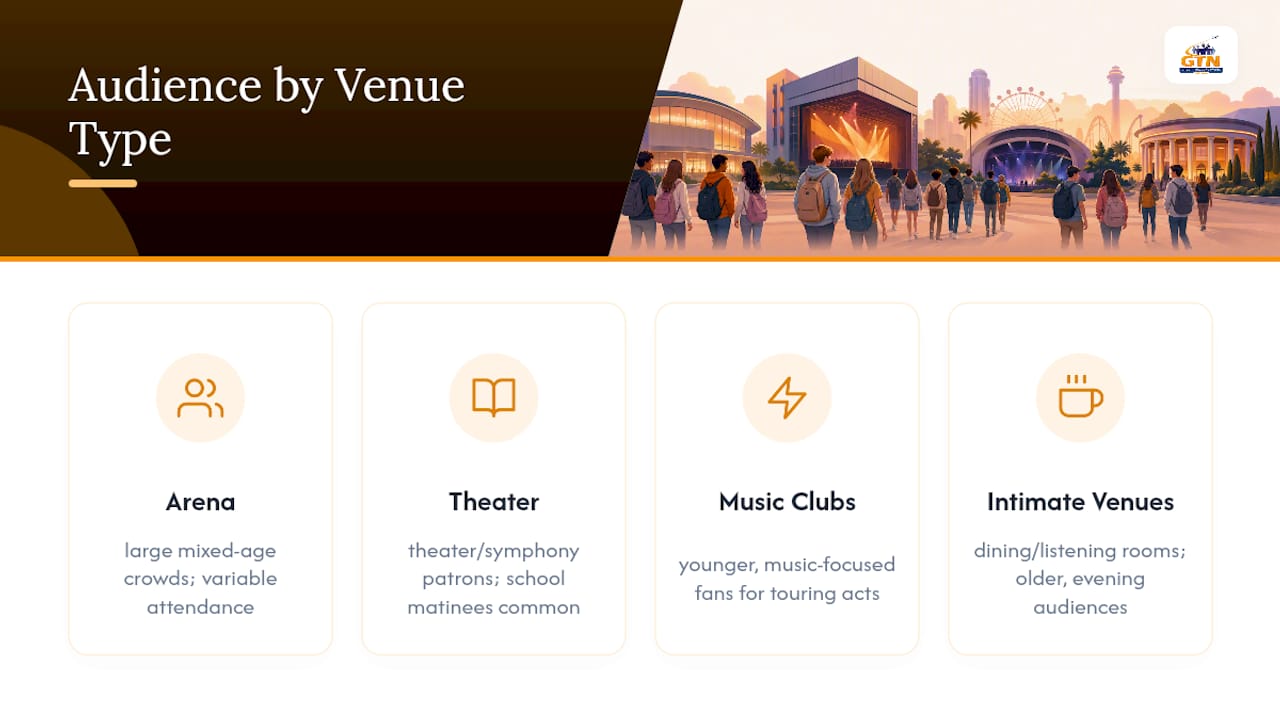
Audience makeup shifts noticeably by venue, and that shift shapes everything from parking demand to concession lines. Kia Center’s arena crowd skews toward large, mixed-age audiences pulled in by national touring names, sports fans, and family shows, with attendance numbers that can swing from a few thousand to a full sellout depending on the act.
Dr. Phillips Center draws a different demographic entirely: theater and symphony patrons, Broadway tourists, and a meaningful share of student groups attending matinee performances tied to school curriculum. The Plaza Live and The Social/Beacham complex pull a younger, more music-focused crowd chasing specific touring artists rather than a general night out, while House of Blues Orlando benefits from its Disney Springs location to attract a heavier tourist mix alongside local regulars.
Supper clubs like Lizzy’s Live and listening rooms like The Vanguard skew toward a slightly older, dining-focused audience looking for a full evening out rather than just a concert. Educational venues like the Valencia College Performing Arts Center see the most varied crowd of all on any given week, from parents attending a student recital to community theater regulars to touring artists booked into the space for a one-off show.
Understanding who else will be in the room matters practically, not just as trivia. A student group attending a Dr. Phillips Center matinee will find themselves among like-minded school groups with similar logistics needs, while the same group at a late House of Blues show would be one of very few youth-focused parties in a mostly adult crowd.
Why Advance Coordination Beats Winging It
Every venue in this guide has its own quirks, and the ones that catch first-time planners off guard are rarely the big obvious ones. It’s the smaller details, like a college performing arts center’s blackout dates around finals, or a supper club’s minimum spend policy, that turn a simple trip into a scramble two weeks out.
The pattern I’ve noticed across dozens of Orlando venue conversations is that the groups who call the box office directly, weeks before assuming anything about seating or accessibility, are the ones who never end up standing in a lobby arguing about a reservation that doesn’t exist. That single habit, picking up the phone instead of trusting a website’s fine print, prevents more trip-day chaos than any packing list ever will.
Group Travel Network’s coordinators build that advance legwork into every performance trip they plan, confirming configuration, accessibility, and load-in details before a group ever boards a bus. It’s not glamorous work, but it’s the difference between a smooth show night and a group leader fielding frustrated calls from parents in the parking lot.
— Donovan
Let Group Travel Network Handle the Venue Logistics
Booking a single ticket to see a show at the Dr. Phillips Center is simple enough on your own. Coordinating tickets, transportation, chaperone staffing, and box-office group rates for forty students headed to an Orlando performance is a different job entirely, and it’s the job Group Travel Network was built to handle.
A dedicated trip coordinator manages the venue calls, confirms seating configurations, and negotiates group-sales rates so you’re not stuck holding forty nonrefundable tickets if a date shifts. Group Travel Network’s vendor relationships with Orlando venues and its flexible payment plans mean a school or ensemble director can spread costs across a semester instead of collecting one lump payment upfront, and built-in travel protection covers the what-ifs that come with any student trip. This kind of managed support pays off most when logistics get complicated: large groups, tight schedules, multiple venues in one trip, or performances that require your own students to coordinate with a venue’s technical staff.
If you’re planning a student performance trip to Orlando, start with the Student Group Trips planning page to see how a coordinator can map out venues, tickets, and travel dates around your group’s specific performance goals.
Sources
- Classes and Camps | Dr. Phillips Center for the Performing Arts
- The Plaza Live — About
- Performing Arts Center | Valencia College
- Hard Rock Live Orlando — Venue information
FAQ
What Are Some Concert Venues in Orlando, Florida?
Orlando’s main concert venues include the Kia Center for arena shows, Hard Rock Live Orlando and The Plaza Live for mid-size touring acts, and The Social, House of Blues Orlando, and The Vanguard for club-scale and intimate shows.
What Is the Biggest Concert Venue in Florida?
The Kia Center in downtown Orlando is among Florida’s largest concert venues, with an arena bowl that reconfigures between roughly 18,000 and 20,000 depending on the event and seating layout.
What Concerts Are Happening in Orlando in 2026?
Show schedules change frequently, so the most reliable source is each venue’s own online calendar. Check the Kia Center, Hard Rock Live Orlando, and Dr. Phillips Center directly for current listings rather than relying on third-party aggregators.
What Are the Top Venues for Student Group Performances?
The Dr. Phillips Center and the Valencia College Performing Arts Center are Orlando’s strongest options for student groups, offering professional staging alongside training programs and academic-friendly booking support. Group Travel Network coordinators regularly work with both when arranging school performance trips.
How Do I Buy Tickets Without Overpaying on Fees?
Contact the venue’s box office directly rather than a resale marketplace, since calling ahead for group ticket purchases can reduce per-ticket processing fees and allow you to hold a block of seats before general sale.
Recommended

Relax with our Student Travel Expertise .
We deliver stress-free student trips backed by an exceptional array of services you won’t find anywhere else:
- Stress-free, creative planning of customized itineraries
- Dedicated GTN Service host on every trip
- Extensive travel protection plan options
- Online, individual registration system
- Flexible payment plans and online payment options
- Bulk buyer discounts for great trips that cost less
Inclusion into #MyGTNFamily for life! (you don’t even have to remember our birthday!)
Spain
There is no place like Spain to offer a student performance opportunity or cultural student trip.
Myrtle Beach
All students love the beach! Especially a beach known for its 60 miles of pristine coastline.
Boston
Have your students experience colonial charm in the city that is considered the hub of New England.
London
Provide your student group with the “Royal” treatment! One of the world’s most recognized cities.
See What People Are Saying
“What wonderful trip we had to NYC! Our group of 51 never missed a beat because of Group Travel Network and our wonderful guide, Tim. It was truly a theatre trip to remember! If you are looking for a travel company who really cares about the details, Group Travel Network is for you!”
“This was my first time using a company to plan our band trip. It was so easy working with Justin and Group Travel Network. We had to make several changes along the way, but they were accommodating changes and worked everything out for us. I would highly recommend using Group Travel Network.”
“It has been my privilege to use Group Travel Network as the exclusive travel coordinator for my band for over 10 years. I can say, without doubt or hesitation, that GTN is, by far, the best travel company for student groups currently in existence. I have often said that I wouldn’t take my band across the street without GTN and that’s not far from the truth!”