

August 29, 2026
Schools: 3 Documents to Finalize Before Minor Travel Without Parents

For school and youth group planners, minor travel without parents means organized group trips where students travel with vetted chaperones under a trip‑specific risk management plan, not solo airline travel. Before you recruit a single student, confirm written organizational approval and finalize that risk plan. Three documents need to be ready before registration opens: the trip approval form, parental authorization and medical release, and an emergency contact roster.
TL;DR:
- Proper planning requires written risk management plans, trip-specific parental authorizations, and detailed emergency procedures to defend against potential liabilities.
- Chaperone screening must include background checks, clear age and role guidelines, and specific training on boundaries, incident reporting, and supervision duties.
- International trips demand early passport and visa applications, with priority on verifying document validity, destination-specific requirements, and group border crossing protocols.
- Airlines treat chaperoned student groups differently from unaccompanied minors, with policies on seating, manifest consistency, and minimum group sizes needing direct confirmation before booking.
- Clear communication with parents about costs, itinerary, behavior expectations, and incident reporting reduces disputes and ensures smooth trip operations.
Table of Contents
- What Is Minor Travel Without Parents, Exactly?
- Printable Pre-Departure Checklist for Trip Planners
- How Do You Build a Trip-Specific Risk Management Plan?
- Chaperone Screening, Ratios, and On-Trip Duties
- What Belongs in a Parental Authorization Form?
- How Do You Vet Transportation, Lodging, and Insurance?
- Parent Meetings, Transparent Pricing, and Trip Communication
- On-Trip Supervision and Incident Response Steps
- Post-Trip Evaluation: What to Document and Keep
- Legal Requirements and Restrictions for Group Youth Travel
- Getting Passports and Travel IDs for Students
- Airline Rules That Affect Your Group Trip
- Crossing International Borders With a Youth Group
- What Experienced Trip Planners Get Wrong
- How Group Travel Network Supports Your Next Student Trip
- Sources
- FAQ
What Is Minor Travel Without Parents, Exactly?
The phrase gets confused constantly with airline “unaccompanied minor” programs, where a single child flies alone and an airline employee escorts them between gates. That’s a different animal entirely.
What you’re managing is a group trip: a band program flying to a competition, a soccer team busing to regionals, a Model UN club touring Washington, D.C. Students travel together, supervised continuously by chaperones your organization selected and trained, under a plan your administration signed off on. The industry term for this is student or youth group travel management, and it comes with its own compliance stack: written risk management plans, trip‑specific consent forms, and defined chaperone ratios.
Get the terminology straight in your own paperwork too. Calling it “unaccompanied minor travel” in a permission slip creates confusion for parents who may associate that phrase with airline policy rather than your supervised itinerary. Precision here isn’t pedantic. It’s the difference between a form that holds up under scrutiny and one that doesn’t.
Printable Pre-Departure Checklist for Trip Planners
Most trip disasters trace back to a skipped step, not a novel crisis. Work through this before you open registration:
- Trip proposal drafted and signed off by your committee or administrator.
- Headcount projected and chaperone ratio confirmed, including backup chaperones and a designated nurse or medically trained adult for trips with health‑sensitive students.
- Parent information meeting scheduled, with signed trip authorization and medical forms collected before final payment.
- Vendor and accommodation contracts reviewed, insurance verified, and a published day‑by‑day itinerary distributed.
- On‑trip binder assembled: printed rosters, photo IDs, medical forms, meeting‑point maps, and an emergency communications plan.
Skip the headcount confirmation and you’ll be renegotiating chaperone ratios the week before departure, which is the worst possible time to discover you’re short two adults.
How Do You Build a Trip-Specific Risk Management Plan?
A risk management plan isn’t a formality tacked onto the itinerary. It’s the document that determines whether your organization can defend its decisions if something goes wrong, and Venable LLP’s guidance on school travel risk processes treats it as the central mitigation tool for exactly this reason.
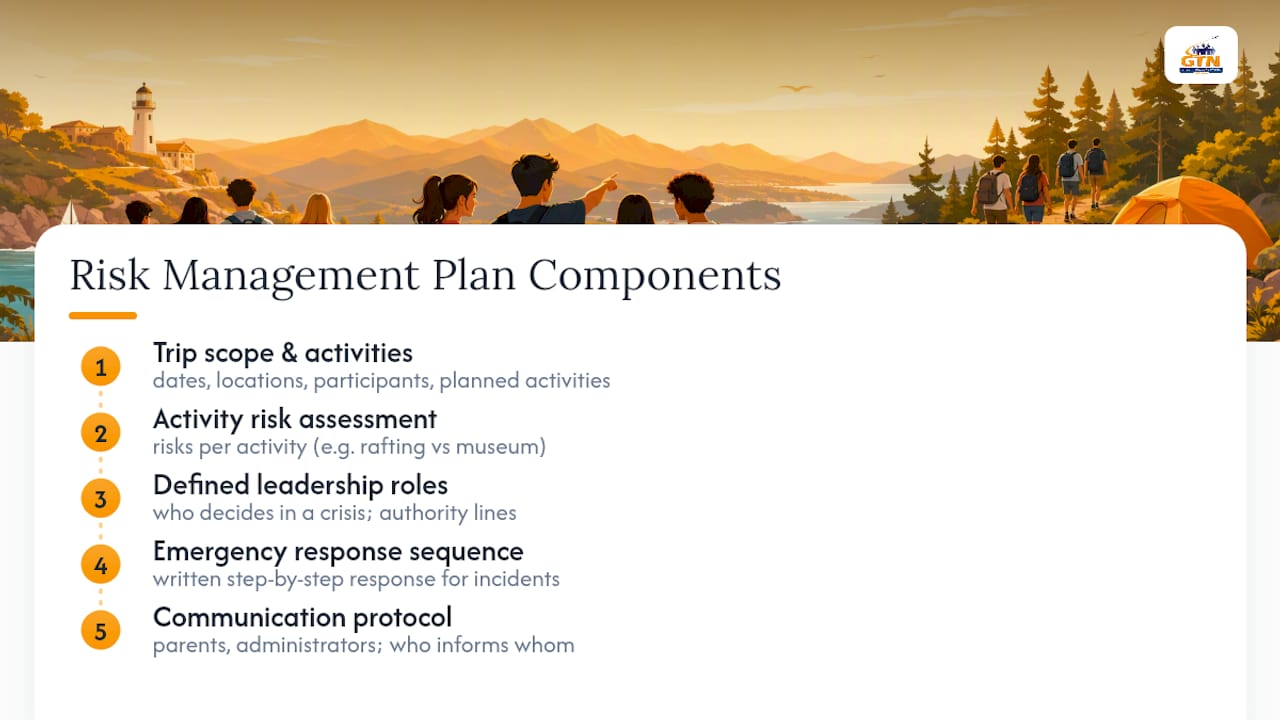
A workable plan covers five things: the trip’s scope and activities, a risk assessment specific to those activities (whitewater rafting carries different exposure than a museum tour), clear roles and decision authority for who calls the shots in a crisis, a written emergency response sequence, and a communication protocol for parents and administrators.
Route the plan through multiple signers before you finalize it: your division head or principal, the business officer or CFO who’s tracking budget exposure, the school nurse if health considerations are in play, and legal counsel for international trips or higher‑risk activities. For complex logistics, bring in outside medical or security advisors rather than guessing.
ISO 31031 guidance on travel risk management gives you a repeatable framework rather than an ad hoc checklist, and it’s worth building your template around it. Keep signed copies of the plan, sign‑off emails, and any advisor consultations. That paper trail is what protects your school if a parent or lawyer later asks what precautions were taken.
Chaperone Screening, Ratios, and On-Trip Duties
Chaperones are your entire supervision infrastructure once the bus pulls away from school. Get this wrong and every other precaution is cosmetic.
Run background checks on every adult chaperone, require a reasonable minimum age for day trips and a higher age for overnight travel, and document the screening process in writing, not just verbally with the front office. Diocesan and Catholic Mutual guidance on overnight youth trips also recommends written chaperone guidelines and adequate night security, both of which get skipped more often than they should.
On ratios, Groups Tours’ school trip planning guidance puts the common baseline at roughly 1 adult per 8 to 10 students for middle and high school groups, tightening to 1 per 5 to 6 for elementary‑age students. Raise those ratios for water activities, international travel, or any student with medical or behavioral needs that require closer supervision.
Train chaperones on:
- Appropriate boundaries and one‑on‑one contact rules
- Basic first aid and when to escalate to a medical professional
- Incident reporting procedures and documentation
- Night supervision protocols, including bed checks and curfew enforcement
- Specific role assignments (who owns the med kit, who leads headcounts)
Pro Tip: Assign each chaperone a named subgroup of students, not a floating “watch everyone” role. Diffuse responsibility is how a missing student goes unnoticed for twenty minutes.
Our chaperone training and screening guide breaks down role assignments in more detail if you’re building a training packet from scratch.
What Belongs in a Parental Authorization Form?
A general enrollment waiver signed in August does not cover a five‑day performance tour in March. Venable’s risk management analysis is specific on this point: overnight or higher‑risk trips need their own trip‑specific authorization and release, because a blanket waiver rarely names the actual risks involved.
Your form should spell out the activities students will do, exact dates, the all‑in cost, emergency contacts, medication instructions, and explicit authorization for a chaperone to make emergency medical decisions if a parent can’t be reached immediately.
On liability language, don’t just copy a template from another district. Tie the waiver’s risk descriptions to your actual itinerary, and loop in legal counsel for international travel or physically demanding activities. A generic waiver signals to a court that nobody actually thought through this trip’s specific risks.
For students with IEPs, allergies, or other medical accommodations, get agreements in writing with parents well before departure, not as a verbal understanding at the meeting. Our medical forms and checklist template covers the documentation most planners forget until it’s too late.
How Do You Vet Transportation, Lodging, and Insurance?
Vendor vetting is where planners either save themselves a nightmare or inherit one from a contractor they never fully checked out.
For any vendor, whether bus company, hotel, or tour operator, request proof of insurance, current licensing, and references from other school groups they’ve served. Read cancellation and force majeure clauses closely; a vague refund policy becomes a five‑figure problem when weather cancels a trip.
For transportation specifically, confirm driver credentials, insurance coverage limits, and whether the charter company has passed a recent safety audit. Don’t take a sales rep’s word for it. If they’re vetting external programs on your behalf, check their process against scam warning signs for parents that youth organizations increasingly flag.
For lodging, verify rooming plans align with your chaperone ratios, confirm secure building access after hours, check proximity to the nearest emergency care facility, and set clear rules on in‑room charges before students ever get a key card. Our accommodation standards guide walks through the specific questions to ask a hotel sales manager.
On insurance, three types matter: school liability coverage, participant travel protection (trip cancellation, interruption), and medical evacuation coverage for international trips. Ask your broker directly whether evacuation coverage is included or a separate rider, since that gap surprises more planners than any other line item.
Parent Meetings, Transparent Pricing, and Trip Communication
Poor communication about risk and cost is one of the most common triggers for parent disputes after a student injury, more so than the incident itself. A well‑run pre‑trip meeting heads most of that off before it starts.
Structure the meeting around these points:
- Full itinerary walkthrough, including scheduled activities and free time
- Named chaperone list and their assigned responsibilities
- Behavior expectations and consequences, stated plainly
- All‑in per‑student cost, payment schedule, and refund policy
- Emergency contact procedure during the trip
Present cost as one number, not a base price with fees revealed later. Groups Tours’ planning guidance recommends bundling vendor requests and booking early to lock in group rates, which also gives you room to quote an accurate all‑in figure instead of a moving target.
Keep signed forms organized, digitally or on paper, with a clear access list of who can pull them in an emergency. During the trip, set a fixed update cadence for parents and a documented process for reporting any incident rather than an informal phone call that nobody logs. Our parent communication guide includes sample scripts for both routine updates and incident notifications.
On-Trip Supervision and Incident Response Steps
Daily routine is what prevents most incidents; the response plan is what contains the ones that happen anyway.
Run scheduled headcounts at every transition point (leaving the hotel, boarding the bus, entering a venue), enforce a buddy system for free time, and hold firm curfews with a chaperone physically checking rooms, not just texting a reminder.

When an incident happens, the sequence matters: secure the immediate scene, get medical care moving first, then notify the lead administrator and parents, and document facts while they’re fresh, not the next morning from memory. Escalate to your emergency contact list if the situation exceeds what on‑site chaperones can handle alone.
For medication, designate one chaperone (ideally the nurse or medically trained adult) to store and administer all student medications, with a dosage log signed at each administration. Never let students self‑administer prescription medication without documentation, even for routine daily doses.
If a student needs to go home early, decide in advance who makes that call, typically the lead administrator in consultation with the parent, and how the cost gets allocated. Most organizations bill the family for early‑return travel arrangements tied to disciplinary issues, while medical emergencies are usually handled under your travel protection policy. Document the decision and the reasoning in writing regardless of which path you take.
Post-Trip Evaluation: What to Document and Keep
The trip isn’t finished when the bus pulls back into the parking lot. Collect feedback from students, chaperones, and parents while memories are fresh, ideally within a week of return, and feed it directly into next year’s risk plan and vendor list.
Incident files, even minor ones, should include the written incident report, medical documentation if applicable, parent notification records, and any follow‑up correspondence. Retain signed authorization forms and incident files for several years past the student’s graduation, since claims can surface long after the trip ends; check with legal counsel on the retention period appropriate for your state and district.
Use after‑action notes to make concrete changes: if a vendor was unresponsive, replace them. If a chaperone ratio felt thin during an activity, raise it next time. If parents flagged confusion about costs, tighten the meeting agenda. Small operational fixes compound fast across multiple trips a year.
Legal Requirements and Restrictions for Group Youth Travel
Minors traveling in a supervised school or youth group generally do not need the individual consent letters associated with a child crossing a border alone or flying as an airline unaccompanied minor. The legal obligation instead falls on your organization to secure proper parental authorization, maintain adequate supervision ratios, and hold a defensible risk management plan.
Requirements vary by state and by district policy, so check your state department of education’s guidance and your district’s own travel policy before finalizing anything. Some districts require school board approval for any trip exceeding a certain distance or duration; others require it only for overnight or international travel. Don’t assume last year’s approval process still applies.
For students with custody arrangements, divorced parents, or guardianship situations, get authorization from whichever parent or guardian holds legal decision‑making authority, and keep a copy of the custody order on file if there’s any ambiguity. This is a common blind spot: a well‑meaning coordinator collects one parent’s signature without confirming that parent has the legal authority to consent.
International trips add another layer. Some destinations require notarized parental consent letters for minors traveling with a group leader rather than a biological parent, particularly at border crossings where officials scrutinize adult‑to‑minor travel groups more closely. Build in extra lead time to research destination‑specific requirements rather than discovering them at check‑in.
None of this replaces legal counsel. For any trip involving custody complications, international travel, or unusually high‑risk activities, get your district’s attorney to review the authorization language before it goes home to parents.
Getting Passports and Travel IDs for Students
International trips mean passport logistics become a program‑wide project, not an individual family errand you can leave to chance.
Every minor under 16 needs a passport application signed in person by both parents or legal guardians, or one parent with a notarized statement of consent from the other, submitted through the U.S. Department of State’s passport process. Processing times fluctuate, so build in a minimum of several months’ lead time before departure, longer during peak application seasons in spring and summer.
Send parents a passport reminder at least six months before an international trip, not the standard two months you’d use domestically. Passport offices see a predictable surge every spring from school groups that started the process too late, and expedited fees add real cost to a trip budget nobody planned for.
For students who already have passports, check expiration dates against the trip’s return date, factoring in the six‑month validity buffer many countries require beyond your actual travel dates. A passport expiring three months after your return date can still get a student turned away at a foreign border if that country requires six months of remaining validity.
Some students may need visas depending on destination and nationality, particularly non‑U.S. citizen students on an international student roster. Handle these applications separately and well in advance, since visa processing for minors often requires additional documentation like school enrollment verification or parental consent letters translated into the destination country’s language.
Keep a master spreadsheet tracking each student’s passport status, expiration date, and visa requirements if applicable. This single document prevents the scramble that happens when someone discovers a lapsed passport two weeks before departure.
Airline Rules That Affect Your Group Trip
Group travel changes how airlines treat your students compared to a lone child flying as an airline‑designated unaccompanied minor.
When students travel as part of a chaperoned group booking, most airlines waive the unaccompanied minor program and its associated fees, since a documented adult chaperone is present throughout. That said, individual airline policies vary on minimum group sizes and chaperone‑to‑minor ratios required to qualify for group handling, so confirm this directly with your airline or travel coordinator before booking, not after tickets are purchased.
Airlines typically still require a passenger manifest listing every minor’s full legal name, date of birth, and the assigned chaperone. Keep this list consistent across your travel documents, medical forms, and airline booking to avoid gate‑side discrepancies that can delay boarding for the whole group.
Seating assignments matter more for youth groups than most planners realize. Request chaperones be seated adjacent to or near their assigned students, and confirm this in writing with the airline rather than assuming it will happen automatically at check‑in. Airlines sometimes auto‑assign seats that scatter a group across the cabin, which undermines your supervision plan the moment the doors close.
Bus and rail transportation carry their own rules worth checking: charter bus companies serving school groups often require a signed roster and chaperone contact list before departure, and some rail carriers cap the number of unaccompanied‑looking minors per car regardless of your chaperone presence. Confirm these details in your vendor contract rather than discovering them at the platform.
Crossing International Borders With a Youth Group
Border crossings with a chaperoned group draw more scrutiny than most planners expect, particularly when the adults present aren’t the students’ biological parents.
Many countries request a notarized letter of consent from each student’s parent or guardian authorizing the trip leader to travel with that minor across the border, even though this isn’t a legal requirement everywhere. Requirements shift by destination and can change with little notice, so verify current rules directly through the destination country’s consulate or embassy website rather than relying on last year’s paperwork.
Carry physical copies of every student’s authorization form, passport, and emergency contact information in a chaperone binder, not just digital versions on a phone that might lose battery or signal at a border checkpoint. Border officials in some countries expect to see original signed documents, not printouts of an email.
If your group crosses through a country with different custody or guardianship recognition standards, particularly relevant for students whose parents are divorced or share custody unevenly, get legal counsel to review documentation requirements well ahead of travel. A missing notarization can strand a student and a chaperone at a checkpoint while the rest of the group continues on.
Build extra time into your itinerary for border processing with a large youth group. Officials often process group crossings more slowly than individual travelers, since they’re verifying multiple sets of documents against multiple minors simultaneously.
What Experienced Trip Planners Get Wrong
Most disputes we hear about after a student trip don’t come from the incident itself. They come from a parent who felt blindsided, either by a risk they didn’t know existed or a cost that showed up after they’d already committed. Written risk plans and trip‑specific consent forms matter less as legal paperwork and more as the mechanism that forces you to have that conversation with parents before it becomes a crisis.
We’ve worked with coordinators managing a 60‑student band trip who almost skipped the formal parent meeting because “everyone already knows the drill.” That’s exactly the group where a vague itinerary detail, an unclear medication policy, turns into a frantic phone call three states away. A dedicated trip coordinator, careful vendor vetting, and a real parent meeting agenda solve that before it starts, not after.
The planners who run the smoothest trips aren’t the ones with the fewest problems. They’re the ones with the paperwork and the plan to handle problems fast.
— Donovan
How Group Travel Network Supports Your Next Student Trip
Group Travel Network handles the parts of this process that eat the most planning hours: building customized itineraries around your risk parameters, assigning a dedicated trip coordinator who knows your group’s specific needs, and managing online registration so parents can complete authorization forms and payments without a paper trail scattered across email threads. Flexible payment plans keep the all‑in cost conversation simple for families, and travel protection options give you a real answer when a parent asks what happens if a student gets sick two days before departure.

If you want a starting point for your own parental authorization form or a sample safety packet, our team can walk you through what we use across school and performance group trips, adjusted to your destination and activity mix. Group Travel Network is the alternative to piecing together vendor contracts, insurance quotes, and consent forms on your own. We run that process for you, so your planning time goes toward the trip itself rather than chasing signatures.
Ready to see what a fully coordinated itinerary looks like for your group? Start with our educational group trip planning guide for schools and request a custom quote for your next trip.
This article is general information, not a substitute for advice from a qualified lawyer. Consult a qualified legal professional about your own circumstances before acting on anything here.
Sources
- Rules of the Road: Risk Management Processes for School-Sponsored Trips and Travel | Venable LLP
- Planning a School Group Trip: Rates, Safety & Itineraries | Groups Tours
FAQ
What Does “Minor Travel Without Parents” Actually Mean for Schools?
It refers to organized group trips where students travel with vetted chaperones under a school‑approved risk management plan, not individual unaccompanied airline travel.
Do Airlines Charge Unaccompanied Minor Fees for School Groups?
Most airlines waive individual unaccompanied minor fees when students travel as part of a documented chaperoned group, though minimum group size requirements vary by carrier.
What Chaperone Ratio Should Schools Use for Overnight Trips?
Common guidance suggests roughly 1 adult per 8 to 10 students for middle and high school groups, tightening to 1 per 5 to 6 for elementary‑age students, with higher ratios for water activities or medically sensitive students.
How Far in Advance Should Students Apply for Passports?
Start passport applications for international trips at least six months ahead, since minors under 16 require in‑person authorization from both parents or guardians and processing times fluctuate seasonally.
Can a Chaperone Legally Make Medical Decisions for a Student Abroad?
Only if the parental authorization form explicitly grants that chaperone emergency medical decision‑making authority in writing, which is why trip‑specific consent forms matter more than general enrollment waivers.
Recommended

Relax with our Student Travel Expertise .
We deliver stress-free student trips backed by an exceptional array of services you won’t find anywhere else:
- Stress-free, creative planning of customized itineraries
- Dedicated GTN Service host on every trip
- Extensive travel protection plan options
- Online, individual registration system
- Flexible payment plans and online payment options
- Bulk buyer discounts for great trips that cost less
Inclusion into #MyGTNFamily for life! (you don’t even have to remember our birthday!)
Spain
There is no place like Spain to offer a student performance opportunity or cultural student trip.
Myrtle Beach
All students love the beach! Especially a beach known for its 60 miles of pristine coastline.
Boston
Have your students experience colonial charm in the city that is considered the hub of New England.
London
Provide your student group with the “Royal” treatment! One of the world’s most recognized cities.
See What People Are Saying
“It has been my privilege to use Group Travel Network as the exclusive travel coordinator for my band for over 10 years. I can say, without doubt or hesitation, that GTN is, by far, the best travel company for student groups currently in existence. I have often said that I wouldn’t take my band across the street without GTN and that’s not far from the truth!”
“This was my first time using a company to plan our band trip. It was so easy working with Justin and Group Travel Network. We had to make several changes along the way, but they were accommodating changes and worked everything out for us. I would highly recommend using Group Travel Network.”
“What wonderful trip we had to NYC! Our group of 51 never missed a beat because of Group Travel Network and our wonderful guide, Tim. It was truly a theatre trip to remember! If you are looking for a travel company who really cares about the details, Group Travel Network is for you!”