


School trip insurance typically runs 5% to 10% of total trip cost, or roughly $26 to $252 per student (opens in a new tab) depending on the trip price and length.
That price typically buys:
- Trip cancellation and interruption coverage
- Emergency travel medical benefits
- Medical evacuation and repatriation
Key Takeaways
School trip insurance generally costs about 5% (opens in a new tab) to 10% of total trip cost, and the coverage that matters most is a medical evacuation limit of at least $250,000. [source]
| Point | Details |
|---|---|
| Budget 5% to 10% of trip cost | Use this as your starting insurance line item for any comprehensive plan. |
| Check per-student rate bands | Flat-rate tables can run from about $10 to $252 depending on trip cost tier. |
| Prioritize evacuation limits | Require at least $250,000 in evacuation coverage before comparing price. |
| Buy CFAR early if needed | Most plans require CFAR purchase within 14 to 21 days of first deposit. |
| Use one group policy | A single enrollment simplifies claims and keeps limits consistent across travelers. |
Table of Contents
- How Much Does School Trip Insurance Cost Per Student?
- What Does School Trip Insurance Actually Cover?
- What Factors Change Your School Trip Insurance Rates?
- Should You Buy a Group Policy or Individual Plans?
- How Do You Estimate and Buy the Right Coverage?
- What Coverage Limits Should Schools Require?
- What Are the Registration and Eligibility Rules to Know?
- How Do Group Travel Operators Handle Trip Insurance?
- What This Guide Gets Right That Most Advice Misses
- Why Cost-First Thinking Beats Feature Comparison
- Sources
- FAQ
How Much Does School Trip Insurance Cost Per Student?
Two numbers matter most: the percent-of-trip-cost benchmark and the flat per-student rate band. Comprehensive student travel insurance generally falls between 5% and 10% of the total trip cost (opens in a new tab), which means a $5,000 group trip usually costs somewhere between $250 and $500 to insure per traveler. Travel medical-only plans, without cancellation or interruption benefits, come in noticeably cheaper than that comprehensive band.
Flat per-student rate tables tell a more granular story. Travel Insured’s Student/School Group Protection plan publishes banded pricing for trips up to 30 days, starting around $10 per student for the lowest trip-cost tier and climbing as insured trip cost rises.
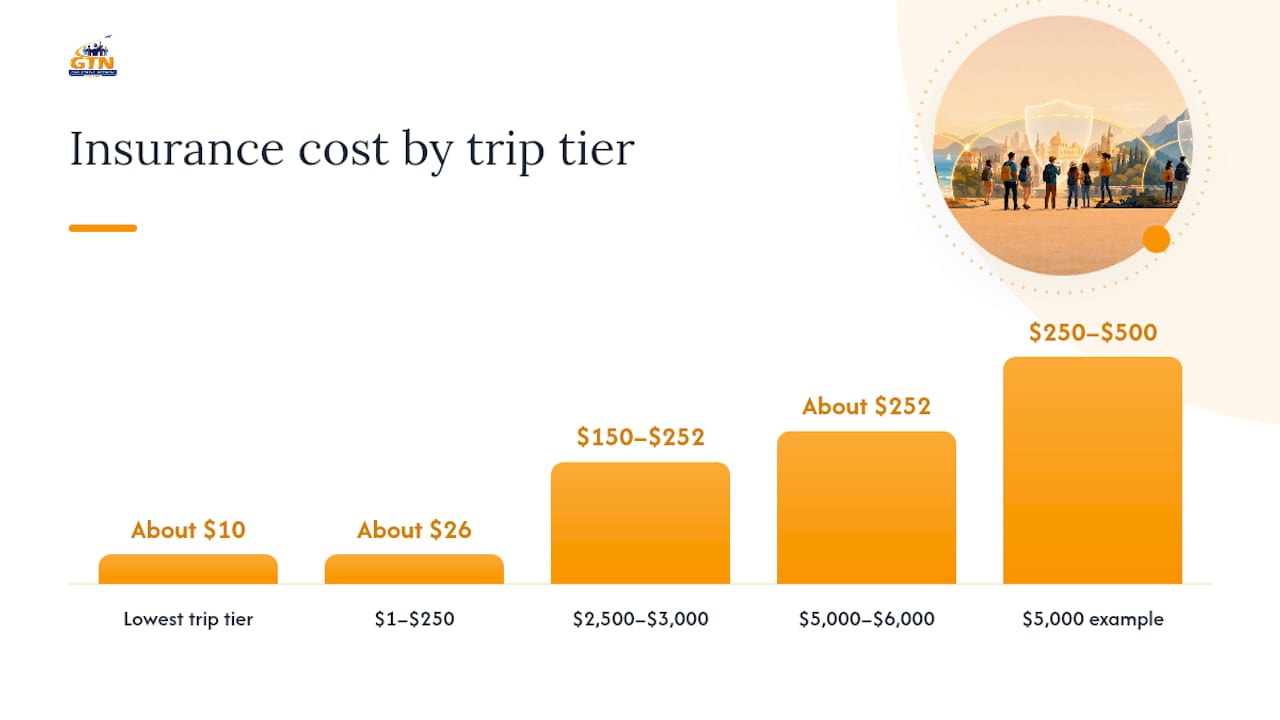
| Trip Cost Per Student | Approximate Insurance Cost |
|---|---|
| — | About $10 |
| $1 to $250 | About $26 |
| $2,500 to $3,000 | $150 to $252 |
| $5,000 to $6,000 | About $252 |
For a $5,000 domestic trip, budget roughly $250 to $500 total, or about $10 to $25 per student for a bare-bones travel medical add-on if cancellation coverage isn’t a priority.
What Does School Trip Insurance Actually Cover?
The price tag only means something once you know what it buys. Standard school trip policies bundle several benefit categories, and the strongest plans list specific dollar limits for each (opens in a new tab) rather than vague promises of “coverage included.”
Expect these core benefits:
- Trip cancellation and interruption, reimbursing prepaid, non-refundable costs
- Emergency travel medical expenses for injury or illness abroad
- Emergency medical evacuation and repatriation
- Baggage loss, delay, and personal effects
- Travel delay reimbursement for missed connections
Common exclusions trip up unprepared coordinators: pre-existing medical conditions without a waiver, high-risk activities like whitewater rafting or zip-lining unless specifically added, and failure-to-appear clauses that deny claims if a student simply misses a flight through their own error.
Pro Tip: Academic trips often carry prepaid program fees, tuition deposits, and housing costs that are separate from airfare and hotels. Confirm your policy’s trip cost definition includes those academic fees. Otherwise you’re only insuring half the financial exposure.
What Factors Change Your School Trip Insurance Rates?
Two identical-looking trips can price out very differently once an insurer runs the numbers. The insured trip cost drives most of the premium, since cancellation and interruption benefits scale directly with what’s at financial risk. Beyond that:
- Trip length — longer trips mean more exposure days, raising the premium
- Destination and territory — international trips, especially to regions with higher medical costs, cost more than domestic travel
- Traveler age — older chaperones and adult sponsors sometimes carry higher per-person medical rates
- Activity risk — adventure sports or performance travel with equipment can trigger add-on premiums
- Coverage limits and deductible — higher limits and lower deductibles both increase cost
- CFAR and other add-ons — these are the single biggest optional cost drivers
- Group size — larger groups sometimes qualify for modest per-student discounts
One quoting quirk worth knowing: some plans price per trip while others price per day of travel. A per-day structure can look cheaper upfront but adds up fast on multi-week academic tours, so always compare the total quoted premium, not just the headline rate.
Should You Buy a Group Policy or Individual Plans?
A single group policy covering every student, teacher, and chaperone under one set of limits is the standard approach for school-sponsored travel, and it’s usually the more efficient one. Group enrollment means one application, one point of contact for claims, and consistent benefit limits across the entire traveling party. Rolling the premium into the overall trip fee is a common, cost-effective practice that avoids chasing down individual payments.

Individual policies still have a place. Some parents prefer choosing their own plan for a student with a pre-existing condition, or want higher personal limits than the group plan offers. The tradeoff is administrative: individual policies mean tracking multiple insurers, multiple claim processes, and potential coverage gaps if a family opts out entirely.
Pro Tip: Build the insurance line item into your trip payment schedule from day one instead of treating it as an optional add-on late in the process. Late add-ons are where coverage gaps happen.
How Do You Estimate and Buy the Right Coverage?
Getting an accurate quote takes a handful of concrete inputs, not guesswork. Work through these steps:
- Total the full trip cost per student, including academic fees, lodging, transportation, and activities
- List every participant, separating students, teachers, and adult chaperones
- Confirm the destinations and any higher-risk activities on the itinerary
- Decide your target medical and evacuation limits before requesting quotes
- Compare at least two or three quotes side by side, checking CFAR eligibility windows
For a worked example: a $5,000 mid-range international trip, insured for the full amount, lands around $350 to $500 comprehensive, or roughly $50 to $80 more if you add CFAR and bump the evacuation limit to $250,000.
Timing matters as much as the numbers. CFAR almost always requires purchase within a short window, often within 14 to 21 days of the first trip deposit. Miss that window, and the option disappears for that trip regardless of price.
What Coverage Limits Should Schools Require?
Medical evacuation is where thin policies fail schools the hardest. Evacuation can run $100,000 or more (opens in a new tab) in a genuine emergency, and insurer guidance recommends a floor of at least $250,000 in evacuation coverage for international student travel. Anything lower leaves the school financially exposed if a real incident happens overseas.
Watch for these red flags when comparing quotes:
- Vague activity exclusion language that doesn’t name specific sports or excursions
- Claim filing windows shorter than 90 days after the incident
- Secondary-only medical coverage, which pays after a family’s private insurance rather than first
To control cost without cutting corners: raise the deductible slightly on lower-risk domestic trips, reserve CFAR for your highest-cost or most schedule-sensitive tours, and bundle teacher/chaperone liability coverage rather than buying it separately.
What Are the Registration and Eligibility Rules to Know?
Insurers set firm windows for certain benefits, and missing one is the most preventable coverage gap a school faces. CFAR typically must be purchased within 14 to 21 days of the first deposit, while group registration minimums often range from 45 to 90 days before departure, though exact rules vary by plan (opens in a new tab).
Group plans generally cover students, teachers, and adult chaperones under one policy, and some extend to accompanying family members if added before the deadline.
| Timing Rule | What It Affects |
|---|---|
| CFAR purchase window (14 to 21 days post first deposit) | Eligibility to add Cancel for Any Reason |
| Group registration lead time (45 to 90 days) | Locking in group rates and full roster coverage |
| Late registrant cutoff | Whether a new sign-up can still join the group policy |
How Do Group Travel Operators Handle Trip Insurance?
Experienced group travel operators treat insurance as a built-in step, not an afterthought. The typical workflow: select policy parameters and limits early, set a firm enrollment deadline for families, collect medical forms and waivers alongside registration, fold the premium into the overall trip payment plan, and confirm every traveler’s coverage before departure.

On the claims side, operators act as a single point of contact, coordinating with the insurer’s 24/7 assistance line so a family dealing with a medical emergency abroad isn’t also trying to decode policy paperwork.
Pro Tip: The most common administrative error is a coordinator assuming late registrants are automatically covered. Confirm every new sign-up is added to the policy roster before final payment, not after.
What This Guide Gets Right That Most Advice Misses
Most articles on this topic compare providers feature by feature and never answer the question administrators actually ask first: what will this cost, and what does that number buy? The rate bands here matter more than any brand name, because a $10 flat fee for a free-cost post-departure plan and a $252 fee for a $6,000 trip aren’t the same product wearing different labels. They’re different risk categories entirely.
The conventional advice to “just get the cheapest quote” undersells how much evacuation limits matter. A policy that saves $15 per student but caps evacuation at $50,000 is a bad trade the moment a real medical emergency happens overseas. Prioritize the $250,000 evacuation floor first, then shop price within that tier.
Where schools consistently underinvest is administrative process, not coverage itself. A single missed CFAR window or an unregistered late sign-up causes more real-world claim denials than any exclusion clause buried in the fine print. Build the timeline before you build the budget.
Group Travel Network works directly with schools to fold insurance planning into the overall trip payment structure (opens in a new tab), so coordinators aren’t managing a separate insurer relationship on top of everything else. If you’re mapping out a trip budget for next year, our educator’s guide to group travel planning (opens in a new tab) walks through how insurance fits alongside airfare, lodging, and program fees, and you can also explore student tour packages (opens in a new tab) that include protection options built into the itinerary from the start.
Why Cost-First Thinking Beats Feature Comparison
Administrators drowning in provider comparison charts often miss the simpler question: does this policy match the actual dollar risk on this specific trip? A $5,000 domestic trip and a $5,000 international trip carry wildly different medical risk profiles even at identical price points, and the insurance should reflect that gap, not just the trip cost.
A low-risk overnight trip to a state capital doesn’t need the same evacuation limit as a three-week trip abroad, yet both might fall in that same percentage band. Treat the percentage as a budget planning tool, not a coverage adequacy test.
What administrators should prioritize first isn’t the cheapest quote or the most comprehensive sounding plan. It’s confirming the evacuation limit, the CFAR purchase window, and whether medical coverage pays primary or secondary. Those three details determine whether a claim gets paid smoothly or turns into a months-long fight during an already stressful situation.
This article is general information, not a substitute for advice from a qualified financial advisor. Consult a qualified financial professional about your own circumstances before acting on anything here.
Sources
- Everything You Need to Know About Student Travel Insurance – Squaremouth (opens in a new tab)
- Student/School Group Protection Plan – TravelInsuranceCenter (opens in a new tab)
- Student Travel Insurance – InsureMyTrip Education Program (opens in a new tab)
- School Trip Insurance – Howden Group (opens in a new tab)
- Student Travel Insurance – Progressive (student page) (opens in a new tab)
FAQ
What Is the Average Cost of Trip Insurance?
Comprehensive travel insurance for student trips typically runs 5% to 10% of the total trip cost, though flat per-student rates can range from about $10 to over $250 depending on the insured trip amount.
Is School Trip Insurance Worth It?
Yes for most trips involving prepaid, non-refundable costs like academic program fees, deposits, or international travel, since a single cancellation or medical emergency can otherwise cost the school or family far more than the premium.
How Much Do School Trips Usually Cost?
School trip costs vary widely by destination and length, from a few hundred dollars for a regional day trip to several thousand dollars for international academic or performance tours, which directly shapes the insurance premium since cost drives price.
How Much Is Travel Insurance for a $5,000 Trip?
A $5,000 school trip typically costs around $250 to $500 to insure comprehensively, based on the standard 5% to 10% benchmark, with CFAR add-ons pushing that total higher.
Recommended
- School Trip Payment Policy: 2026 Templates And Timelines (opens in a new tab)
- Travel Insurance For School Group Trips Explained • Group Travel Network (opens in a new tab)
- Group Travel Insurance Explained: Protect Student Trips Easily • Group Travel Network (opens in a new tab)
- Liability Protection For Group Travel: 2026 Guide For Schools • Group Travel Network (opens in a new tab)