

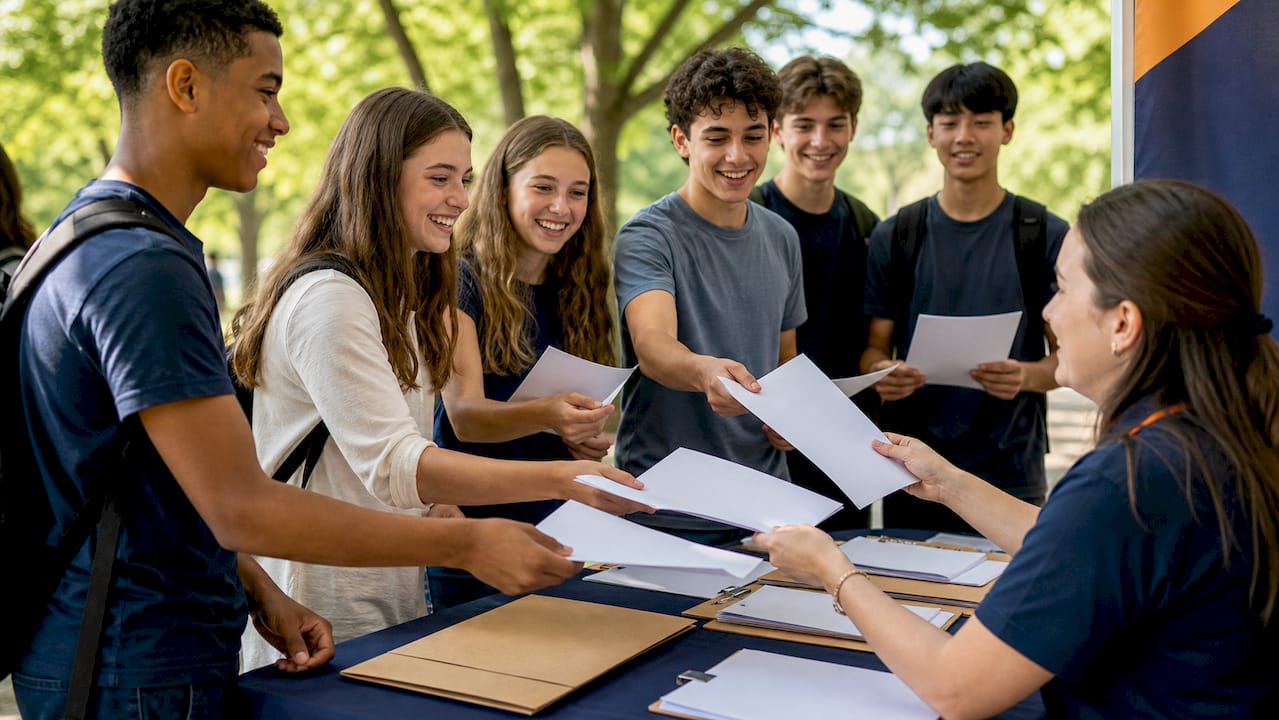
There is no such thing as a valid “group passport” for U.S. citizens. Every student in your group needs an individual U.S. passport book, full stop. The State Department is unambiguous (opens in a new tab): collective or group travel documents are not recognized for American travelers going abroad. The sooner your school treats this as an individual-by-individual logistics problem, the fewer last-minute crises you’ll face at the airport.
Three things to do right now:
- Verify each student’s passport status — expired, expiring within 6 months of your return date, or never issued all require different actions.
- Set a “passport-in-hand” deadline at least 90 days before departure to leave room for processing delays.
- Schedule an on-campus passport drive or block-book appointments at a local acceptance facility so families aren’t navigating the process alone.
The core forms you’ll work with: DS-11 (opens in a new tab) (first-time applicants and all minors), DS-82 (renewals for eligible adults), DS-3053 (parental consent for minors), and DS-5504 (limited corrections). Once passports are in hand, enroll the group in the Smart Traveler Enrollment Program (STEP) (opens in a new tab) so your institution has a direct communication line with the nearest U.S. embassy in an emergency.
Key Takeaways
Every student in a U.S. group requires an individual passport; there is no group passport, and the 90-day DS-3053 notarization window is the most common cause of last-minute delays for school trips.
| Point | Details |
|---|---|
| No group passport exists | U.S. law requires each traveler to hold an individual passport book for international travel. |
| 6-month validity rule | Require every student’s passport to be valid at least 6 months beyond the trip’s return date. |
| DS-3053 timing | Notarized consent forms expire for submission purposes 90 days after notarization; re-notarize if the drive runs later. |
| Passport-in-hand deadline | Set the deadline at least 90 days before departure to allow time for processing delays and corrections. |
| Grouptravelnetwork | Provides dedicated trip coordinators and on-campus passport-drive support to manage group logistics end-to-end. |
Table of Contents
- How do passports for student groups actually get processed?
- What consent rules apply to minor students’ passports?
- How do processing times and validity rules affect your trip schedule?
- How do you run a school passport drive efficiently?
- What funding programs can help students afford a passport?
- Where do students submit applications and get compliant photos?
- Copy-ready checklist and 90/60/30-day timeline for school administrators
- Why centralizing passport logistics changes the outcome
- Grouptravelnetwork handles the logistics so you can focus on the trip
- Sources
- FAQ
How do passports for student groups actually get processed?
The short answer: one application at a time, but you can batch the logistics. Here’s how to run it cleanly.
First-time applicants (DS-11)
Every student who has never held a U.S. passport, or whose last passport was issued before age 16, must complete Form DS-11. This form cannot be submitted by mail — the applicant must appear in person at an acceptance facility. Collect the following from each student before the event:
- Proof of U.S. citizenship: certified birth certificate (with raised seal), previous U.S. passport, Consular Report of Birth Abroad (CRBA), or Certificate of Naturalization.
- Photo ID: a valid driver’s license, school-issued ID with photo, or parent/guardian ID for minors.
- Photocopy of both sides of the ID on a single sheet of white paper.
- One passport photo meeting State Department specs (2×2 inches, white background, taken within the last 6 months).
- Application fee plus the acceptance facility fee — both are required at submission. Check the current fee schedule since amounts vary by passport type (book vs. card) and applicant age.
Do not pre-sign DS-11. The acceptance agent must witness the signature. This is the single most common intake error at school passport drives.
Renewal-eligible adults (DS-82)
A student or chaperone can renew by mail using DS-82 if their most recent passport was issued at age 16 or older, is less than 15 years old, is undamaged, and is in their possession. Mail-in renewals skip the acceptance facility step, which speeds things up for adult chaperones. Still, confirm eligibility before assuming DS-82 applies — a student who got their first passport at 14 must use DS-11 again.
Ages 16–17
These applicants use DS-11 and appear in person, but the parental-consent rules differ from under-16 cases (covered in the next section). One parent or guardian signature on the form is sufficient, though the State Department recommends both parents sign when possible.
Pro Tip: Pre-populate a master intake spreadsheet with each student’s name, date of birth, and application type before the passport drive. Print a cover sheet for each student’s document packet so the intake volunteer can verify completeness in under 60 seconds.
What consent rules apply to minor students’ passports?
This is where school administrators most often get tripped up, and a single missing signature can delay a student’s passport by weeks.
Under-16 applicants
Both parents or legal guardians must either appear together at the acceptance facility or one parent appears while the other submits a notarized DS-3053 Statement of Consent. The notarized DS-3053 must be submitted within 90 days of the notarization date — a detail that catches many schools off guard when they collect consent forms months before the passport drive.
The 90-day window is a hard deadline. A DS-3053 notarized on September 1 expires for submission purposes on November 29. If your passport drive runs later than that, the form must be re-notarized. Build this into your planning calendar and communicate it explicitly to families.
There are limited exceptions: if one parent has sole legal custody, they bring the custody documentation. If a parent is deceased, a death certificate is required. If a parent’s whereabouts are unknown, Form DS-5525 (Statement of Exigent/Special Family Circumstances) may apply.
Ages 16–17
The rules loosen slightly. One parent or guardian must sign the DS-11 application, but both parents are not required to appear. The State Department still recommends parental awareness, but the legal threshold for this age band is lower.
The August 2024 rule change administrators should know
A final rule effective August 26, 2024 (opens in a new tab) created a new option: a non-applying parent can now sign DS-3053 in front of a passport specialist at a public passport agency or center, rather than before a notary. This is useful when a parent cannot easily access a notary but can visit a passport agency in person. It does not eliminate the notarization option — it adds an alternative.
In loco parentis situations
If a school administrator or chaperone is applying on behalf of a student whose parents cannot appear, the institution must provide documentation of legal guardianship or in loco parentis authority. This is a high bar. In practice, the cleanest path is always to get a parent or legal guardian to the acceptance facility or to have them execute a notarized DS-3053 in advance.
Minor passport consent checklist (per student):
- DS-3053 notarized within the 90-day window before submission
- Custody or guardianship documentation if applicable
- Both parents’ names and signatures confirmed (under-16) or one parent confirmed (16–17)
- Copies of both parents’ IDs attached to the DS-3053
How do processing times and validity rules affect your trip schedule?
Plan backward from your departure date, not forward from when you feel ready to apply.
Standard vs. expedited processing
The State Department’s current processing windows fluctuate seasonally. Routine processing typically runs several weeks; expedited service (available for an additional fee) shortens that window. For urgent travel within days, in-person appointments at a regional passport agency are the only option — and those appointments are limited. Check Passportstatus (opens in a new tab) to monitor individual applications once submitted.
For school groups, assume the slowest realistic timeline applies to at least a few students. Someone will submit late, have a document rejected, or need a DS-3053 re-notarized. Build that buffer in.
The 6-month validity rule
Many countries require a passport to be valid for at least 6 months beyond the traveler’s return date. The State Department’s studying-abroad guidance advises confirming destination-specific entry requirements early, because some countries enforce this strictly at the border. A student with a passport expiring 4 months after the trip returns may be denied boarding.
School policy recommendation: require every student’s passport to be valid at least 6 months beyond the return date, regardless of destination. It’s a conservative standard, but it eliminates a category of last-minute problem entirely.
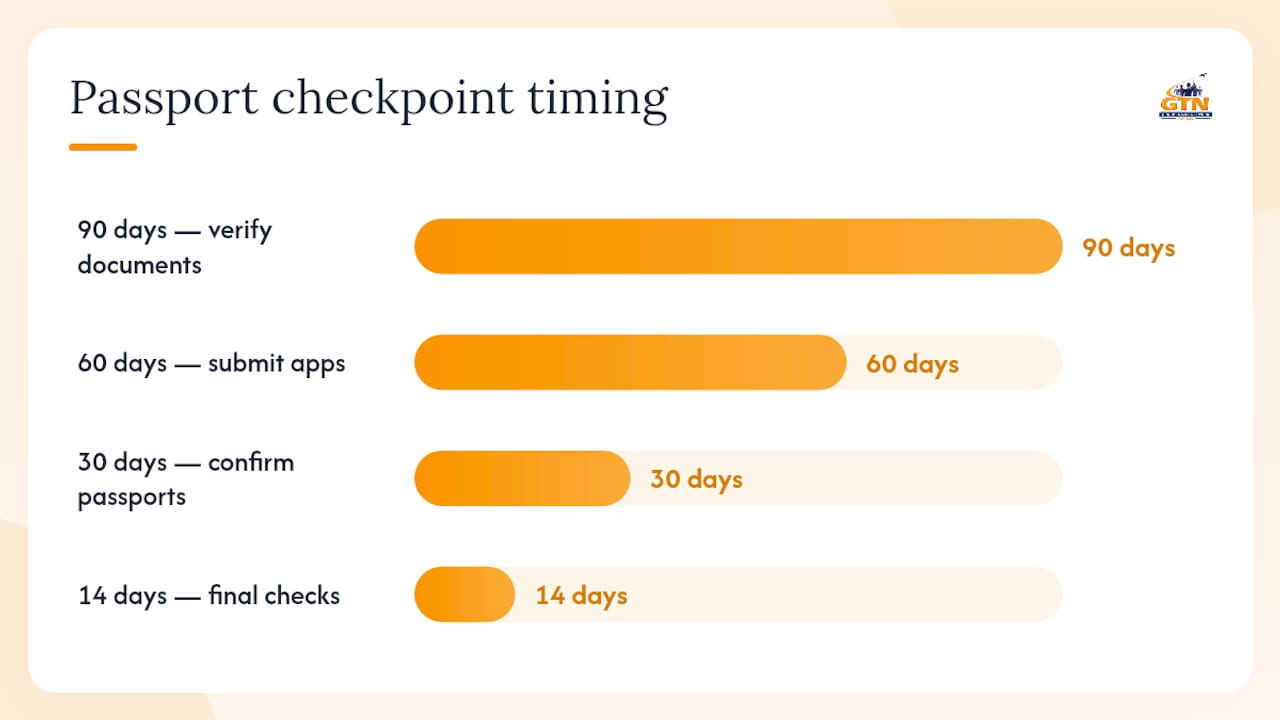
90/60/30/14-day planning checkpoints
| Checkpoint | Key actions |
|---|---|
| 90 days before departure | Verify citizenship documents for all students; identify first-time vs. renewal applicants; communicate DS-3053 notarization deadline to families |
| 60 days before departure | Host on-campus passport drive or confirm acceptance facility appointments; submit all applications; confirm DS-3053 forms are within the 90-day window |
| 30 days before departure | Confirm passport receipt for all students; flag any pending applications; initiate expedited processing or agency appointments for stragglers |
| 14 days before departure | Final passport-in-hand verification; enroll group in STEP; confirm destination validity requirements are met for every passport |
What to do if a passport arrives late
If a student’s passport hasn’t arrived within 2 weeks of departure, call the National Passport Information Center and request an urgent appointment at the nearest regional passport agency. Bring proof of travel (flight itinerary, hotel booking) to the appointment. This is not a guaranteed fix, but it’s the fastest legitimate path.
How do you run a school passport drive efficiently?
A passport drive is a project with moving parts: document collection, photo services, notarization, acceptance-facility coordination, and secure handling of original documents. Treat it like an event, not an errand.
Pre-drive planning
Set your passport-in-hand deadline first (at least 6 months before departure), then work backward to schedule the drive at least 90 days before that. Contact your local post office or county clerk’s office early — many acceptance facilities require advance scheduling for group events, and slots fill up. Some facilities will send an acceptance agent to your campus for large groups; ask.
Coordinate a photo station at the same event. Passport photos taken on-site and verified against State Department specs before submission dramatically reduce rejections. A local pharmacy or photo service can often set up on campus for the day.
Tracking spreadsheet: fields to collect
| Field | Notes |
|---|---|
| Full legal name | Must match birth certificate exactly |
| Date of birth | Verify against citizenship document |
| Application type | DS-11 (new/minor) or DS-82 (renewal) |
| Citizenship document type | Birth certificate, prior passport, CRBA |
| DS-3053 status | Notarized date; confirm within 90-day window |
| Photo verified | Yes/No; date verified |
| Payment submitted | Application fee + facility fee |
| Submission date | Date application handed to acceptance agent |
| Passport number | Fill in upon receipt |
| Expiration date | Confirm 6-month buffer beyond return date |
| Handoff confirmation | Signature when passport returned to student |
For team travel coordination tips (opens in a new tab) that go beyond passports, Grouptravelnetwork has additional school-specific resources worth reviewing.
Running the event: roles and flow
Assign three stations: intake (verifies documents against the checklist, assigns a numbered envelope to each student’s originals), photo (takes or verifies passport photos on the spot), and liaison (communicates with the acceptance agent and handles payments). One coordinator floats between stations to handle exceptions.
Pro Tip: Number each student’s envelope and log that number in your spreadsheet. When original documents are returned after processing, match by number before handing anything back. This single step prevents the most common document-mix-up scenario at group events.
Store original documents in a locked cabinet or secure room from intake through submission. Never leave them in an open office or classroom, even briefly.
What funding programs can help students afford a passport?
Passport fees are a real barrier for some families. The good news: there are programs specifically designed to address this, and more institutions are building their own.
National programs
The IIE American Passport Project is a national initiative that works with institutions to reduce passport cost barriers for students from lower-income backgrounds. It operates through campus partnerships, so the first step is contacting your institution’s international education or study-abroad office to ask whether your school participates or can apply.
Campus grant programs
Some universities have built their own passport grant programs. UC Davis, for example, runs a U.S. Passport Grant Program (opens in a new tab) through its Global Learning Hub that covers application fees for eligible students. The eligibility criteria, award amounts, and application timelines vary by institution, but the UC Davis model is a concrete example administrators at other schools can reference when making the case to their own financial aid or international education offices.
What “free passport” programs typically cover: most campus grants and national initiatives cover the application fee (currently set by the State Department and listed on the official fee page), but not always the acceptance facility fee or expedited processing surcharge. Communicate this clearly to families so expectations are accurate.
Community and private sponsorships
Rotary clubs, community foundations, and local businesses sometimes fund passport costs for student travel programs, particularly for cultural exchange or service-learning trips. A short grant letter from your school, explaining the educational purpose and the number of students who need support, is often enough to open a conversation. Pair this with a virtual engagement session for parents (opens in a new tab) to explain the program and the funding ask at the same time.
Practical steps for administrators
- Contact your international education or study-abroad office first — they often know about campus-level funds that aren’t widely advertised.
- Align your grant application timeline with your passport-drive schedule; most programs require applications weeks in advance.
- Identify eligible students early and communicate privately, so families have time to apply before the passport-drive deadline.
Where do students submit applications and get compliant photos?
Acceptance facility types
Designated acceptance facilities are the standard submission point for DS-11 applications. These include many U.S. post offices, county clerk offices, public libraries, and some courts. Not every post office accepts passport applications — use the State Department’s facility locator to confirm which locations near your school are authorized.
Regional passport agencies handle urgent and emergency cases only. Students must have documented international travel within 14 days (or 28 days for visa applications) to qualify for an appointment. These are not the right venue for routine group submissions.
On-campus passport stations are possible when a school arranges for an acceptance agent to come to campus. This is the most efficient option for large groups and worth pursuing for any group of 20 or more students.
Getting compliant passport photos
State Department photo requirements that most commonly cause rejections:
- Background must be plain white or off-white — no shadows, no patterns.
- Photo must be 2×2 inches, with the head between 1 inch and 1 3/8 inches from chin to crown.
- Taken within the last 6 months — a photo from a student’s freshman year won’t pass for a senior.
- No glasses (this rule has been in effect since 2016).
- Neutral expression, both eyes open, facing directly forward.
Coordinate photo collection and verification on the same day as document intake. A photo rejected at the acceptance facility means the student must return, which breaks the batch workflow and delays the whole group.
Copy-ready checklist and 90/60/30-day timeline for school administrators
Per-student document checklist
- DS-11 completed (not pre-signed) or DS-82 completed and signed
- Certified proof of U.S. citizenship (birth certificate with raised seal, prior passport, or CRBA)
- Original photo ID plus one photocopy (both sides on one page)
- One compliant passport photo (verified against State Dept specs)
- DS-3053 notarized within 90 days of submission date (minors under 16 with one absent parent)
- Custody/guardianship documentation if applicable
- Application fee payment confirmed
- Acceptance facility fee payment confirmed
90/60/30-day timeline
Day -90: Send family notification letter with passport requirements, DS-3053 instructions, and the notarization deadline. Identify students who need first-time applications vs. renewals. Begin collecting citizenship documents.
Day -60: Host on-campus passport drive. Verify all documents at intake. Submit applications to acceptance facility. Confirm DS-3053 forms are within the 90-day window on submission day.
Day -30: Confirm passport receipt for every student. For any pending applications, check status at passportstatus.state.gov and escalate to expedited processing or a regional agency appointment if needed.
Sample parental consent language for permission slips
Schools can adapt this language for their parent packet. It is not a substitute for DS-3053 — it is a companion document that sets expectations and confirms parental awareness before the passport drive.
For a broader look at must-have travel documents for group trips (opens in a new tab), Grouptravelnetwork’s 2026 resource covers what to prepare beyond passports.
Why centralizing passport logistics changes the outcome
The schools that run smooth passport drives share one habit: they separate document logistics from the educator’s teaching role. When a trip coordinator or international office staff member owns the passport workflow — tracking spreadsheet, deadline communications, DS-3053 follow-up — educators stay focused on the curriculum and the experience. When that ownership is diffuse, things fall through.
The most underestimated risk in group passport applications isn’t a missing form. It’s the family that doesn’t read the email, doesn’t get the DS-3053 notarized in time, and shows up to the passport drive with an expired birth certificate. That scenario is almost always preventable with one proactive phone call two weeks before the drive. Build that follow-up call into the workflow as a standard step, not an exception.
Grouptravelnetwork’s experience coordinating school group travel planning (opens in a new tab) consistently shows that groups with a single point of contact for passport logistics have fewer last-minute escalations. Pair that with safe travel planning steps (opens in a new tab) and STEP enrollment, and you’ve covered the two biggest administrative failure points before departure.
Recommended resources to pair with your passport drive:
- Dedicated trip coordinator (single point of contact for all logistics)
- Group travel insurance (opens in a new tab) with medical evacuation coverage
- STEP enrollment for every traveler (free, takes 5 minutes per student)
- Pre-departure orientation covering destination entry requirements and passport validity
Grouptravelnetwork handles the logistics so you can focus on the trip

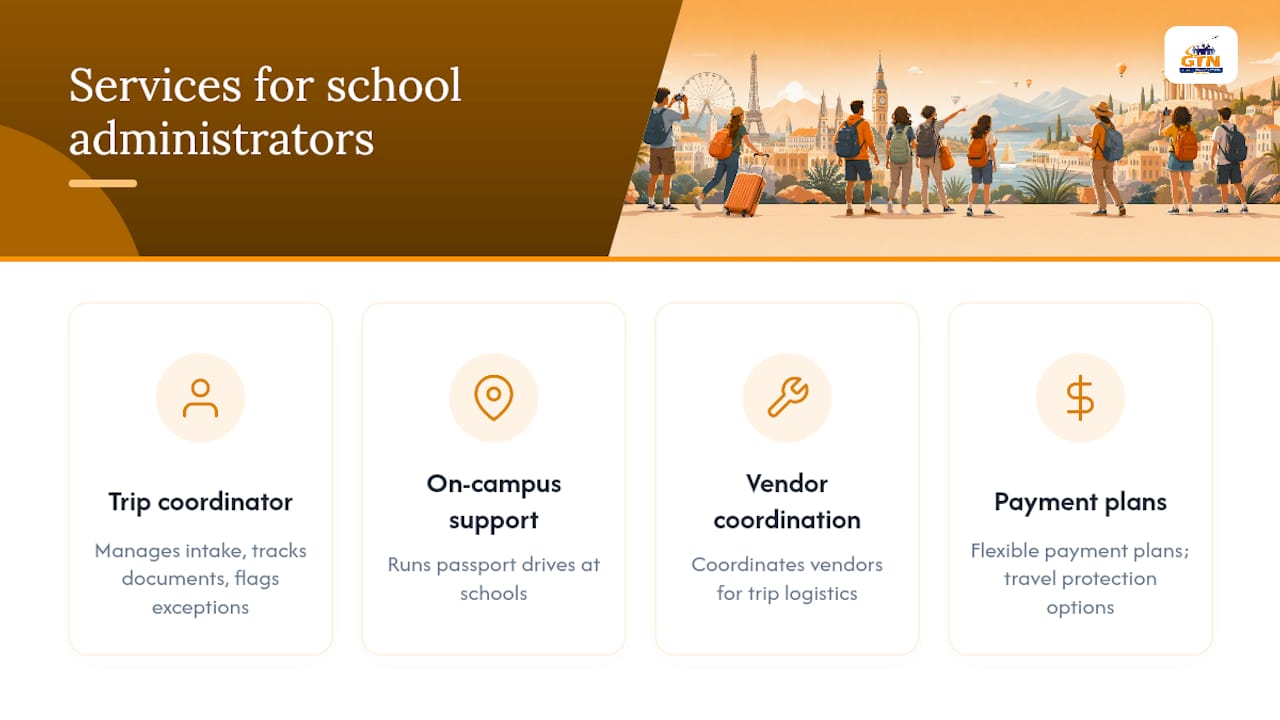
Passport coordination is one piece of a much larger planning puzzle. Grouptravelnetwork works directly with school administrators, band directors, and trip leaders to manage the full scope of group travel logistics: dedicated trip coordinators who own the document-tracking workflow, on-campus passport-drive support, vendor coordination, flexible payment plans, and travel protection options built for student groups.
The concrete difference for administrators: instead of chasing 40 families individually, you have one coordinator managing the intake process, flagging exceptions, and keeping the timeline on track. Grouptravelnetwork has coordinated student group tours (opens in a new tab) across dozens of destinations and understands State Department requirements at the operational level.
Ready to hand off the logistics? Start your school group travel planning with Grouptravelnetwork and request a planning consult today.
Sources
Official resources administrators should bookmark and share with families:
- Apply for a Child’s Passport Under 16 (opens in a new tab)
- DEPARTMENT OF STATE 22 CFR Part 51 Public Notice: 12461 RIN 1400–AF71 Passports: Form DS–3053 Statement of Consent (opens in a new tab)
- Study Abroad and Other International Student Travel | Yellow Book | CDC (opens in a new tab)
- U.S. Passport Grant Program – Global Learning Hub – UC Davis (opens in a new tab)
- Eforms (opens in a new tab)
FAQ
Does every student in a group need their own passport?
Yes. The U.S. Department of State requires each traveler to hold an individual passport book for international travel; there is no valid group or collective passport for U.S. citizens.
How much does a passport cost for a student?
Fees vary by applicant type and passport product. Check the current fee schedule on travel.state.gov, and budget for both the application fee and the separate acceptance facility fee paid at submission.
What is the current wait time for a U.S. passport?
Processing times fluctuate seasonally. For school groups, plan for routine processing to take several weeks and build in a 90-day buffer before departure; expedited service is available for an additional fee, and urgent regional agency appointments are available for travel within 14 days.
Who qualifies for a free passport?
There is no universal free passport program, but the IIE American Passport Project and campus grant programs (such as the UC Davis model) can cover application fees for income-eligible students. Contact your institution’s international education office to find out what programs your school participates in or can apply for.
What is Form DS-3053 and when does a school need it?
DS-3053 is the Statement of Consent required when one parent or guardian of a minor under 16 cannot appear in person at the acceptance facility. It must be notarized and submitted within 90 days of the notarization date; a 2024 rule change also allows signing before a passport specialist at a public passport agency in certain circumstances.
Recommended
- Must-Have Travel Documents For Group Trips In 2026 • Group Travel Network (opens in a new tab)
- Safe Travel Planning Steps For Student Groups In 2026 • Group Travel Network (opens in a new tab)
- Student Travel Accommodation Standards: 2026 Guide For Schools • Group Travel Network (opens in a new tab)
- How To Plan Safe And Impactful Student Group Travel • Group Travel Network (opens in a new tab)