


Why feedback shapes every successful student group trip
Feedback is the single most reliable tool you have for closing the gap between what you planned and what students actually experienced. When organizers treat traveler input as a planning resource rather than an afterthought, itineraries get sharper, logistics get smoother, and participants stay engaged from departure to return.
Research confirms this directly. Overall ratings (opens in a new tab) carry more weight in travel decision-making than the sheer volume of reviews, though both positively influence choices. For student group organizers, that means the quality of feedback you collect and act on matters more than how much of it you gather.
Here is what feedback actually does for your planning process:
- Identifies gaps between what students and parents expected and what the trip delivered
- Gives you facts to work with instead of assumptions when adjusting future itineraries
- Reduces planning workload by pointing to specific problem areas rather than requiring a full redesign
- Supports customized itineraries (opens in a new tab) built around participant interests and educational goals
- Creates a continuous improvement loop so each trip is measurably better than the last
What types of feedback actually matter for group trip planning
Not all feedback carries equal weight. Knowing which types to prioritize saves you time and produces better decisions.
Numerical ratings give you a fast, comparable snapshot across venues, vendors, and activities. They are easy to track over multiple trips. However, long-form written reviews (opens in a new tab) are often seen as more valuable than star ratings alone, particularly for accommodations, attractions, and restaurants, because they surface the specific details that numbers cannot capture.
Social feedback carries real influence. User-generated content (opens in a new tab) is perceived as more trustworthy than official tourism websites, travel agents, and mass media advertising. When students and chaperones share trip photos and comments, that content shapes how future participants and parents perceive the experience.
Post-trip surveys from students, parents, and chaperones give you three distinct perspectives on the same trip. Students notice engagement and enjoyment. Parents focus on safety and communication. Chaperones catch logistical friction that neither group articulates as clearly.

Online travel reviews describing intellectual and sensory experiences (opens in a new tab) most strongly increase travel intentions, which matters when you are pitching future trips to school administrators or parents who are on the fence.
How to collect and analyze feedback from students and stakeholders
Collecting feedback from a group of teenagers requires a different approach than surveying adult travelers. The timing, format, and framing all affect the quality of what you get back.
- Use behavior-triggered forms rather than blanket surveys. Ask for input at natural transition points: after a venue visit, at the end of a travel day, or immediately following a performance. Avoid piling questions on students during downtime they have earned.
- Keep post-trip surveys focused. Separate logistics questions from learning and enjoyment questions. A student who loved the museum but hated the three-hour bus ride should be able to say both clearly.
- Deploy mobile-accessible feedback tools. Students are far more likely to complete a short Google Form or a tool like SurveyMonkey on their phones than to fill out paper forms at the end of a long day.
- Tag themes when analyzing responses. Group comments by category: transportation, accommodations, activities, meals, pacing. Sentiment scoring tools can speed this up for larger groups.
- Involve chaperones in structured debrief conversations. Their observations about student behavior and group dynamics often reveal issues that survey responses miss entirely. Grouptravelnetwork’s chaperone planning guide (opens in a new tab) covers how to structure these conversations effectively.
Pro Tip: Scope any itinerary corrections to the smallest possible unit. If one activity received poor feedback, adjust that activity rather than rebuilding the whole day. Keeping changes targeted preserves trust in the rest of the plan and makes it easier for students and parents to see that their input caused a real result.
How to apply feedback to improve itineraries and participant experience
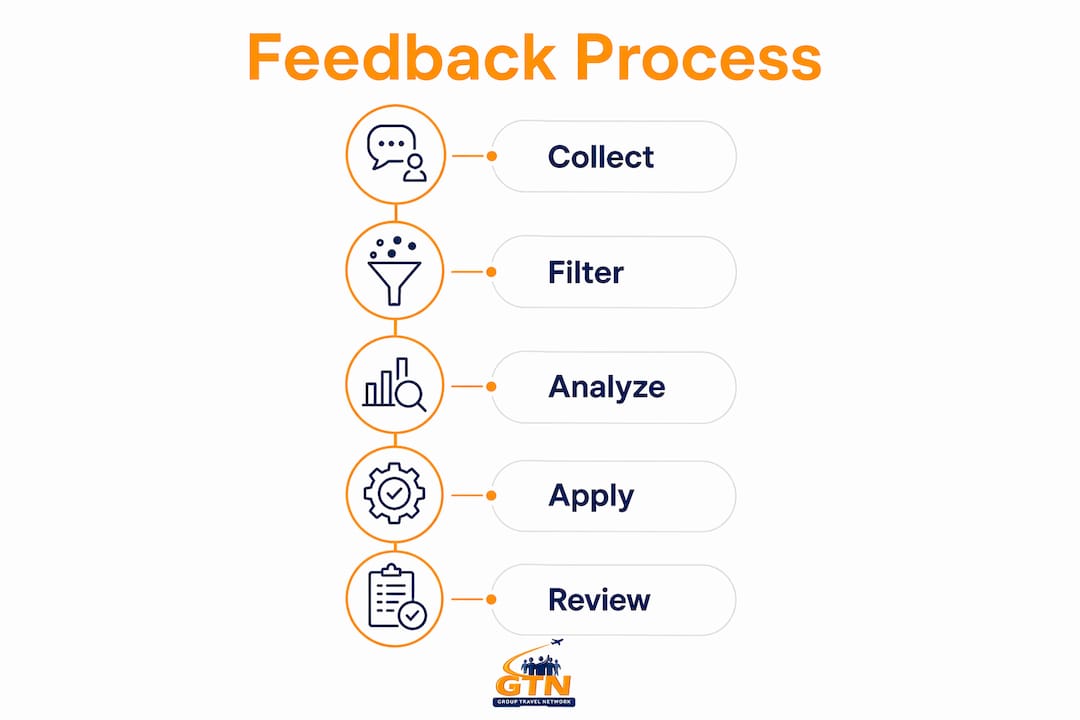
Collecting feedback is only useful when it changes something. The most effective organizers build a direct pipeline from survey responses to planning decisions.
Travel companies use iterative feedback loops to discover unmet needs and drive new offerings, keeping their programs competitive. The same logic applies to school trip planning. If students consistently report that a particular museum visit felt rushed, the fix is not a different museum. It is more time at that one, or a pre-visit briefing that sets clearer expectations.
Feedback also improves your communication materials. If parents repeatedly ask the same questions about luggage, meeting points, or emergency contacts, that is a signal your pre-trip emails and FAQ documents are missing something. Rewrite them based on what people actually asked, not what you assumed they needed to know.
For vendor relationships, post-trip feedback is a direct evaluation tool. Grouptravelnetwork reviews hotel and attraction partnerships based on participant experience, which keeps the vendor network aligned with what student groups actually need. Reviews highlighting intellectual and sensory experiences in particular tend to drive stronger engagement and higher satisfaction on future trips.
Common challenges in using feedback for group trips, and how to solve them
Feedback collection comes with real friction. Here is where most organizers run into trouble, and what to do about it.
- Information overload. Too many reviews create cognitive overload, making it harder to act on any of them. Filter for actionable feedback by prioritizing responses that name a specific problem and suggest or imply a solution.
- Timing conflicts. Asking for feedback mid-trip can feel intrusive. Asking too long after the trip produces vague responses. A 48-hour post-return window tends to capture clear memories without overwhelming participants.
- Conflicting opinions. A venue that one student loved, another found boring. Weight feedback by frequency, not intensity. One strong negative opinion rarely justifies removing an activity that the majority rated positively.
- Skepticism about whether feedback changes anything. Students stop responding when they believe nothing will change. Close the loop explicitly: tell them what changed based on last year’s input before asking for this year’s.
- Data analysis paralysis. You do not need sophisticated software to act on feedback. A simple spreadsheet with tagged themes and a frequency count is enough to identify the top three things to fix before the next trip.
Feedback tools and platforms suited for educational group trip planning
The right tool depends on your group size, tech comfort level, and how you plan to use the data.
Google Forms is free, mobile-friendly, and integrates directly with Google Sheets for easy analysis. For most school trip organizers, it covers everything needed for post-trip surveys and pre-trip preference gathering.
SurveyMonkey offers more question logic and reporting features, which helps when you are running surveys across multiple chaperones, students, and parents simultaneously and need to compare responses by group.
Typeform produces a more conversational survey experience, which tends to get higher completion rates from students who find traditional forms tedious.
TripAdvisor and Google Reviews are the primary platforms where public feedback about venues and accommodations lives. Checking these before finalizing any itinerary stop gives you a realistic picture of what your group will encounter. For selecting student travel destinations (opens in a new tab), long-form reviews on these platforms consistently outperform star ratings as a planning resource.
For real-time trip feedback, WhatsApp group chats or dedicated trip apps let chaperones flag issues as they happen, giving coordinators a chance to respond before a small problem becomes a larger one.
Case studies: feedback integration that changed how trips were planned
Venue timing adjustments. A band director running annual performance tours collected post-trip surveys for three consecutive years. Students consistently flagged that the final day felt rushed, with too many activities packed before the evening performance. The director cut one afternoon venue and added a two-hour rest block. Completion rates on the evening performance improved, and parent satisfaction scores rose the following year.
Communication overhaul from parent feedback. An educational trip organizer noticed that parent questions to chaperones during the trip clustered around the same three topics: meal times, hotel check-in procedures, and emergency contact protocols. None of these were clearly addressed in the pre-trip email sequence. After rewriting those emails based on the feedback pattern, chaperone call volume during trips dropped noticeably.
Vendor relationship decisions. One travel coordinator used post-trip hotel ratings from students and chaperones to evaluate accommodation partners annually, a practice Grouptravelnetwork applies across its school group travel planning (opens in a new tab) process. Hotels that consistently received low scores on cleanliness or proximity to venues were replaced, even when pricing was favorable.
Grouptravelnetwork builds feedback collection into every stage of its planning process, from pre-trip preference surveys to post-return debrief calls with trip coordinators. If you are ready to plan a student or performance group trip with a team that treats your participants’ input as a core planning tool, start your trip planning with Grouptravelnetwork today.
Key Takeaways
Feedback in trip planning works best when it is collected at the right moment, filtered for what is actionable, and visibly connected to real changes in the itinerary.
| Point | Details |
|---|---|
| Quality over quantity | Overall ratings carry more influence than review volume in travel decision-making. |
| Written reviews reveal more | Long-form reviews surface specific details that numerical ratings cannot capture. |
| Social content builds trust | User-generated content is perceived as more trustworthy than official tourism websites. |
| Scope changes narrowly | Correcting one itinerary element at a time preserves confidence in the rest of the plan. |
| Close the feedback loop | Tell students what changed based on their input before asking for new responses. |
Perspective
Feedback is a planning tool, not a report card
Most organizers treat post-trip surveys as a way to measure how well a trip went. That framing misses the real value. Feedback is forward-looking. It tells you what to build next, not just how to grade what you already did.
The organizers who get the most out of feedback are the ones who treat it as a design input from the start. They ask students what they are curious about before the trip, not just what they enjoyed afterward. They ask chaperones what caused friction during the trip, not just whether they would recommend it. That shift in timing changes everything about the quality of responses you receive.
There is also a trust dimension that rarely gets discussed. When students see that their input from last year’s trip changed something specific about this year’s, they become invested in the planning process. They stop being passengers and start being collaborators. For student field trips (opens in a new tab) built around educational goals, that shift in ownership often produces better learning outcomes, not just higher satisfaction scores.
The challenge is discipline. It is easy to collect feedback and harder to act on it consistently. The organizers who build a real feedback practice are the ones who schedule time to review responses, tag themes, and make at least one concrete change before the next trip. That habit, more than any particular tool or platform, is what separates trips that improve from trips that repeat the same mistakes.
FAQ
How does feedback improve student group trip itineraries?
Feedback identifies specific gaps between what participants expected and what they experienced, letting organizers adjust timing, venues, and communication materials before the next trip.
What is the best time to collect feedback from student travelers?
A post-trip survey sent within 48 hours of return captures clear, specific memories without overwhelming participants who are still tired from travel.
Are ratings or written reviews more useful for trip planning?
Written reviews tend to surface more actionable detail, though overall ratings carry strong influence in travel decision-making and both are worth tracking.
How do you get students to actually complete feedback surveys?
Keep surveys short, make them mobile-accessible, and close the loop by telling students what changed based on their previous responses before asking for new input.
How does Grouptravelnetwork use feedback in its planning process?
Grouptravelnetwork incorporates participant feedback at every stage, from pre-trip preference surveys to post-return coordinator debriefs, using responses to refine itineraries and evaluate vendor partnerships.
Recommended
- Step-by-step Group Travel Planning For School Trips • Group Travel Network (opens in a new tab)
- The Role Of Online Trip Management For School Groups • Group Travel Network (opens in a new tab)
- Educational Group Trip Guide: Expert Planning For Schools • Group Travel Network (opens in a new tab)
- Why Use Travel Testimonials For Group Trip Planning • Group Travel Network (opens in a new tab)