


TL;DR:
- Organized tour management involves coordinating logistics, communication, and finances to ensure safe, on-schedule group trips. Proper roles, technology, and team structures support scalable, error-free operations, especially for complex multi-day tours. Building strong DMO partnerships and adopting AI tools further enhance trip quality and efficiency.
Most people assume tour management is just booking buses and hotels. It isn’t. Organized tour management is the full operational system that keeps a group of 40 students, band members, or chaperones moving safely, on schedule, and within budget across multiple days, venues, and destinations. If you’ve ever watched a school trip fall apart because of a missed confirmation or a payment tracking nightmare, you already know the difference between booking travel and actually managing it. This guide breaks down what organized tour management really involves, and how to do it well.
Table of Contents
- Key takeaways
- What organized tour management actually means
- Technology tools that make tour management work
- Common challenges and how to solve them
- Team structures that support quality at scale
- Logistics, budgeting, and financial integration
- My take on where organized tour management is heading
- Plan your next group trip with Grouptravelnetwork
- FAQ
Key takeaways
| Point | Details |
|---|---|
| More than booking | Organized tour management covers logistics, communication, finances, and supplier coordination across the full trip lifecycle. |
| Roles matter | A tour manager runs operations; a tour guide provides local expertise. Confusing the two creates accountability gaps. |
| Technology pays off | Dedicated tour management platforms cost $15 to $99 per month and dramatically reduce errors compared to spreadsheets. |
| Team structure drives quality | Aligning your team model with your software’s capabilities keeps client experience consistent as your group size grows. |
| DMO partnerships change the game | Proactive relationships with Destination Marketing Organizations unlock exclusive experiences that standard packages never offer. |
What organized tour management actually means
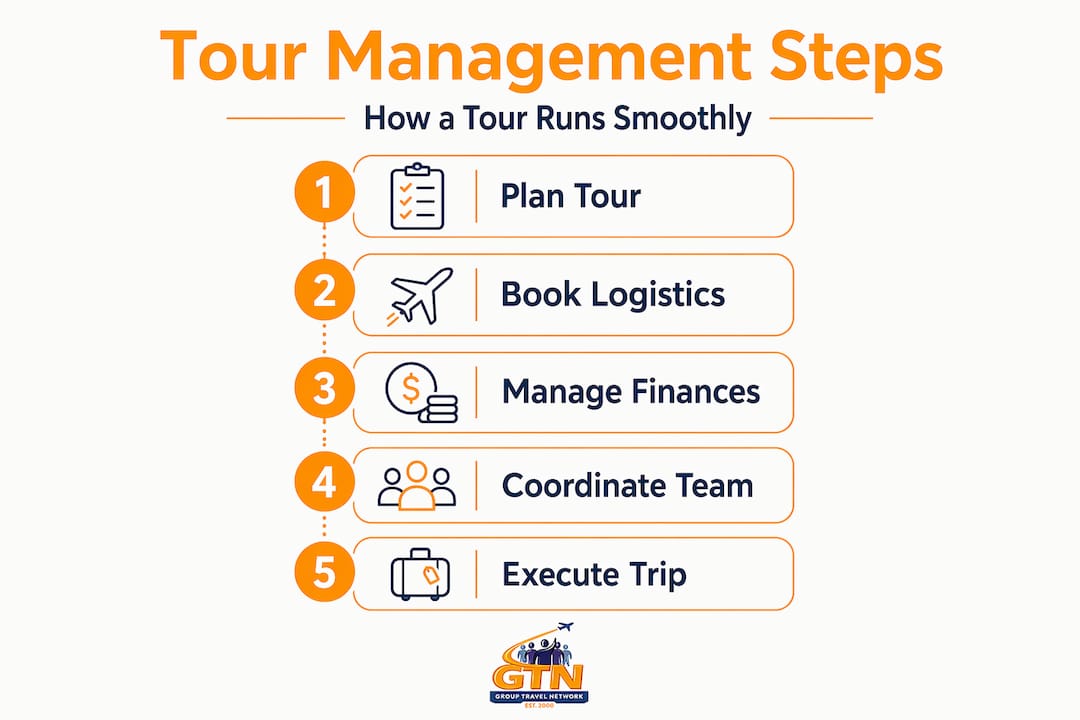
Organized tour management is the structured process of planning, coordinating, and executing all logistical, financial, and communication elements of a group trip from start to finish. It goes far beyond selecting a destination. When you are managing a school band tour or an educational excursion for 60 students, you are simultaneously tracking vendor contracts, payment schedules, dietary restrictions, accommodation assignments, performance permits, and emergency contacts.
One clarification that matters more than most people realize: tour manager and tour guide (opens in a new tab) are distinct roles with separate functions. A tour manager oversees the entire multi-day operation, handling logistics, suppliers, and group coordination. A tour guide provides localized knowledge at specific sites. Mixing up these responsibilities means nobody owns the full picture, and that is when trips go sideways.
The core responsibilities of organized tour management include:
- Itinerary planning: Building a realistic, sequenced schedule that accounts for travel time, meal windows, and activity duration
- Vendor booking and confirmation: Contracting hotels, transportation providers, performance venues, and activity operators
- Group communication: Keeping travelers, parents, and local partners informed before and during the trip
- Financial tracking: Managing deposits, installment payments, and expense reconciliation against a budget
- Supplier coordination: Confirming details with every vendor at the right intervals to avoid last-minute surprises
- Contingency planning: Building in backup options for weather delays, cancellations, or group size changes
Understanding how to organize school tours (opens in a new tab) at this level of specificity is what separates a stressful trip from a smooth one.
Technology tools that make tour management work
The shift from spreadsheets to dedicated tour management software is not just a preference. Centralized tour management software (opens in a new tab) consolidates bookings, communications, itineraries, and payments into one platform, which directly reduces the errors that come from managing those elements in separate documents.
Most platforms in this space run between $15 and $99 per month for standard plans, with enterprise-level tools offering free trials so you can evaluate fit before committing. The features that matter most for group travel coordinators include:
- Payment scheduling: Collecting installments from individual travelers automatically, with reminders sent without manual follow-up
- Supplier tracking: Logging confirmation numbers, contract terms, and contact details for every vendor in one place
- Mobile access: Giving trip leaders real-time access to the itinerary and emergency contacts from any device
- Individual customization within groups: Managing dietary needs, roommate preferences, or payment variations per traveler, not just per booking
That last point is often overlooked. Personalized management within group structures means you can accommodate the student with a gluten allergy or the parent paying in three installments without creating a separate manual workflow.
Pro Tip: Before purchasing any tour management platform, map out your current workflow on paper first. The software that solves your actual bottlenecks is better than the one with the most features.
Meanwhile, AI-powered itinerary and financial tools (opens in a new tab) are shifting how managers handle data queries. Instead of building custom reports, you can ask plain-language questions and get real-time answers about budget status or scheduling conflicts. This frees you to focus on the parts of trip planning that actually require human judgment.
Common challenges and how to solve them
Group tour coordination has predictable failure points. Knowing them in advance is the advantage you need. Here are the most frequent problems and practical responses:
-
Itinerary chaos: Overlapping arrival windows, underestimated travel time, and venue conflicts stack up fast. Build buffer time of at least 20 minutes between activities and confirm every venue’s load-in requirements before finalizing the schedule.
-
Communication breakdowns: Parents, students, vendors, and local partners often receive inconsistent information. Designate one communication channel per audience. For example, use a parent app for family updates and direct email threads for vendor coordination.
-
Manual registration and data issues: Paper forms and disconnected spreadsheets create duplicate entries and missed deadlines. Moving registration to an online platform with automatic data validation cuts processing time significantly. Grouptravelnetwork covers this in detail in their group travel services guide (opens in a new tab).
-
Local partner gaps: The biggest operational hurdle is communication gaps with local partners (opens in a new tab). Vendors who haven’t heard from you in weeks assume things have changed. Schedule a check-in call with every key supplier 10 days before departure, no exceptions.
-
Over-reliance on one person: When a single coordinator holds all the information, any absence creates a crisis. Build documentation into your workflow from the start, not after something goes wrong.
Pro Tip: Treating DMOs as creative partners rather than information sources gives you access to exclusive experiences and local connections that standard travel packages never include. Contact them six months out, not six weeks.
Team structures that support quality at scale
How you structure your team matters as much as which tools you use. High-performing tour operators (opens in a new tab) design their team workflows around their software’s capabilities, not the other way around. There are two dominant models worth understanding.

| Model | Structure | Best for |
|---|---|---|
| Pod model | Small cross-functional teams each own a full client journey | Agencies managing complex, multi-day group tours |
| Specialist model | Individual team members handle specific functions across all clients | High-volume operations with standardized trip types |
The pod model gives each group a consistent point of contact from inquiry through post-trip follow-up. Students and educators consistently report higher satisfaction when they deal with the same coordinator throughout the process. The specialist model scales more efficiently for operators running dozens of similar trips simultaneously.
The underlying principle is that your platform functions as an operating system that defines what your team can consistently do. If your software tracks supplier confirmations in one place, your specialist in charge of vendor management can handle twice the volume without increasing error rates. Alignment between team design and software capability is what makes tour management operations scale without losing quality.
Logistics, budgeting, and financial integration
Advanced organized tour management treats logistics and finances as one connected system, not separate tracks. This is where routing and advancing come in as distinct operational concepts.
Routing is the process of optimizing the geographic sequence of stops to minimize travel time and transportation cost. Advancing refers to confirming technical and logistical details with each venue before arrival, covering load-in times, equipment specs, accessibility needs, and on-site contacts. Both routing and advancing are essential (opens in a new tab) for operational efficiency and directly affect whether a trip runs on time and on budget.
| Financial element | What it tracks | Why it matters |
|---|---|---|
| Per-traveler cost | Individual charges vs. actual costs | Identifies where margins shrink or overage occurs |
| Supplier payments | Deposit and balance due dates | Prevents missed payments and contract penalties |
| Budget variance | Planned vs. actual spend by category | Signals where future estimates need adjustment |
| Profitability | Revenue minus total operational costs | Determines whether the trip model is financially viable |
Connecting your tour management platform to accounting software like QuickBooks or Xero creates a direct data feed between operational decisions and financial records. You make a booking change, and the budget reflects it immediately. This is the operational reality that spreadsheets cannot replicate at volume.
My take on where organized tour management is heading
I’ve spent years watching group travel coordinators burn out trying to manage 80-person trips through email threads and color-coded spreadsheets. The frustration isn’t a lack of effort. It’s a structural problem that better systems solve.
What I’ve learned is that the coordinators who handle the most complex trips the most calmly are the ones who adopted centralized systems early, before they needed them. They built the documentation habits, the vendor relationships, and the team protocols when the stakes were lower. By the time they were running multi-city performance tours, the system ran the logistics and they ran the experience.
The shift toward AI-augmented tour management is real and faster than most educators expect. I’ve seen trip coordinators use plain-language queries to pull real-time financial data that would have taken two hours in a spreadsheet. That’s not a distant future. It’s available now. The coordinators who treat these tools as extensions of their own judgment rather than replacements for it will handle larger, more ambitious trips with smaller teams.
My strongest recommendation: stop treating DMO relationships as a nice-to-have. The coordinators who contact Destination Marketing Organizations months in advance, ask what exclusive programming they can offer, and position themselves as long-term partners consistently deliver experiences that nobody else can replicate. That is the edge that turns a good trip into a memorable one.
— Donovan
Plan your next group trip with Grouptravelnetwork
Organized tour management works best when you have an experienced partner behind it. Grouptravelnetwork specializes in educational group trip planning (opens in a new tab) for schools, bands, sports teams, and youth organizations, handling everything from custom itineraries and vendor coordination to online registration and flexible payment plans.

Whether you’re coordinating your first student tour or managing an annual performance trip, Grouptravelnetwork gives you dedicated trip coordinators, built-in travel protection options, and destination expertise across cultural, nature, and performance-focused locations. For a thorough look at what’s possible, start with the student educational travel guide (opens in a new tab) and see how the right support structure changes the entire planning experience.
FAQ
What is organized tour management?
Organized tour management is the full process of planning, coordinating, and executing all logistics, communications, and finances for a group trip. It covers everything from itinerary design and vendor contracting to on-trip communication and budget tracking.
How is a tour manager different from a tour guide?
A tour manager oversees all operational logistics for the entire trip, while a tour guide provides localized expertise at specific destinations or sites. These are separate roles with separate responsibilities.
What software is used for group tour management?
Dedicated tour management platforms consolidate bookings, itineraries, supplier contacts, and payments in one place. Most options cost between $15 and $99 per month, with enterprise tools offering free trials.
What are the biggest challenges in managing group tours?
Communication gaps with local partners, manual registration errors, and itinerary scheduling conflicts are the most frequent pain points. Proactive vendor check-ins and centralized data systems address all three directly.
Why does team structure matter in tour management?
Aligning your team model with your software’s capabilities keeps the client experience consistent as group size grows. Pod or specialist team structures each have advantages depending on the volume and complexity of your tours.
Recommended
- How To Organize School Tours: 2026 Planning Guide • Group Travel Network (opens in a new tab)
- How To Coordinate Group Tours: Step-by-Step Guide For Schools • Group Travel Network (opens in a new tab)
- Band Trip Planning Guide: Organize Student Music Travel (opens in a new tab)
- Music Tours: A School Administrator’s Planning Guide • Group Travel Network (opens in a new tab)