


TL;DR:
- Travel protection plans are offered by travel suppliers and cover only specific bookings through those vendors. Full travel insurance provides broader coverage, including cash reimbursements for multiple vendors and international emergencies. For group or international travel, buying standalone insurance offers greater protection and flexibility.
A travel protection plan is a coverage product sold directly by travel suppliers, such as airlines, cruise lines, and tour operators, that provides limited protections tied to that specific booking. Unlike traditional travel insurance, these plans focus on cancellation fee waivers, change credits, and supplier-specific reimbursements rather than broad trip-wide coverage. For individual travelers and group organizers planning student trips, performance tours, or educational excursions, understanding what a travel protection plan actually covers, and what it does not, is the difference between being protected and being underinsured.
What is a travel protection plan and what does it cover?
A travel protection plan is a supplier-issued product that protects your financial investment in a specific booking, not your entire trip. Travel protection plans (opens in a new tab) are governed by supplier policies and typically provide credits or fee waivers limited to that supplier’s booking, unlike regulated travel insurance policies subject to insurance law. That distinction matters because the rules, exclusions, and payout types are set by the vendor, not a state insurance regulator.
Most plans include a defined set of benefits. Here is what you can typically expect:
- Cancellation fee waivers: The supplier waives its own cancellation penalties if you cancel for a covered reason.
- Change fee credits: You receive a voucher or credit toward a future booking rather than a cash refund.
- Trip delay assistance: Trip delay coverage (opens in a new tab) generally activates after 5–12 hours of delay, covering essentials like meals, lodging, and local transport.
- Baggage loss assistance: Basic reimbursement for lost or delayed luggage, often capped at low dollar amounts.
- Limited medical benefits: Some plans include a small medical benefit, but these rarely meet the minimums needed for international travel.
What these plans almost never include: emergency medical evacuation, broad cancellation for any reason, or coverage for events tied to a different supplier on the same trip. A flight delay that causes you to miss a separately booked hotel stay, for example, typically falls outside the plan’s scope.
Pro Tip: Read the exact list of “covered reasons” before purchasing. Many plans only pay out for specific events like illness or severe weather, not for personal emergencies or work conflicts.
How does a travel protection plan differ from traditional travel insurance?
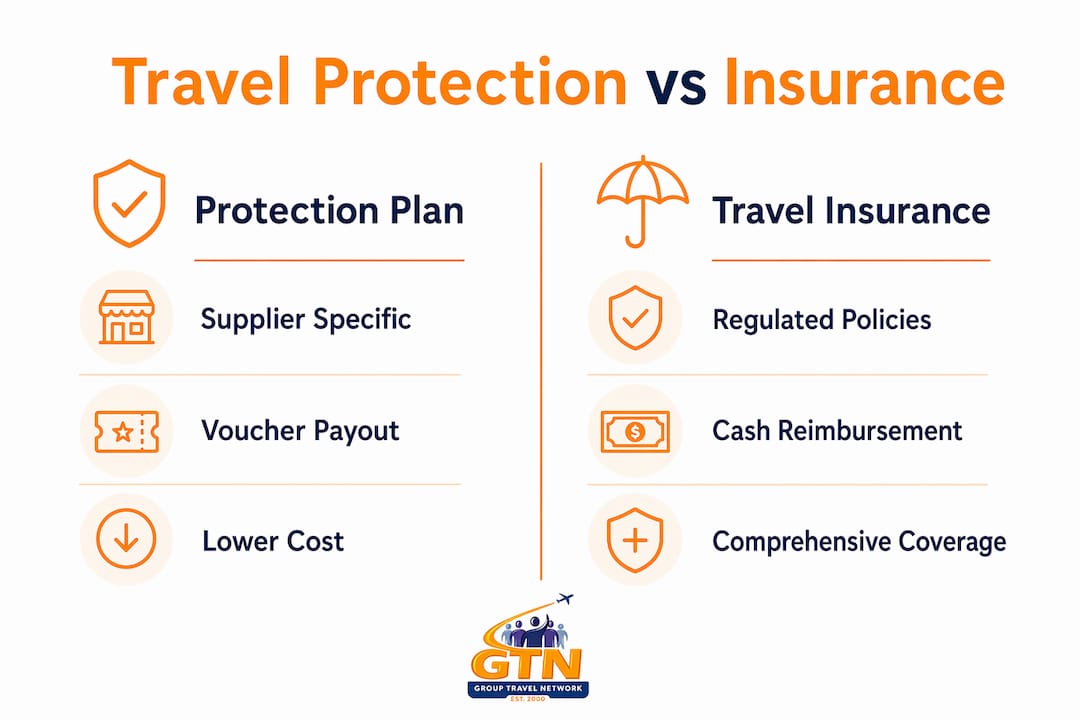
The core difference is regulation and reimbursement type. Travel insurance policies are regulated by state insurance laws and provide cash reimbursements for broad, trip-wide events, covering cancellations, interruptions, medical issues, evacuation, and baggage loss. Travel protection plans, by contrast, are sold by suppliers and pay out in credits or vouchers, not cash.
| Feature | Travel protection plan | Travel insurance |
|---|---|---|
| Sold by | Travel supplier (airline, cruise, tour) | Licensed insurance company |
| Regulated by | Supplier policy terms | State insurance law |
| Reimbursement type | Credits or vouchers | Cash reimbursement |
| Coverage scope | Single supplier booking only | Entire trip, all suppliers |
| Medical/evacuation coverage | Rarely included | Standard in most policies |
| Cancel for Any Reason option | Uncommon | Available on many policies |
| Cost | Often lower or bundled | Higher, but more comprehensive |
The reimbursement gap is the most misunderstood point. A voucher sounds useful until you realize it comes with blackout dates, expiration windows, or restrictions that make it hard to use. Cash from an insurance claim has none of those limits.
Travel protection plans are cheaper or bundled as perks, but they lack the comprehensive benefits and flexibility of full insurance. That price difference reflects a real gap in what you receive. For group organizers booking student trips across multiple vendors, a single supplier plan leaves most of the trip unprotected.
Pro Tip: Travel experts recommend standalone insurance policies for easy side-by-side comparison (opens in a new tab) rather than sole reliance on add-on supplier protections. Comparing policies independently gives you more control over what you actually buy.
When should individuals or groups purchase travel protection?
Timing and trip complexity determine which type of coverage makes sense. Here are the key decision factors to work through before you buy:
- Single-supplier booking: If your entire trip is booked through one provider, a travel protection plan may cover your main financial risk at a lower cost.
- Multi-supplier itinerary: When flights, hotels, and tours are booked separately, only full travel insurance covers the gaps between vendors.
- International travel: U.S. government agencies, Medicare, and Medicaid (opens in a new tab) do not cover medical care or emergency evacuation abroad. A protection plan with minimal medical benefits is not sufficient for international trips.
- Group travel: Group organizers face amplified risk. One sick student or a weather event can trigger cancellations across dozens of bookings. A supplier plan tied to one vendor does not protect the full group investment.
- Credit card reliance: Only 32% of consumer credit cards provide travel insurance benefits, and these tend to be limited primarily to baggage loss or rental car damage. Relying on card perks alone leaves significant gaps.
- Budget constraints: If cost is the primary concern, a protection plan is better than nothing for a domestic, single-supplier trip. For anything more complex, the savings are not worth the exposure.
Purchasing coverage immediately after your first trip payment unlocks benefits like pre-existing condition waivers and Cancel for Any Reason eligibility that cannot be added later. This timing rule applies to both protection plans and insurance. Waiting until the week before departure means you forfeit those options entirely.
For school administrators and band directors organizing student group travel (opens in a new tab), the stakes are higher than for individual travelers. A single disruption affects every participant, every parent, and every payment already collected.

How does travel protection work in practice?
Understanding the claims process prevents surprises when you actually need to use the plan. Here is how it typically works and where travelers run into problems:
- File promptly: Most plans require you to notify the supplier within 24–72 hours of a covered event. Missing this window can void your claim entirely.
- Document everything: Medical certificates, weather reports, and official delay notifications are required. Verbal confirmations from airline staff are not enough.
- Expect credits, not cash: The payout for most protection plans is a supplier credit. That credit may have an expiration date of 12 months or less and may exclude peak travel periods.
- Check for exclusions: Pre-existing medical conditions, government travel advisories, and events known before purchase are almost always excluded.
- Understand the “covered reasons” list: Plans do not pay for every cancellation. If your reason is not on the list, the claim is denied regardless of how serious the situation is.
A common scenario: a student on a performance tour gets sick two days before departure. The tour operator’s protection plan covers the cancellation fee for that student’s booking. But the separately booked flights, the hotel deposit, and the performance registration fee are not covered because they were booked through different vendors. The family recovers part of their cost and loses the rest.
Pro Tip: For school group trips (opens in a new tab), always verify whether the protection plan covers all vendors in the itinerary or just the tour operator. If it only covers one vendor, a standalone insurance policy is the safer choice for the full group.
What factors should you weigh when choosing coverage?
Choosing between a travel protection plan and full travel insurance comes down to five variables: trip cost, destination, trip complexity, traveler health, and group size.
| Factor | Favors protection plan | Favors travel insurance |
|---|---|---|
| Trip cost | Low to moderate | High or non-refundable |
| Destination | Domestic | International |
| Trip complexity | Single supplier | Multiple vendors |
| Traveler health | No pre-existing conditions | Pre-existing conditions present |
| Group size | Individual or small group | Large group (10+ travelers) |
Medical risk is the factor most travelers underestimate. Industry guidance for 2026 recommends minimum medical coverage (opens in a new tab) of $100,000 for international trips and evacuation coverage of $250,000–$500,000. No travel protection plan sold by a supplier comes close to those figures. For any trip outside the United States, full travel insurance is the only coverage that meets those minimums.
Policy transparency also matters. Travel insurance policies are standardized documents regulated by state law, which means you can compare them directly. Supplier protection plans vary widely in language, exclusions, and payout terms. Reading two plans side by side often reveals that the cheaper option covers far less than it appears to at first glance.
Key Takeaways
A travel protection plan covers supplier-specific costs only, making full travel insurance the necessary choice for international trips, multi-vendor itineraries, and group travel.
| Point | Details |
|---|---|
| Protection plans are supplier-specific | Coverage applies only to the booking made with that supplier, not your full trip. |
| Payouts are credits, not cash | Expect vouchers with restrictions, not cash reimbursements like insurance provides. |
| Medical coverage is minimal | Plans rarely meet the $100,000 medical minimum recommended for international travel. |
| Buy coverage at first payment | Waiting to purchase forfeits pre-existing condition waivers and Cancel for Any Reason options. |
| Group trips need broader coverage | A single supplier plan leaves most of a multi-vendor group itinerary unprotected. |
What I have learned from watching travelers get this wrong
The most common mistake I see is travelers treating a travel protection plan as equivalent to travel insurance. It is not. Misunderstanding travel protection as equivalent to travel insurance (opens in a new tab) causes many travelers to be underinsured, especially regarding medical emergencies and evacuation abroad, which can incur high costs. I have seen this play out with group organizers who purchased a tour operator’s bundled protection plan, assumed they were covered, and then faced a medical emergency overseas with no evacuation coverage and no cash reimbursement.
The other mistake is waiting. Coverage purchased weeks after the initial deposit is stripped of its most valuable features. Pre-existing condition waivers and Cancel for Any Reason options disappear the moment you delay. I tell every group organizer I work with: buy coverage the same day you make the first payment, not the week before departure.
My honest recommendation for 2026 is this: use a travel protection plan only when your trip is simple, domestic, and booked through a single vendor. For anything involving students, international destinations, or multiple suppliers, invest in a standalone travel insurance policy. The price difference is real. The coverage difference is larger.
— Donovan
How Grouptravelnetwork approaches travel protection for group trips
Grouptravelnetwork specializes in organizing student, school, and performance group trips where the stakes of being underinsured are highest. Every itinerary involves multiple vendors, international destinations, and dozens of participants whose families are counting on proper coverage.

Grouptravelnetwork builds travel protection guidance directly into its trip planning process, helping school administrators and band directors understand exactly what their coverage includes before a single deposit is made. From educational group trip planning (opens in a new tab) to performance tours, the team works with organizers to match the right coverage to the actual risks of each trip. Explore Grouptravelnetwork’s insurance and certifications (opens in a new tab) page to see the standards applied to every group booking.
FAQ
What is the main difference between travel protection and travel insurance?
Travel protection plans are sold by suppliers and pay out in credits or vouchers for that specific booking. Travel insurance is regulated by state law and provides cash reimbursements across your entire trip.
Does a travel protection plan cover medical emergencies abroad?
Most travel protection plans include little to no medical coverage. Industry guidance recommends a minimum of $100,000 in medical coverage for international trips, which only standalone travel insurance policies provide.
When is the best time to buy travel coverage?
Purchase coverage immediately after your first trip payment. Waiting forfeits pre-existing condition waivers and Cancel for Any Reason eligibility, both of which are time-sensitive benefits.
Is a travel protection plan enough for a student group trip?
No. Student group trips typically involve multiple vendors, international destinations, and large groups, all of which require the broader coverage that only full travel insurance provides.
Does my credit card cover travel protection?
Only 32% of consumer credit cards offer any travel insurance benefits, and those benefits are usually limited to baggage loss or rental car damage. Credit card perks are not a substitute for dedicated travel coverage.
Recommended
- Safe Travel Planning Steps For Student Groups In 2026 • Group Travel Network (opens in a new tab)
- Youth Group Travel Planning 2026: The Educator’s Guide • Group Travel Network (opens in a new tab)
- Travel Insurance For School Group Trips Explained • Group Travel Network (opens in a new tab)
- What Is Student Travel Liability? A 2026 Guide • Group Travel Network (opens in a new tab)