

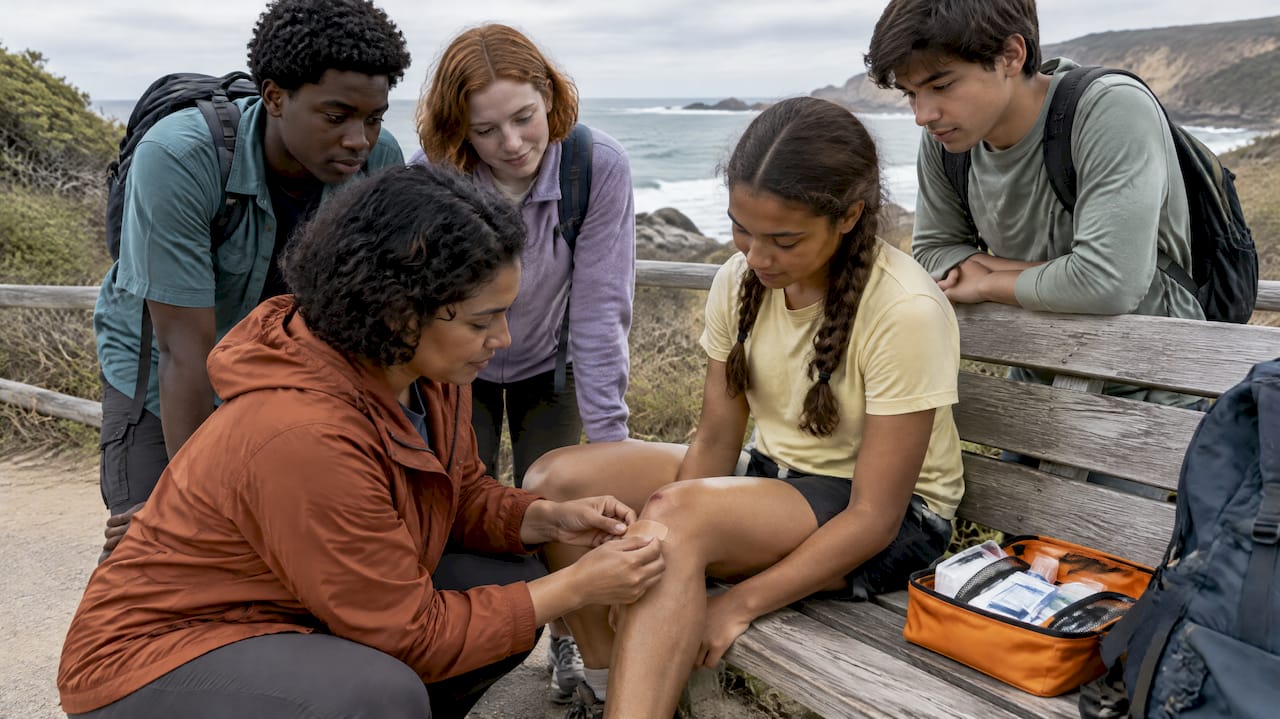
A good student trip first-aid setup is more than a kit. It is a stocked, portable kit with bandages, gauze, tape, gloves, antiseptic wipes, a CPR mask and basic over-the-counter medicine, plus each student’s medical information, a written emergency plan and a trained adult who knows where both are. Below is the 2026 packing list, how to scale it to your group and destination, and what to have in hand before the bus leaves.
TL;DR
- Pack the 10 core items below, then adjust the quantities and extras to your trip length, activities and distance from medical care.
- Carry each student’s allergies, conditions, emergency care plans and parent consent with the kit, not back at the school office.
- Store medication securely: reachable by adult staff, out of reach of students, and kept at a suitable temperature.
- Name who is trained to give first aid and medication, and make sure every chaperone knows where the kit is.
- Restock the kit after every trip so it is ready for the next one.
Table of Contents
- What a student trip first-aid kit is for
- The 10 must-pack items for 2026
- How to size the kit to your trip
- Medical information that travels with the kit
- Medications: storing, carrying and giving them
- What trip leaders should carry besides the kit
- If a student is hurt or ill
- The kit after the trip
- Plan the trip with first aid built in
- FAQ
- Sources
What a student trip first-aid kit is for
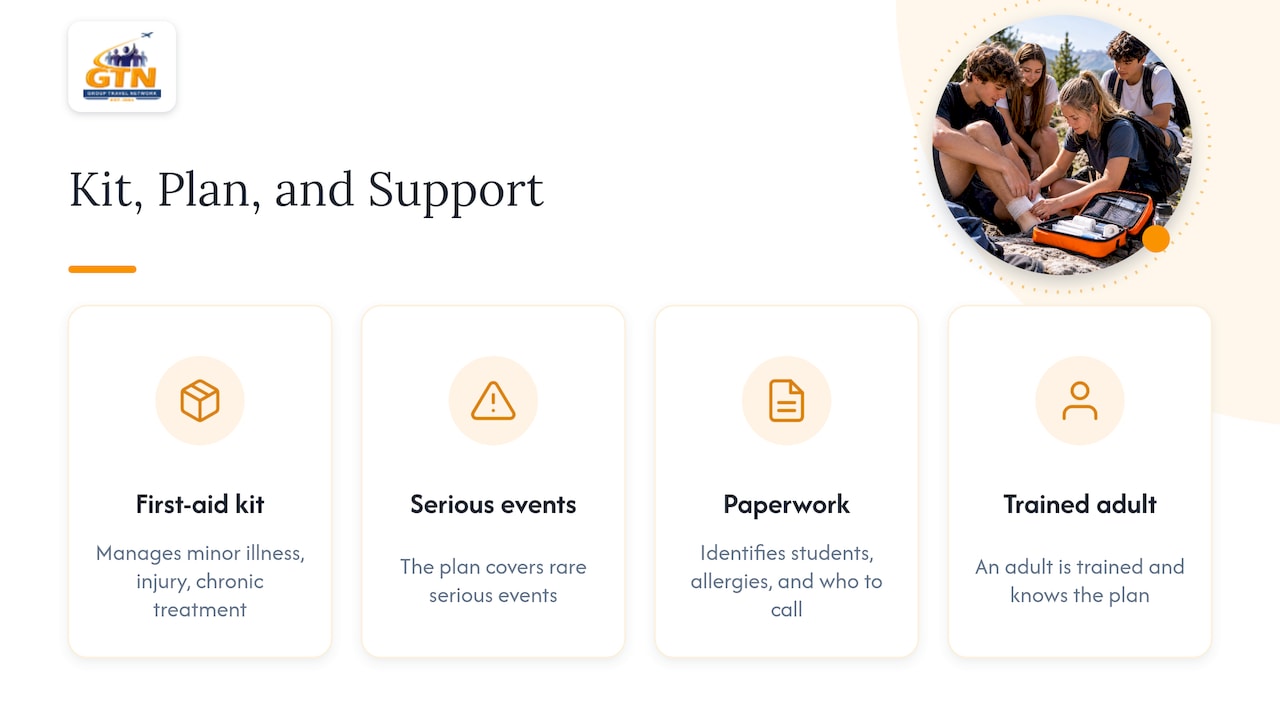
The CDC describes travel health kits as mainly for managing common, minor illnesses and injuries, and for continuing treatment of existing chronic conditions. See the CDC Yellow Book guidance (opens in a new tab). That is the right frame for a school group. Most of what happens on a field trip, a band tour or a senior class trip is blisters, scraped knees, headaches, upset stomachs and allergic reactions. Your kit should make those easy to handle in the first minutes, while your plan covers the rare serious event.
Two things sit alongside the kit and matter as much as the supplies. One is paperwork: who each student is, what they are allergic to, who to call. The other is people: an adult who is trained and knows the plan. The sections below cover all three.
The 10 must-pack items for 2026
State education departments publish the most useful checklists for school groups. The Wisconsin Department of Public Instruction’s field trip health toolkit (opens in a new tab) lists adhesive bandages in various sizes, gauze pads and rolls, medical tape, non-latex gloves, antiseptic wipes, scissors, tweezers, a CPR mask, a thermometer, instant ice packs and basic over-the-counter medications. The list below groups those into ten working categories.
- Adhesive bandages in several sizes. Blisters, paper cuts and scrapes are the most common complaints. Pack more small ones than you think you need.
- Sterile gauze pads and rolls. For wounds that bleed more than a bandage can handle, and for wrapping.
- Medical tape. It holds gauze in place and has many other small uses.
- Non-latex gloves. Use non-latex so a latex allergy never becomes a second problem. Pack several pairs, because you need a fresh pair for each person you treat.
- Antiseptic wipes or towelettes. For cleaning hands, skin around a wound and tools. The Tennessee Department of Education also lists antiseptic towelettes in its field trip health services guidance (opens in a new tab).
- Scissors and tweezers. For cutting tape and gauze and for removing splinters or ticks.
- A CPR mask. A pocket mask is a barrier device for rescue breathing. Tennessee’s list names pocket masks too.
- A non-mercury thermometer. Tennessee specifies non-mercury. A fever is often the first sign that a student should go home or see a clinician.
- Instant ice packs. For sprains, bumps and bruises. They need no freezer, which suits a bus or a campsite.
- Basic over-the-counter medications. Wisconsin’s examples are pain relief, antihistamines and anti-diarrhea medicine. Follow your district’s or organization’s policy on who may give any medication to a minor, and with what permission (more on that below).
Useful extras
Depending on the trip, add what Wisconsin and Tennessee suggest beyond the core list: emergency blankets, an eye flush, sanitary supplies, safety pins, splints, triangular bandages, disposable surgical masks and bags for students who are sick. A splint and triangular bandages make sense for a hiking day. Eye flush matters on a science or outdoor trip. Sanitary supplies matter on every trip with teenagers.
How to size the kit to your trip
A fixed list is only the start. The CDC says to personalize supplies based on several factors: how close local medical care and evacuation are, your itinerary and activities, the length of the trip, how many people may need treatment, the group’s medical expertise, space and weight, and how the kit will be carried. The CDC lists these factors (opens in a new tab) for travelers in general, and they translate neatly for a school group.
Length and overnight stays
For extended or overnight trips, Wisconsin advises increasing quantities. Its example is raising gauze pads from 6 to 10 or more, and bandage rolls from 1 to 2 or 3. Wisconsin’s toolkit (opens in a new tab) gives the numbers. The principle is that a half-day museum visit and a five-day tour should not carry the same kit.
Activities and destination
The Royal College of Surgeons of Edinburgh, in its guidance on medical provision for wilderness settings, says kits should reflect the illnesses and injuries likely from the planned activities. Read the RCSEd guidance (opens in a new tab). Put that into practice with a quick table:
| Trip type | Likely issues | Add to the core kit |
|---|---|---|
| Band or choir performance tour | Long bus days, sore throats, motion sickness, blisters from marching or standing | Extra bandages, bags for sick students, thermometer, throat comfort items per your medication policy |
| Museum and city educational trip | Blisters, headaches, upset stomachs | Extra bandages, ice packs, wipes |
| Outdoor or hiking day | Sprains, scrapes, insect bites | Splints, triangular bandages, emergency blankets |
| International trip | Distance from familiar care, language barriers | Larger supply, copies of medical records, original-container medications |
The Wilderness Medical Society adds a practical caution: balance over-preparation against under-equipping, and favor supplies that have more than one use to control weight and bulk. Their guidance on base camp kits (opens in a new tab) is aimed at expeditions, but the logic holds for a chaperone carrying one bag through an airport.
More than one kit
If your group splits across buses, rooms or activity groups, give each group its own kit. A single kit in the lead chaperone’s bag is no help to a student injured at the other end of a park.
Medical information that travels with the kit
Supplies handle the injury. Records tell you who you are treating and what not to give them.
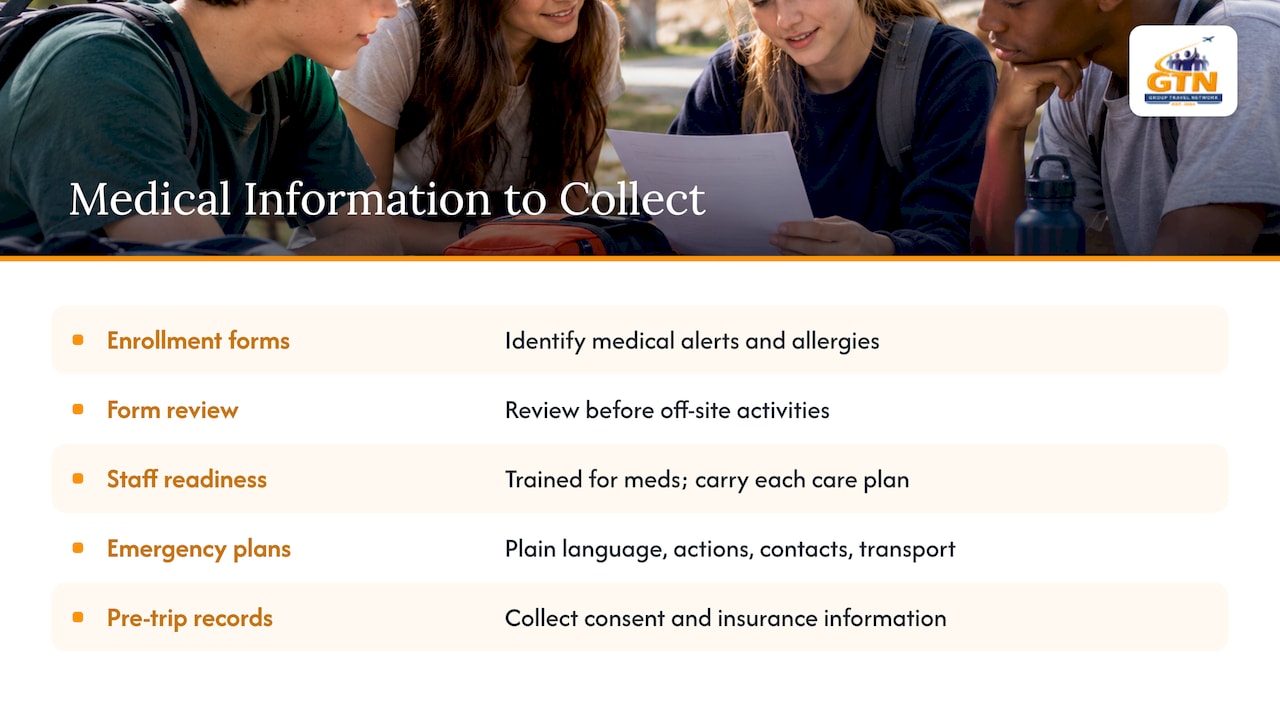
New York State Education Department guidance says enrollment forms should identify medical alerts and allergies, and staff should review medical forms before off-site activities. It also says designated staff should be trained to give emergency medications and should have each student’s emergency care plan, and that parents or guardians should give informed consent for planned activities. See the NYSED reminders (opens in a new tab). These are written for grant-funded programs in New York, but they describe good practice for any school group.
Tennessee adds that you should collect parent or guardian consent and insurance information for emergency medical services before the trip. Tennessee’s guidance (opens in a new tab) also says emergency action plans for students with conditions such as asthma, diabetes or severe allergies should use plain, layperson language with clear action steps, notification lists and transportation procedures. A chaperone with no medical background should be able to follow it at 2 a.m. in a hotel hallway.
We have written separate guides to help you build this paperwork: a student medical forms checklist with templates (opens in a new tab), the eight fields every minor travel consent form needs (opens in a new tab) and a walkthrough of how to prepare student travel forms (opens in a new tab). If you collect forms online, our electronic consent compliance guide (opens in a new tab) covers what to check, and our piece on FERPA and school trips (opens in a new tab) explains how student information can be shared.
Once you are gathering permissions, medical details and payments for many students, a system for managing school activities digitally (opens in a new tab) can keep forms and family communication in one place instead of in a stack of paper folders.
Medications: storing, carrying and giving them
Medication is where most first-aid planning goes wrong, because the rules differ by district, state and program.
- Who is responsible. NYSED says responsibility for administering medication must align with the program’s governing body, such as the district for school-run programs or OCFS for School Age Child Care programs. Ask your district nurse or administrator which rules govern your trip before you pack anything.
- Who gives it. Tennessee says field-trip staff who help with medication should be trained, with their training and competence documented.
- Where it lives. Colorado’s guidance says medication should be stored safely with temperature in mind, accessible to adult caregivers and inaccessible to students. Colorado’s school nurse page on field trips (opens in a new tab) is the source. Wisconsin’s handbook adds a locked medication container to the off-site essentials.
- International trips. The CDC says narcotic and psychoactive medications for personal use should travel in their original prescription containers, and many countries limit them to a 30-day supply or less. The CDC explains this (opens in a new tab). A student on a prescribed stimulant or similar medication needs this checked with the prescriber and the destination’s rules well before departure. Our international adventures (opens in a new tab) coordinators help groups with destination planning, and your district nurse should lead on the medication questions.
A practical habit: keep a one-page medication log for the trip with the student’s name, medication, dose, time, who gave it and who witnessed it. Fill it in every time.
What trip leaders should carry besides the kit
Wisconsin’s school nursing handbook says off-site first-aid personnel should have a communication device, student emergency information, emergency care plans, a portable first-aid kit, a locked medication container, and knowledge of where the nearest AED is. See Chapter 7 of the handbook (opens in a new tab). Treat it as a pre-departure checklist:
- A charged phone and a backup way to reach help.
- Printed emergency information for every student, because phones die.
- Emergency care plans for students who have them.
- The portable kit and the locked medication container.
- The location of the nearest AED at each stop.
Tennessee encourages staff to plan emergency procedures for areas without cell reception and to identify hospitals along the route and at the destination. For NYSED, a stocked kit should be reachable during transport and on site, with an activity-specific Emergency Action Plan and staff briefed on the protocols. Our guide to four emergency plan essentials (opens in a new tab) and a school trip risk assessment template (opens in a new tab) turn these into documents you can fill in.
The Wilderness Medical Society also recommends that all group members know where the medical kit is and what is in it, so anyone can reach it fast. Their evidence-based first aid kit article (opens in a new tab) makes the case. In a school group, that means a chaperone briefing on day one, not only a note to the lead adult.
If a student is hurt or ill
Tennessee’s guidance is simple: school staff should give emergency first aid to their level of training and competence, and activate emergency medical services by calling 911. That is stated in the Tennessee document (opens in a new tab). On an international trip, you will need the local emergency number, which your pre-trip plan should list.
A short sequence your chaperones can memorize:
- Make the scene safe and keep the rest of the group with another adult.
- Give first aid only at the level you are trained for.
- Call emergency services when the situation calls for it, without waiting for a second opinion.
- Pull the student’s emergency information and care plan.
- Notify the parent or guardian and the school contact using the notification list.
- Write down what happened, what you did and when.
The kit after the trip
Wisconsin advises that kits be resupplied and checked after every trip. Make that a line in your trip close-out checklist: count what was used, replace it, check expiration dates on medications, and note any item that you ran short of so the next kit is better.
Our perspective on first aid for student groups
After years of working with school administrators, band directors and youth organizations, we see the same pattern: a well-stocked kit is rarely what separates a smooth trip from a stressful one. Preparation is. The groups that handle a sprained ankle or an allergic reaction calmly are the ones whose chaperones knew the plan, had the student’s information in hand and had decided in advance who calls whom.
That is why our approach to planning is built around the details that make a trip easier to run: a dedicated trip coordinator, online registration that collects the information you need in one place, flexible payment plans and travel protection options. We design trips so first aid is part of the itinerary from day one, with hospitals, schedules and activities considered together instead of afterward.
If you are choosing between packing a bigger kit and spending an hour on your emergency plan, do the plan first. Then pack the kit.
Donovan
Plan the trip with first aid built in
When you book with Group Travel Network, you work with a dedicated trip coordinator who plans the itinerary around your group’s needs, with online registration and travel protection options available. Whether you are taking a band on the road, a class on an educational trip (opens in a new tab), a senior class trip (opens in a new tab) or a youth group abroad, we can help you plan with safety in mind. See our performance tours (opens in a new tab) or contact us through our site (opens in a new tab) to start planning.

FAQ
What should I put in a first aid kit for a school trip?
Start with bandages in several sizes, gauze, medical tape, non-latex gloves, antiseptic wipes, scissors, tweezers, a CPR mask, a thermometer, instant ice packs and basic over-the-counter medicine, as listed in Wisconsin’s field trip toolkit. Then add items for your activities, such as splints for hiking or an eye flush for outdoor science. Increase quantities for overnight trips.
Who can give medication to students on a trip?
It depends on the program’s governing body. NYSED says responsibility must align with the district for school-run programs, and Tennessee says staff who assist with medication should be trained and have that training documented. Ask your district nurse before departure.
Where should medication be stored on the trip?
Colorado’s guidance says medication should be stored safely with temperature in mind, within reach of adult caregivers and out of reach of students. Wisconsin’s handbook recommends a locked medication container for off-site staff.
Can students carry prescription medication abroad?
Often yes, with care. The CDC says psychoactive and narcotic medications for personal use should stay in original prescription containers, and many countries limit them to a 30-day supply or less. Check the destination’s rules and talk to the prescriber early.
How often should we restock the kit?
After every trip. Wisconsin advises checking and resupplying the kit each time so it is ready for the next excursion. Check expiration dates on medications at the same time.
Sources
- Meeting Student Health Needs While on Field Trips Tool Kit, Wisconsin DPI (opens in a new tab)
- Providing Health Services on Field Trips, Tennessee Department of Education (opens in a new tab)
- Travel Health Kits, CDC Yellow Book (opens in a new tab)
- Field Trip and Off-Site Safety Reminders, NYSED (opens in a new tab)
- Field Trips and Extracurricular Activities, Colorado Department of Education (opens in a new tab)
- Wisconsin School Nursing Handbook, Chapter 7 (opens in a new tab)
- Updated Guidance for Medical Provision for Wilderness Medicine, RCSEd (opens in a new tab)
- Base Camp Medical Kits, Wilderness Medical Society (opens in a new tab)
- An Evidence-Based First Aid Kit, Wilderness Medical Society (opens in a new tab)
Recommended
- Youth Travel Packing List: 10 Must-Haves For 2026 (opens in a new tab)
- U.S. School Trips: Four Emergency Plan Essentials To Carry (opens in a new tab)
- Student Medical Forms For School Trips: Checklist And Templates (opens in a new tab)
- U.S. Organizers: 8 Must Have Fields In Minor Travel Consent Forms (opens in a new tab)