


There is no longer a Sterling versus First Advantage choice to make. First Advantage completed its acquisition of Sterling Check on October 31, 2024 (opens in a new tab), in a deal valued at about $2.2 billion, and Sterling now operates under the First Advantage name. If you run a school, band program, sports club or youth nonprofit and you screen chaperones, coaches or volunteers, the real questions are different: what changed, what it means for your contract, and what you still owe the people you screen.
This guide is written for the people who plan group trips, not for HR departments hiring thousands of employees. We are a student and youth group travel company, so we see this issue from the chaperone roster side: who is allowed to supervise students overnight, and how the paperwork gets done before departure.
TL;DR
- Sterling and First Advantage are the same company since October 31, 2024. Sterling’s own site now says it is now First Advantage (opens in a new tab).
- Expect platform migration and possible contract changes. Ask your account contact for dates in writing.
- Pricing is quote-based. TechRadar reports (opens in a new tab) basic criminal checks in the $20 to $30 range and comprehensive packages at $50 to $100 per report.
- Screening volunteers triggers the same FCRA duties as screening employees, and the legal responsibility stays with your organization.
- Run chaperone checks weeks before departure, not the week of the trip.
Table of Contents
- Are Sterling and First Advantage the same?
- What changed for customers after the merger
- Sterling vs First Advantage: a practical comparison
- Questions to ask before you sign or renew
- The part that does not change: FCRA duties fall on you
- A simple chaperone screening timeline
- Our perspective: the vendor name matters less than the process
- Where we fit in
- Who should care about this merger, and who can ignore it
- FAQ
- Sources
Are Sterling and First Advantage the same?
Yes. This is the most common confusion, and the search results show it: the top pages are all explaining the merger rather than comparing two rivals. Before the deal, they were two separate public companies selling employment background screening, identity verification and related services. Today Sterling is a brand and product lineage inside First Advantage.
A few details worth knowing:
- Timeline. The deal was announced in early 2024 and closed on October 31, 2024, according to First Advantage’s announcement (opens in a new tab) and the SEC filing (opens in a new tab).
- Brands. Some product names persist. One 2026 comparison of screening companies (opens in a new tab) notes that Sterling and Sterling Volunteers remained active brands after closing. That matters if your organization screens volunteers, because the volunteer product is the one many schools and nonprofits actually use.
- Candidate experience. If a chaperone gets an email from Sterling, it is legitimate in most cases, but the portal and branding are moving to First Advantage. Tell your volunteers what to expect so they do not mistake a real request for spam, or ignore it.
What changed for customers after the merger
A merger of two large public companies is rarely invisible to customers. Two things deserve your attention.
Platform consolidation
Sterling’s site promises that everything customers rely on is moving to one place (opens in a new tab). Industry commentary goes further: a 2026 vendor roundup (opens in a new tab) describes customers being moved off legacy Sterling technology onto First Advantage platforms, with some organizations facing new interface requirements by 2027. Treat that as industry opinion rather than a guarantee, but it is a good reason to ask direct questions.
Integration costs and timelines
First Advantage has been open that integration takes time. In its Q3 2025 results (opens in a new tab), the company reported expenses related to the acquisition and integration. Its earnings presentation (opens in a new tab) frames the strategic goal partly around investing in automation and AI. For a school, the practical reading is simple: workflows may become more standardized and more automated, and a small account may get less hands-on service than a large enterprise customer.
That last point is a judgment, not a fact about your account. Small-volume buyers such as a district running a few dozen chaperone checks a year should confirm what support level they will have.
Sterling vs First Advantage: a practical comparison
Because they are one company, a feature-by-feature duel makes little sense. What does make sense is knowing where each legacy side tended to sit, and what to verify.
| Question | Legacy Sterling | Legacy First Advantage | What to do now |
|---|---|---|---|
| Who owns it? | Acquired Oct. 31, 2024 | Acquirer, NASDAQ: FA | Contract with First Advantage entity |
| Volunteer screening | Sterling Volunteers brand | Broader enterprise suite | Confirm which product your account uses |
| Pricing | Quote-based | Quote-based | Ask for a written per-check schedule |
| Platform | Legacy Sterling stack | First Advantage platform | Ask for your migration date |
| Support | Existing account team | Existing account team | Ask who your contact will be in 2027 |
The pricing row is the one most buyers want. First Advantage does not publish a standard price list. TechRadar’s review (opens in a new tab) reports that pricing depends on volume, the checks included and organization size, with basic criminal checks around $20 to $30 and comprehensive packages around $50 to $100 per report. Treat those as ballparks. Your quote may differ, and add-ons such as county-level searches or international checks change the total.
Questions to ask before you sign or renew
If you already use Sterling, or you are being offered First Advantage, bring this list to the conversation:
- Which legal entity is on my contract, and does the current agreement carry over unchanged?
- When will my account move to the First Advantage platform, and will volunteers see a different portal?
- What is the per-check price, and which searches are included? Get county, state and national searches itemized.
- What is the typical turnaround? A check that takes days is fine in October for a May trip. It is a problem two weeks before departure.
- Who handles disputes? Applicants have the right to challenge errors. Know who answers them.
- Is there a minimum volume? Some enterprise-oriented vendors favor large accounts.
- Can I export records? If you ever change providers, you want your records in a usable format.
If the answers are vague, that tells you something. A school with 30 chaperones a year is a very different customer from a staffing firm, and you should be able to find a plan that fits.
The part that does not change: FCRA duties fall on you
Whichever brand name appears on the report, the law places the obligations on the organization ordering it. As BIB’s FCRA compliance guide (opens in a new tab) explains, the screening company supplies the data, while the organization must apply the guidance, judge relevance to the role and give every applicant due process.
A common mistake is thinking this only covers paid staff. The same guide notes that screening volunteers, contractors and temporary workers through a third-party agency triggers full Fair Credit Reporting Act (FCRA) obligations. Parent chaperones, booster club volunteers and assistant coaches count.
What the process looks like
Before running a check you generally need to give the person a standalone disclosure and get written authorization. If a report leads you to turn someone away, the adverse action process has two steps, as laid out in BIB’s adverse action guide (opens in a new tab):
- Pre-adverse action notice. Send a notice with a copy of the report and a summary of rights, then wait a minimum of five business days so the person can dispute errors.
- Final adverse action notice. If the decision stands, send a final notice with the provider’s contact information and a statement that the provider did not make the decision.
That guide lists denying a volunteer application and denying access to a school or facility among the actions that count. Another 2026 refresher from ClearStar (opens in a new tab) covers the same two-step approach. This is general information, not legal advice. Your district counsel or school attorney should confirm your procedure, especially if state law adds requirements.
Why timing matters for trips
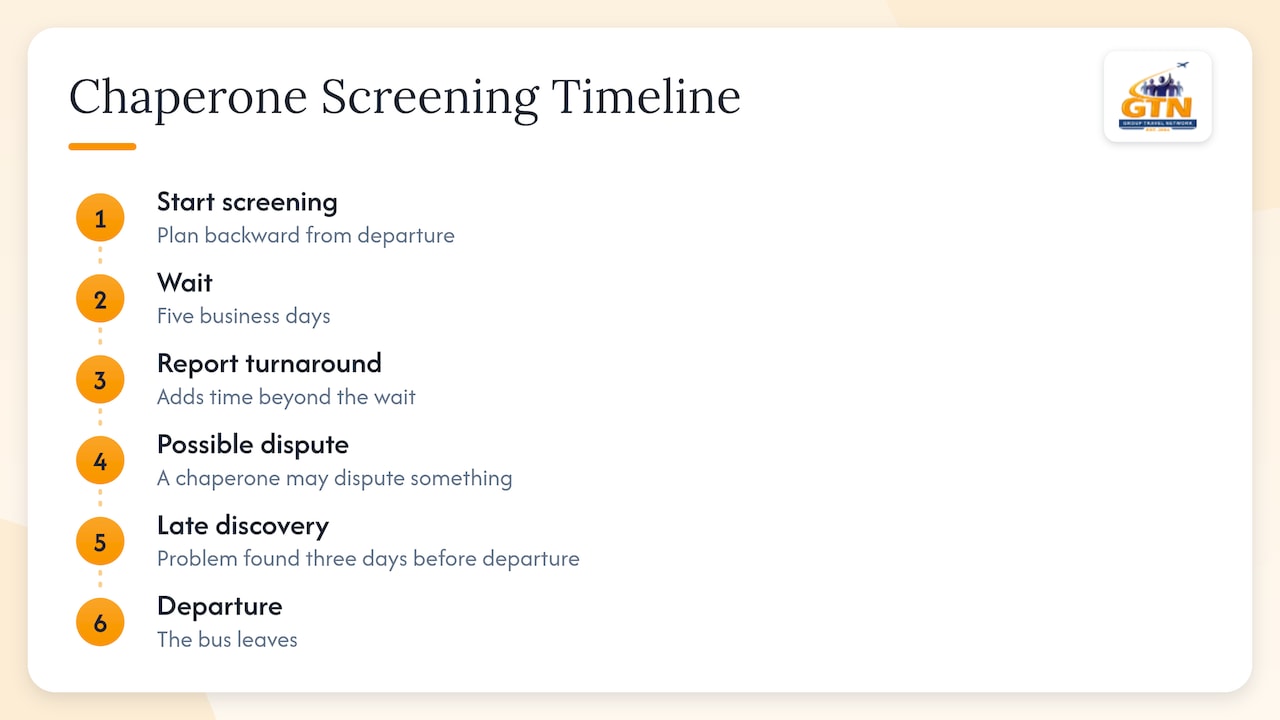
Five business days of waiting, plus report turnaround, plus the chance that a chaperone disputes something, adds up. If you discover a problem three days before the bus leaves, you have no good options. Build the schedule backward from departure and start screening early. We lay out a timeline in our guide to running chaperone checks weeks before trips and meeting FCRA requirements (opens in a new tab).
A simple chaperone screening timeline
Here is the order we suggest for a spring trip. Adjust to your district’s policy.
- Six to eight months out: Confirm which vendor your district already uses. Many districts have an existing contract, and you may not get to choose.
- Four to five months out: Recruit chaperones, collect disclosures and written authorizations.
- Three to four months out: Submit checks. Leave room for slow county records.
- Two to three months out: Review results using one written standard applied the same way to everyone. Start the pre-adverse process for any issues.
- One to two months out: Finalize the chaperone roster and share it with your trip coordinator.
- Departure: Carry the approved roster, emergency contacts and medical forms.
A written standard matters. Applying criteria inconsistently is one of the quickest routes to a complaint, and it is also unfair to the volunteers.
Our perspective: the vendor name matters less than the process
We plan student, band, choir and team trips every year, and chaperone screening is one of the steps that most often gets left late. In our experience the brand on the report is rarely the thing that causes trouble. The trouble comes from a roster that changes two weeks before departure, a parent who was never asked for authorization, or a district policy nobody on the trip team has read.
The Sterling and First Advantage merger is a useful reminder of that. Vendors consolidate, platforms change and contract terms get rewritten. A school that has a clear written policy, a calendar and a single person responsible for the roster can adapt to any of that. A school that relies on one vendor’s portal to remember everything cannot.
Our advice to administrators and trip leaders:
- Keep your own record of who was screened, when, and under which policy.
- Ask your district which vendor it uses before you buy a separate check.
- Make chaperone approval a hard gate for the final roster, not a courtesy.
- Share the timeline with parents at the first meeting, so nobody is surprised.
This is what a dedicated trip coordinator is for: keeping dates, forms and rosters moving so the educator is not holding it all alone.
— Donovan
Where we fit in
We do not replace your screening vendor. We plan the trip around the deadlines that screening creates. If you are organizing a band tour, a class trip or an international program, our Performance Tours (opens in a new tab), Educational Endeavors (opens in a new tab) and Youth Travel (opens in a new tab) programs come with a dedicated trip coordinator, online registration, flexible payment plans and travel protection options. Start from our home page (opens in a new tab) to tell us about your group, and we will build the itinerary and the planning calendar together.
If you are still choosing a travel partner, our guide to why trusted travel partners matter for student trips (opens in a new tab) covers what to look for.
Who should care about this merger, and who can ignore it
Care if: you have an existing Sterling account, your district contract names Sterling, your volunteers have received messages from Sterling recently, or you are about to renew.
Probably ignore if: your district handles all screening centrally and you only receive a cleared list. In that case the vendor is your district’s problem, though a quick question to your HR office about platform changes costs nothing.
Pay attention if: you run a small nonprofit or booster organization with no HR department. You carry the full legal responsibility with the least support, so write your policy down and keep it simple.
FAQ
Did First Advantage buy Sterling?
Yes. First Advantage completed the acquisition of Sterling Check Corp. on October 31, 2024, in a deal valued at about $2.2 billion, per its announcement (opens in a new tab). Sterling now operates as part of First Advantage.
Is First Advantage also Sterling?
For practical purposes, yes. Sterling’s website now states that it is First Advantage (opens in a new tab), though some product names, including the volunteer screening brand, have continued in use during the transition.
How much does First Advantage cost?
There is no published price list. TechRadar (opens in a new tab) reports basic criminal checks around $20 to $30 and comprehensive packages around $50 to $100 per report, with pricing set by volume and services. Request a written quote for the exact searches you need.
Do we need background checks for parent chaperones?
If you use a third-party agency to screen volunteers, FCRA obligations apply just as they do for employees, according to BIB’s compliance guide (opens in a new tab). Your district policy and state law may also require checks. Ask your school attorney or district office what applies to you.
How long should we allow before the trip?
Start at least several months out. The pre-adverse action step alone requires a minimum five-business-day wait, per BIB (opens in a new tab), and that is before any slow county records or disputes.
Sources
- First Advantage Completes Acquisition of Sterling Check for $2.2 Billion (opens in a new tab)
- First Advantage Form 8-K, October 2024 (SEC) (opens in a new tab)
- Sterling Background Check Solutions is now First Advantage (opens in a new tab)
- First Advantage Reports Third Quarter 2025 Results (opens in a new tab)
- First Advantage Q3 2025 Earnings Presentation (opens in a new tab)
- First Advantage review, TechRadar (opens in a new tab)
- Background Check Services: 10 platforms ranked, Zendikt (opens in a new tab)
- Best Background Screening Companies for 2026, BIB (opens in a new tab)
- FCRA Background Check Compliance, BIB (opens in a new tab)
- Adverse Action in Background Screening, BIB (opens in a new tab)
- Adverse Action in 2026: A Mid-Year Refresher, ClearStar (opens in a new tab)