


Destination ideas turn trip planning from logistics into learning. They define the learning or performance purpose, drive student engagement, and shape every logistical decision that follows. The immediate next step: choose 2–3 candidate destination ideas and map each to one clear learning outcome or performance objective before you touch a budget spreadsheet.
- Purpose first: A destination idea without a linked outcome is just a location.
- Engagement driver: Compelling ideas boost enrollment (opens in a new tab) and simplify fundraising by creating a shared vision early.
- Logistics anchor: Every vendor, timeline, and cost decision flows from the destination idea you commit to.
- Recommended partner: Grouptravelnetwork specializes in converting destination ideas into fully coordinated trips for student and youth groups.
Table of Contents
- Why destination ideas matter for student and youth group trips
- How destination ideas shape learning outcomes and itinerary design
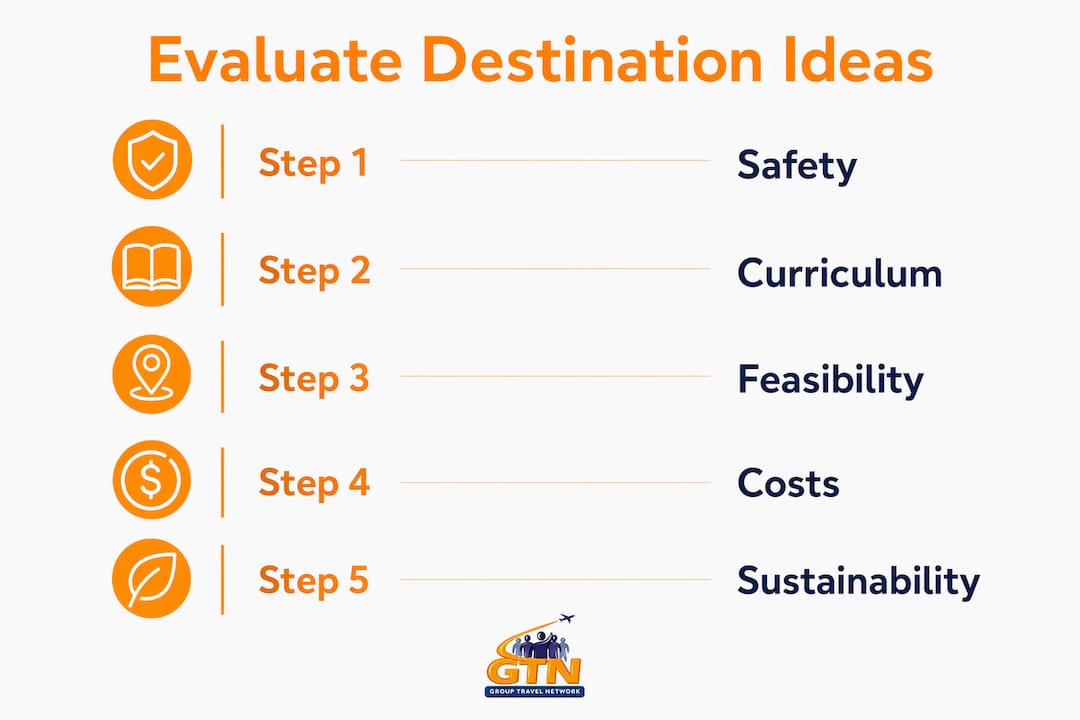
- Quick checklist: how to evaluate destination ideas
- Practical destination ideas grouped by trip type
- How to pitch a destination idea to administrators, parents, and funders
- Logistics basics: timeline, budgeting, and common cost drivers
- How a destination specialist turns your ideas into a deliverable trip
- Strategies for integrating destination ideas into a cohesive itinerary
- Methods to involve group leaders and participants in selecting destination ideas
- Common challenges in applying destination ideas and how to overcome them
- Measuring and assessing the educational impact of chosen destination ideas
- Tips for balancing educational goals with participant engagement and enjoyment
- Key Takeaways
- What the conventional wisdom on destination planning gets wrong
- Grouptravelnetwork handles the details so you can focus on learning
- Useful sources
- FAQ
Why destination ideas matter for student and youth group trips
The right destination idea does more than excite students. It changes what they learn, how much they retain, and whether they show up at all.
“Novel stimuli encountered during travel actively excite dopamine neurons, driving curiosity, attention, and the impulse to engage — a full-brain workout that everyday routines simply never trigger.”
— Psychology Today, 2026 (opens in a new tab)
Breaking routine through travel (opens in a new tab) triggers measurable cognitive benefits: improved mood, sharper attention, and a mental reset that carries back into the classroom. For youth groups, that reset translates directly into better engagement on return.
The travel industry has recognized this shift. Reporting from Travel and Tour World shows the sector is moving from a bookings-first model to an inspiration economy (opens in a new tab) where storytelling and early-stage dreaming drive destination choice and booking intent. For educators, that means presenting a vivid destination idea early in the academic year creates momentum that carries through fundraising, registration, and deposit deadlines.
- Strong destination ideas reduce late dropouts by building commitment before logistics are finalized.
- Early inspiration lifts enrollment by giving students and parents a concrete vision to rally around.
- A well-chosen idea aligns the whole group on purpose, which simplifies every approval conversation.
How destination ideas shape learning outcomes and itinerary design
A destination idea earns its place when it maps directly to a learning or performance objective and generates an on-site activity that can be assessed. The sequence is simple: objective → destination idea → activity → assessment → itinerary slot.
| Objective Type | Sample Destination Idea | On-Site Activity | Assessment Method |
|---|---|---|---|
| STEM | NASA Kennedy Space Center | Engineering workshop, launch simulation | Lab report, reflection journal |
| History | Washington, D.C. | Primary-source archive visit, monument tour | Comparative essay, oral debrief |
| Arts / Performance | Carnegie Hall area, New York | Masterclass, public performance | Recorded critique, peer review |
| Service-Learning | Gulf Coast restoration site | Habitat work, community debrief | Service log, impact presentation |
| Language Immersion | San Antonio cultural district | Guided tour in target language | Vocabulary assessment, conversation rubric |
Curriculum mapping (opens in a new tab) works best when each itinerary slot has a named learning purpose. A sample day might look like this:
- Morning: Workshop or site visit tied directly to the unit objective.
- Afternoon: Performance, service activity, or guided exploration with a debrief prompt.
- Evening: Structured reflection or group discussion that connects the day’s experience to classroom content.
Virtual tours (opens in a new tab) before departure reduce uncertainty and help students arrive with context, which deepens on-site engagement.
Quick checklist: how to evaluate destination ideas

Use a three-tier framework: must-have criteria eliminate ideas that cannot work; should-have criteria rank the remaining options; nice-to-have criteria break ties.
Must-have (non-negotiable):
- Safety and compliance: Does the destination meet your district’s travel policy and state guidelines?
- Curriculum alignment: Can you name at least one specific learning standard this destination addresses?
- Logistics feasibility: Is the travel time, visa situation, and group-size capacity workable?
Should-have:
- Cost per student falls within the realistic fundraising range for your group.
- Timing fits the academic calendar without conflicting with testing windows or major school events.
- Accessibility and inclusion: Are accommodations and activities accessible for all participants?
Nice-to-have:
- The destination offers a unique experience students cannot replicate locally.
- Partner venues provide group discounts, dedicated educator contacts, or curriculum materials.
Pro Tip: Check safety and sustainability credentials early. Surveys show these two factors have grown significantly as decision drivers for modern travelers — and school boards ask about them first.
Early cost items to confirm: transportation (charter bus, flights, rail), lodging, meals, admissions, and any required chaperone or escort costs. Missing one of these in the initial budget is the most common reason approval packets get sent back.
Practical destination ideas grouped by trip type
Choose an idea that matches one primary learning or performance objective. Everything else follows from that anchor.
Performance tours (multi-day, overnight):
- New York City concert venues: exposure to professional performance standards.
- New Orleans jazz district: live genre study and cultural context for music history units.
- Chicago theater district: masterclass access and professional critique opportunities.
STEM trips (day trip to multi-day):
- Kennedy Space Center, Florida: aerospace engineering and mission design workshops.
- Smithsonian National Air and Space Museum, D.C.: hands-on science exhibits tied to physics curricula.
- Local university research labs: career exposure and applied science demonstrations.
History and social studies (day trip to multi-day):
- Gettysburg National Military Park: primary-source battlefield analysis.
- Colonial Williamsburg: living history immersion for early American studies units.
- National Civil Rights Museum, Memphis: document-based inquiry and oral history work.
Nature and environmental science (day trip to multi-day):
- Everglades National Park: ecosystem study and conservation fieldwork.
- Appalachian Trail segments: geology, ecology, and Leave No Trace curriculum.
- Local watershed restoration sites: service-learning with measurable environmental outcomes.
Service-learning (day trip to multi-day):
- Habitat for Humanity build sites: community development and civic responsibility.
- Food bank logistics operations: supply chain and social equity connections.
- Urban garden projects: biology, nutrition, and community health integration.
For language immersion destinations (opens in a new tab), even domestic options like Miami’s Little Havana or San Francisco’s Chinatown can deliver measurable vocabulary gains when the itinerary is structured around conversation tasks.
How to pitch a destination idea to administrators, parents, and funders
A three-sentence elevator pitch plus a five-item benefits list handles most initial approvals. Keep the pitch tight: what the destination is, what students will learn, and what it costs per student.
Elevator pitch template:
- “We are proposing a [X-day] trip to [destination] for [grade/group], focused on [one learning objective].”
- “Students will [specific activity], which directly supports [named curriculum standard or performance goal].”
- “The estimated cost is [$X] per student, with flexible payment options and travel protection included.”
Five-item benefits list for approval packets:
- Named learning outcomes tied to state or district standards.
- Safety plan and risk management summary.
- Cost breakdown and payment schedule.
- Chaperone ratio and supervision protocol.
- Travel protection options and cancellation policy.
Attachment checklist for approval packets:
- One-page itinerary summary with daily schedule.
- Risk management and emergency contact plan.
- Cost per student with itemized line items.
- Registration and deposit deadlines.
- Parent permission and medical form templates.
Research on travel inspiration and decision-making (opens in a new tab) shows that when people are genuinely inspired, they move faster from deliberation to commitment. A vivid, well-packaged destination idea shortens the approval cycle.
Pro Tip: 71% of travelers say video influenced their destination decisions versus 24% for static images. Include a 60–90 second destination video in your approval packet to convert hesitant parents and administrators faster.
Logistics basics: timeline, budgeting, and common cost drivers
Start planning 6–12 months out for multi-day international or performance trips. Domestic multi-day trips need at least 8–12 weeks, though more runway always helps with group pricing and venue availability.
Planning timeline:
- Decision phase (month 1): Confirm destination idea, get preliminary admin approval, set a target group size.
- Deposit phase (months 2–3): Secure vendor holds, open student registration, launch fundraising.
- Registration phase (months 3–5): Collect forms, confirm headcount, finalize rooming and transport.
- Final payment phase (1–2 months before departure): Collect balances, confirm all bookings, distribute travel documents.
Common cost drivers to track from day one: transportation, lodging, meals, site admissions, chaperone costs, and travel protection premiums. Funding options worth pursuing early include school booster organizations, local business sponsorships, grant programs through arts or STEM foundations, and staggered payment plans that spread student costs across the academic year.
Planning callout: Using destination ideas early in the academic year boosts excitement and simplifies registration by creating a shared vision well before deposit deadlines — a direct enrollment benefit.
How a destination specialist turns your ideas into a deliverable trip
A destination specialist converts your destination ideas into vetted vendors, safety plans, and payment systems while you stay focused on students and curriculum. That division of labor is the core value.
Services a specialist typically provides:
- Destination scouting and vendor contracting (hotels, venues, transport).
- Insurance and travel protection coordination.
- Online registration and payment plan management.
- On-site support and emergency protocols.
- Curriculum mapping assistance to align activities with learning objectives.
“Experienced group leaders use destination ideas as anchors that guide enrollment campaigns, fundraising messaging, and curriculum alignment — reducing late dropouts and raising early deposits.”
— Amadeus Hospitality Insight
Grouptravelnetwork provides dedicated trip coordinators who handle all of the above, giving band directors and school administrators a single point of contact from idea to return flight. The customized itinerary process (opens in a new tab) means every activity slot is mapped to your group’s specific goals, not a generic template.
Strategies for integrating destination ideas into a cohesive itinerary
The most effective itineraries treat the destination idea as a through-line, not a backdrop. Every activity, meal break, and travel segment should connect back to the central learning or performance theme.
Start by writing one sentence that names the trip’s core purpose. Then audit every proposed activity against that sentence. If an activity does not advance the purpose or provide necessary recovery time, cut it. Overpacked itineraries are the leading cause of student fatigue and shallow learning.
Build in structured reflection at least once per day. A ten-minute debrief after a site visit does more for retention than an extra hour at the venue. Pair reflection prompts with the learning objectives you mapped during the planning phase, and you have built-in assessment data.
Leave buffer time. A 15-minute gap between activities prevents cascading delays and gives students space to process what they just experienced. Groups that run on tight schedules consistently report lower satisfaction and fewer memorable moments.
Methods to involve group leaders and participants in selecting destination ideas
Student ownership of the destination idea increases commitment and reduces dropout rates. The simplest method: present two or three vetted options and let students vote, with the condition that each option has already passed your must-have evaluation criteria.
For band directors, involve section leaders in the selection conversation. They carry influence with peers and can become internal advocates who drive peer-to-peer enrollment. A brief presentation by section leaders at a rehearsal is worth more than a flyer sent home.
Parent and chaperone input matters too, particularly on safety and cost. A short survey with three questions (preferred destination type, budget comfort level, scheduling constraints) takes ten minutes to distribute and surfaces objections before they become withdrawals. Addressing those objections in the pitch packet makes approvals faster.
Common challenges in applying destination ideas and how to overcome them
Budget gaps are the most common obstacle. Counter them by launching fundraising before registration opens, not after. A destination idea with a vivid narrative raises more money than a generic “help us fund our trip” campaign.
Administrative approval delays usually stem from incomplete packets. Use the attachment checklist from the pitch section above. Boards approve faster when safety plans and cost breakdowns are already in the packet.
Low enrollment often signals that the destination idea was not communicated compellingly enough. Research on content attributes.2025.256-268) shows that informative, emotionally resonant content increases travel intention. Apply that principle to your internal campaign: use photos, short videos, and student testimonials from past trips.
Itinerary overload is easy to create and hard to fix once vendors are booked. The fix is to plan the debrief and reflection time first, then fill in activities around it. That constraint forces prioritization.
Measuring and assessing the educational impact of chosen destination ideas
Assessment works best when it is planned before departure, not after. Identify two or three measurable outcomes at the start: a pre-trip knowledge check, an on-site observation rubric, and a post-trip reflection or project.
Pre-trip assessments establish a baseline. A short quiz on the destination’s historical or scientific context takes five minutes and gives you comparison data for the post-trip version. The gap between pre and post scores is your most defensible evidence of learning impact.
On-site tools include observation checklists, guided journaling prompts, and photo documentation tasks that ask students to capture evidence of a specific concept. These work for experiential learning (opens in a new tab) settings where traditional testing is impractical.
Post-trip projects — a presentation, a written report, a curated photo essay — give students a way to synthesize the experience and give administrators a tangible artifact to share with school boards or funders. That artifact also strengthens the case for the next trip.
Tips for balancing educational goals with participant engagement and enjoyment
The tension between rigor and fun is real, but it is mostly a scheduling problem. Students disengage when every minute is structured and they have no agency. Build in at least one free-choice period per day where students can explore within a defined area.
Anchor the educational content in the morning when attention is sharpest. Save lighter, more social activities for the afternoon. Evening programs work well for performances, group dinners, or reflection activities that feel less like school.
Name the fun explicitly in your pitch. Parents and students respond better to itineraries that acknowledge enjoyment as a goal, not a byproduct. “Students will perform at [venue] and have two hours of free time in [district]” is more compelling than a schedule that lists only educational activities.
The student travel experiences (opens in a new tab) that generate the strongest memories almost always combine a high-stakes learning moment with an unscripted social experience. Plan for both.
Key Takeaways
Destination ideas define the educational purpose of a trip and drive every planning decision that follows — choose yours before you open a budget spreadsheet.
| Point | Details |
|---|---|
| Map ideas to outcomes | Link each destination idea to one specific learning or performance objective before evaluating logistics. |
| Evaluate with three tiers | Use must-have, should-have, and nice-to-have criteria to rank ideas quickly and eliminate non-starters. |
| Start planning early | Multi-day international or performance trips need 6–12 months of lead time; domestic trips need at least 8–12 weeks. |
| Involve participants early | Student and parent input in destination selection reduces dropout rates and accelerates enrollment. |
| Use Grouptravelnetwork | Grouptravelnetwork provides dedicated trip coordinators, customized itineraries, payment plans, and travel protection to convert destination ideas into fully managed trips. |
What the conventional wisdom on destination planning gets wrong
Most planning guides tell you to finalize the itinerary first, then sell it. That sequence is backwards, and it creates the exact problems educators complain about most: low enrollment, late dropouts, and budget shortfalls.
The smarter approach is to lead with the destination idea as a narrative, build stakeholder enthusiasm around it, and lock logistics only after enrollment forecasts are stable. A vivid, purpose-driven idea raises more money, generates more deposits, and produces better learning outcomes than a polished itinerary that nobody is excited about.
There is also a tendency to underestimate what students actually gain from the experience of being somewhere unfamiliar. The cognitive benefits of novel environments, the identity disruption that forces self-reflection, the creativity that comes from genuine cultural immersion — these are not soft outcomes. They are documented neurological effects that persist long after the trip ends. When you frame a destination idea around those outcomes, you are not selling a field trip. You are making a case for a learning intervention that no classroom can replicate.
Pick the idea first. Build the story around it. Then let the logistics follow.
Grouptravelnetwork handles the details so you can focus on learning
Planning a group trip from a destination idea to a fully booked itinerary involves dozens of moving parts that pull educators away from their actual job. Grouptravelnetwork exists to take that weight off your desk.
Dedicated trip coordinators handle vendor scouting, contract negotiation, online registration, and on-site logistics. Flexible payment plans spread student costs across the school year, and comprehensive travel protection options cover the unexpected. Every itinerary is built around your group’s specific learning or performance goals, not a recycled template.
Whether you are planning a performance tour (opens in a new tab) for your band program or a multi-day educational trip, Grouptravelnetwork builds the trip around your destination idea from the first conversation. Start with the educational group trip planning guide (opens in a new tab) to map your next steps, or reach out directly to get a custom itinerary quote for your group.
Useful sources
These sources back the claims above and provide deeper reading for administrators building approval packets or curriculum rationale documents.
- The benefits of going on vacation — Cleveland Clinic overview of cognitive and wellbeing benefits of travel; useful for parent and board presentations.
- Travel doesn’t just relax you, it breaks your identity — Psychology Today, 2026; covers neurological mechanisms behind travel’s cognitive benefits, including dopamine response and hippocampal plasticity.
- Global travel industry faces major vibe shift — Travel and Tour World; explains the inspiration economy and why storytelling drives booking intent.
- Travel inspiration in tourist decision making — Academic study on how inspiration accelerates commitment; supports early-idea strategy.
- What really sparks wanderlust? — Web in Travel; video vs. static image influence data (71% vs. 24%); directly applicable to approval packet design.
- Reimagining travel inspiration — City Nation Place; covers safety, sustainability, and virtual tours as trust-building tools.
- The future of travel: meeting travelers at the moment of imagination — Amadeus Hospitality; early-dreaming strategy and its effect on enrollment and deposits.
- Student group travel transforms education (opens in a new tab) — Grouptravelnetwork; case studies on educational impact of group trips built around strong destination ideas.
- Educational travel benefits (opens in a new tab) — Grouptravelnetwork; summary of what students gain beyond the classroom, useful for board presentations.
FAQ
What is the role of destination ideas in educational trip planning?
Destination ideas define the learning or performance purpose of a trip and anchor every logistical decision that follows. Without a clear destination idea mapped to a learning objective, planning defaults to logistics with no educational rationale.
How early should educators introduce destination ideas to students and parents?
Introduce destination ideas at the start of the academic year, ideally 6–12 months before departure for international or multi-day trips. Early exposure builds enrollment momentum and simplifies fundraising by giving the group a shared vision before deposit deadlines arrive.
How do you evaluate whether a destination idea is the right fit?
Use a three-tier framework: must-have criteria (safety, curriculum alignment, logistics feasibility), should-have criteria (cost fit, timing, accessibility), and nice-to-have criteria (unique experiences, group discounts). Any idea that fails a must-have is eliminated regardless of how appealing it looks.
Can Grouptravelnetwork help if we only have a destination idea and no itinerary?
Yes. Grouptravelnetwork’s trip coordinators start from your destination idea and build a fully customized itinerary, including vendor contracts, payment plans, and travel protection, so you do not need a finished plan before reaching out.
How do you measure the educational impact of a chosen destination?
Measure impact with a pre-trip knowledge baseline, an on-site observation or journaling tool, and a post-trip project or reflection. The gap between pre and post assessments is the most defensible evidence of learning outcomes for board or funder reports.
Recommended
- Student Travel Orlando 2025: 7 Educational Gems Beyond Parks (opens in a new tab)
- Educational Group Trip Guide: Expert Planning For Schools • Group Travel Network (opens in a new tab)
- Student Educational Trips 2025: 5 Keys For Success (opens in a new tab)
- Student Educational Travel: Ultimate 2025 Guide For Schools (opens in a new tab)