


Require a school-specific contract addendum, or your district’s own master hotel agreement, before you sign anything. That single step protects your budget, your liability exposure, and your students far more reliably than negotiating line by line off a hotel’s standard template.
Before you send a signature back, lock four things: the room block (types and total nights), exactly what the quoted rate includes, whether you’re paying by master account or individual room charges, and your cut-off and decision dates. Business Travel News notes that group rates are typically quoted exclusive of fees (opens in a new tab) like resort charges and parking, which is exactly the kind of gap an addendum should close. Group Travel Network has reviewed enough of these agreements to know where schools get burned, and Florida International University’s master hotel agreement (opens in a new tab) shows one clean way to structure the paperwork, using separate exhibits for guest rooms and event space.
- Lock the room block and note what happens to any unused rooms.
- Confirm the rate includes (or excludes) taxes, resort fees, parking, and gratuities.
- Decide master billing vs. individual payment before you negotiate concessions.
- Set your decision date and cut-off date, and write both into the contract.
Pro Tip: Ask the sales manager for their standard contract first, then hand back your own addendum rather than editing theirs clause by clause. It’s faster, and it puts your language on top.
Key Takeaways
A school-specific addendum or master agreement, covering room block, rate inclusions, payment method, and liability terms, is the single most protective step before signing any hotel contract.
| Point | Details |
|---|---|
| Use an addendum or master agreement | Attach school-specific liability, insurance, and safety terms before signing a hotel’s standard contract. |
| Confirm rate inclusions | Verify whether quoted rates exclude taxes, resort fees, parking, or gratuities before budgeting. |
| Choose your billing model deliberately | Master billing unlocks concessions but adds administrative and financial exposure; individual payment shifts risk to guests. |
| Lock dates and attrition terms | Set cut-off and decision dates, and understand sliding-scale attrition penalties tied to room pickup. |
| Get contract review support | Group Travel Network’s trip coordinators review contracts and provide addendum templates before you sign. |
Table of Contents
- Which Contract Clauses Should Schools Insist On?
- What Fees and Payment Terms Actually Cost You
- How Should Schools Handle Insurance and Liability?
- How Do You Negotiate a Hotel Contract for a School Trip?
- Timeline: From Decision Date to Post-Trip Reconciliation
- Sources
- FAQ
Which Contract Clauses Should Schools Insist On?
A hotel’s standard agreement is written to protect the hotel’s revenue and limit its risk, not to protect your students. That’s not a criticism of hotels. It’s just the reason every school contract needs the same set of clauses, regardless of destination or property type.
Room block and attrition. Specify exact room types, total committed room nights, and the release date when unused rooms drop off your obligation. Attrition language determines what you owe if your group falls short of the block. A real school contract example from Anaheim shows how cut-off dates, attrition clauses, and required deposits (opens in a new tab) typically get written into these agreements, often tied directly to a percentage of pickup.
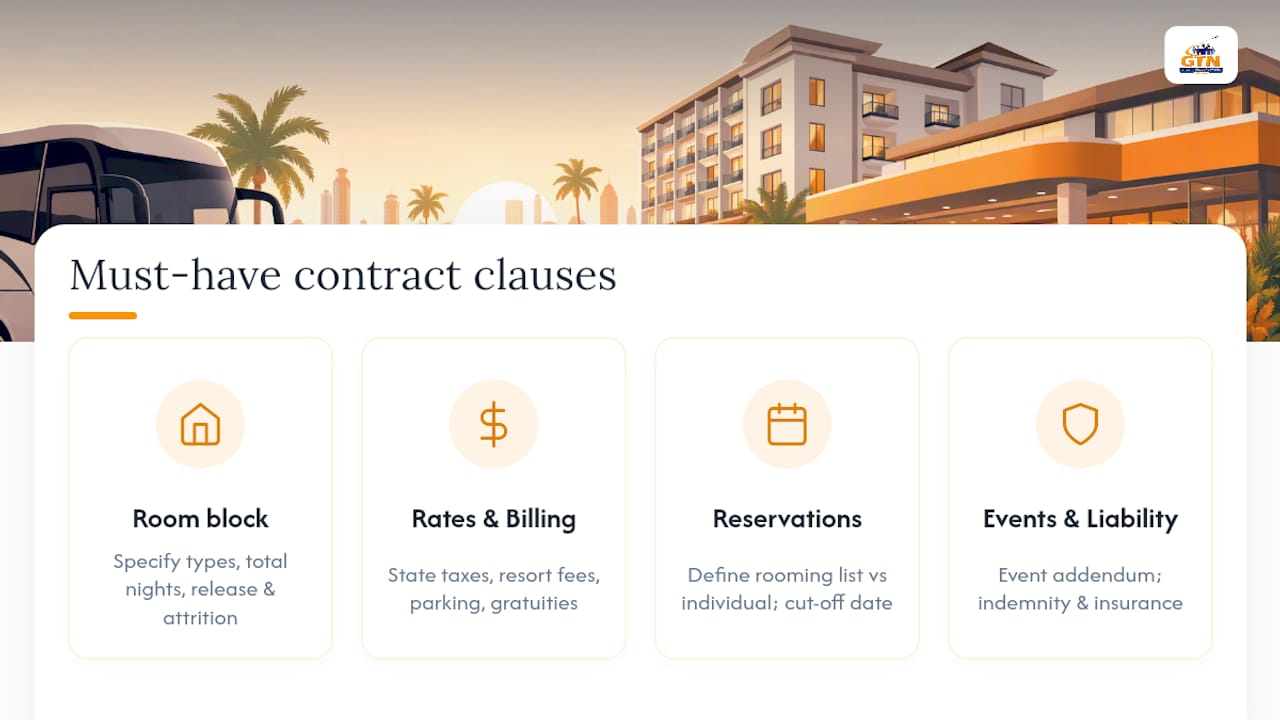
Rates and inclusions. State plainly whether quoted rates are inclusive or exclusive of taxes, resort fees, parking, and mandatory gratuities. Require the hotel to put this in a rate schedule exhibit, not a verbal assurance from the sales rep.
Reservation method and cut-off. Decide upfront whether you’re submitting a rooming list or booking individual reservations, then define your cut-off date and what happens to reservations submitted after it.
Attrition and cancellation. Look for sliding-scale damages tied to how far out you cancel, and a decision date that gives the hotel (and you) a hard deadline for committing.
Concessions and complimentary rooms. Get staff comps, internet, motorcoach parking, and meeting space in writing, tied to specific utilization thresholds rather than left as a handshake promise.
Function-space and catering addenda. If your trip includes group meals or meetings, require an Event Addendum itemizing rooms, A/V, catering estimates, and who handles setup and breakdown.
Indemnity, insurance, and safety. Baseline indemnification, insurance minimums, and chaperone supervision language belong in every school contract. Flag anything unusual here for district legal review (opens in a new tab).

Direct-bill and master account terms. Spell out who pays what, invoicing timelines, and liability for guests’ incidental charges like room service or movie rentals.
Pro Tip: Keep a running checklist of these eight clauses and score every hotel proposal against it before you compare pricing. A cheaper rate with three missing clauses usually costs more once it accounts for the requirements.
What Fees and Payment Terms Actually Cost You
The advertised rate is rarely the full story. Contracted group rates are typically non-commissionable and quoted exclusive of fees, meaning resort fees, parking, and mandatory gratuities often land on top of the number in your proposal. Confirm this before you build your trip budget, not after the final invoice arrives.
Deposits vary by property and season, but they’re commonly due at signing, at cut-off, or ahead of final payment. A sample Marriott group-sales agreement structure for a charter school trip ties advanced deposit requirements to utilization thresholds, where hitting roughly 80% pickup unlocks concessions and adjusts what’s owed. Push to tie your own deposit schedule to your decision date rather than an arbitrary calendar date the hotel picks.
Master account billing and individual payment work very differently. Master billing centralizes charges under the school and typically unlocks concessions like comp rooms and discounted parking, but it also puts more administrative weight and financial exposure on you. Individual payment shifts room charges to guests directly, which limits your school’s liability but usually means fewer concessions, since hotels tie perks to master account commitments (opens in a new tab).
- Confirm whether rates exclude taxes, resort fees, parking, or gratuities.
- Ask when deposits are due and whether they’re refundable before cut-off.
- Negotiate invoice review windows and remove or cap interest and penalty language.
- Request an exhibit listing every possible ancillary charge, including cleaning fees.
Pro Tip: Ask for a sample folio from a previous group booking. It reveals more about hidden fees than any sales conversation will.
How Should Schools Handle Insurance and Liability?
Insurance and safety clauses are where legal review earns its keep. Insist on indemnification language, defined limits of liability, general liability and workers’ compensation minimums, and a certificate of insurance with additional insured status for your district. These aren’t optional extras. They’re the terms that determine who pays if something goes wrong on hotel property.
Beyond insurance, spell out chaperone ratios, check-in and check-out procedures, and key or room-access rules for minors. Address minibar restrictions and room-party risks directly, and confirm the property’s emergency contact and response procedure in writing. A partner safety guide for hotel travelers (opens in a new tab) offers useful traveler-level precautions worth sharing with chaperones before departure.
Tax-exempt status also needs attention. Some public-agency templates, including a Florida Department of Education model, treat individual guests as responsible for room payment (opens in a new tab) unless the group expressly agrees otherwise, and tax exemption typically requires documentation presented at time of purchase, not after the fact.
Send the contract to district counsel if you see unilateral hotel indemnity, a force majeure clause written only in the hotel’s favor, or unfamiliar assignment and arbitration language.
- Require certificates of insurance naming the district as additional insured.
- Document chaperone ratios and room-access rules for minors in writing.
- Confirm tax-exempt documentation requirements before arrival.
- Flag one-sided indemnity or arbitration clauses for legal review.
Pro Tip: Build a one-page accommodation standards checklist (opens in a new tab) your team reuses for every trip, so nothing gets missed between destinations.
How Do You Negotiate a Hotel Contract for a School Trip?
Negotiation works best in a specific order. Skip ahead too fast and you’ll trade away leverage you need later.
- Gather your utilization data and firm dates before you call, including estimated room nights and arrival windows.
- Ask for master account concessions first, since these depend on the hotel seeing your full booking commitment.
- Confirm rate inclusions and require an itemized fee exhibit before discussing anything else.
- Lock your cut-off and decision dates in writing.
- Require liability and safety addenda as a condition of signing, not an afterthought.
Prioritize rates and inclusions first, concessions and complimentary rooms second, and nonessential upgrades last. Procurement specialists advise schools to attach their own addendum (opens in a new tab) whenever a hotel won’t accept the district’s standard agreement outright, since standard hotel paper is built to protect hotel revenue first.
A workable addendum outline includes five exhibits: guest room accommodations, conference space and catering, insurance and indemnity, reservation and payment terms, and an attrition schedule. For the rooming list itself, decide who submits it (usually the trip coordinator), when it’s due (typically two to three weeks before arrival), what guest data fields are required, and how you’ll handle privacy for minors’ information.
Timeline: From Decision Date to Post-Trip Reconciliation
Pre-contract: Collect your travel dates, estimated room nights, tax-exempt paperwork, and insurance requirements, then set a decision date with the hotel.
Contract stage: Sign, pay the deposit, and confirm your cut-off date and rooming list deadline in writing.
Pre-arrival: Submit the final rooming list, finalize direct-bill setup, and distribute an onsite contact list with an emergency plan to chaperones.
Post-event: Reconcile the master account, audit incidental charges line by line, apply any owed credits, and confirm attrition billing adjustments match the contract terms.
Keep this timeline next to your school group travel planning guide (opens in a new tab) so deadlines don’t slip between departments.
What Trip Coordinators Wish Someone Had Told Them Sooner
Coordinators who’ve run a dozen trips all say the same thing: get bus parking and evening security in writing, every time. Verbal promises about “plenty of parking” or “someone’s always at the desk” evaporate the moment your buses roll in late.
A word of caution: standard hotel contracts are written for the hotel’s benefit first. If you sign without an addendum or your district’s master agreement attached, you’re accepting their risk allocation, not yours.
How Group Travel Network Makes Hotel Contracting Easier
Reviewing hotel contracts clause by clause takes time most administrators don’t have between everything else on their plate. Group Travel Network’s dedicated trip coordinators handle that review directly, flagging missing insurance language or vague attrition terms before you ever sign.

Beyond contract review, the team provides sample addendum templates built around the same structure covered here, guest room exhibits, catering addenda, and insurance requirements, so you’re not drafting from scratch. Direct-bill setup support and flexible payment plans take the administrative load off your office once the contract is signed. If you’re planning your next trip, start with the educational group trip planning guide (opens in a new tab) or reach out to request a contract review before your next hotel proposal lands on your desk.
Sources
- Hotel rate types every travel manager should understand (opens in a new tab)
- Hotel Agreements | Business Contracts (opens in a new tab)
- MASTER HOTEL AGREEMENT BETWEEN FIU AND HOTEL (Aloft Miami Doral) (opens in a new tab)
- Hotel concessions and addendum guidance (IEEE/events standards) (opens in a new tab)
- Agreement between GHI Inc. dba, The Anaheim Hotel and Crittenden (school contract excerpt) (opens in a new tab)
FAQ
What Is a Hotel Contract Addendum for Schools?
It’s a supplemental document attached to a hotel’s standard agreement that adds school-specific liability, insurance, and safety terms the base contract doesn’t cover.
Should Schools Use Master Billing or Individual Payment?
Master billing centralizes charges and typically unlocks concessions like comp rooms and free internet, while individual payment shifts room-charge liability to guests but usually limits concessions.
What Fees Do Hotels Often Leave Out of Group Rates?
Resort fees, parking, and mandatory gratuities are commonly excluded from quoted group rates and should be itemized in a contract exhibit before you finalize your budget.
When Should a School Send a Hotel Contract to Legal Counsel?
Send it to district counsel if you see unilateral hotel indemnity language, a one-sided force majeure clause, or unfamiliar assignment and arbitration terms.
Can Group Travel Network Help Review a Hotel Contract?
Yes. Group Travel Network’s trip coordinators review hotel contracts, flag missing clauses, and provide sample addendum templates for schools negotiating student travel agreements.
Recommended
- Student Travel Accommodation Standards: 2026 Guide For Schools • Group Travel Network (opens in a new tab)
- Student Behavior Contract For Travel: 2026 Best Practices • Group Travel Network (opens in a new tab)
- Student-Friendly Hotels: Top 10 Picks For School Groups 2026 • Group Travel Network (opens in a new tab)
- How To Select Vendors For School Trips: 2026 Guide • Group Travel Network (opens in a new tab)