


Most group flight deposits are nonrefundable once paid, and airlines apply them toward the final balance rather than returning them if plans change. The single most important move for any organizer is to get the written group confirmation before collecting a dollar from participants, then calendar every deadline it contains. Skip that step, and a scheduling slip can cost you the whole deposit.
TL;DR:
- Deposits vary widely, from $5 per person with Frontier to $400 for first class on American Airlines, and are typically credited toward final fares.
- Missing key deadlines like deposit payments, name-list submission, or final payment can lead to cancellation, forfeiting deposits, or increased costs.
- Refund clauses depend heavily on utilization percentages, with some airlines forfeiting deposits if minimum headcount or utilization thresholds are not met.
- Booking within 30 to 60 days often requires full payment upfront, and expanding or shrinking groups after booking can significantly affect total costs.
- Organizers should meticulously track all deadlines and use written contracts to avoid losing deposits through miscommunication or missed timelines.
Table of Contents
- What Do Group Flight Deposit Policies Actually Cover?
- What Are the Key Deadlines for Group Flight Payments?
- Which Contract Clauses Determine Your Refund?
- How Should You Manage Participant Payments Without Losing the Deposit?
- Organizer Checklist: From Quote to Ticketing
- Applying These Rules: Templates and Coordinator Workflows
- How Do Deposit Policies Differ Between Airlines and Agencies?
- What Happens If Your Group Size Changes After Booking?
- Do Deposits Protect Your Group’s Fare From Price Increases?
- What Legal Protections Exist for Group Deposit Disputes?
- An Editor’s Take on Where Organizers Go Wrong
- Let Grouptravelnetwork Handle Your Group’s Deposit Deadlines
- Sources
- FAQ
What Do Group Flight Deposit Policies Actually Cover?
Airlines collect deposits for one reason: they are holding seat inventory that could otherwise be sold to someone else, and they want proof you intend to fill it. The deposit is the price of that hold. It also gives the airline leverage to charge you if your headcount falls apart later.
The amounts vary more than most organizers expect. JetBlue (opens in a new tab) charges a nonrefundable deposit that commonly runs $50 per person for North and South America bookings made 120 days or more before departure. American Airlines (opens in a new tab) structures deposits by cabin class, with Economy typically at $100 per passenger, Premium Economy near $150, Business around $200, and First close to $400. Frontier Airlines (opens in a new tab) takes a smaller approach: a $5 acceptance amount plus a $40 per-person deposit.
A few patterns show up across carriers:
- Deposits scale with cabin class and route distance, not flight length alone.
- International and transatlantic itineraries tend to carry higher per-passenger deposits than domestic routes.
- Booking further out (90 to 120+ days) usually unlocks smaller upfront deposits, since the airline has more time to adjust inventory if your group shrinks.
- Deposits are almost always credited toward the final fare balance, not charged on top of it.
What Are the Key Deadlines for Group Flight Payments?
Every group contract runs on a timeline, and missing one date on it tends to trigger the next, worse consequence. The typical sequence looks like this:
- Quote issued. The airline or agency sends a group quote with a validity window, often 7 to 14 days.
- Deposit due. You pay the initial deposit to lock the block of seats, usually within days to a few weeks of accepting the quote.
- Name-list deadline. You submit passenger names by a set cutoff, often 30 to 45 days before departure.
- Final payment and ticketing. The remaining balance is due, commonly 30 to 60 days before travel. JetBlue sets this at 30 days for domestic flights and 60 days for international ones.
Book inside a short lead time, and this schedule collapses. American Airlines notes that reservations made within roughly 30 to 60 days of travel often require full payment upfront instead of a staged deposit, since there is no runway left for a separate collection cycle.
Miss the final payment or reduction deadline, and the airline can cancel the group reservation outright, forfeit what you have paid, and force remaining travelers to rebook at published individual fares.
Which Contract Clauses Determine Your Refund?
The number on your deposit invoice matters less than the clause defining what happens if your group changes size. Read the contract for these three provisions before you sign anything.
Utilization percentage. This is the share of your original block that must actually fly. Delta (opens in a new tab) ties refunds directly to ticketing and utilization: fall short of the minimum headcount, commonly 10 passengers, and you can forfeit deposits outright, with cancellation fees pulled from what you already paid.
Holding fees versus refundable deposits. Some carriers separate a small, nonrefundable acceptance fee from a larger deposit that becomes refundable once final payment is made and passengers are ticketed. Others treat the entire deposit as one nonrefundable block. Frontier’s policy is unusually forgiving here: deposits stay refundable right up until the final payment deadline for bookings made 60 or more days out.
Name-list and name-change rules. Substituting one traveler for another inside the group typically carries a fee, and travelers who never make the roster can leave you covering their share of the utilization shortfall.
- Ask specifically what percentage of the block must be filled to avoid a penalty.
- Confirm whether the deposit or only the ticketed balance is refundable.
- Get the name-change fee in writing before you promise participants flexibility.
Pro Tip: Never accept a verbal quote as your source of truth. Extract every deadline and penalty clause from the signed group confirmation and put them on a shared calendar the same day you receive it.
How Should You Manage Participant Payments Without Losing the Deposit?
Money management, not airline paperwork, is where most organizers actually lose deposits. The fix is treating airline funds, agency fees, and participant collections as three separate ledgers instead of one lump sum.
- Track the airline deposit, any booking or holding fee, and participant-collected payments in separate accounting lines, since each can carry different refund terms.
- Build a staged payment schedule for participants that lands ahead of every airline deadline, not on it, so a late payer does not jeopardize the whole group.
- Require signed payment commitments from families or team members before you count their seat as filled.
- Keep a seat-level reconciliation sheet mapping each paid seat to a specific traveler, and update it weekly.
That reconciliation sheet is the piece most coordinators skip, and it is the one that catches a shortfall before the airline’s utilization deadline does. If five people drop out two weeks before the reduction window closes, you want to know that on day one, not day thirteen.
Organizer Checklist: From Quote to Ticketing
Copy this sequence into your project calendar the day you receive a group quote:
- Obtain the written group confirmation and read every deposit, reduction, and cancellation clause.
- Extract the deposit due date, name-list deadline, and final payment date into a shared calendar.
- Collect deposits from participants on a schedule that beats the airline’s due date by at least a week.
- Submit the passenger name list before the cutoff.
- Make the final payment and confirm ticketing.
- Reconcile used seats against your original block and follow up on any shortfall immediately.
Assign one person, usually the lead coordinator, to own the calendar and deadlines, with a designated backup who can act if that person is unavailable. Airlines that tie refunds to utilization thresholds leave real financial exposure sitting on missed deadlines. A group that drops below its minimum before final payment risks forfeiting the full deposit, not just the portion tied to the missing seats.
Applying These Rules: Templates and Coordinator Workflows
At Grouptravelnetwork, the written group confirmation is the starting point for every trip, never an afterthought signed after money changes hands. Our dedicated trip coordinators build payment schedules that land ahead of each airline deadline, using online registration to track who has paid and which seat that payment secures. That structure is what our group airfare guide (opens in a new tab) walks through in more detail, alongside timelines coordinators can adapt for their own trips.
How Do Deposit Policies Differ Between Airlines and Agencies?
The four major carriers referenced throughout this guide illustrate just how much deposit structure varies. JetBlue’s flat $50 per-person deposit is simple to explain to a school board or booster club, but it is nonrefundable from the moment it is paid. American’s class-based schedule means a Business cabin group deposit can run four times the Economy rate, which matters if your trip mixes cabin types for chaperones and students. Frontier’s small acceptance fee plus modest deposit, paired with refundability until final payment, makes it one of the more forgiving structures for a group whose headcount might shift.
Delta’s approach leans harder on the utilization clause than on the deposit amount itself, so the real risk sits in what happens to your headcount over time, not in what you paid upfront.
Travel agencies and group consolidators add another layer of variation. Some negotiate blended deposit terms across multiple airlines and absorb small utilization shortfalls before they reach the group. Others simply pass through whatever the airline’s contract states, with an added service fee layered on top.
None of this is standardized across the industry, which is exactly why reading the actual group confirmation matters more than trusting a rule of thumb you heard from another coordinator. A policy that worked fine for a football team’s charter last year may not apply to your school’s commercial group block this year, even on the same airline, if the route, lead time, or cabin mix differs. Treat every quote as its own contract, because it is.
What Happens If Your Group Size Changes After Booking?
Group size rarely stays fixed between the quote and departure, and airlines build their contracts around that reality, up to a point. Most carriers allow a free reduction window, a period during which you can drop a certain number of seats from the block without penalty. Once that window closes, every dropped seat counts against your utilization percentage.
Growing a group is usually the easier problem. Airlines will often add seats to an existing block if inventory allows, sometimes at the original negotiated rate and sometimes at a new rate reflecting current fare levels. Ask early, since availability at your original price is never guaranteed.
Shrinking a group is where deposits get forfeited. If your final headcount lands below the airline’s minimum, commonly 10 travelers, the airline may cancel the entire group reservation rather than simply reducing it. Delta’s group policy specifically ties utilization shortfalls to per-seat cancellation fees pulled from the deposit, and a group that collapses below minimum before final payment can lose the deposit outright.
The practical lesson: build a buffer into your initial headcount estimate rather than booking the exact number you expect to travel. A group that books for 25 when it expects 22 has room to absorb a few dropouts inside the free reduction window. A group that books for exactly 22 has none. Weekly reconciliation against your seat-level tracking sheet is what catches a shrinking headcount early enough to act within the free window instead of after it closes.

Do Deposits Protect Your Group’s Fare From Price Increases?
Paying a deposit does lock in the negotiated group fare for the seats it covers, but that protection has limits worth understanding before you promise families a fixed price. The fare guarantee typically applies only to the number of seats reflected in your paid deposit and confirmed name list, not to seats you might add later.
If you need to expand the group after the initial block is set, those additional seats are often priced at whatever the current fare is, not the original quote. That can mean a meaningful jump if fares have risen since your group first booked, particularly on international routes where pricing moves more.
The flip side matters too. If fares drop after you have locked in your group rate, you generally do not get a retroactive discount. The deposit fixes the price in both directions once it is paid and the block is confirmed.
Utilization shortfalls complicate this further. If your group falls below the ticketed minimum, some airlines reserve the right to reprice remaining passengers at published individual fares rather than honoring the original group rate for a now-smaller party. That is one more reason the free-reduction window deserves attention: dropping seats before that window closes keeps your fare guarantee intact for everyone left on the roster, while dropping them after can put the whole group’s rate at risk.
What Legal Protections Exist for Group Deposit Disputes?
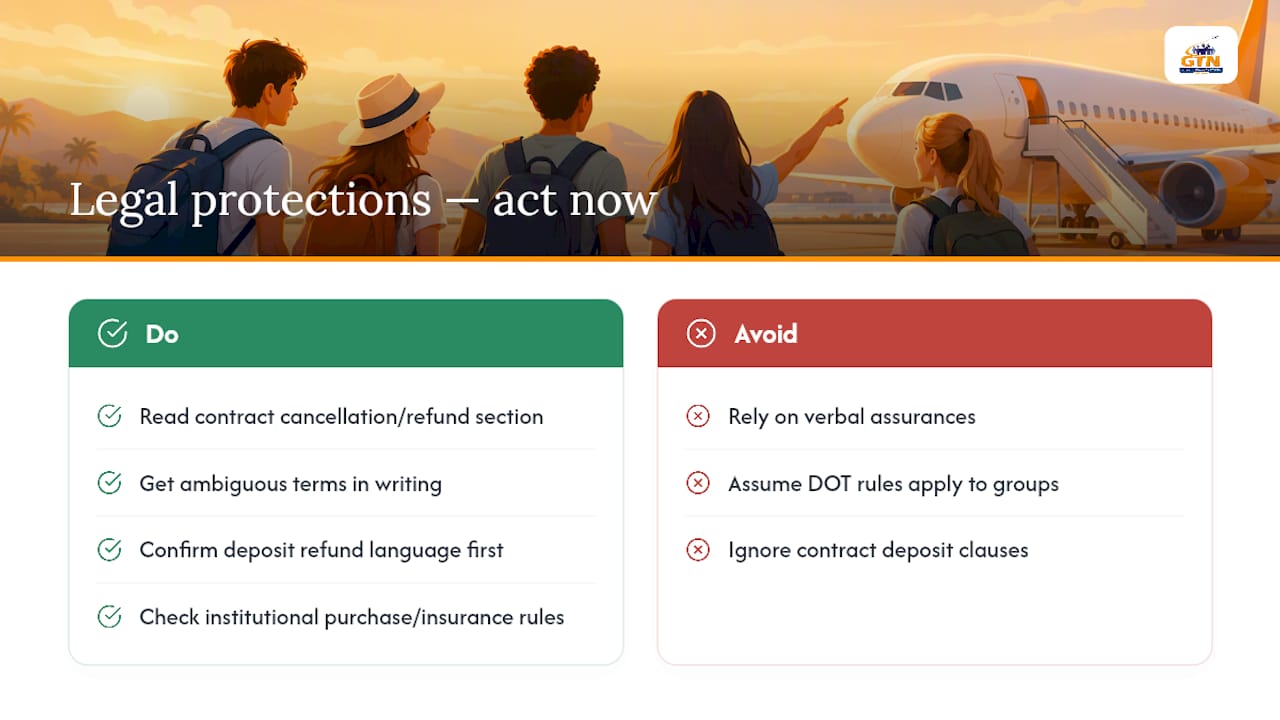
Group flight deposits sit in a different legal category than individual consumer airfare, and that distinction catches organizers off guard. Federal consumer protections that apply to individual ticket refunds, including the Department of Transportation’s rules on airline-caused cancellations, generally were not written with negotiated group block contracts in mind. Group bookings are governed primarily by the terms of the written contract itself.
That makes the group confirmation the closest thing you have to a legal safeguard. Courts and airline customer relations teams will point to the contract language on deposits, utilization, and cancellation before considering any general consumer-protection argument. If the contract states a deposit is nonrefundable, that clause is very likely enforceable exactly as written.
Organizers working with school districts, nonprofits, or corporate finance departments should also check whether their institution requires a specific type of purchase agreement or insurance rider before releasing funds for a deposit. Some school systems, for instance, require travel protection or cancellation insurance as a condition of approving group travel spending, which is a separate layer from the airline’s own deposit terms.
Read the cancellation and refund section of your group contract as carefully as the price. If anything is ambiguous, especially around what counts as a “ticketed passenger” for refund purposes, get clarification from the airline or your booking agent in writing before you collect deposits from participants. A verbal assurance from a sales representative carries no weight against contract language stating otherwise.
An Editor’s Take on Where Organizers Go Wrong
The recurring failure isn’t ignorance of deposit amounts. It’s trusting a verbal quote, misreading a fee as refundable, and never tracking utilization until it’s too late to fix. Three habits fix most of it: pull every deadline into a shared calendar the day you get the contract, insist on written terms before collecting a cent, and reconcile seats weekly instead of the week before departure.
— Donovan
Let Grouptravelnetwork Handle Your Group’s Deposit Deadlines
Grouptravelnetwork exists for organizers who would rather spend their time on the trip itself than chasing down airline paperwork and contract fine print. Every group we book starts with a written confirmation our coordinators review line by line, so you know exactly what’s refundable, what’s not, and when each payment is due before you collect a dollar from a single participant.

Instead of juggling deposit deadlines, utilization thresholds, and name-list cutoffs on your own, you get a dedicated trip coordinator who builds a staged payment plan around your group’s actual timeline, plus online registration that tracks who has paid and travel protection options that add a safety net if plans shift. That’s a meaningfully different experience than managing an airline contract solo with a spreadsheet and a countdown clock. Whether you’re planning a school band’s performance tour (opens in a new tab) or a class’s educational trip (opens in a new tab), the process starts the same way: request a group quote, and a coordinator will walk you through deposit terms, deadlines, and payment options before you commit a dollar.
Sources
- Group Bookings | JetBlue (opens in a new tab)
- Group Travel | Delta Air Lines (opens in a new tab)
- Group & Meeting Travel terms (PDF) | American Airlines (opens in a new tab)
- Groups | Frontier Airlines (opens in a new tab)
FAQ
Can You Cancel One Flight From a Group Booking?
Usually not without consequence. Dropping a single traveler from a confirmed group block typically counts against your utilization percentage and can trigger a per-seat cancellation fee pulled from the deposit, per Delta’s group policy.
Is It Cheaper to Book Flights as a Group Than Individually?
Group fares are often lower per seat than booking each traveler separately, especially for 10 or more passengers on the same itinerary. The trade-off is a nonrefundable or conditionally refundable deposit and utilization requirements that individual bookings don’t carry.
Can You Just Pay a Deposit on Flights?
Yes, that’s the standard structure for most group bookings: pay a deposit to hold the seats, then pay the remaining balance by the final payment deadline, commonly 30 to 60 days before departure as required by JetBlue’s group policy. Bookings made inside short lead times sometimes require full payment upfront instead.
What Counts as a Group on Airlines Like American Airlines?
Most U.S. carriers, including American Airlines, define a group as roughly 10 or more passengers traveling on the same itinerary and booked under a single group contract. The exact minimum and deposit schedule vary by airline and cabin class.
What Happens If My Group Misses the Final Payment Deadline?
The airline can cancel the group reservation, forfeit the deposit already paid, and require remaining travelers to rebook at published individual fares. This is why calendaring the final payment date from the written contract matters more than remembering it informally.
Recommended
- 10 Travelers Trigger Group Airfare: Organizer Checklist & Timeline (opens in a new tab)
- How To Manage Group Travel Payments In 2026 (opens in a new tab)
- Step-by-step Group Travel Planning For School Trips (opens in a new tab)
- Fix Ticket Names Before 24 Hours: Airline Name Change Policy For Groups (opens in a new tab)