


For a Charleston history trip, plan three days built around the Historic District, a Fort Sumter ferry crossing, one major plantation, and either the Charleston Museum or the Avery Research Center. Three days gives you time for all four without rushing. Book the Fort Sumter ferry and your plantation tickets before you leave home, because both are the first things to sell out.
TL;DR:
- Choose Magnolia for gardens and slavery interpretation, Middleton Place for African American history, Boone Hall for Gullah culture, or Drayton Hall for preserved architecture.
- Fort Sumter is accessible only by the concession boat; pair the harbor crossing with a self paced afternoon at Fort Moultrie to compare coastal defenses.
- The Avery Research Center adds Gullah Geechee context; the Charleston Museum suits rainy weather, while Aiken Rhett House interprets enslaved people’s living spaces.
- Walking tours reveal details on narrow streets but can challenge visitors on uneven pavement; carriage tours reduce walking while sacrificing detailed views of buildings.
Table of Contents
- Which historic sites should you see first?
- Which tour format fits your group: walking, carriage, trolley or harbor cruise?
- What will you find at Magnolia, Middleton Place, Boone Hall and Drayton Hall?
- How do you visit Fort Sumter and Fort Moultrie?
- Which museums and African American heritage sites belong on your list?
- How many days do you need, and what does a 3-day itinerary look like?
- When should you go, and what do tickets, costs and getting around look like?
- How do you plan a Charleston history trip for school and youth groups?
- What safety guidelines and supervisor-to-student ratios work for Charleston group trips?
- How can you build interactive learning into historic sites?
- Where should student and youth groups stay in Charleston?
- How do you handle meals and dietary restrictions for a group?
- Can your group perform or present at historic venues?
- Why a curated itinerary beats a do-it-yourself plan
- Let us plan your Charleston history trip
- FAQ
- Sources
Which historic sites should you see first?
Start downtown, where the peninsula packs centuries of history into a few walkable blocks. Then add two outlying stops that tell the story of the colony’s founding and the Lowcountry landscape. The Charleston Convention and Visitors Bureau describes history here as something you take in through architecture, museums and tours, so plan to look up at buildings as much as you read plaques.
Rainbow Row is the famous stretch of pastel Georgian row houses on East Bay Street. Allow time to take in the streetscape. The point is the streetscape itself: narrow lots, shared walls and colors that read as postcard-pretty today but come from a commercial waterfront that once handled enormous volumes of trade. The Battery is the seawall promenade at the tip of the peninsula, lined with grand antebellum houses and shaded by live oaks. Allow time to explore, and walk it in the morning when the light is soft and the heat is manageable. White Point Garden at its edge holds cannons and monuments that give you a good first lesson in how the city defended its harbor.
Between those two anchors, the French Quarter, City Market and King Street show you where history and commerce meet. The Market has served as a trading space for generations, and King Street’s mix of antique shops, restaurants and preserved storefronts shows how the city adapted old buildings to new uses. Treat this area as connective tissue between the headline sites, not as a destination on its own.
Here is a shortlist worth building around:
- Rainbow Row: Georgian architecture and a working picture of the colonial waterfront, a short visit.
- The Battery and White Point Garden: harbor views, cannons and antebellum mansions, a leisurely visit.
- Historic churches and graveyards: St. Michael’s, St. Philip’s and the Unitarian Church grounds show religious and political life from the colonial era onward, a brief visit from the outside, longer with an interior visit.
- Quiet alleys and cobblestone lanes: places like Philadelphia Alley and Stoll’s Alley give a sense of the city’s original scale, a brief stop at each.
- Charles Towne Landing: the site of the first permanent English settlement in the colony, a few hours.
- Angel Oak: a centuries-old live oak on Johns Island, a short visit.
The outlying sites need a car or rideshare, so group them on a single half-day. Charles Towne Landing State Historic Site (opens in a new tab) is a large park with a 12-room interactive museum, a replica 17th-century trading ship, interpretive trails, gardens and an Animal Forest. Its listed hours are 9am to 5pm, which makes it a comfortable morning or early-afternoon stop. It is especially good for younger students because they can move around outdoors instead of filing through rooms.
Angel Oak is a relaxed stop. The tree is the draw, so you do not need to plan around a museum schedule. Pair it with Charles Towne Landing in the same trip out of the peninsula and you will have covered the colony’s beginnings and one of the Lowcountry’s most recognizable natural landmarks without doubling back.
Which tour format fits your group: walking, carriage, trolley or harbor cruise?
The format you choose shapes how much students actually absorb, so match it to interests and mobility rather than picking whatever is easiest to book. The Charleston Convention and Visitors Bureau lists walking tours, carriage tours, plantation visits and public gardens among the core historic experiences, and each one suits a different group.
- Walking tours: the best fit for most history trips. You cover small streets that vehicles cannot enter, guides can point to details on buildings, and groups can pause for questions. Allow enough time for a substantial tour. They are less suited to anyone who struggles with uneven pavement.
- Carriage tours: a seated, narrated ride through the Historic District, usually a relatively short ride. They suit mixed-mobility groups, older travelers and anyone who needs to rest. You see more distance with less effort, though you trade away the close-up detail a walking guide provides.
- Trolley and motorized tours: good for orientation on day one. A hop-on style tour gives a sweep of the peninsula and helps students build a mental map before you go deeper on foot.
- Harbor cruises: the best way to understand why Charleston mattered. Seeing the harbor from the water explains the forts, the shipping trade and the geography that shaped the city’s story. Fort Sumter’s ferry is the most history-heavy version of this, covered in its own section below.
Themed tours add depth once students have the basic story. Gullah/Geechee tours center the culture and contributions of the African American communities of the Lowcountry. Women’s history tours highlight figures the standard narrative skips. Ghost tours are popular with teens and can hook reluctant participants, though treat them as an evening activity rather than a core lesson. The Travel + Leisure guide to Charleston notes that many specialist tours offer real depth, so a themed tour is often where your group’s most memorable learning happens.
When you book, ask each operator about maximum group size, since many walking tours cap groups and a large class may need to split into two guides. Confirm the typical duration so you can slot it into your schedule without overrunning lunch. Schedule outdoor tours for the morning, when it is cooler and the streets are quieter.
Pro Tip: Book a walking tour for your first morning and ask the guide to stop at the sites you plan to revisit later. It turns the rest of the trip into a series of “remember when we saw this” moments.
What will you find at Magnolia, Middleton Place, Boone Hall and Drayton Hall?
The plantations along the Ashley River and nearby are central to understanding Lowcountry history, and they are also where the story of slavery is told most directly. Each emphasizes something different, so pick the one that matches your learning goals, or two if you have time. The South Carolina Department of Archives and History (opens in a new tab) lists Magnolia Plantation & Gardens and Middleton Place among African American heritage destinations in the Charleston area, which signals how central the enslaved community’s story is to both sites.
- Magnolia Plantation & Gardens: famous for its gardens, with spring the best season for blooms. It also offers “Slavery to Freedom” programming that interprets the lives of the enslaved people who worked the land. It is a good fit when you want both a visual landscape and a strong interpretive thread.
- Middleton Place: known for its formal landscape, the oldest landscaped gardens in the country by its own account, and for tours that focus on African American history. It works well when your goal is to connect the designed beauty of the grounds to the labor that created and maintained it.
- Boone Hall: the long avenue of oaks leading to the house is one of the most photographed approaches in the region. It interprets plantation life and includes exhibits on Gullah culture, and it tends to be more visitor-friendly for large groups.
- Drayton Hall (opens in a new tab): an interpreted site with historic architecture and programming. Its preserved, largely unrestored house makes it a strong choice for students interested in how buildings reveal history.
Terrain matters. Plantation grounds are large, often unpaved or uneven, and mostly outdoors. Check each site’s accessibility policy before you travel if anyone in your group uses a mobility aid.
Arrive at opening time. Magnolia’s own FAQ emphasizes morning scheduling to avoid the heat, and the advice holds across all four sites. Bring water, hats and sunscreen, and build in shade breaks. Reserve tickets and any special tours ahead, since guided programs fill faster than general admission.
How do you visit Fort Sumter and Fort Moultrie?
Fort Sumter is where the Civil War began, and visiting it means taking a boat. According to the National Park Service (opens in a new tab), Fort Sumter sits in Charleston Harbor and is accessible only by the concession-operated tour boat. The fort does not charge an entrance fee, but you need ferry tickets, and you can buy them in advance. Do that. Peak-season sailings sell out, and a missed crossing can break a whole day’s plan.
Plan about half a day for the full experience. The ferry ride gives you a harbor tour on the way out, and time on the island lets students walk the fort, read the exhibits and hear a ranger talk. The setting does much of the teaching: standing where the first shots were fired makes a textbook chapter concrete.
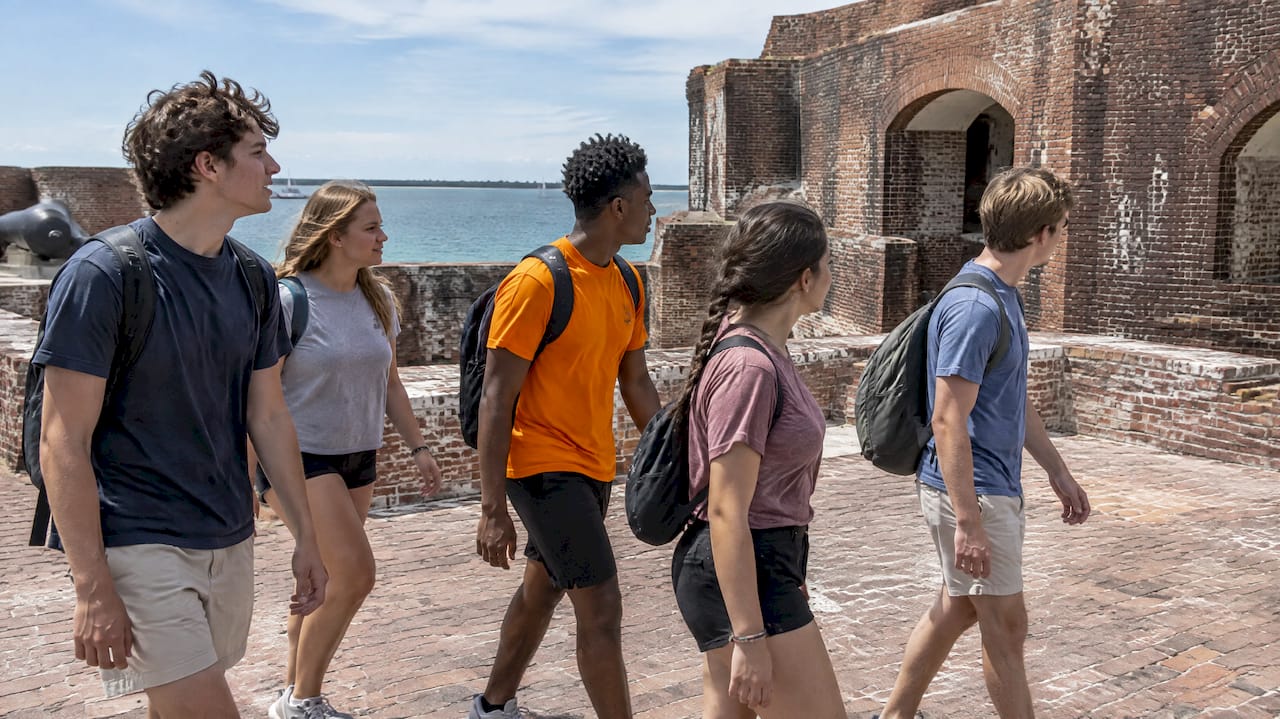
Fort Moultrie, on Sullivan’s Island, covers a much longer arc. It protected the harbor from the Revolutionary War through World War II, which makes it a useful companion to Sumter. The National Park Service manages both sites together, and you can see the layers of coastal defense in a single walk.
To fit both into one day:
- Morning: take an early Fort Sumter sailing, when it is cooler and less crowded.
- Midday: return to the mainland, eat lunch, and give the group a break.
- Afternoon: drive or take a rideshare to Fort Moultrie for a shorter, self-paced visit.
- Group booking: reserve the same sailing for every member of your group. Private vessels cannot dock at the fort, so everyone must travel on the concession boat, and splitting across sailings makes headcounts and supervision harder.
If you are planning a full history-focused day, the National Park Service’s Resilience and Freedom itinerary pairs the forts and maritime defenses with the Avery Research Center and a harbor cruise to Fort Sumter, a useful model for sequencing military and African American history in a single day.
Which museums and African American heritage sites belong on your list?
A Charleston history trip is incomplete without institutions that tell the fuller story. These sites add context that the more scenic stops sometimes leave out, and they give students a place to ask harder questions. Researchers and educators writing about the region recommend balancing standard historic house tours with specialized visits, as in this College of Charleston exhibit on Gullah/Geechee cultural life (opens in a new tab), which singles out the Avery Research Center for building a more complete picture of Gullah/Geechee culture and the African American experience in the Lowcountry.
- Avery Research Center for African American History and Culture: essential for context on Gullah/Geechee and African American history. It sits in a former school building and holds archives and exhibits. Allow time for a visit, and check ahead for hours and any group arrangements.
- Charleston Museum (opens in a new tab): a key local museum with exhibits on the city’s role in the American Revolution and Civil War, among other local histories. Allow time for a visit. It works well as a rainy-day anchor or a cooler midday stop.
- Aiken-Rhett House: a preserved townhouse that includes interpreted slave quarters, which the South Carolina Department of Archives and History (opens in a new tab) lists as an African American heritage site. Allow time for a visit. It is valuable because it shows the working spaces of the property, not just the formal rooms.
- Caw Caw Interpretive Center: an off-peninsula heritage site, also on the state’s list, that offers a more complete perspective on the Lowcountry landscape and the people who worked it. Treat it as an optional half-day for groups with extra time.
These stops pair well with the others. A morning at the Avery Research Center can follow a harbor day, and the Charleston Museum slots neatly beside a downtown walking tour. The Gibbes Museum of Art (opens in a new tab) is a good add-on if your group wants a cultural-history angle through art.
How many days do you need, and what does a 3-day itinerary look like?
Three days is the sweet spot for a history-focused visit. Charleston Visitor’s planning guide (opens in a new tab) says three days is ideal for most visitors, with downtown and tours first, then a plantation plus a harbor activity, then Angel Oak, a beach or museums. A shorter trip may force you to drop either the plantation or the museums. Extra days let you slow down, add Boone Hall, Caw Caw or a Gullah/Geechee tour, and avoid back-to-back full days.
Here is a plan you can use or adapt:
- Day 1, morning: start early with a walking tour of the Historic District, including Rainbow Row and The Battery.
- Day 1, afternoon: break for lunch around City Market, then take a carriage tour or explore historic churches and cemeteries at a slower pace.
- Day 1, evening: a themed evening tour, such as a ghost or history walk, if your group has energy left.
- Day 2, morning: arrive at your chosen plantation at opening time, such as Magnolia or Middleton Place, with tickets reserved ahead.
- Day 2, midday: return downtown for lunch and a rest break out of the heat.
- Day 2, afternoon: take a harbor cruise or Fort Sumter ferry, with ferry tickets booked in advance. Add Fort Moultrie if time allows.
- Day 3, morning: visit the Avery Research Center for African American and Gullah/Geechee context.
- Day 3, midday: tour the Charleston Museum or Aiken-Rhett House.
- Day 3, afternoon: finish at Charles Towne Landing or Angel Oak, or use the time for a final walk and group reflection.
Start mornings early for anything outdoors, and book the ferry and plantation tours before you arrive. Everything else can stay flexible. If weather changes, swap Day 2’s outdoor plans with Day 3’s museum visits and nothing is lost.
When should you go, and what do tickets, costs and getting around look like?
The best seasons are spring and fall. A College of Charleston exhibit page (opens in a new tab) notes that spring (March to May) and fall (September to November) are widely considered the best times to visit for milder weather and the city’s famous gardens and festivals, with spring temperatures averaging in the 60s to 80s°F and fall running about 60 to 78°F.
Spring (March to May) averages in the 60s to 80s°F, and fall (September to November) runs about 60 to 78°F, per the College of Charleston’s exhibit. Those are the months when outdoor touring is comfortable and the gardens are at their best.
Summer brings heat and humidity that make long outdoor stretches tiring, especially for students. Storms can affect travel, so build flexibility into your plans and consider travel protection.
- Tickets and costs: Fort Sumter charges no entrance fee, but ferry tickets are required and can be purchased in advance, according to the National Park Service. Plantations and guided tours set their own admission, so check each site for current pricing and group rates. Charleston Visitor offers sample cost ranges for a three-day trip.
- Getting around downtown: the peninsula is compact and walkable, though sidewalks and cobblestones can be uneven, as one accessibility guide notes.
- Getting to outlying sites: plantations and Angel Oak generally require a car, charter or rideshare. Local transit such as CARTA covers parts of the area, but a group schedule usually runs better on private transportation.
- Accessibility: plantation terrain varies, and Fort Sumter’s access is constrained by the ferry and the fort’s layout. Check each site’s policy before you book, and confirm ADA access at churches and museums, since it varies.
How do you plan a Charleston history trip for school and youth groups?
A good group trip is built backward from learning goals, then filled in with logistics. Use this checklist to move from ideas to a confirmed plan.
- Reserve early: lock in group slots for the Fort Sumter ferry and your chosen plantation. Put every student on the same sailing.
- Confirm chaperone ratios: decide your supervision plan before you go and make sure it matches each site’s group policies.
- Collect paperwork: gather permission slips, medical information and emergency contacts for every student, and keep a copy with each chaperone.
- Match sites to curriculum: the American Revolution (Charleston Museum, Fort Moultrie), the Civil War (Fort Sumter), Reconstruction and African American history (Avery Research Center, Aiken-Rhett House, Middleton Place).
- Add classroom bookends: before the trip, assign short research on a specific site. Afterward, have students write or present what changed in their understanding.
- Plan the day’s flow: set meal windows, identify safe pick-up and drop-off points, and arrange mobility accommodations in advance.
For more on structuring learning around a trip, see our guide on student history tours (opens in a new tab) and our Boston example of an educational history trip (opens in a new tab).
Pro Tip: Give each chaperone a small group and one clear job, such as timekeeper, headcounter or question-collector. Students stay engaged and supervision stays simple.
What safety guidelines and supervisor-to-student ratios work for Charleston group trips?
Charleston’s mix of cobblestone streets, harbor crossings and long outdoor stretches calls for a few specific precautions. Ratios depend on your school or organization’s policy and the ages in your group, so confirm those first, then add site-specific habits on top. A common approach is to keep chaperone groups small enough that an adult can see every student at all times, and to tighten the ratio for younger students and for water-based activities such as the Fort Sumter ferry.
Practical habits that work in Charleston:
- Headcounts at every transition: count before boarding the ferry, after getting off, and before leaving each site.
- Buddy pairs on the water and in crowds: the Historic District and the ferry dock both get busy.
- Heat plan: water bottles, hats, scheduled shade breaks and indoor stops at midday, especially in warmer months.
- Footwear: sturdy, closed shoes for uneven pavement and plantation grounds.
- Emergency information: every chaperone carries the group’s contact list, medical notes and the address of your accommodations.
- Weather flexibility: during hurricane season, keep an indoor backup plan and watch forecasts as the trip nears.
Check each site’s own group policies before you finalize ratios, since some set their own limits on group size or supervision.
How can you build interactive learning into historic sites?
Students remember what they do more than what they hear, so turn passive visits into active ones. Many Charleston sites already have programming that supports this, and you can layer your own activities on top.
- Primary-source scavenger hunts: give students a short list of details to find on a walking tour, such as architectural features, plaques or street names, then discuss what each reveals.
- Role perspectives: at a plantation or the Aiken-Rhett House, ask students to consider the same space from different viewpoints, such as an owner, an enslaved worker and a visitor today, and write a short reflection.
- Ranger and guide Q&A: prepare student questions in advance for the Fort Sumter ranger talk or a plantation guide. It makes the program feel like a conversation.
- Journaling stops: build in a quiet pause at each major site for sketching, note-taking or a short written response.
- Cross-site comparison: have students track how Fort Moultrie and Fort Sumter tell different parts of the harbor’s story, or how Magnolia and Middleton Place interpret slavery.
Ask each site whether it offers educator resources or group workshops when you reserve. For deeper background on structuring learning goals, see our overview of educational group travel (opens in a new tab).
Where should student and youth groups stay in Charleston?
For history-focused groups, location matters more than amenities. The Travel + Leisure guide recommends South of Broad and the French Quarter as neighborhoods for staying near historic sites, and being close to the Historic District lets you walk to many stops and return easily for rest breaks. The tradeoff is that downtown lodging can be pricier, so compare it with options just outside the peninsula that offer easy access by shuttle or short drive.
When you evaluate accommodations for a group, look for:
- Proximity to the Historic District: fewer vehicle transfers and more time on site.
- Group room blocks and flexible policies: rooming lists, deposits and cancellation terms that suit a school calendar.
- Safe, controlled entrances: especially important for student groups.
- Meeting or common space: a place for evening debriefs and journaling.
- Parking or coach access: if you travel by bus, confirm the property can accommodate it.
- Breakfast included: it simplifies your first-hour logistics and keeps mornings on schedule.
Book early. Spring and fall are the most popular months, and group blocks fill first. A coordinator who knows the local lodging market can compare options and negotiate group terms, which saves group leaders considerable time.
How do you handle meals and dietary restrictions for a group?
Charleston is a food city, which helps, but groups need planning to eat well without losing the schedule. Build meals around your sightseeing rather than the reverse, and secure reservations early for any sit-down meal.
- Reserve group tables ahead: many popular restaurants limit large parties or require advance notice, especially near City Market and King Street.
- Collect dietary needs early: gather allergies, religious restrictions and vegetarian or vegan needs on your permission forms, then share the list with restaurants when you reserve.
- Choose flexible menus: places with several options per course make it easier to accommodate everyone without special orders.
- Use casual lunches: quick-service spots near your tour stops keep the day moving, and picnic lunches work well at Charles Towne Landing and plantation grounds.
- Plan around the schedule: eat before the Fort Sumter ferry and bring water and snacks, since food service on a crossing is limited.
- Keep allergy protocols visible: assign one chaperone to carry any emergency medication list and confirm who administers what.
Confirm menus and allergy handling directly with each venue, because practices change and staff can only plan for needs they know about in advance.
Can your group perform or present at historic venues?
If your group includes a band, choir or ensemble, Charleston can serve as both a history lesson and a stage, but performance access at historic sites takes advance coordination. Many historic venues have preservation rules, limited capacity and set schedules, so reach out well ahead and ask what is permitted.
- Ask early and ask specifically: contact each venue about whether performances or student presentations are allowed, and under what conditions.
- Match the space to the group: outdoor grounds, churches and public squares each have different rules for sound, equipment and crowd size.
- Plan logistics: instrument transport, load-in times, rehearsal space and restroom access all need advance arrangement.
- Consider presentations too: for non-performance groups, student-led talks or readings at a site can be a meaningful way to share what they learned.
- Build in rehearsal time: a short warm-up on site, away from visitors, helps groups feel prepared.
- Confirm permissions in writing: get any approvals from the venue in writing before you travel.
If performance is a major part of your trip, our Performance Tours (opens in a new tab) service is built for combining a stage with an itinerary like this one.
Why a curated itinerary beats a do-it-yourself plan
I think the best history trips are the ones where someone has already done the unglamorous work. Reading a list of Charleston sites is easy. Sequencing the ferry, the plantation, the museums and lunch so that forty students arrive rested, on time and ready to learn is a different job entirely. When logistics are handled, teachers and chaperones can teach instead of troubleshoot, and students pick up more because they are not standing in a line wondering what comes next. Safety improves for the same reason: a plan with clear transitions, vetted vendors and someone on call when the weather turns leaves far fewer gaps. If you have the time and the experience, you can absolutely build it yourself. If you would rather spend your energy on the learning, organized planning is a sensible shortcut.
— Donovan
Let us plan your Charleston history trip
We build custom group trips for schools, bands and youth organizations, and a Charleston history itinerary is the kind of project where our planning shows most.

- Customized itineraries: built around your curriculum goals and group size.
- Dedicated trip coordinators: one point of contact before and during the trip.
- Online registration: simple sign-up and paperwork for families.
- Flexible payment plans: payments spread out so families are not hit all at once.
- Travel protection options: coverage to help when plans change.
We handle the ferry bookings, plantation reservations, lodging and meals so you can focus on teaching. Start with our Educational Endeavors (opens in a new tab) page to tell us about your group, and we will map out your Charleston trip with you.
FAQ
What are the best history tours in Charleston?
Walking tours of the Historic District are the best starting point for most groups, with harbor cruises and themed tours such as Gullah/Geechee or women’s history adding depth. The Charleston Convention and Visitors Bureau lists walking tours, carriage tours and plantation visits among the core historic experiences.
How many days is enough for Charleston?
Three days is ideal for most history-focused visitors. Charleston Visitor’s planning guide suggests downtown and tours on day one, a plantation and harbor activity on day two, and Angel Oak, a beach or museums on day three.
What is the best time of year to visit Charleston?
Spring and fall offer the mildest weather and the best gardens. A College of Charleston exhibit identifies March to May and September to November as the best months to visit.
Do you need to book Fort Sumter in advance?
Yes, buying ahead is the safe approach. Fort Sumter is reachable only by the concession-operated ferry, and the National Park Service notes that tickets can be purchased in advance.
Sources
- Plan Your Visit – Fort Sumter and Fort Moultrie National Historical Park (U.S. National Park Service) (opens in a new tab)
- CHARLES TOWNE LANDING (opens in a new tab)
- Ldhi (opens in a new tab)