


Allergy management on a school trip comes down to four things done before departure: a written plan for each allergic student, a trained adult who carries the emergency medication, meals and lodging confirmed in advance, and a clear emergency script every chaperone knows. Students with allergies must be able to go. Your job is to build the trip so that they can go safely. We plan group trips for schools, bands, teams and youth organizations, and the sections below give you the routine in the order you will need it.
TL;DR
- Strict avoidance is the only way to prevent a food-allergy reaction, so the plan is built around meals, transport, lodging and hand hygiene.
- Start early: nurse approval, parent conversations and medication hand-offs all have lead times, and some states set them in writing.
- A trained adult must carry the student’s emergency plan and epinephrine for the whole trip, and every chaperone must know who gives it and who calls 911.
- Never exclude an allergic student. Change the destination, menu or room instead.
- Confirm restaurants, hotels and stops by phone before you book, not on arrival.
Table of Contents
- Why this belongs in your trip plan
- Step 1: Build the plan with families, nurse and staff
- Step 2: Choose destinations and vendors with allergies in mind
- Step 3: Plan meals, snacks and hand hygiene
- Step 4: Make the bus and transport safe
- Step 5: Medication and emergency information
- Step 6: Train chaperones and rehearse the response
- Our perspective
- Plan your next trip with allergies built in
- FAQ
- Sources
Why this belongs in your trip plan
The CDC reports (opens in a new tab) that an estimated 1 in 13 U.S. children, about two per classroom, has a food allergy, and that at least 2 in 5 have been treated in an emergency department for a reaction. A bus of 45 students will almost certainly include several. On a trip, the usual safety net (the school cafeteria, the nurse’s office, the familiar room layout) is gone.
That is why the same guidance appears in state after state: field trips need extra planning, not fewer allergic students. FAACT (opens in a new tab), a food allergy education nonprofit, advises that students with food allergies must not be excluded from school activities. The Wisconsin Department of Public Instruction (opens in a new tab) notes in its field trip tool kit that federal law requires equal access to school-sponsored activities, and that health services, including medication administration, may be required to provide it.
Step 1: Build the plan with families, nurse and staff
Minnesota’s health department says that advance planning (opens in a new tab) has to cover communication among administrators, teachers, nurses, parents or guardians, students and other staff. It suggests setting notification timelines, deciding who approves trips and how the nurse is included, and planning for last-minute changes.
In practice, assign one person, usually the trip lead, to own the following:
- A list of every student with a known allergy. Include food, insect sting, medication and latex allergies. FAACT asks organizers to consider all of these (opens in a new tab), not only peanuts and tree nuts.
- Each student’s emergency plan. This is the written document from the student’s doctor describing symptoms and what to give. Depending on the district it may be called an emergency action plan, an Individualized Health Care Plan or a 504 Plan.
- A nurse sign-off date. Connecticut’s guidance for school nurses requires the nurse to be notified and to approve trips at least four weeks ahead (opens in a new tab). Arlington Public Schools in Virginia asks teachers to coordinate with clinic staff at least one week prior (opens in a new tab). Use your own district’s rule, and use the longer lead time when you can.
- A family conversation. Ask what the student reacts to, what the last reaction looked like, and what the family needs from the trip. Invite parents to chaperone if they wish. FAACT and the CDC both say parents should be invited, never required (opens in a new tab), to attend.
For the paperwork side, our guide to student medical forms for school trips (opens in a new tab) covers what to collect and when. Our emergency plan essentials (opens in a new tab) show what the whole group should carry.
Out-of-state and overnight trips
Rules change at state lines. The Wisconsin tool kit tells schools planning out-of-state trips to check the destination state’s nursing scope of practice and delegation rules (opens in a new tab), including whether unlicensed personnel may give medication. Ask your district nurse about this before you commit to a destination, not after.
The same document makes a point worth remembering: it argues that professional judgment and collaboration with students, families and health teams matter more than mandates when balancing safety with letting students take part and build independence. A teenager who manages their own allergy well at home can be part of the plan, for example by carrying their own medication where the school authorizes it.
For policy language on overnight trips, see our overview of what to include in an overnight field trip policy (opens in a new tab).
Step 2: Choose destinations and vendors with allergies in mind
The CDC’s pre-trip checklist for teachers starts with the location: decide whether it can be made safe for students with food allergies, and if it cannot, reschedule or cancel (opens in a new tab). FAACT recommends collaborating to avoid high-risk destinations. The CDC and FAACT guidance is also clear that this decision is about the venue, never about leaving the student behind.
High-risk settings include food-focused attractions such as chocolate factories, farm activities with feed and hay, and any stop where food is handed out as part of the program. Our school trip organization tips (opens in a new tab) can help you weigh venues before you commit.
Then call. FAACT says to phone every destination (opens in a new tab), including travel stops, restaurants and hotels, to confirm accommodations and review emergency protocols with their representatives. A useful call covers these questions:
- Can the kitchen prepare a meal for a named allergen, and who is the person on shift who will do it?
- Are ingredient lists or labels available for the group menu?
- Where is the nearest emergency medical facility, and how does the site reach 911?
- If you are eating outdoors, is there a sheltered backup location? FAACT specifically advises choosing one in advance in case of bad weather.
When the itinerary involves many vendors, this is a lot of calls. Our trip coordinators work with vendor partnerships and build customized itineraries, so allergy requirements can be part of the brief from the start rather than a late fix.
Step 3: Plan meals, snacks and hand hygiene
Meals are where most exposure happens. FARE’s Food Allergy Management in Schools recommendations (opens in a new tab), published in October 2024, say prevention protocols should apply to school-sponsored events including bus rides and field trips. For activities involving food, they call for equivalent allergen-safe alternatives, using packaged foods with clear labeling and labeled catered food.
A workable meal routine:
- Group meals: Choose menus with the allergy list in hand, and get written confirmation of ingredients. Our group meal planning playbook (opens in a new tab) walks through this for coordinators.
- Snacks: Pack or buy sealed, labeled items. If your schedule includes a pool or beach day, plan the timing and contents of snacks around it; this guide to pre-swim snacks for kids (opens in a new tab) gives ideas for what to pack and when.
- No sharing: FAACT recommends a no food or beverage sharing policy (opens in a new tab) on trips. Say it out loud at the departure meeting, and say it to students, not only to chaperones.
- Handwashing: FARE’s recommendations advise washing hands before and after preparing, serving or eating, and cleaning surfaces before and after meals.
Packing wipes, not just sanitizer
Arlington Public Schools makes a distinction that is easy to miss. Hand sanitizer kills germs but does not remove allergens (opens in a new tab). When soap and water are not available, such as at a rest stop or on a hike, the guidelines call for allergen-free hand wipes, without ingredients such as shea or lanolin. Put a pack in each chaperone’s bag.
Hotels
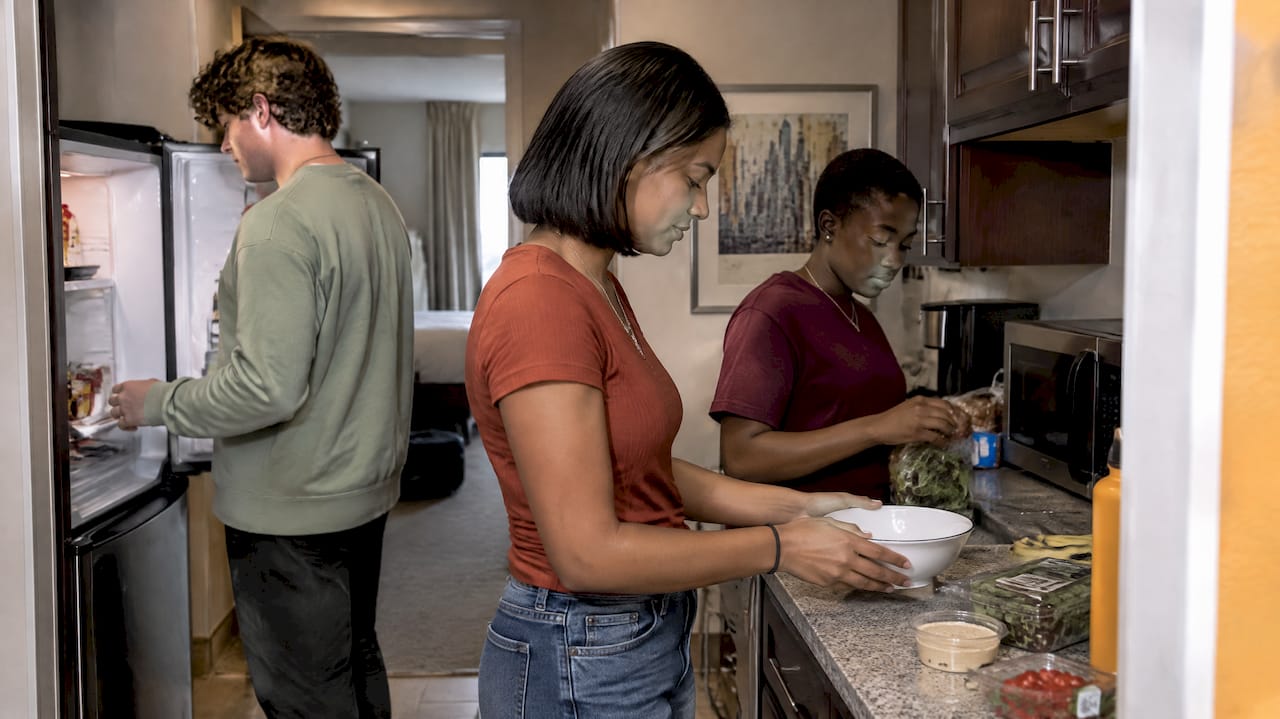
For overnight stays, FAACT recommends asking for rooms with kitchens, refrigerators and microwaves so students with food allergies can prepare their own meals. Add the request to your hotel contract language, and ask about it in the same call where you confirm room blocks. Our student travel accommodation standards (opens in a new tab) and hotel security guide (opens in a new tab) cover what else to require of a property.
Step 4: Make the bus and transport safe
Transport rules are the most consistent across states. The Illinois State Board of Education’s guidelines call for a no-food-consumption policy on buses unless medically necessary (opens in a new tab), driver training in risk reduction and reaction recognition, and cleaning of surfaces including seats and handrails. They also direct that a student who is already showing a suspected reaction does not board the bus and is never left alone, with 911 called if needed.
Arlington’s rules add useful specifics:
- Drivers do not hand out food or drink to students.
- Epinephrine cannot be stored on the bus (opens in a new tab) because drivers change and temperatures vary, so it travels with the responsible adult.
- If food is eaten on a field-trip bus, chaperones wipe down all seats before the bus returns to regular service.
FAACT’s transportation checklist adds that drivers, attendants and substitutes should receive annual food allergy and anaphylaxis training, and that every vehicle should have a tested communication device. If you hire a charter, put the driver briefing in the contract and give the driver the plan for each allergic student on board.
Step 5: Medication and emergency information
The CDC says to take the student’s emergency care plan, emergency contact information and emergency medication (opens in a new tab) on the trip. Only a trained staff member or the student’s parent should carry and administer the medication, though some students may be authorized to carry their own epinephrine.
Three practical points:
- Who carries it. Arlington requires that the medication, including epinephrine auto-injectors, and a copy of the physician’s severe allergy action plan accompany the student, and that the responsible teacher be trained, monitor the student and carry the medication throughout the trip.
- How much and in what container. Connecticut notes that a school nurse may give staff only one dose from the school supply for a day trip. More than that counts as dispensing, so for multi-day trips parents must supply medication from their pharmacy in a labeled container. Parents should hand it over at least three school days before departure.
- Stock epinephrine. Washington’s guidelines for students with anaphylaxis (opens in a new tab) say a nurse or designated trained personnel may carry school-owned auto-injectors on field trips when the district has a stock program. Ask your district whether it does.
At the end of the trip, FAACT’s checklist says to return all medications to the designated staff member or school nurse immediately.
A first-aid kit for the whole group belongs alongside this; see our list of student trip first aid essentials (opens in a new tab).
Step 6: Train chaperones and rehearse the response
FAACT says trip coordinators, chaperones and bus drivers should be prepared to respond to anaphylaxis (opens in a new tab), including in a student who has never had a reaction before. A designated adult directly available to allergic students must understand the student’s allergies, the emergency plan and the emergency procedures. FARE’s November 2024 announcement of its expert recommendations for K-12 schools (opens in a new tab) recommends that all school staff receive food allergy training at least once a year, and that every known food-allergic student have an emergency plan on file.
Before departure, hold a ten-minute briefing and assign these roles by name, as FAACT’s checklist suggests:
| Role | Question to settle |
|---|---|
| Gives epinephrine | Who carries it and who is the backup? |
| Calls 911 | Who dials, and who meets the ambulance? |
| Contacts parents | Who has the phone numbers on paper and in a phone? |
| Rides to the hospital | Who goes with the student, and who stays with the group? |
The response itself
The Texas health department’s guidelines state that epinephrine is the first-line treatment for anaphylaxis (opens in a new tab) and should be given at the first sign of symptoms, because other medications act too slowly. Emergency medical services should evaluate the student afterward even if symptoms appear to have gone away. Follow the student’s own emergency plan, and call 911 as it directs.
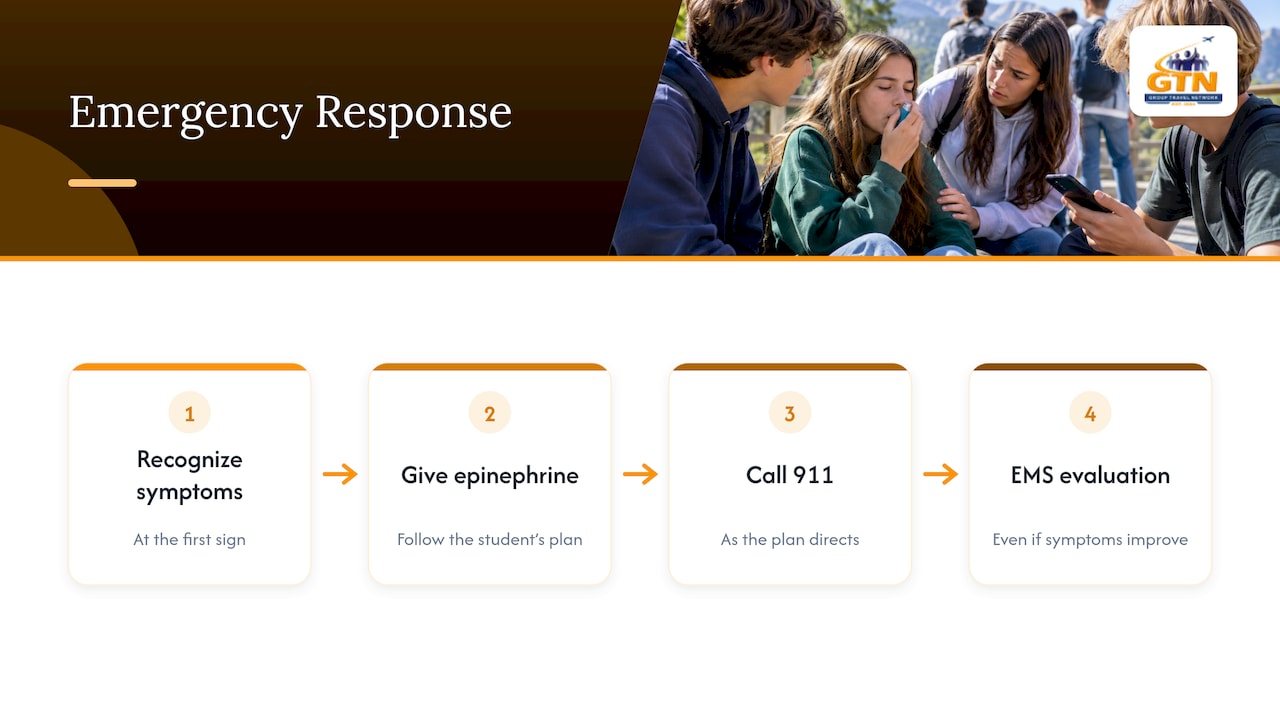
Washington’s April 2025 standing order (opens in a new tab) specifically covers stock epinephrine on field trips and sanctioned excursions, and it states that EMS must be activated by calling 911. Your state may differ, so confirm the rule with your district nurse.
Know the nearest emergency facility to every stop, as the CDC checklist advises, and write it on the chaperone card.
Our perspective
Allergy planning fails most often at the hand-offs: the family told the teacher, the teacher told no one, and the restaurant never heard. A trip is a chain of vendors, and every link needs the same information.
That is why we think a group this size is better served by a dedicated trip coordinator than by a teacher making twenty phone calls in the evening. Our trip coordinators build customized itineraries and work with vendor partners, which gives the allergy list a single place to live. Registration is online, payment plans are flexible, and travel protection options are available, so families can enroll early and the nurse conversation can start early.
Our advice to any administrator: write the allergy requirements into the itinerary brief before the first venue is chosen. Whatever else changes, the answer to a student with an allergy should be “here is how we make this trip work for you.”
Donovan
Plan your next trip with allergies built in
If you are organizing a trip for a school, band, team or youth organization, we can plan it around your students’ needs from the first itinerary draft. Our dedicated trip coordinators, customized itineraries and vendor partnerships are described on our Youth Travel (opens in a new tab) page. Band directors can start from our Performance Tours (opens in a new tab) page, and classroom-focused programs are on Educational Endeavors (opens in a new tab).

Bring your allergy list to the first planning conversation, and we will build the meal, lodging and transport plan with it.
FAQ
Can a student with a severe allergy be left off the trip?
No. FAACT advises that students with food allergies must not be excluded from school activities, and Arlington’s guidelines say a student should not be excluded because of allergen-exposure risk. If the venue cannot be made safe, the CDC checklist says to change the plan: reschedule or choose another location.
Does a parent have to come along?
No. The CDC and FAACT both say parents of food-allergic students should be invited to chaperone, but not required to. The school remains responsible for a trained adult who carries the medication and knows the plan.
How early should we tell the school nurse?
As early as you have a destination. Connecticut requires notification and approval at least four weeks before a trip. Arlington asks for at least one week. Your district’s policy sets the minimum, and early notice gives the nurse time to get medication and plans in order.
Is hand sanitizer enough at meals?
No. Arlington’s guidelines point out that sanitizer does not remove allergens. Use soap and water, or allergen-free wipes when a sink is not available.
What should happen if a student has a reaction on the bus?
Follow the student’s emergency plan: give epinephrine at the first sign of anaphylaxis as the plan directs, call 911, and keep the student with an adult. Texas guidance says EMS should evaluate the student afterward even if symptoms improve.
Sources
- FAACT: Field Trips for School Personnel (opens in a new tab)
- CDC: Food Allergies in Schools (opens in a new tab)
- CDC: Managing Food Allergies in Schools, Role of School Teachers (opens in a new tab)
- Minnesota Department of Health: Field Trip Preparedness (opens in a new tab)
- Wisconsin DPI: Meeting Student Health Needs on Field Trips (opens in a new tab)
- Connecticut SDE: School Personnel Roles and Responsibilities (opens in a new tab)
- Illinois ISBE: Guidelines for Managing Life-threatening Food Allergies (opens in a new tab)
- Arlington Public Schools: Management and Support of Students With Severe Allergies (opens in a new tab)
- FARE: Food Allergy Management in Schools expert recommendations (opens in a new tab)
- FARE: Expert Recommendations for K-12 Schools announcement (opens in a new tab)
- Washington OSPI: Guidelines for Care of Students with Anaphylaxis (opens in a new tab)
- Texas DSHS: Guidelines for the Care of Students with Food Allergies (opens in a new tab)
- Washington State Department of Health: Standing Order for Epinephrine (opens in a new tab)
Recommended
- Student Medical Forms for School Trips: Checklist and Templates (opens in a new tab)
- Student Travel Accommodation Standards: 2026 Guide for Schools (opens in a new tab)
- Student Trip First Aid: 10 Must-Pack Items for 2026 (opens in a new tab)
- U.S. School Trips: Four Emergency Plan Essentials to Carry (opens in a new tab)