


A group reservation does not guarantee that your students will sit together. Airlines sell a block of seats to groups of 10 or more, and most will try to seat you side by side, but seat assignments stay subject to change until the flight departs. The coordinators who get good results treat seating as a process they manage from the first quote to the gate: one reservation, early requests, clean names and a plan for when the seat map shifts. We plan group trips for schools, bands, teams and youth organizations, and this guide lays out how the policies work and what to do about them.
TL;DR
- A group booking gets you a block of seats and a fare, not a promise of adjacent seats. Airlines such as JetBlue and Frontier say assignments can change.
- Keep everyone on one group reservation. Separate bookings look like unrelated travelers to an airline’s system.
- Most major carriers set a 10-passenger minimum. Drop below it and you can lose your group fare or your deposit.
- Federal family seating rules were proposed for children 13 and under only. They do not cover most student groups.
- Ask early, confirm in writing, and recheck the seat map at each name, payment and check-in milestone.
Table of Contents
- What a group reservation actually gives you
- How airlines assign seats to groups
- Carrier group rules that affect seating
- How to request seats together, step by step
- Minors, chaperones and boarding
- Do federal family seating rules protect school groups?
- What to do when the seats change anyway
- Why groups do better with a planner on the booking
- Planning a trip with Group Travel Network
- FAQ
- Sources
What a group reservation actually gives you
A group reservation is a negotiated booking for a set number of travelers on the same flight. The airline holds a block of seats, quotes a fare, and asks for a deposit. What it holds is capacity. Where each person sits is a separate question.
JetBlue’s group program is open to sports, church, youth, school and community groups of at least 10 travelers on the same flight. After a nonrefundable deposit of $50 per seat ($150 for transatlantic bookings), a block of seats is assigned. JetBlue says it will do its best to seat the group together (opens in a new tab) based on availability at the time of the deposit, and it also states that seat assignments are not guaranteed and are subject to change.
Frontier works differently. Its group program for 10 or more passengers on nonstop routes (opens in a new tab) includes pre-assigned seats and a choice of carry-on or checked bag. The airline assigns the seats, though, and it says it cannot honor specific seat requests for individual group members. Assignments can change with schedule, equipment or policy changes.
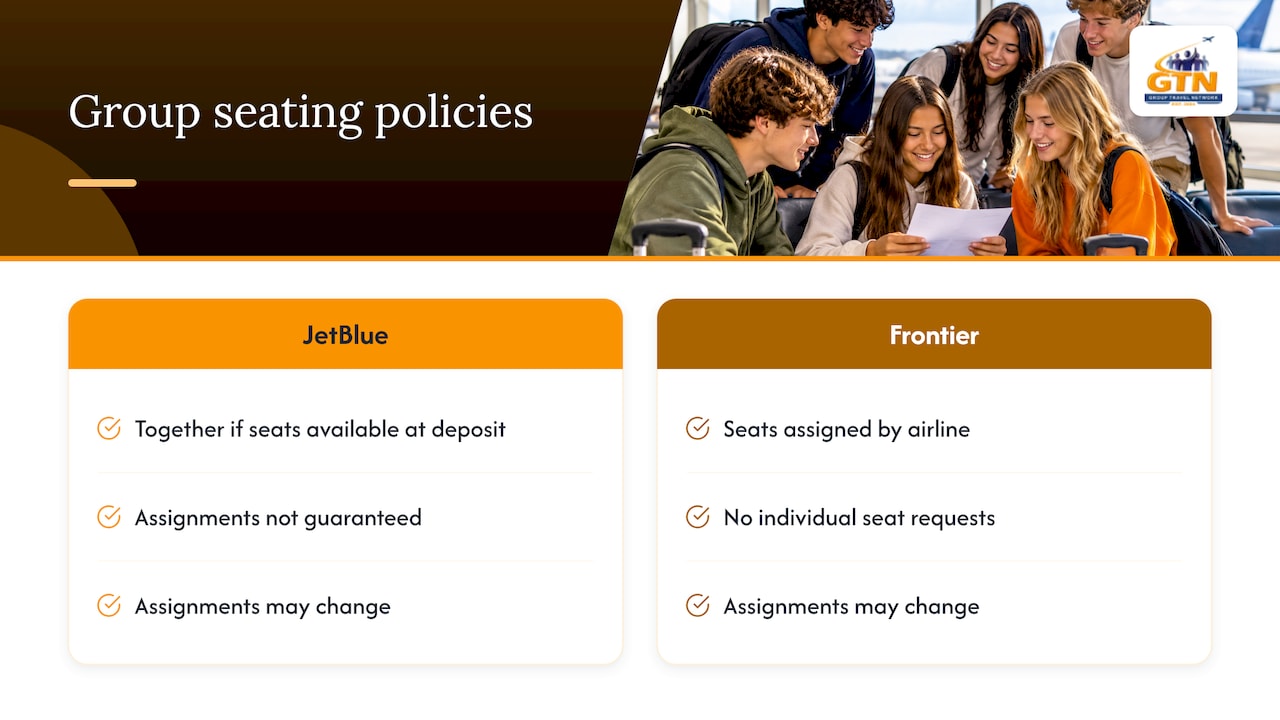
The pattern is consistent. The airline controls the seat map, and your group is one of many things its system is balancing.
How airlines assign seats to groups
Seating is mostly automated. A UK Civil Aviation Authority review of 10 airlines found that seats are usually allocated by algorithms (opens in a new tab). Every airline in the study allowed free seat allocation at check-in, but those seats may not be next to other members of your party. Passengers who want to be sure of sitting together typically have to pay an extra charge. The same study found that school groups and passengers with children are typically identified through booking-data checks one, three and five days before departure, and flagged for manual seating if the automatic process fails.
That study is from the UK, but the mechanics it describes explain what U.S. coordinators see. Three things split groups:
- Separate reservations. Finnair explains that separately booked companions appear as independent records (opens in a new tab), so the airline cannot know they want to sit together. It recommends one reservation for everyone.
- Paid seats chosen by other passengers. Once other travelers pre-select seats, the open seats scatter across the cabin, and a block that was contiguous in the system at deposit may not be contiguous later.
- Aircraft changes. A swap to a different aircraft layout forces the system to reassign seats, and your block can be broken up in the process.
The lesson for a coordinator is practical. You cannot control the algorithm, but you can control how clean your booking looks to it.
Carrier group rules that affect seating
Seating is tied to the rest of the group contract. Minimum sizes, deposits, name deadlines and payment dates all decide how much flexibility you have to fix a seating problem. The table below summarizes what the airlines publish on their own group pages. Figures such as deposits and fees are the carriers’ published terms and can be revised, so confirm them on the airline’s page or with the group desk when you request your quote.
| Carrier | Group minimum | Deposit and fees as published | Seating and name terms |
|---|---|---|---|
| JetBlue (opens in a new tab) | 10 travelers | $50 per seat nonrefundable ($150 transatlantic); no group fare discount | Seat block assigned after deposit, best effort to seat together, not guaranteed; traveler information due 30 days before travel |
| Frontier (opens in a new tab) | 10 passengers, nonstop routes | $40 per person deposit, refundable until final payment; $5 per passenger booking fee; final payment due 60 days before outbound travel | Seats pre-assigned by Frontier, no specific requests; names due 21 days before departure |
| United (opens in a new tab) | 10 on a common flight to a common destination | Guaranteed fare for the whole group | Dedicated group airport coordinator; name-change flexibility |
| Delta (opens in a new tab) | Set by fare rules, generally 10 | Deposit forfeited if the group falls below the minimum | Booking cancelled if below minimum |
Two details deserve attention. First, Delta’s tariff says that fewer than the minimum number may not travel at group fares (opens in a new tab) even if you pay for the minimum number of fares, unless a specific fare rule permits it. If your roster shrinks from 12 to 9 after a few withdrawals, your fare and your seat block are both at risk. Second, JetBlue states that cancelling after a deposit forfeits all monies paid, so a seating problem is a poor reason to walk away once you are committed.
For sports teams, United also notes that teams of 6 or more on United-operated flights within the U.S., Puerto Rico and Canada get its change fee waived during the group’s travel window, and each passenger gets one free name change until the day before departure, with a $100 fee on the day of departure. Ask each airline what its own sports or youth program offers before you assume the standard group rules apply.
Our own breakdown of the 10-passenger rule is in airline group booking rules for U.S. coordinators (opens in a new tab), and the fare math is in group airfare vs. individual tickets (opens in a new tab).
How to request seats together, step by step
1. Book as one group, never as individuals
When 10 or more people are traveling together, use the airline’s group desk rather than buying single tickets. Individual tickets create separate records, which is the biggest cause of split seating. If a few travelers must be ticketed separately, ask the desk to link their records.
2. Request in writing and early
Put your seating needs in the quote request: total headcount, number of minors, number of adult chaperones, and any students who need to sit near an adult. The U.S. Department of Transportation advises travelers to book as early as possible (opens in a new tab) and to put children on the same reservation as adults so the airline knows the party belongs together. Early booking matters because the block is built from the seats open at the time of your deposit. JetBlue notes quotes stay valid up to two weeks when you book 120 days or more ahead, so decide on the quote quickly. Our group flight booking timeline (opens in a new tab) shows when to start.
3. Submit names on time and correctly
Names drive ticketing, and ticketing opens the door to seat changes. Frontier, for example, wants the passenger list 21 days before departure; after the due date, up to 5% of names can be changed through 72 hours before the first flight, with $50 charged for each additional change. A misspelled name found late costs money and can reset seat assignments. See our airline name change policy guide (opens in a new tab) for the deadlines to keep.
4. Recheck the seat map at each milestone
Look again after final payment, after ticketing, 30 days out, and again in the week before departure. Aircraft swaps and schedule changes are when blocks get broken, and the sooner you notice, the more options the desk has. Ask the airline whether more seats will open later, since seats often free up as other passengers change plans.
5. Have an airport plan
Arrive early with a printed roster. If the group was split, ask the gate agents to help before boarding, and put the youngest students and the least experienced flyers beside chaperones first. The airline may be able to ensure each child sits next to an adult even when the whole group cannot sit together, according to DOT guidance.
Minors, chaperones and boarding
Seating for a youth group is also a supervision issue. Each airline sets its own rules, so confirm them with the group desk. A few published examples show how they differ.
JetBlue states that group passengers cannot check in online, through the app or at kiosks, and must use the ticket counter. Groups with minors under 18 need adequate chaperones aged 18 or older on the same reservation. That means chaperone names belong on the same booking as the students, not on a separate one.
Delta’s October 2025 domestic tariff says children under 15 generally need an adult 18 or older on the same flight and in the same cabin (opens in a new tab). It also limits unaccompanied minors on domestic flights over two hours that depart between 9 p.m. and 5 a.m. A student group with a responsible adult is a different case from an unaccompanied minor, but it shows why airlines care that the adult and child are linked in the record.
Plan chaperone placement before you plan anything else. Spread adults through the block rather than clustering them, so every row of students has an adult within reach. Our chaperone-to-student ratio guide (opens in a new tab) covers how many adults to bring, and TSA rules for minors (opens in a new tab) covers security screening. If your group includes very young travelers, a guide to traveling with children (opens in a new tab) may help you prepare the families.
Do federal family seating rules protect school groups?
Only in a narrow way. Section 516 of the FAA Reauthorization Act of 2024 directed DOT to start a rulemaking on seating children under 14 next to an accompanying adult (opens in a new tab) when adjacent seats are available, without a fee beyond the price of the seat. In August 2024, DOT published a proposal, Family Seating in Air Transportation (opens in a new tab), that would require carriers to seat children 13 and under next to an accompanying adult at no additional cost, with exceptions such as when the adult declines or the aircraft layout makes adjacency impossible.
Three points matter for coordinators:
- It concerns children 13 and under. Most high school bands, teams and senior classes are older.
- It is about a child and an accompanying adult, not about a whole roster sitting in one block.
- It was a proposal. Check DOT’s website for the rule’s current status before you rely on it.
In practice, the best protection for a middle school group is still a single reservation with chaperones on the same record, which DOT itself says airlines prioritize when they assign or reassign seats.
What to do when the seats change anyway
Seat changes happen even to well-run groups. When one does:
- Call the group desk, not general reservations. The group desk has the block and the booking history.
- Ask for the fix by priority. Chaperones next to the youngest students first, then students with medical or accessibility needs, then friends and sections.
- Ask whether the records are linked. If travelers were booked separately, DOT recommends asking the airline to merge them into one reservation or cross-reference them in the booking notes.
- Ask about paid seats. JetBlue, for example, allows extra-legroom seats to be purchased after final payment, names and ticketing. A small number of paid seats can anchor a chaperone presence in the group.
- Keep a record. Note the date, the agent and what was promised, so the airport team can pick up where the desk left off.
If a student or two end up several rows away, that is normal. Make sure each is seated near an adult on the roster, and brief the students on where to find their chaperone.
Why groups do better with a planner on the booking
The hard part of group air travel is not any one rule. It is that dozens of small rules have to line up: the minimum headcount, the deposit date, the name deadline, the final payment, the seat check, and the airport day. A missed date loses a fare or a block, and the person who pays is the coordinator.
Our perspective
When a band director or a school administrator calls us about flights, the question is rarely about the seat map. It is about whether they will be left holding the problem when something moves. Airlines publish firm terms on deposits, minimums and name deadlines, and each one is a place a volunteer coordinator can get caught.
That is why we build trips around dedicated trip coordinators, online registration and flexible payment plans. Registration gives you one clean roster to hand to the airline. Payment plans spread the cost across families so a withdrawal does not become a surprise. Travel protection options give you a plan when the unexpected happens. Our approach is to take the checklist off your desk and keep your group on one reservation with the right people on it.
Seating will never be something any group can fully control, but it can be managed well. Start early, keep the record clean and have someone watching the dates.
Donovan
Planning a trip with Group Travel Network
We organize student, school and youth group trips across the U.S. and abroad, with custom itineraries, dedicated trip coordinators, online registration, flexible payment plans and travel protection options. Whether your group is a marching band headed to a festival or a senior class heading out of state, we can build the trip around your dates and your roster. Explore our Performance Tours (opens in a new tab), Educational Endeavors (opens in a new tab) and Youth Travel (opens in a new tab) programs, or start from Group Travel Network (opens in a new tab).

If your trip needs coverage for cancellations or medical issues, read our guide to travel insurance for school group trips (opens in a new tab).
FAQ
Do airlines have to seat school groups together?
No. For groups, there is no federal rule that requires it, and the airlines’ own group pages say they will try based on availability but assignments can change. The proposed federal family seating rule concerns children 13 and under with an accompanying adult.
How many people count as a group?
Most major U.S. airlines use 10 travelers on the same flight as the starting point. Some carriers have different minimums on certain routes. If your headcount falls below the minimum, the booking may be cancelled and the deposit forfeited, so confirm the rule with the airline.
Can we pick seats for each student in a group booking?
Usually not. Some airlines assign group seats themselves and say they cannot honor specific requests for individual members. Others allow paid seat purchases after ticketing. Ask the group desk what your carrier allows when you request your quote.
When should we ask about seating?
At the quote stage, and again after ticketing. The block is built from what is open when you pay the deposit, so early requests have the most seats to work with. Recheck the seat map at each payment and name deadline.
Sources
- JetBlue Group Bookings (opens in a new tab)
- Frontier Airlines Groups (opens in a new tab)
- United for Business: Group and Sports Travel (opens in a new tab)
- Delta Air Lines Group Travel (opens in a new tab)
- Delta Domestic General Rules Tariff, March 2024 (opens in a new tab)
- Delta Domestic General Rules Tariff, October 2025 (opens in a new tab)
- UK CAA: Paid-for allocated seating in aviation (opens in a new tab)
- Finnair: how seating on board works (opens in a new tab)
- U.S. DOT: Tips for Families (opens in a new tab)
- U.S. Code, Chapter 423, Passenger Air Service Improvements (opens in a new tab)
- Federal Register: Family Seating in Air Transportation (opens in a new tab)
Recommended
- Airline Group Booking: 10 Passenger Rule U.S. Coordinators Must Know (opens in a new tab)
- When To Book Group Flights: 2026 Timeline For Schools (opens in a new tab)
- Group Airfare Vs Individual Tickets: 5 Checks For 2026 (opens in a new tab)
- TSA Rules For Minors: 2026 Guide For Group Leaders (opens in a new tab)