


Airalo is the better pick for most student groups: it sells fixed data buckets that cost far less for students who mostly use maps, messaging and social media, and it generally allows tethering. Holafly is the better pick when you want unlimited, set-and-forget data for heavy users or long stays and you accept a higher price. Neither is perfect, and the right answer depends on how your students actually use their phones. This guide compares them on the points a band director, teacher or team manager has to settle before departure.
TL;DR
- Cost: In one 2026 catalogue comparison (opens in a new tab), Airalo starts at $4.00 and its best rate is $0.74/GB. Holafly starts at $11.90 and its best rate is $1.71/GB.
- Heavy users: Holafly’s flat-rate unlimited plans are predictable, but “unlimited” still comes with fair use rules and often a small daily hotspot cap.
- Laptops and hotspots: Airalo generally allows tethering on its fixed plans. Holafly’s hotspot allowance is frequently limited to roughly 500MB to 1GB a day.
- Refunds: Holafly says it refunds unused plans for up to six months. Airalo’s refund policy is narrower, with a 30-day window.
- For groups: Install before departure, on home Wi-Fi, and tell families that eSIMs are data-only and will not receive SMS codes.
Table of Contents
- Why group leaders care about eSIMs
- How Airalo and Holafly differ
- Price: what a group actually pays
- “Unlimited” has limits
- Hotspot and laptop use
- Refunds, support and what can go wrong
- Which one to pick: a decision guide
- Setting up eSIMs for a group
- Our perspective
- Let us handle the planning around the phones
- FAQ
- Sources
Why group leaders care about eSIMs
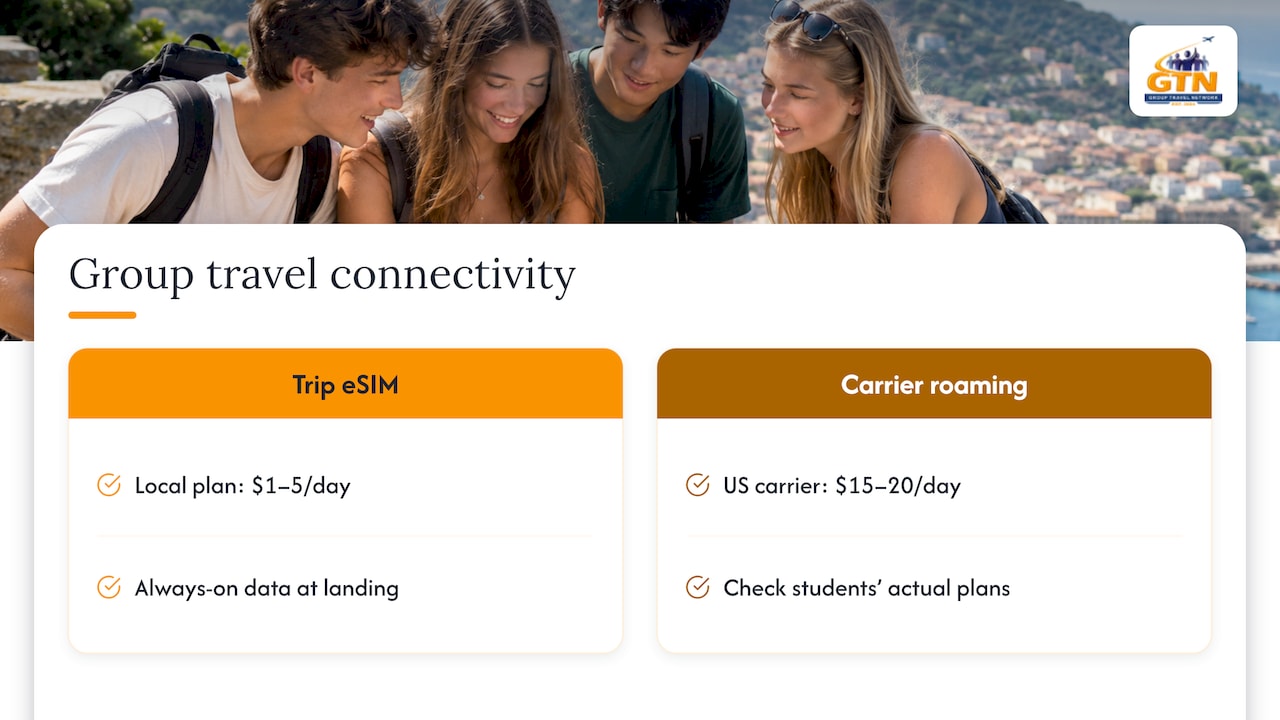
For an individual traveler, an eSIM is a money question. For a trip leader, it is a duty-of-care question. Student travel coordinators point out (opens in a new tab) that always-on data lets you reach every participant the moment the group lands. It removes the stretch where students hunt for airport Wi-Fi or a local SIM kiosk.
The alternative is carrier roaming. One school-trip eSIM provider puts typical roaming at $15 to $20 a day (opens in a new tab) on a regular US carrier plan. Check your students’ actual carrier plans before you assume that figure. Across a 30-student group over ten days, the gap between roaming and a prepaid eSIM is large enough to justify a policy.
A local eSIM plan typically costs $1 to $5 a day depending on the region (opens in a new tab). That is the range both providers compete in.
How Airalo and Holafly differ
The core difference is the pricing model.
- Airalo is a marketplace. It sells fixed-data plans for set periods, so you pay for gigabytes. Industry comparisons describe it as best suited to value-conscious travelers (opens in a new tab).
- Holafly specializes in unlimited data. You choose the number of days, from 1 to 90, and pay a flat rate for that period.
One comparison puts the breakeven for heavy users around 15GB of total monthly data (opens in a new tab). Below that, fixed data usually wins on price. Above it, the flat rate starts to make sense. For a ten-day school trip, most students will not reach that level unless they stream video all day.
Price: what a group actually pays
Prices move often, so treat these as a snapshot and check the provider’s page on the day you buy.
| Scenario (2026 figures from the cited pages) | Airalo | Holafly |
|---|---|---|
| Entry price in one catalogue comparison | From $4.00 (opens in a new tab) | From $11.90 (opens in a new tab) |
| Best price per GB in that comparison | $0.74/GB | $1.71/GB |
| Europe, 7 days (Airalo 5GB Eurolink; Holafly unlimited with a 5GB/day cap) | $22.50 (opens in a new tab) | $27.90 (opens in a new tab) |
| Coverage in that Europe table | 39 countries | 36 countries |
The Europe row shows why the headline gap does not always hold. For a week in Europe with 5GB, the two providers sit within a few dollars of each other. For light use of maps and browsing, Airalo’s 7-day European plan is often about three times cheaper (opens in a new tab) than Holafly’s flat-rate equivalent, according to the same comparison. Which figure you meet depends on the country and the plan size.
Holafly also sells monthly subscriptions. One comparison lists $64.90 a month for unlimited data in 160+ countries (opens in a new tab). That is aimed at frequent travelers and long stays, not a one-week band tour.
A worked example
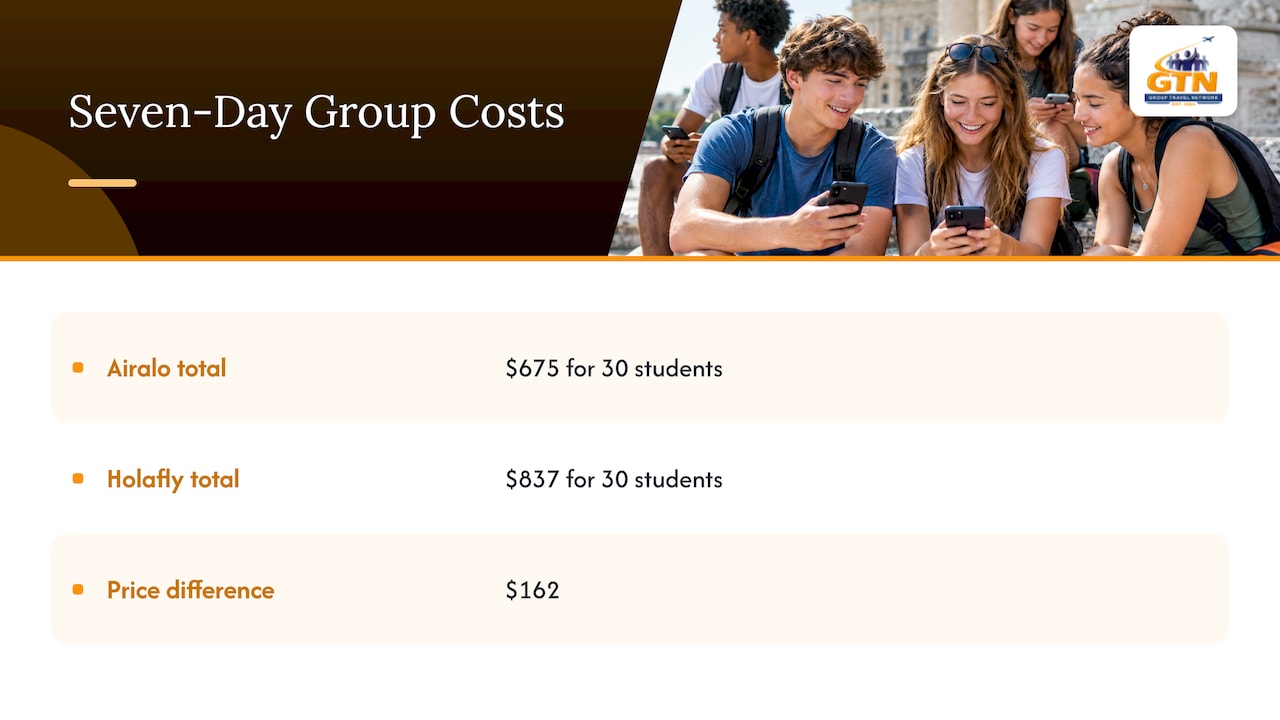
Say 30 students travel to Europe for 7 days. At the Europe table prices above, 5GB Airalo plans come to $675 (30 × $22.50). Holafly unlimited plans come to $837 (30 × $27.90). The $162 difference is small enough that the decision should turn on hotspot rules, support and refunds, not price alone.
Now take a trip where students only need maps and messaging. A 1GB plan at the entry price makes Airalo clearly cheaper, and you can top up students who run out. Fixed data also teaches a useful habit: download the itinerary and offline maps before leaving the hotel.
“Unlimited” has limits
Holafly’s headline feature deserves caution. Experts note that unlimited plans are subject to fair use policies that trigger around 3 to 5GB a day (opens in a new tab). After that, speeds can fall sharply, often below 1 Mbps. Students who treat their phone as a home internet replacement can find themselves throttled mid-trip.
In practice, a student who posts a few videos a day will rarely hit those numbers. A student who streams on the bus and uploads long clips will. Our advice is to set expectations in your pre-trip letter instead of promising “unlimited internet.”
To understand how throttling shows up and how to spot speed caps before you buy, this guide to eSIM data throttling (opens in a new tab) walks through what to look for in plan terms.
Hotspot and laptop use
This is the biggest practical difference for students who need to connect a laptop, for instance during a study abroad program or a competition with online submissions.
- Airalo generally allows tethering across most of its fixed-data plans (opens in a new tab).
- Holafly includes hotspot on unlimited plans, but frequently caps it at 500MB to 1GB per day (opens in a new tab), regardless of the “unlimited” label.
A Dubai plan review (opens in a new tab) lists a 5-day Holafly unlimited plan at $19 and flags the same 500MB daily hotspot cap. It is a good plan for phone-only use and a poor one for a chaperone who needs to work from a laptop.
Refunds, support and what can go wrong
Holafly’s own comparison page states that it offers full refunds on unused plans for up to 180 days (opens in a new tab), including accidental purchases and incompatible devices. The same page says Airalo limits refunds mostly to cases where the service fails, within 30 days. Since that page is published by Holafly, confirm the terms on each provider’s current policy page before you rely on them.
Why it matters for a group: someone always has an incompatible phone. A flexible refund policy softens the cost of buying 30 plans and finding that three students have locked or older devices.
Check compatibility first
Build a short compatibility check into registration. Ask each family to confirm that the phone supports eSIM and is carrier-unlocked. Students without a compatible device need another plan, such as a loaner phone or a physical SIM for chaperones.
No phone number, no SMS
Travel eSIMs are overwhelmingly data-only. They include no local phone number (opens in a new tab), so SMS verification codes from banks, airlines or apps will not arrive. Students should keep their home SIM active for texts or move important accounts to an authenticator app before leaving. Chaperones should also review eSIM security steps such as setting a telco PIN (opens in a new tab) before they fly.
Which one to pick: a decision guide
| Your group | Better fit | Why |
|---|---|---|
| Short trip, maps, messaging and photos | Airalo | Lower cost, pay for what you use |
| Students who need laptop tethering | Airalo | Tethering generally allowed on fixed plans |
| Heavy streaming or no desire to watch data | Holafly | Flat rate, no gigabyte tracking |
| Long study abroad stay | Holafly or a monthly plan | Simplicity and support may justify the premium |
| Unsure about device compatibility | Holafly | More generous stated refund window |
The advice from experts who have used both (opens in a new tab) is consistent with this: the best provider is the one that fits how your students behave. Independent travelers who mostly use maps and social media benefit from Airalo’s fixed-data efficiency. A group that needs guaranteed, simple connectivity for a long stay may find Holafly’s premium worth paying.
One more option for trip leaders: you do not have to pick one provider for everyone. Some groups buy Airalo for students and an unlimited plan for the lead chaperone, who carries the group’s contact sheets, tickets and emergency documents.
Setting up eSIMs for a group
- Decide the policy early. Choose whether eSIMs are required, recommended or optional, and tell families at the first parent meeting.
- Run a compatibility check. Collect phone model and carrier-unlock status with registration forms.
- Choose the plan size by itinerary. Count days, then estimate daily use: maps and messaging versus video.
- Install on home Wi-Fi before departure. The most common eSIM failure is trying to activate on arrival (opens in a new tab). Use the scheduled activation feature so data starts when the group lands.
- Collect numbers and app handles. Build a contact sheet for every student, with a backup channel if one app fails.
- Do a landing check. At baggage claim, confirm every student has a signal and can reach you.
Some providers also offer bulk provisioning for student programs, with one request producing many QR codes (opens in a new tab) to distribute by email before departure. That is worth asking about if you run the same program every year.
Our perspective
We plan student, school and performance trips, and connectivity is one of the quiet items that decides whether a trip feels calm or chaotic. Our view is simple: the best eSIM is the one every student has installed before the bus leaves the school parking lot.
For most groups we would start with fixed-data plans. They are cheaper, they teach students to be deliberate with data, and tethering helps chaperones in a pinch. We would move to unlimited plans for long stays or for trips where students will be expected to work online daily, and only after explaining fair use limits in plain words.
We also treat phones as one layer of safety, not the whole plan. Every trip needs a printed contact sheet, a meeting-point protocol that works without data, and travel protection that covers the group. Our guides on student travel electronics (opens in a new tab) and group travel insurance (opens in a new tab) cover those layers in more detail.
— Donovan
Let us handle the planning around the phones
Connectivity is one line on a long checklist. If you would rather not build the rest of the checklist yourself, our team plans custom itineraries, assigns a dedicated trip coordinator, runs online registration and offers flexible payment plans and travel protection options. Explore our International Adventures (opens in a new tab) for trips abroad, or see how we approach school group travel planning step by step (opens in a new tab). To start a conversation about your group, visit Group Travel Network (opens in a new tab).
FAQ
Is Airalo or Holafly cheaper?
Airalo is usually cheaper, especially for light use. One 2026 comparison lists Airalo from $4.00 against Holafly from $11.90 (opens in a new tab). The gap narrows on larger plans, such as a 5GB week in Europe, where the two sit within a few dollars of each other.
Is Holafly really unlimited?
Not without conditions. Unlimited plans run on local carriers and follow fair use policies, which often start around 3 to 5GB a day (opens in a new tab). Hotspot is commonly capped much lower than the main allowance.
Can students use an eSIM for WhatsApp and maps?
Yes, data works for messaging apps and maps. But travel eSIMs are mostly data-only, so SMS verification codes will not arrive (opens in a new tab). Students should set up app-based authentication before leaving.
When should students install the eSIM?
Before departure, on stable home Wi-Fi. Activating on arrival is the most common cause of failure (opens in a new tab). Schedule activation so it starts when the plane lands.
Does a school group need an eSIM at all?
It is not mandatory, but it gives trip leaders a reliable way to reach every participant on arrival and is often cheaper than carrier roaming. Check each family’s carrier plan, because international day passes vary by provider.
Sources
- Airalo vs Holafly eSIM: which is better in 2026, eSIMCompare (opens in a new tab)
- Holafly vs Airalo: which one should you choose, Holafly (opens in a new tab)
- Airalo vs Holafly China eSIM, Travel Hub China (opens in a new tab)
- How eSIMs help university travel groups, GoAbroad (opens in a new tab)
- Best Travel eSIM 2026 tested across 10 countries, Travel Anywhere (opens in a new tab)
- Holafly, Airalo and Saily review, Chris and Sara (opens in a new tab)
- Best eSIM for Europe 2026, PrepaidTraveleSIM (opens in a new tab)
- Holafly vs Airalo 2026, Andre on Digital (opens in a new tab)
- Best eSIM for Dubai and Abu Dhabi 2026, Resident (opens in a new tab)
- Connectivity at summer school abroad, ConnectPls (opens in a new tab)
- School trips made easier, aloSIM (opens in a new tab)
- eSIM API for student travel programs, Bappy (opens in a new tab)
- eSIM data throttling for travelers, Lumo (opens in a new tab)
- eSIM security for travelers, Sabra Connect (opens in a new tab)
Recommended
- Best Student Travel Companies 2025: Choose The Right Partner (opens in a new tab)
- Tour-Rific.com Alternatives For Student Travel In 2026 (opens in a new tab)
- Top GradCity.com Alternatives For Student Groups In 2026 (opens in a new tab)
- EF Tours Alternatives: Top 7 Affordable Student-Group Picks (opens in a new tab)