

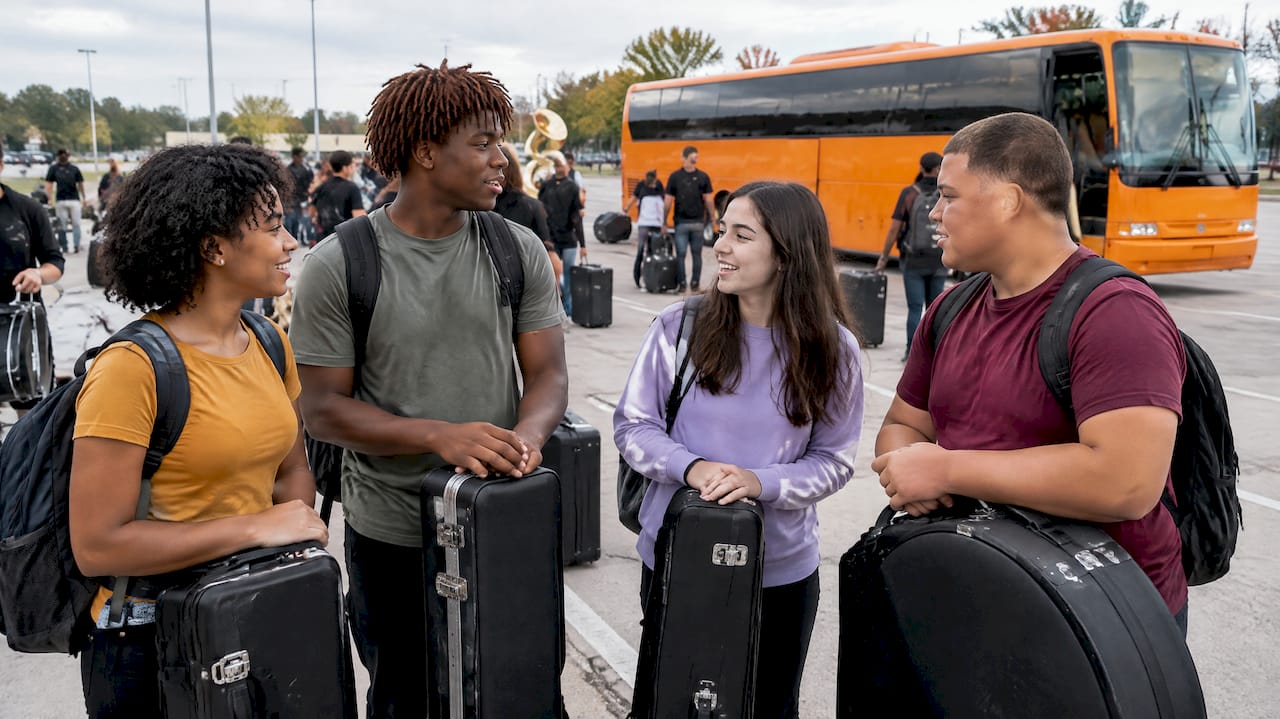
Parade travel logistics come down to five things: what the parade organizer requires, how your group gets to staging on time, how instruments and uniforms move, where students sleep and eat under supervision, and what you do when something goes wrong. Get those five in writing before you book a single bus seat. A dedicated trip coordinator who owns the schedule from the first call to the last bus unload takes much of that load off a director’s desk, and the sections below show where the work sits.
TL;DR
- Ask the parade organizer for the staging location, street-closure time, bus approach route and step-off time before you finalize transportation.
- Work backward from step-off: staging arrival, instrument unload, warm-up, then hotel departure. Build in a buffer for road closures.
- Assign equipment, uniform and chaperone duties by name. Use a buddy system and a written emergency plan.
- Permit, insurance and street-closure rules are set by each city, so check the local rules for every destination.
- Start the parade application timeline (opens in a new tab) early, and book transport weeks ahead.
Table of Contents
- What to confirm with the parade organizer first
- Build the day backward from step-off
- Transportation, arrival and staging
- Moving instruments, uniforms and equipment
- Lodging, meals and supervision
- Emergencies, delays and weather
- Permits, insurance and street-closure rules
- A sample timeline for directors
- Perspective
- How Group Travel Network handles parade trips
- FAQ
- Sources
What to confirm with the parade organizer first
Before you commit to buses, hotels or flights, collect a short list of facts from the organizer. Parades differ widely: a small-town festival, a stadium-based band championship and a national televised event all handle arrival differently. The facts that decide your logistics are:
- Staging location and time. Where does your group assemble, and when must it be there?
- Street closures and bus access. Which streets close, when, and which approach route may buses use?
- Step-off time and position. When does your unit move, and where does it line up in the order?
- Drop-off points for equipment. Is there a designated place to unload percussion, props and cases?
- Parking and disposal. Where do buses go after unloading, and can private cars park with them?
- Participant paperwork. What forms, rosters or insurance documents does the organizer need, and by when?
- Route length and surface. How far is the march, and where do you disperse at the end?
Organizers often publish this in a director’s packet, and the details can be very specific. One California band championship packet for 2026, for example, tells buses to approach via Olive Street from Floral Avenue and check in just after Stillman Street (opens in a new tab), and says private cars cannot park with the buses. A detail like that decides which lot your driver aims for and whether a parent following in a minivan can stay near the group.
If an organizer has not published a packet, ask for the same information by email and keep the reply. It becomes the base document for your itinerary and your driver’s instructions.
Build the day backward from step-off
The single most useful planning habit is working backward. Start with the step-off time and subtract each block:
- Step-off. The time your unit actually begins to move, not the parade start time.
- Line-up and final check. Time to get in order, check uniforms and take attendance.
- Warm-up. Time for sections to tune and rehearse at or near staging.
- Equipment unload and carry. Cases, drums and carts take longer than directors expect.
- Bus unload and check-in. Organizers may require check-in at a specific spot.
- Drive time with closures. Add a buffer for detours, since streets near the route close before the parade starts.
- Hotel departure and breakfast. The first fixed time on your itinerary.
The schedule distance between parade start and your own step-off can be large. That same 2026 California packet lists a 9:00 a.m. parade start (opens in a new tab) and provides individual band step-off times separately, so a band later in the order has more time but must still arrive within the organizer’s check-in window.
Closures are the other half of the clock. The 2027 Western Welcome Week Grand Parade in Saint Paul states that staging is on Gallup Street and that the street closes to non-parade traffic at 6:30 a.m. on festival day (opens in a new tab). Anything not in place by then has to go around. The same page says Gallup and adjacent streets are expected to reopen around noon (opens in a new tab) once the parade clears and barricades are removed, which tells you when buses can realistically return for pickup.
Publish the backward schedule to staff, chaperones and drivers as a one-page run sheet, with a clock time, a location and a named person for every line.
Transportation, arrival and staging
Choose the bus plan before the hotel plan
A motorcoach that has to drop a band at a staging area before a road closes, then clear out, then return after the parade needs a plan the hotel location can support. Pick lodging that makes the morning drive short and uses roads that stay open. Give the driver the organizer’s approach route, the check-in point and the drop-off point in writing, plus your own cell phone number and a chaperone’s.
Plan for the driver, too
Overnight trips carry costs for the driver that districts often require you to cover. The St. Lucie County School District field-trip procedures state that sponsors of overnight trips must arrange in advance for the bus driver’s hotel rooms, tolls and meals (opens in a new tab). The same document requires overnight trip requests to include a complete itinerary and directions to the destination. Check your own district’s version of these rules early, because they affect your budget and your approval timeline.
Arrival tracking for chaperones and families
Parents want to know the moment the buses arrive, and chaperones want to know no one has wandered off at staging. Many groups use school arrival alerts (opens in a new tab) to understand how arrival and departure notifications work, then decide what notification routine fits a travel day. Whatever tool you use, name one adult who sends the “arrived safely” message so families are not texting directors during the warm-up.
Keep your route and detour maps visible
The International City/County Management Association’s parade safety guide says route maps and emergency-detour maps should clearly show street closures and identify stationary performance zones (opens in a new tab). If the organizer gives you a map, print it for every chaperone and the driver. If the organizer does not, ask which streets are closed and mark them yourself.
Moving instruments, uniforms and equipment
Equipment is where parade days most often slip. Percussion, sousaphones, flags, props and garment bags need their own plan, separate from the student plan.
Assign a pit or equipment crew. Name the adults and students responsible for each category: percussion, large brass, color guard equipment, uniforms and water. Give each person a written list.
Learn the unload rules. The 2026 California championship packet is a good example of how specific these can be: it names a designated equipment drop-off at the corner of Thompson and Huntsman (opens in a new tab), says equipment must be pushed into the stadium because motorized vehicles are not allowed on the track, and says pit crews must bring their own conducting podium or ladder. If your event has similar rules, you need carts, wheels and a crew before you arrive, not after.
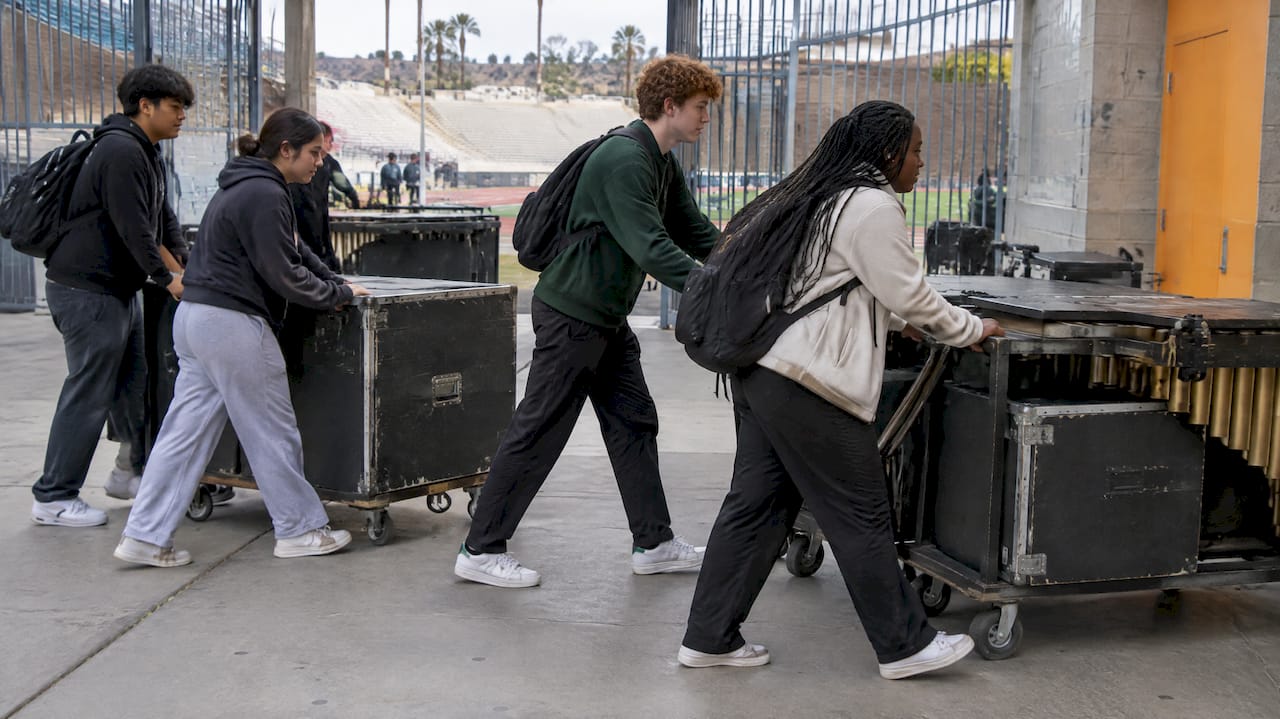
Book equipment transport early. Trucks, trailers and cargo space on a coach are limited, and many groups need them in the same peak weeks. Our guide to performance trip equipment transport (opens in a new tab) explains why booking transport weeks ahead keeps the schedule intact.
Standardize uniforms. Garment bags, shoes, gloves and hats are the items students forget. Our performance uniform packing rules (opens in a new tab) break this into six steps a director can assign, so packing is a checked task, not a hope.
Label everything. Name, school, section and bus number on every case. Keep a spare reed, stick, valve oil and safety-pin kit with one chaperone.
Lodging, meals and supervision
A parade day starts earlier than most school days, so lodging and meals shape how the band performs.
- Hotel location. Choose by morning drive time and road-closure exposure, not nightly rate alone.
- Early breakfast. Confirm the hotel can serve a group before your departure time, or arrange boxed meals.
- Meals on parade day. Plan food and water at staging. Marching in heat or cold without a meal plan is how students fade before step-off.
- Accessibility. Ask about accessible rooms, ramp or elevator access at the hotel and how a student with a mobility need will reach staging and the route.
- Rooming and supervision. Fix room assignments, adult ratios and floor coverage before departure, and share them with families.
Student conduct rules should be written into a handout. One school band handbook, the TVHS Band Handbook, instructs students on overnight trips to use a buddy system, keep a chaperone’s phone number, follow checkpoints and curfew, and never travel alone (opens in a new tab). Those four habits are easy to copy into your own handbook and easy for chaperones to enforce.
Emergencies, delays and weather
A parade plan needs a written answer to three questions: who decides, who communicates, and where do students go.
Who decides. Many cities put weather monitoring and the decision to cancel on the organizer. Raleigh’s planning guide assigns event organizers responsibility for monitoring weather and deciding whether to cancel (opens in a new tab). Ask the organizer how a cancellation or delay will reach participating groups and by what channel, and give that channel to your lead chaperone.
Written plans. Larger events must file plans with the city. Raleigh’s guide says its Emergency Action Plan is due no sooner than six weeks and no later than two weeks before an event (opens in a new tab) under that city’s process. Bryan, Texas requires events expected to exceed 1,000 attendees to submit an Event Action Plan covering weather, emergency access, first aid, communications and crowd management (opens in a new tab). These plans belong to the organizer, but they tell you what to ask for: where first aid is, how emergency vehicles reach the route and how announcements are made.
Your own group plan. A one-page version is enough:
- A head count at every transition: hotel, bus, staging, after the parade, bus again.
- A named meeting point at staging if someone is separated.
- Every chaperone carries the full roster with student, parent and director phone numbers.
- A backup indoor location near staging for lightning or cold rain.
- A plan for a missed bus, a late driver and an injured student, with who stays and who goes.
- Medication and medical-information handling per your district’s rules.
This is also where travel protection matters. Group Travel Network offers travel protection options, and we recommend talking through coverage for cancellations and delays with your trip coordinator when you build the budget.
Permits, insurance and street-closure rules
Parade rules are local. Do not assume what works in one city works in another. The examples below show the range, and each applies only in the city named.
- Definition of a parade. The City of Eugene, Oregon defines a parade for its permit process as at least 10 people moving more than 100 feet on public streets, sidewalks, alleys or thoroughfares (opens in a new tab) for a common public-demonstration purpose.
- Application and insurance. Eugene’s guide says qualifying parades generally need a permit application at least 48 hours before the event and proof of liability insurance, with a stated exception for groups of 100 or fewer using only city sidewalks and obeying pedestrian and traffic laws.
- Street closures. Bryan, Texas says temporary street closures of eight hours or less require an application and closure sketch (opens in a new tab), with fees and approval rules specific to that city.
- Participant documents. Atlanta Pride’s parade guidance says participant documents should be available to law enforcement before, during or after the event (opens in a new tab). Keep rosters, insurance certificates and permission paperwork in one folder that travels with the lead chaperone.
- Neighbor notification. ICMA’s guide recommends notifying residents and businesses along the route well in advance (opens in a new tab) of event impacts and possible closures. For a school group, this usually falls on the organizer, but it explains why streets near your hotel or staging may close earlier than you expect.
In most cases, a school band joining an established parade is covered by the parade organizer’s permit, and your job is to complete the organizer’s application and provide what it asks for. Our parade application timeline (opens in a new tab) lays out when to submit at each stage, so rosters, insurance and deposits are not left to the last month.
A sample timeline for directors
The numbers below are a planning pattern, not a rule, so adjust them to your organizer and your district.
| When | What to do |
|---|---|
| 9 to 12 months out | Pick the parade, confirm eligibility and open your district’s approval process |
| 6 to 9 months out | Submit the application, get the director’s packet, set the budget and payment schedule |
| 4 to 6 months out | Book transport, hotel and equipment hauling, and confirm chaperone ratios |
| 2 to 3 months out | Collect rosters, medical forms and permission slips, and publish the run sheet draft |
| 2 to 4 weeks out | Confirm step-off time, bus route, drop-off and emergency plan, and brief chaperones |
| Week of | Weather check, final head counts, packing audit and driver briefing |
For a longer version, our 90 day band performance tour playbook (opens in a new tab) and the broader travel logistics for schools (opens in a new tab) guide go step by step. If your parade is a major national event, the Macy’s parade band trip budget plan (opens in a new tab) shows how directors keep the workload manageable.
Perspective
Directors tell us the parade itself is the easy part. The hard part is the thirty small decisions around it: which street the bus can use, who carries the bass drum, where the chaperone with the roster stands, what happens if the organizer moves staging.
Our view is that those decisions should be made once, early and in writing, by a person whose job is to make them. That is why we assign dedicated trip coordinators to group trips and why we build custom itineraries around the organizer’s actual rules instead of a generic template.
A band that arrives calm, with equipment unloaded and students fed, performs better. Online registration and flexible payment plans keep families organized and the budget steady, and travel protection options give you a plan for the things nobody can schedule. Your attention belongs on the students and the music.
Donovan
How Group Travel Network handles parade trips
If you are building a parade trip, our Performance Tours (opens in a new tab) are designed for school bands, choirs and performance groups. We build a custom itinerary, assign a dedicated trip coordinator, offer online registration and flexible payment plans, and provide travel protection options. Coordinators are on the trip with your group. Tell us the parade and your dates, and we will map the day backward from step-off.

You can also see our Stress-Free Student Travel (opens in a new tab) overview, or read about the main types of student performance tours (opens in a new tab) to decide whether a parade, a festival or a combined tour fits your program.
FAQ
What is the first thing to confirm when planning parade travel?
Confirm the staging location, the time the surrounding streets close, the bus approach route and your step-off time. Those four facts determine your arrival time, your driver instructions and your hotel choice. Ask for them in writing, or find them in the organizer’s director’s packet.
How early should a band arrive at parade staging?
Arrive early enough to unload, check in with the organizer, warm up and line up before step-off. Work backward from your step-off time and add a buffer for closures. Some organizers set a check-in window, so use their instructions rather than a general rule.
Do school groups need a permit to march in a parade?
Usually the parade organizer holds the permit and your group completes the organizer’s application. Local rules vary by city, including definitions, insurance and street-closure requirements. Check the city’s special-event page for the destination and ask the organizer what it covers.
Who handles weather decisions on parade day?
In many cities the event organizer monitors weather and decides whether to delay or cancel. Ask how the organizer will notify groups, and give that contact to your lead chaperone. Keep your own backup shelter plan near staging.
How should we move percussion and large equipment?
Assign an equipment crew, learn the organizer’s unload point and rules, and bring carts or wheels. Some venues do not allow motorized vehicles near the unload area, so equipment may have to be pushed. Book cargo transport weeks ahead.
Sources
- 2027 Western Welcome Week Grand Parade (opens in a new tab)
- 2026 Selma Directors Packet (opens in a new tab)
- ICMA parade safety guide (opens in a new tab)
- St. Lucie County School District field trip guidelines (opens in a new tab)
- City of Raleigh special event planning guide (opens in a new tab)
- City of Bryan special events guide 2026 (opens in a new tab)
- TVHS Band Handbook 2022 (opens in a new tab)
- City of Eugene special event planning guide (opens in a new tab)
- Atlanta Pride parade application guidelines (opens in a new tab)
Recommended
- Avoid 200 Hours: Macy’s Parade Band Trip Budget Plan For Directors (opens in a new tab)
- Performance Uniform Packing Rules: 6 Steps Band Directors Can Assign (opens in a new tab)
- 90 Day Band Performance Tour Playbook For School Directors (opens in a new tab)
- Your Parade Application Timeline: When To Submit At Every Stage (opens in a new tab)