


A bus driver on an interstate trip can drive a maximum of 10 hours after at least 8 consecutive hours off duty, and cannot drive after being on duty for 15 hours. Weekly caps of 60 hours in 7 days or 70 hours in 8 days also apply. If you plan band, team or class trips, these limits decide how far your driver can take you in a day, and they should shape your itinerary before you book anything.
TL;DR
- Passenger-carrying drivers get 10 hours of driving after 8 consecutive hours off duty (opens in a new tab), and then must rest for 8 hours before driving again.
- The on-duty clock is 15 hours, and it keeps running during loading, waiting and any stop where the driver is still responsible for the bus or your students.
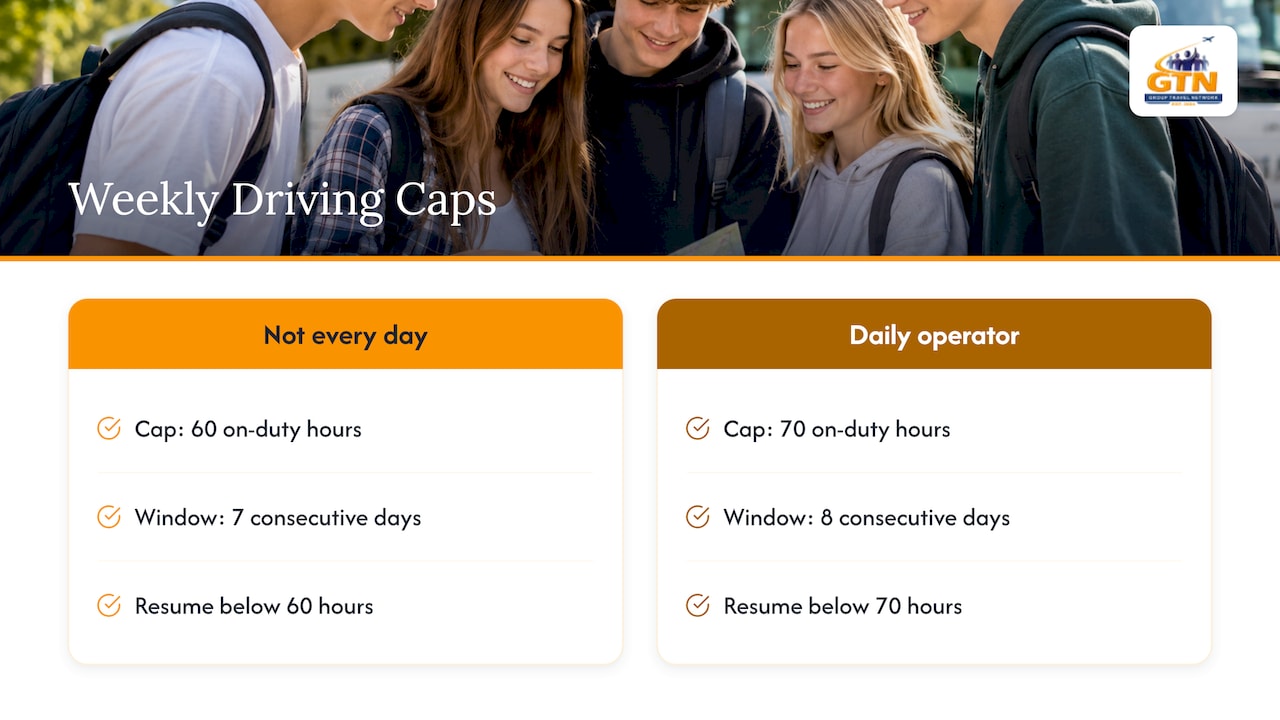
- Weekly limits are 60 hours in 7 days or 70 hours in 8 days, depending on whether the carrier runs vehicles every day.
- Federal rules apply to interstate trips. Trips that stay inside one state may fall under state rules, so ask the operator which ones govern your route.
- Build the schedule around the driver’s legal day, not just the miles on the map.
Table of Contents
- The five limits that shape every group trip
- What counts as on duty, and what does not
- When federal rules apply to your trip
- Turning the rules into an itinerary
- Questions to ask your charter operator
- Perspective: build the trip around the driver’s day
- Plan your trip with a coordinator
- FAQ
- Sources
The five limits that shape every group trip
Federal hours-of-service rules for passenger carriers are short. Five numbers do most of the work, and the table shows how each one affects a trip you are organizing.
| Limit | What it says | What it means for your itinerary |
|---|---|---|
| 10-hour driving limit | A driver may drive up to 10 hours after 8 consecutive hours off duty | Plan no more than 10 hours of actual driving per day per driver |
| 15-hour on-duty limit | No driving after 15 hours on duty following 8 consecutive hours off | Your whole day, stops and waiting included, must fit in a 15-hour window |
| 8-hour rest | 8 consecutive hours off duty before driving again | Late arrivals push back the next morning’s departure |
| 60/7 weekly cap | No driving after 60 hours on duty in 7 consecutive days | Matters on week-long tours, especially with several back-to-back trips |
| 70/8 weekly cap | No driving after 70 hours on duty in 8 consecutive days | Applies when the carrier operates vehicles every day |
The daily numbers come from the FMCSA’s hours-of-service page for motor carriers of passengers (opens in a new tab), which also states the weekly caps.
1. Ten hours of driving
A bus driver can drive a maximum of 10 hours after having at least 8 consecutive hours off duty. Once the 10 hours are used, the driver must take 8 consecutive hours off duty before driving a commercial vehicle again. The FMCSA interstate passenger-carrying driver’s guide (opens in a new tab) repeats the same rule.
This is the number people quote when they ask how long a bus driver can drive. It is also the number that gets misread. Ten hours is a legal ceiling, not a target. A 9.5-hour driving day with one driver leaves no room for a traffic jam, a detour around a closed road or a slow unload at the hotel.
2. Fifteen hours on duty
A driver may not drive after being on duty for 15 hours following 8 consecutive hours off duty. The FMCSA defines on-duty time broadly: it runs from when the driver begins work, or is required to be ready for work, until the driver is relieved of all responsibility for performing work. That includes any other compensated work.
For group travel, this is the limit that bites. Consider a typical concert day: the driver reports at 6:30 a.m., loads instruments, drives 4 hours, waits at the venue through a sound check, a performance and a meal, loads out, then drives 3 hours to the hotel. Actual driving is only 7 hours. But if the driver stays responsible for the bus and group throughout, the 15-hour window closes around 9:30 p.m., and any delay can make the last leg illegal to drive.
3. Eight hours off duty
The reset is 8 consecutive hours off duty. Daytime breaks help, too: according to the FMCSA guide, off-duty time taken during the day, like lunch, does not count toward the 15-hour on-duty limit. The condition is that the driver is truly off duty.
4. The 60-hour and 70-hour weekly caps
Passenger-carrying drivers may not drive after being on duty 60 hours in any 7 consecutive days if the carrier does not operate commercial vehicles every day. If the carrier does operate every day, the cap is 70 hours in any 8 consecutive days. A driver may drive again once total hours fall below the applicable limit.
On a single-day field trip this rarely matters. On a six-day festival tour, or when a driver was on another group’s trip the week before, it can. Ask the operator how many hours your driver has already logged before your trip starts.
5. Sleeper berth rules on long trips
On multi-day trips, a sleeper berth may provide the equivalent of 8 consecutive hours off duty if its requirements are met. Per the FMCSA summary of hours-of-service regulations (opens in a new tab), drivers using a sleeper berth must take at least 8 hours in it and may split that time into two periods, provided neither is shorter than 2 hours and the total is at least 8 hours.
Most school and performance coaches are not set up for this. Plan on the assumption that your driver rests in a hotel, and that your hotel check-in time is part of the driver’s clock.
What counts as on duty, and what does not
This is where itineraries go wrong. Drivers are not off duty just because the bus is parked. According to the FMCSA, a driver counts as off duty during a meal or routine stop only when relieved of all duty and responsibility for the vehicle, passengers, baggage and freight, and free to pursue their own activities.
In practice:
- A 90-minute lunch where the driver stays with the bus, watches the students or guards the instrument trailer is on-duty time.
- A 90-minute lunch where a second chaperone group takes over, the bus is secured and the driver leaves is off-duty time.
- Loading and unloading, fueling, waiting at a venue and paperwork all count as work.
If you want to understand how time-tracking logic works when shifts include long gaps, split shift scheduling rules (opens in a new tab) explain how breaks are treated in workforce scheduling. Transportation drivers follow the FMCSA definitions above, so use the federal rule for any question about a bus.
When federal rules apply to your trip
The key question is interstate versus intrastate. Drivers operating in interstate commerce must follow the federal rules while in that commerce and for a short period after finishing. The FMCSA guide notes that an empty commercial vehicle counts as operating in interstate commerce if it goes outside its state, and counts as intrastate if it stays within the state.
So a band trip from Ohio to a festival in Pennsylvania is interstate, and so is the empty deadhead drive when the coach returns without you. A field trip from a district to a museum in the same state is intrastate.
For intrastate trips, the FMCSA guide says states may have regulations similar or identical to the federal ones, and drivers should contact the appropriate state agency to learn the requirements. Your state’s rules may differ, so have the operator confirm in writing what applies to your route.
For-hire charter versus school-owned buses
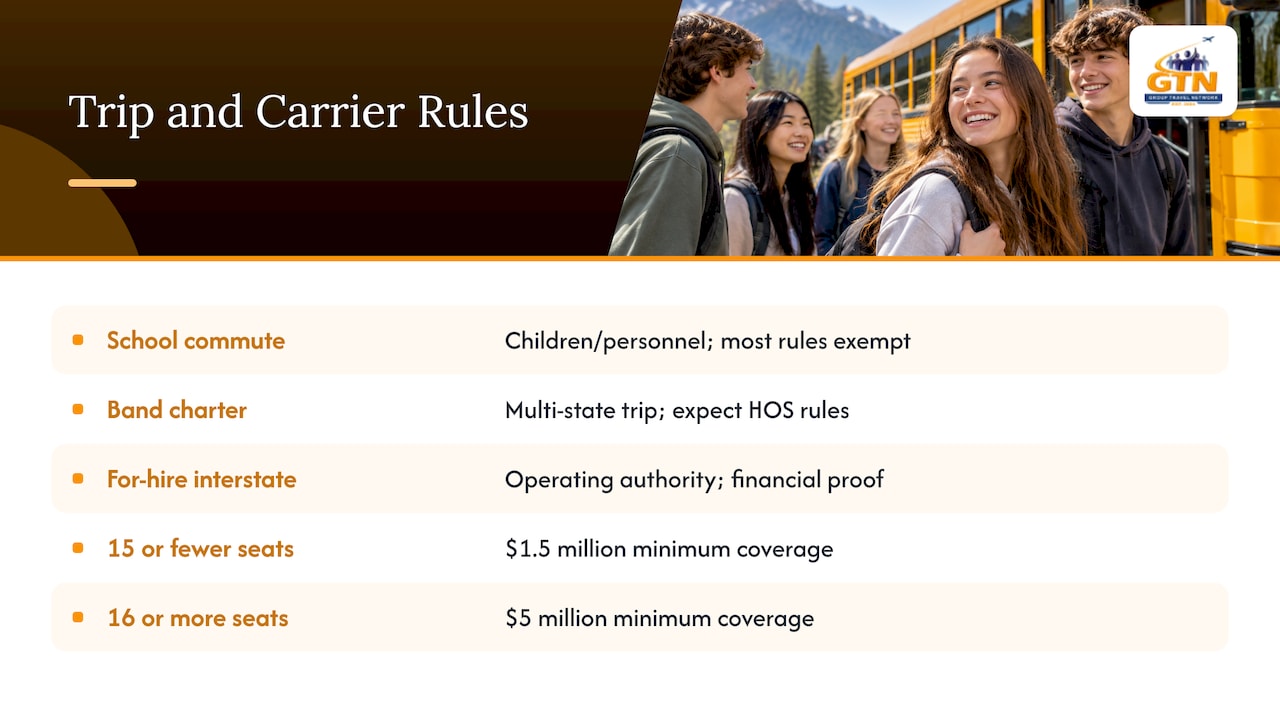
The FMCSA’s education-related transportation page (opens in a new tab) explains that federal passenger rules depend on whether the vehicle is a commercial motor vehicle operating in interstate commerce and, for the commercial regulations, whether the transportation is for hire. It also notes that in interstate commerce, school bus operations carrying only school children and school personnel from home to school and back are not required to comply with most safety regulations.
That exemption covers the daily home-to-school run. A charter coach hired for a multi-state band trip is a different situation, and you should expect the hours-of-service rules to govern the driver. Whatever your district’s own school buses are exempt from, ask your operator to confirm in writing which rules govern each leg.
For-hire interstate carriers also need operating authority and proof of financial responsibility. The FMCSA passenger carrier fact sheet (opens in a new tab) puts the minimum coverage at $1.5 million for vehicles seating 15 or fewer passengers and $5 million for vehicles seating 16 or more. It is a useful item on your vendor checklist next to hours of service.
Turning the rules into an itinerary
Here is a simple method we recommend for a one-day or multi-day group trip.
- Start at the driver’s report time. Count the 15-hour window from when the driver starts work, not from when your group boards.
- Add every task that is not driving. Loading, unloading, waiting at venues, fueling and paperwork all consume the window.
- Cap driving at well under 10 hours. A 8 to 9 hour driving ceiling leaves slack for weather and traffic.
- Protect the 8-hour rest. If the group arrives at 11 p.m., the driver cannot legally drive before 7 a.m. at the earliest. Schedule departure accordingly.
- Check the weekly total. On tours of five days or more, ask how many hours the driver has worked in the prior 7 or 8 days.
- Plan for a second driver when the day is long. Two drivers can split driving, but each driver’s own limits still apply.
A worked example
A high school marching band leaves at 7:00 a.m. for a festival 480 miles away. Say the driver reports at 6:15 a.m. and drives about 8 hours with a break. The group arrives mid-afternoon, and the driver stays on duty through a 3-hour performance and equipment handling. The 15-hour window from 6:15 a.m. ends at 9:15 p.m. A planned 9-hour driving day plus a 3-hour wait and a 90-minute load-out already puts the clock near its limit, so a return the same night is not realistic. The better plan is an overnight stay and an early-morning departure after the driver’s 8-hour rest.
Questions to ask your charter operator
- Is this trip interstate, and which hours-of-service rules cover each leg, including the empty return?
- How many hours will the driver have worked in the previous 7 or 8 days when our trip starts?
- Will there be one driver or two, and where does the driver rest overnight?
- Where will the driver be off duty during lunch or venue waits, and who takes over responsibility for the bus?
- Can you show the planned daily schedule against the 10-hour and 15-hour limits?
For more on vetting a vendor, see our guide to charter bus safety for students (opens in a new tab) and our overview of student bus tours and safe educational transportation (opens in a new tab). To budget for the extra driver days or hotel rooms these limits can require, our school group bus cost guide (opens in a new tab) is a good next step. If you travel with instruments, book space early using our advice on performance trip equipment transport (opens in a new tab).
Perspective: build the trip around the driver’s day
Planners tend to start with the destination and work backward. We start with the driver’s legal day. When you know the 10-hour driving limit, the 15-hour on-duty window and the 8-hour rest, the itinerary almost designs itself: where the group should sleep, when the performance should end and which legs need a second driver.
Our approach is to treat these limits as a design tool rather than an obstacle. A dedicated trip coordinator who builds each day with the operator’s schedule in view avoids the late-night scramble when a rehearsal runs long and the bus cannot legally leave. That is the stress-free planning we aim to give band directors, administrators and team managers.
If you are weighing an ambitious route, ask the question early: what does the driver’s clock allow? Then let us help you shape the plan around the answer.
Donovan
Plan your trip with a coordinator
If your group needs motorcoach travel that fits a realistic schedule, we build itineraries, work with transportation vendors and provide on-trip coordination, with flexible payment plans and travel protection options. Explore our performance tours (opens in a new tab) for bands and choirs, or see our Stress-Free Student Travel (opens in a new tab) services for schools and youth organizations.

Tell us your dates, group size and route, and we will help you map out a schedule that works for your students and your driver.
FAQ
How long can a bus driver drive?
A passenger-carrying driver can drive up to 10 hours after 8 consecutive hours off duty, according to the FMCSA. After that, the driver must be off duty for 8 consecutive hours before driving again. The driver also cannot drive after being on duty for 15 hours.
Do hours-of-service rules apply to charter bus drivers?
If the charter coach operates in interstate commerce, yes, the federal rules apply to the driver during the trip. An empty vehicle that crosses a state line is also in interstate commerce. Trips that stay within one state may follow state rules, which can be similar or identical to the federal ones, so confirm with the operator or the state agency.
Do lunch stops count against the driver’s hours?
Only if the driver remains responsible. To be off duty, the driver must be relieved of all duty and responsibility for the vehicle, passengers and baggage, and be free to do as they choose. A lunch break that meets that standard does not count toward the 15-hour on-duty limit.
What are the weekly limits for bus drivers?
The limit is 60 hours on duty in 7 consecutive days if the carrier does not operate vehicles every day, or 70 hours in 8 consecutive days if it does. A driver may drive again once total hours drop below the applicable limit.
Are school buses covered by the same rules?
Not always. In interstate commerce, school bus operations carrying only students and school personnel from home to school and back are not required to comply with most safety regulations, per the FMCSA. Extracurricular and charter trips are different, so ask the operator which rules apply to your specific trip.
Sources
- Hours of Service for Motor Carriers of Passengers, FMCSA (opens in a new tab)
- Interstate Passenger Carrying Driver’s Guide to Hours of Service, FMCSA (opens in a new tab)
- Summary of Hours of Service Regulations, FMCSA (opens in a new tab)
- Education-Related Transportation, FMCSA (opens in a new tab)
- Passenger Carrier Guidance Fact Sheet, FMCSA (opens in a new tab)
Recommended
- School Group Bus Cost: What Districts Actually Pay In 2026 (opens in a new tab)
- Charter Bus Safety For Students: What Every Planner Must Check (opens in a new tab)
- Student Bus Tours: Safe Educational Transportation Guide (opens in a new tab)
- Group Transportation Logistics For Educational Trips In 2026 (opens in a new tab)