


For a domestic student trip, students under 18 do not need ID at the TSA checkpoint. Every adult on your roster does: chaperones, teachers, band directors and any 18-year-old seniors. Each adult needs a REAL ID-compliant license or another accepted document, such as a passport. REAL ID enforcement has been in effect since May 7, 2025, so the “deadline” is behind us. What remains is a roster-checking job for you, and it is easy to get wrong.
This guide walks through who needs what, which documents work in place of a REAL ID, what to do about international students, and how to build an ID check into your trip timeline.
TL;DR
- Adults 18 and older, including chaperones and 18-year-old seniors, must show a REAL ID or another acceptable ID (opens in a new tab) to fly domestically.
- TSA does not require children under 18 to show ID on domestic flights, but each airline sets its own rules for minors, so confirm with the carrier.
- A valid passport works in place of a REAL ID. Trips outside the U.S. still require a passport.
- Anyone who arrives without acceptable ID can try TSA ConfirmID for a $45 fee, but there is no guarantee their identity will be verified.
- Audit every adult’s ID months before departure, because state DMV appointments and document gathering take time.
Table of Contents
- Where the REAL ID deadline stands now
- Who needs ID on a student group flight
- How to tell if a license is REAL ID compliant
- What other ID works instead of a REAL ID
- International students on a school trip
- What happens at the airport without acceptable ID
- A timeline for checking ID on your roster
- Keeping track of students once ID is cleared
- Our perspective
- Let us handle the paperwork with you
- FAQ
- Sources
Where the REAL ID deadline stands now
If you searched for the 2026 deadline, here is the short version. TSA says REAL ID enforcement began on May 7, 2025 (opens in a new tab). There is no later cliff coming for ordinary licenses. What changed in 2026 is the fallback: TSA ConfirmID started on February 1, 2026, and it replaced the old practice of improvising at the checkpoint for people without acceptable ID.
For a school or youth organization, the practical meaning is simple. A standard, non-compliant driver’s license is no longer enough by itself for an adult to board a domestic flight. A group leader who finds this out at the airport, with 40 students waiting, has a problem that no one else in the group can fix.
Who needs ID on a student group flight
The rule splits by age, and that is how you should organize your roster.
Students under 18
TSA does not require children under 18 (opens in a new tab) to provide identification when traveling within the United States. That covers most middle school and high school travelers. Two cautions apply.
First, the FAA notes that each airline determines its own identification requirements for minors (opens in a new tab) and advises travelers to check with the airline well ahead of the trip. A group booking on one carrier may have different expectations than a single ticket on another.
Second, “not required by TSA” is not the same as “nothing to carry.” Your students will still benefit from a school ID or a copy of their birth certificate in a chaperone’s folder. For international legs, a passport is mandatory. Our guide to TSA rules for minors (opens in a new tab) covers the minor-specific details for group leaders.
Students who are 18 or older
Seniors turn 18 during the school year, which makes senior class trips the place where this rule most often catches people. An 18-year-old is an adult passenger at the checkpoint. If your senior has no driver’s license, no state ID with the star, and no passport, they have a problem. Ask early, and do not assume that being on a school trip changes anything.
Chaperones, teachers and directors
Adult chaperones 18 and older must show valid identification at the checkpoint (opens in a new tab). The name on the ID should match the name on the airline ticket. Before you collect final manifests, have each chaperone confirm that the name they gave you matches the ID they will carry. Our page on running chaperone checks (opens in a new tab) explains how to fit that vetting into your timeline.
How to tell if a license is REAL ID compliant
USAGov says REAL ID-compliant licenses and state IDs have a star in the upper right-hand corner (opens in a new tab). That is the quick check. Send your chaperones a reminder to look at the physical card, not to rely on memory. Many adults renewed a license years ago and assumed the star came with it.
If the card has no star, there are two paths: upgrade it at your state licensing agency, or carry an accepted alternative instead. The second path is often faster.
What other ID works instead of a REAL ID
A REAL ID is not the only way to board. TSA lists several alternatives. According to the TSA’s REAL ID FAQ (opens in a new tab), acceptable options include:
- A U.S. passport or passport card
- An Enhanced Driver’s License (EDL)
- A DHS trusted traveler card
- A permanent resident card
- Other documents on the TSA list, including military IDs and specific tribal IDs
Enhanced Driver’s Licenses are issued only by Washington, Michigan, Minnesota, New York and Vermont (opens in a new tab). If a chaperone lives in one of those states, their EDL may already do the job.
A passport is the most useful option for a group. It works for domestic flights, and it is required for any international leg. If your trip might grow into an international one, it is worth knowing who already has one. See our passport playbook for student groups (opens in a new tab) and our note on passport validity for students (opens in a new tab).
Quick comparison for group leaders
| Document | Works for domestic flights | Works for international travel | Typical use on a group roster |
|---|---|---|---|
| REAL ID license (star) | Yes | No | Adult chaperones with a driver’s license |
| U.S. passport book | Yes | Yes | Anyone, especially if the trip may go abroad |
| U.S. passport card | Yes | Limited to certain land and sea crossings | Backup domestic ID |
| Enhanced Driver’s License | Yes | Limited to certain land and sea crossings | Adults in the five EDL states |
| Permanent resident card | Yes | With the right travel documents | Adult staff or students who are residents |
Check the State Department or CBP before using a passport card or EDL for any border crossing. For flights, a passport book is the safest assumption.
International students on a school trip
Group leaders in universities and high schools with exchange programs often ask whether international students need a REAL ID. In most cases the answer is no, if they have a passport.
CU Boulder’s international student office advises that students without a REAL ID-compliant document should use an accepted alternative such as a passport (opens in a new tab) for domestic flights. The same page reminds nonimmigrants and permanent residents that they must carry immigration documents at all times, such as a Form I-20, Form DS-2019 or a permanent resident card.
If a student does want a REAL ID, the state decides the process. USAGov says states typically ask for proof of identity, a Social Security number and proof of state residency (opens in a new tab), and tells applicants to consult their local licensing agency for the details. Some international students will not have all of that, and it is not a reason to cancel their seat on the trip. Passport in hand, they can fly.
For group planning, this means:
- Ask every international student what they will carry, well before final manifests.
- Have them bring their passport plus immigration paperwork to the airport.
- If the trip crosses a border, confirm visa and reentry requirements with the school’s international student office, not just the travel planner.
What happens at the airport without acceptable ID
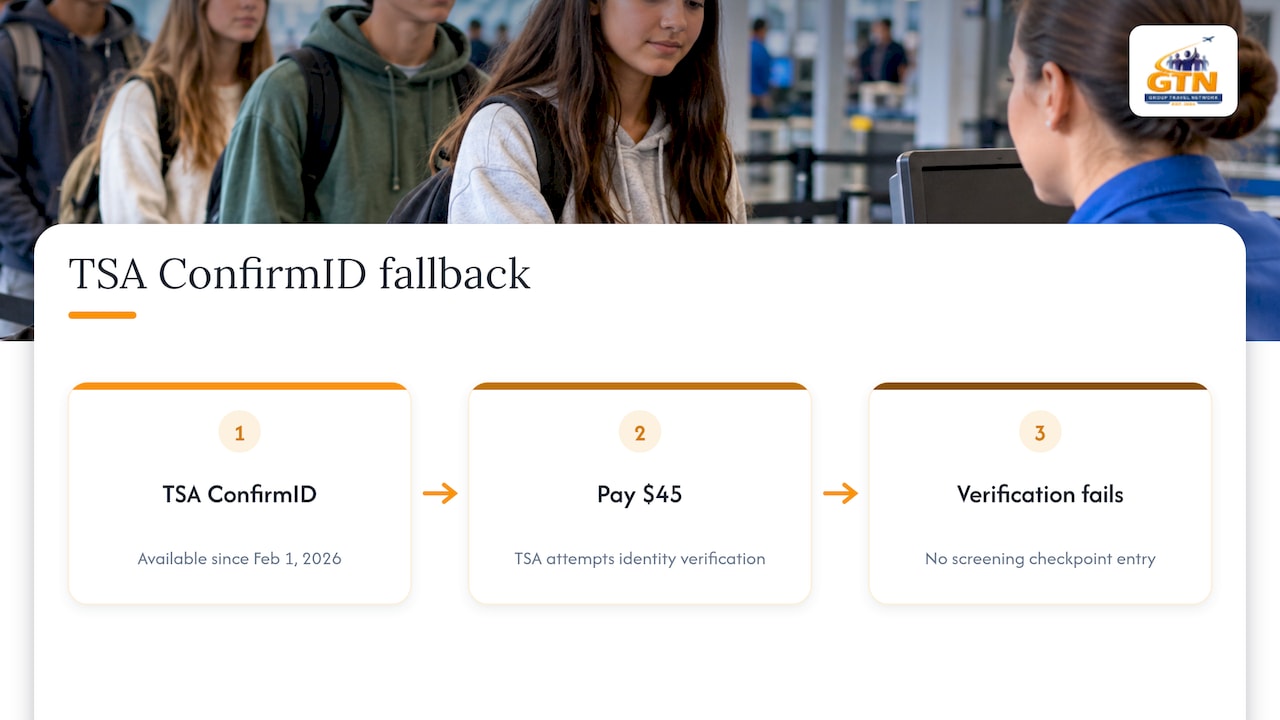
The fallback exists, but you do not want to depend on it. TSA says that since February 1, 2026, travelers without acceptable ID can pay $45 for TSA ConfirmID (opens in a new tab), which attempts to verify their identity so they can begin screening. If TSA cannot verify the person, they will not be allowed into the screening checkpoint.
That last sentence is the one to repeat to your chaperones. For a student group, losing one adult can mean losing your supervision ratio. A band that cannot legally leave a 17-year-old unsupervised may have to rebook, split up or cancel. The $45 fee is the small problem; the missed flight is the big one.
A REAL ID requirement also does not change documentation rules elsewhere (opens in a new tab). It does not add ID requirements where none existed, such as entering public areas of a federal facility. For most school trips, though, the airport is the only place it comes up.
A timeline for checking ID on your roster
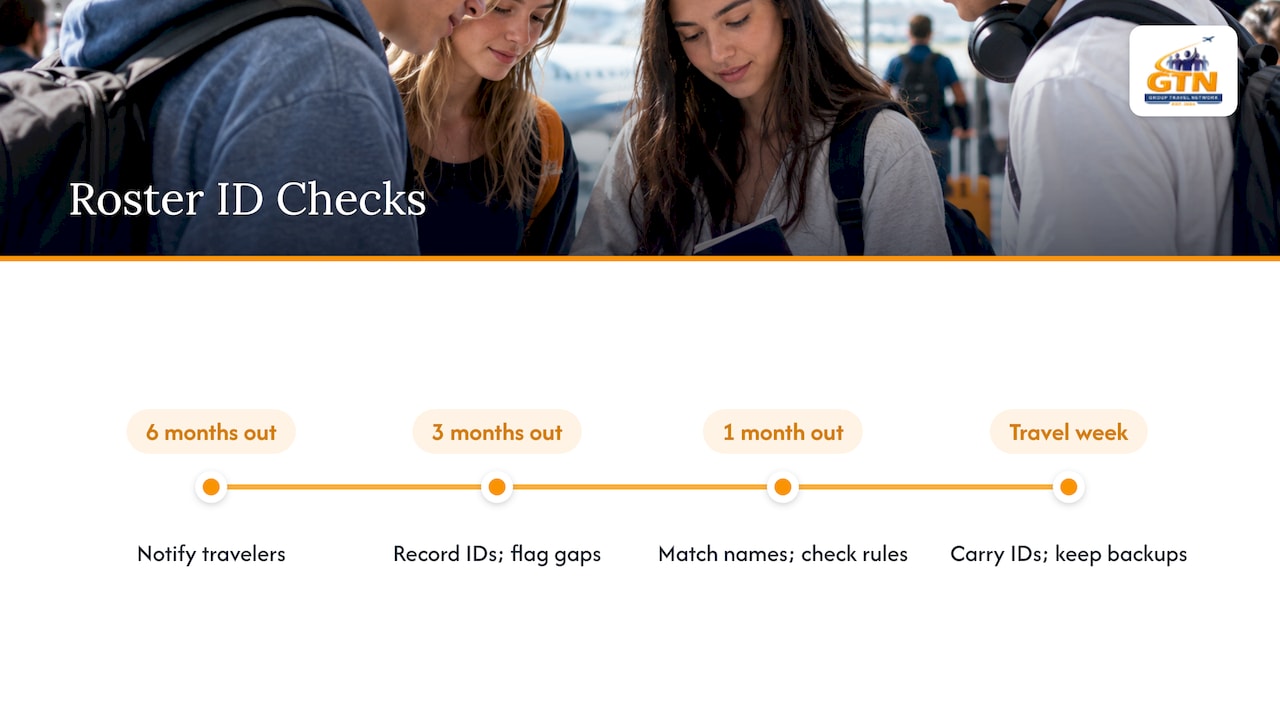
Do the work in this order and you will rarely have a surprise.
Six months out
Publish a one-page notice to chaperones and any 18-year-old participants: adult travelers need a REAL ID (star) or a passport. Tell them which card to check and where to renew if needed. Appointment availability varies by state, so do not wait.
Three months out
Collect a document type from every adult. You do not need a copy of the ID itself on a spreadsheet, only a note such as “REAL ID” or “passport.” Flag the gaps and follow up one by one. If your school has a process for student forms, our guide to preparing student travel forms (opens in a new tab) can slot this in with the rest of the paperwork.
One month out
Match names on tickets to names on IDs. Middle names, hyphens and recent name changes cause most boarding-pass mismatches. Confirm the airline’s policy for minors in writing, as the FAA suggests, and have it in your trip binder.
Travel week
Send a short reminder: bring the ID you listed, in a pocket you can reach, not in checked luggage. If you carry a backup copy of each minor’s birth certificate and signed consent, keep it with the lead chaperone. Our guides on consent form fields (opens in a new tab) and documents to finalize before minors travel without parents (opens in a new tab) show what to include.
For the broader list of paperwork, see our must-have travel documents for group trips (opens in a new tab).
Keeping track of students once ID is cleared
Getting everyone through the checkpoint is only the first airport task. Terminals are large, and groups of teenagers disperse quickly. Some leaders add a small layer of safety by giving students GPS trackers for kids while traveling (opens in a new tab), alongside the buddy system and headcounts. Check your school’s policy and get parent consent before using any device like that.
Our perspective
We plan student, school and performance trips, and the pattern we see is consistent: ID problems are not hard, they are late. A chaperone who is willing to renew a license in March is rarely a problem. A chaperone who finds out at the gate in June is.
Our view is that the group leader should not be the only person policing documents. Build the check into registration, assign one coordinator to track it, and treat adult ID the same way you treat medical forms: nothing is final until it is on file. That is why we pair every group with a dedicated trip coordinator and handle registration online, so the paperwork is visible long before departure.
If you take one habit from this page, make it this: ask adults for a passport first. It costs more up front, but it solves the REAL ID question, any later international leg and most name-matching worries at once.
— Donovan
Let us handle the paperwork with you
Group Travel Network builds custom itineraries for schools, bands, teams and youth organizations, with dedicated trip coordinators, online registration, flexible payment plans and travel protection options. Whether you are planning a performance tour (opens in a new tab), a senior trip or an international program, we can help you set up a document checklist that fits your roster.

If you are ready to plan, start with our Stress-Free Student Travel (opens in a new tab) page, or look at our Senior Class Trips (opens in a new tab), where 18-year-old travelers make ID checks especially important.
FAQ
Do students under 18 need a REAL ID to fly?
No. TSA does not require children under 18 to show ID for domestic flights. However, airlines set their own policies for minors, so confirm with your carrier before the trip. Any international flight requires a passport.
Can I fly without a REAL ID in 2026?
Yes, if you carry another acceptable document such as a U.S. passport. Without any acceptable ID, TSA ConfirmID can attempt to verify your identity for a $45 fee. If it cannot, you will not be allowed into the checkpoint.
Can international students get a REAL ID?
It depends on the state, since each state sets its own documents and process. Students who do not have a REAL ID can use a passport for domestic flights and should carry their immigration documents, such as a Form I-20 or DS-2019. Check with the state licensing agency and the school’s international student office.
Do chaperones need a REAL ID?
Chaperones who are 18 or older need acceptable ID, which can be a REAL ID-compliant license or an alternative such as a passport. Their ID name should match the airline ticket. Collect this information from each chaperone well before travel.
Is a REAL ID enough for a trip abroad?
No. A REAL ID is for domestic air travel and certain federal facilities. International trips, including to Canada and Mexico by air, need a passport. See our guide to minor international travel documents (opens in a new tab) for planning.
Sources
- Acceptable Identification at the TSA Checkpoint | TSA (opens in a new tab)
- REAL ID Frequently Asked Questions | TSA (opens in a new tab)
- Do minors need identification to travel? | FAA (opens in a new tab)
- How to get a REAL ID and use it for travel | USAGov (opens in a new tab)
- General travel advisory | International Student and Scholar Services, CU Boulder (opens in a new tab)