

Booking a music clinic comes down to five decisions: who leads it, when, what it costs, what the students will work on, and where it happens. Settle those early and put them in writing, and the day runs itself. This guide covers each decision for band, choir and orchestra directors. It also covers a case many directors miss: arranging a masterclass or clinic while your ensemble is on tour.
TL;DR
- A clinic is a guest educator working with your ensemble, usually in one rehearsal. A masterclass is more individual and performance-focused. Choose by what your students need to fix.
- Contact clinicians early. Those who live far away or work with many ensembles may need to be booked well in advance.
- Budget for the fee and travel. The Florida Bandmasters Association suggests $50 an hour or more in town and $75 an hour or more out of town, travel included.
- Send the clinician your music, your ensemble’s strengths and weaknesses, and your goals, then confirm equipment, timeline, building schedule and a backup plan.
- On tour, a masterclass can be built into the itinerary, ideally scheduled alongside your rehearsals and performances.
Table of Contents
- What a music clinic is, and how it differs from a masterclass
- Which format fits your group
- Our perspective: treat the clinic as part of a season, not an event
- How to find and book a clinician
- What a clinic costs
- Put the details in writing
- Prepare the room, the students and the schedule
- Permissions, access and backup plans
- Masterclass on tour: building a clinic into a performance trip
- A ten-item checklist before you confirm
- Let us handle the travel side
- FAQ
- Sources
What a music clinic is, and how it differs from a masterclass
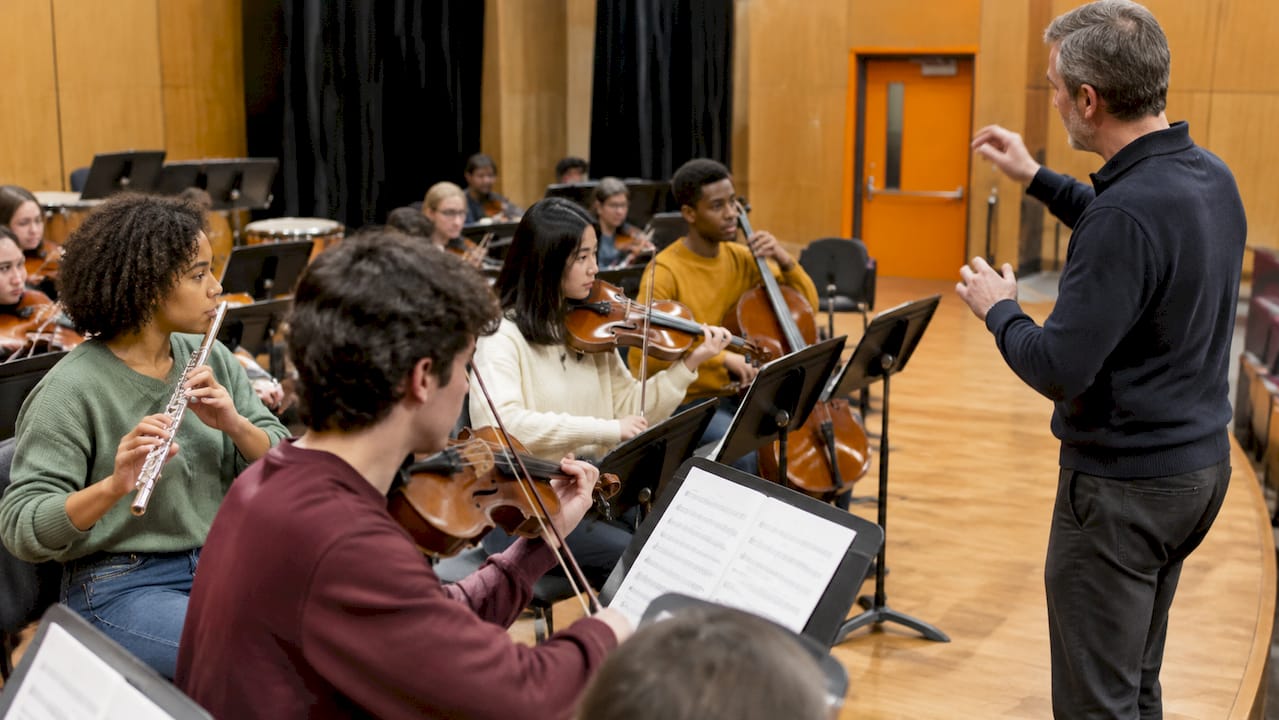
A music clinic brings an outside expert into a rehearsal. The guest might be a conductor, a college professor, a professional player or a retired director. They listen to your group, work on specific problems and leave your students and you with new tools. Most school clinics are one rehearsal to a full day, and they often lead into a concert, a festival or a contest.
A masterclass is narrower. One student, or a small group, plays or sings for the guest while the rest of the room watches and learns from the coaching. It suits soloists, sections and chamber groups more than a full ensemble.
Both formats can stretch into residencies. Jazz St. Louis (opens in a new tab) runs artist residencies that bring professional jazz artists and educators to the city for a week of clinics, master classes and community concerts. That is a useful model: a clinic can be one piece of a larger visit instead of a stand-alone event.
Which format fits your group
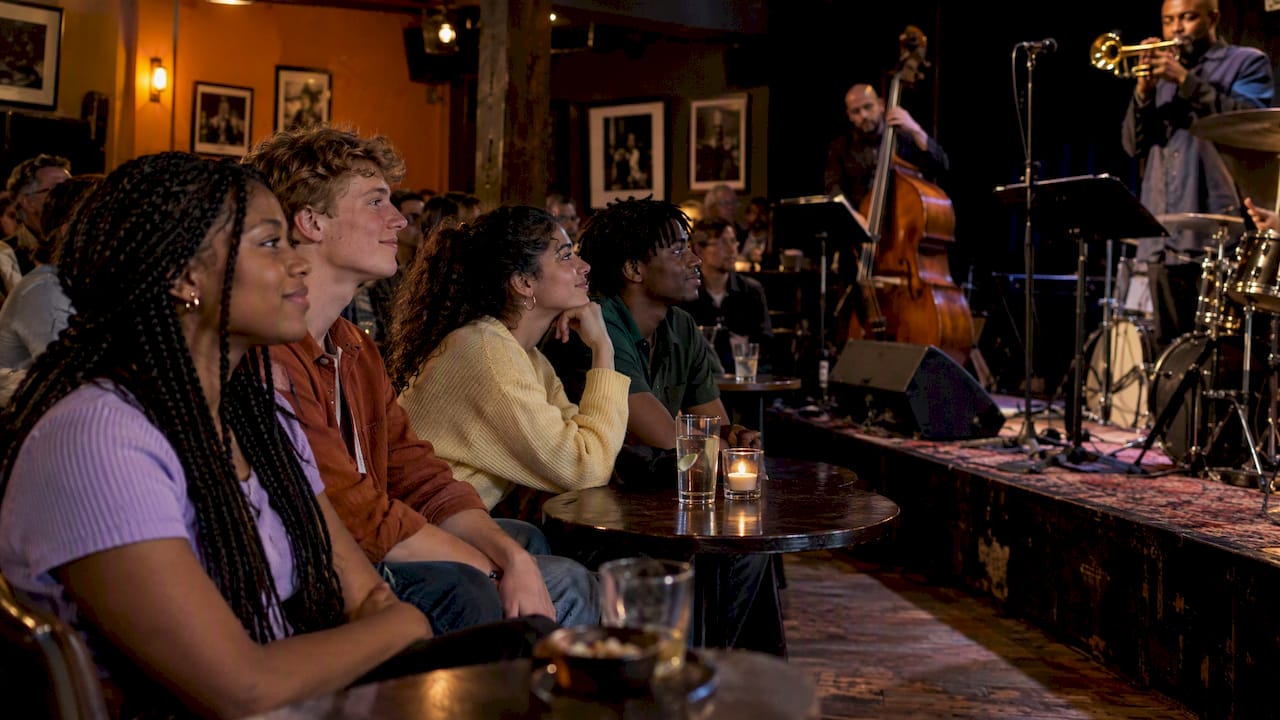
Start from the problem, not the format. If your trumpets are flat in the upper register, a full-band clinic wastes everyone else’s time. If the whole ensemble has uneven balance before a festival, a section masterclass will not fix it.
| Your situation | Best format | Typical length |
|---|---|---|
| Full ensemble preparing for a concert or adjudicated festival | Conductor clinic with the whole group | One rehearsal, 45 to 90 minutes |
| Weak sections or a few advanced players | Sectional clinic or masterclass | One class period |
| Soloists preparing auditions | Individual masterclass with audience | Half day |
| A program that wants a boost in culture and motivation | Multi-day residency with a concert | Two days to a week |
| An ensemble already traveling for a performance | Tour masterclass or clinic at a host venue | One itinerary block |
Be honest about the size of the need. A single well-prepared hour with the right person usually beats a vague full day with a famous name.
Our perspective: treat the clinic as part of a season, not an event
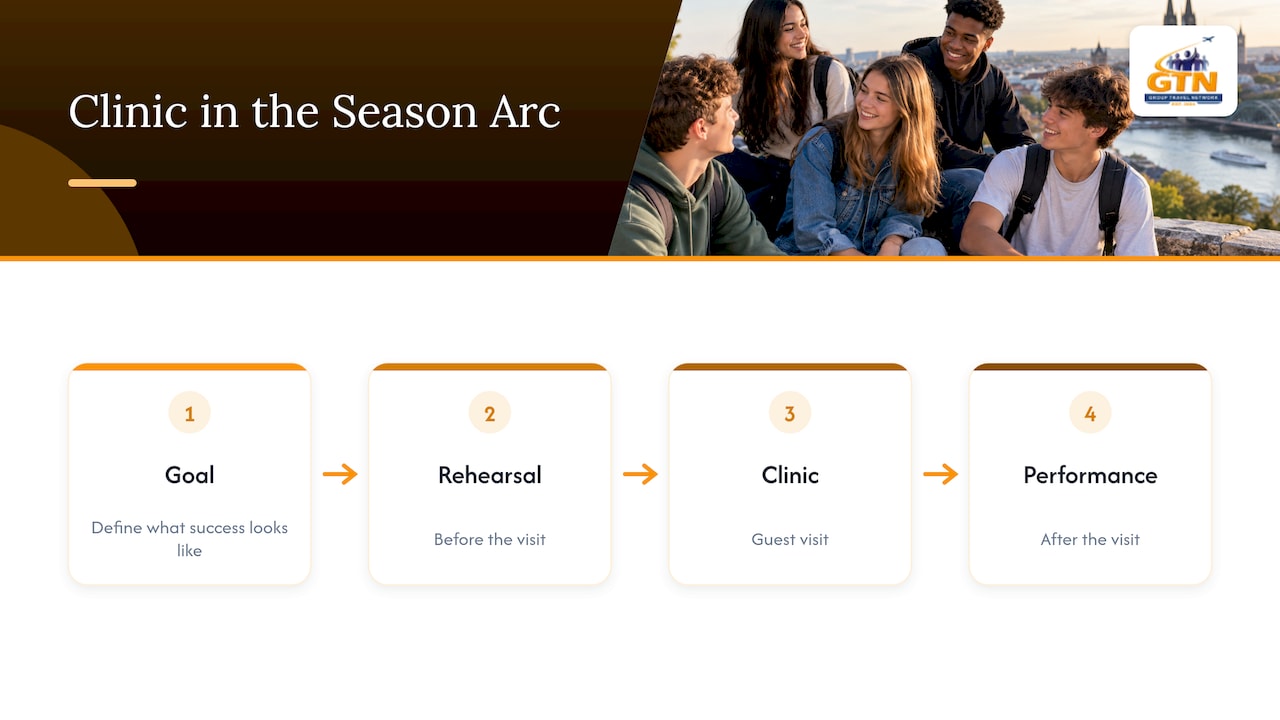
We plan performance and educational trips for school music programs, and we see the same pattern. The clinics that change a group are the ones the director built into a larger arc: a goal, a rehearsal plan before the visit, a performance after it. The clinics that fizzle are the ones booked late and filled with logistics the director is still solving while the guest is already in the room.
That is why we push directors to treat a clinic the way they would treat a tour. Define what success looks like, assign the jobs, write the schedule and leave nothing to the morning of. When a clinic or masterclass is part of a tour, the same rule applies, and the stakes are higher because the group is away from its own building, instruments and routines. A clinic on tour works best when it sits between a rehearsal and a performance, so students can use what they just learned in front of an audience.
— Donovan
How to find and book a clinician
Ask colleagues first
The Florida Bandmasters Association’s guidance for hosting a clinician suggests asking colleagues about a clinician’s skills and experience (opens in a new tab), then contacting the person directly, in person, by mail, email or phone, to invite them and settle a date. Your state music educators association, your district’s music supervisor and neighboring directors are the fastest sources of names. Ask what the guest did well, how they handled students of your age, and whether they were prepared.
Check the credentials that matter
The same guidance recommends someone known as a successful conductor with their own ensembles and demonstrated success as a guest conductor or clinician. A great performer is not automatically a great teacher of a group of fourteen-year-olds. Ask for a reference from a director with a similar program, and for a short description of how they run a first rehearsal.
Contact them early
Book as far ahead as you can. Clinicians who live far away or work with many ensembles may need to be booked well in advance, and the busy season before spring festivals fills fastest. Offer two or three possible dates instead of one, and confirm which you pick by email.
Send the information they need
A clinician who arrives cold spends half the session figuring out your group. Send your music, the specific issues you hear, the ensemble’s strengths and weaknesses, and the goals for the rehearsal. Include the ensemble’s size, instrumentation, grade level and your rehearsal period length. Share a recording if you have one.
What a clinic costs
Fees vary by region, reputation and format, so treat any number you read as a starting point and confirm locally. The Florida Bandmasters Association’s guideline is $50 an hour or more for in-town rehearsals and $75 an hour or more for out-of-town sessions (opens in a new tab), inclusive of travel expenses. It is a guideline for Florida directors, not a national rate card, but it is a reasonable floor when you start a conversation.
Travel is the line that surprises people. Yamaha’s guest artist guidance for educators notes that flying an artist in can cost much more (opens in a new tab) than booking someone within driving distance. A strong regional clinician you can reach by car often gives better value than a national name with airfare, hotel and ground transport.
A working budget has these lines:
- Clinician fee, hourly or flat.
- Travel: mileage if driving, airfare and ground transport if flying.
- Lodging, if the clinician travels from far away.
- Meals on the day.
- Equipment rentals, such as percussion, a piano or amplification.
- Printing or purchasing music, if the clinician will use specific editions.
- A small buffer for anything you forgot.
Who pays? Some programs cover the fee from the department budget, some use booster funds and some split it with a neighboring school hosting a shared clinic. Two schools sharing a visiting clinician can split travel and lodging, and the students get to meet peers.
Put the details in writing
Treat the booking like a small contract, even if it is a friendly email chain. The Florida guidance suggests outlining compensation, mileage, rehearsal schedule, meals, accommodations and housing (opens in a new tab) in advance. Add these to your list:
- Date, start and end times, and the rehearsal’s exact length.
- Fee and when it will be paid, and who processes the paperwork.
- What you will cover for travel and how you will reimburse it.
- The music to be rehearsed and when the clinician receives it.
- A cancellation and rescheduling policy for both sides.
- Whether recording or photography is allowed.
If you coordinate several visits through a season, a shared checklist keeps it manageable. A conference planning checklist (opens in a new tab) is built for larger events, but its approach to time slots, catering and lodging details carries over well to a multi-session clinic day.
Prepare the room, the students and the schedule
Yamaha’s advice is blunt: directors should not be figuring out logistics during the session. They should be running a pre-established, structured plan (opens in a new tab). That plan should include:
- Equipment: confirm what the clinician needs, from stands and chairs to a podium, a piano or a sound system.
- Timeline: write out the day minute by minute, including warm-up, the clinician’s block, breaks and transitions.
- Building schedule: check that no other group, assembly or custodial project has the room.
- Students: have them prepared on the music, instruments tuned and folders ready. Tell them what the visit is for and how to behave with a guest.
- Your role: decide in advance whether you will take notes, mark parts or step back and listen. Directors who take careful notes can carry the guest’s ideas into the next six weeks of rehearsals.
A good habit: run the music once without the guest the week before, so the clinician’s time goes to improvement and not note-learning.
Permissions, access and backup plans
Clearance and check-in. In Florida, the hosting guidance reminds directors to make sure a clinician meets district standards under the Jessica Lunsford Act (opens in a new tab), a state law on background screening for people working on school grounds. Other states and districts have their own rules, so ask your district office what a visitor needs before the date. Tell the front office the guest’s expected arrival time and check that the rehearsal space is not double-booked.
Accessibility. Confirm the room works for every student, including wheelchair access, seating and any accommodations in students’ plans. Tell the clinician in advance if students need adapted instruments or extra time.
A backup plan. Yamaha recommends deciding who will run the rehearsal if the director is unexpectedly unable to attend (opens in a new tab). Add two more: what happens if the clinician cancels (a rescheduled date or a recorded session), and what happens if the weather closes school. Put all three in the confirmation email.
Masterclass on tour: building a clinic into a performance trip
A masterclass while on tour is one of the best uses of a travel day. Students hear a new voice in a new place, then play or sing for a different audience the same week. Common ways to arrange it:
- At a host school or university. Your group visits a program in the destination city and shares a joint clinic with their students.
- At a festival. Many festivals pair adjudication with a clinic, so students hear feedback and can use it right away. Our guide to turning adjudication into rehearsal (opens in a new tab) explains how that works.
- At a performance venue. Some venues and local artists offer a workshop alongside your concert.
- With a clinician traveling with you. A guest conductor joins the tour for rehearsals and concerts.
The timing matters. Put the clinic after a rehearsal and before a performance, and keep it away from long travel days when students are tired. Our three-part rehearsal scheduling system (opens in a new tab) shows how to place rehearsal blocks on a tour so none gets squeezed. Equipment is another tour detail: if the clinic needs percussion or amplification, book transport for gear weeks ahead (opens in a new tab). For the wider picture, our school administrator’s planning guide to music tours (opens in a new tab) covers approvals, budgets and communication with families.
Depending on your ensemble, you may also want our guides for band tours (opens in a new tab), choir tours (opens in a new tab) and orchestra tours (opens in a new tab).
A ten-item checklist before you confirm
- A clear goal for the session, written in one sentence.
- A format chosen for that goal: clinic, masterclass or residency.
- Two or three candidate clinicians, checked with colleagues.
- Dates offered early, with a backup date.
- Music and ensemble notes sent to the clinician.
- Fee, travel, lodging and meals agreed in writing.
- District clearance and front-office notice handled.
- Room, equipment and timeline confirmed.
- A backup for the director and for the clinician.
- A follow-up plan: thank-you note, rehearsal notes and a short student reflection.
Let us handle the travel side
If your clinic is part of a trip, the travel logistics can swallow the planning time you need for the music. At Group Travel Network we build performance tours (opens in a new tab) for school bands, choirs and orchestras, with itineraries shaped around your rehearsal and performance goals, a dedicated trip coordinator, online registration and flexible payment plans. Tell us you want a masterclass or clinic built into the schedule and we will plan the days around it.

To start, contact us through our site (opens in a new tab) with your ensemble, your target season and what you want students to gain.
FAQ
How far ahead should I book a music clinician?
As early as you can. Clinicians who live far away or work with many ensembles may need to be booked well in advance, according to Florida Bandmasters Association guidance (opens in a new tab). Offer several dates and confirm the choice in writing.
How much should I pay a visiting clinician?
The Florida Bandmasters Association suggests $50 an hour or more for in-town rehearsals and $75 an hour or more for out-of-town sessions, travel included. Add lodging, meals and equipment if they apply, and compare against what neighboring districts pay.
What should I send the clinician beforehand?
Send your music, the specific issues you hear, your ensemble’s strengths and weaknesses, and your goals for the rehearsal. A recording and your schedule for the day help a great deal.
Can a masterclass be part of a student tour?
Yes. Directors often schedule a clinic at a host school, a festival or a venue in the destination city. Place it between a rehearsal and a performance so students can use the feedback right away.
What if the clinician or I cannot make it?
Plan for both. Name who will run the rehearsal if you cannot attend, and agree with the clinician on a reschedule date or recorded alternative before you book.
Sources
- Best Practices for Hosting a Music Clinician, Florida Bandmasters Association (opens in a new tab)
- How to Book a Guest Artist for Your Program, Yamaha Music (opens in a new tab)
- Education, Jazz St. Louis (opens in a new tab)
- Complete Conference Planning Checklist for Successful Events (opens in a new tab)