


You can fly with most instruments, but the rules favor small ones. A violin, trumpet or guitar-sized case can ride in the cabin if it fits in the overhead bin or under the seat and space is left when you board. Anything bigger has to be checked or given its own paid seat. For a band director, the hard part is not knowing the rule. It is making sure sixty students follow it at the same airport on the same morning.
This guide covers the ten rules that matter most in 2026, drawn from federal rules and musicians’ own travel guidance, with the group-travel adjustments we see as a student travel planner.
TL;DR
- Federal rules let small instruments ride as carry-on only if they fit in the bin or under the seat and space is available. There is no priority over other passengers.
- Larger instruments can be checked (up to 150 linear inches and 165 pounds) or, if the airline offers it, flown in a purchased seat.
- Newer CT scanners at checkpoints have smaller openings, so plan extra time for instrument cases.
- Standard airline liability for a lost or damaged instrument is capped, so insure anything valuable separately.
- For groups, board early, assign instrument responsibilities, and move big gear by separate transport weeks ahead.
Table of Contents
- The 10 rules at a glance
- 1. Small instruments can go in the cabin, space permitting
- 2. A big instrument may fly in its own seat
- 3. Checked instruments have size and weight limits
- 4. Airline liability is capped, so insure the instrument
- 5. Choose non-stop or through flights
- 6. Expect delays at the security checkpoint
- 7. Ask TSA Cares to coordinate screening
- 8. If the gate agent says no, stay calm and offer a fix
- 9. Pack the case, not just the instrument
- 10. Move oversized gear separately
- A director’s pre-flight checklist
- Our perspective: instruments are the part of the trip you cannot improvise
- Planning a performance trip with instruments?
- FAQ
- Sources
The 10 rules at a glance
| # | Rule | What it means for your group |
|---|---|---|
| 1 | Carry-on is allowed if it fits and space remains | Board early; no priority for instruments |
| 2 | Seat baggage is optional for airlines | Confirm in writing before booking |
| 3 | Checked limit: 150 linear inches, 165 pounds | Measure every case |
| 4 | Liability is capped | Insure instruments separately |
| 5 | Prefer non-stop or through flights | Fewer chances to lose a case |
| 6 | CT scanners are smaller | Build in 30 extra minutes |
| 7 | TSA Cares can coordinate screening | Call 72 hours ahead |
| 8 | Stay calm if a gate agent says no | Cite the rule, offer a compromise |
| 9 | Pack the case, not just the instrument | Loosen strings, pad, label |
| 10 | Ship oversized gear separately | Book transport weeks ahead |
1. Small instruments can go in the cabin, space permitting
Under the Department of Transportation’s rule at 14 CFR Part 251 (opens in a new tab), which took effect in March 2015, U.S. airlines must let passengers carry a small instrument on board if it fits in the overhead bin or under the seat and space is available at the time of boarding. The rule applies to U.S. carriers and to service to, from or within the United States.
Two details trip planners miss. First, the instrument gets no priority: it competes with every roller bag on a first-come, first-served basis. Second, the airline does not have to remove other passengers’ items to make room.
That is why the American Federation of Musicians travel kit (opens in a new tab) advises boarding as early as you can, including buying priority boarding when needed. For a group, that means asking your coordinator whether early boarding for instrument carriers can be arranged at booking, not at the gate.
2. A big instrument may fly in its own seat
Cellos, string basses in hard cases and similar instruments will not fit under a seat. The federal rule allows a passenger to buy an additional seat for an instrument, which is treated as seat baggage. The instrument and case cannot exceed 165 pounds and must meet FAA-approved stowage requirements (14 CFR Part 251 (opens in a new tab)).
Airlines are allowed to offer this, not required to. Do not assume. Before you put a deposit on a flight block, confirm in writing that the carrier sells seat baggage tickets for your instruments, what the ticket costs, and how the instrument is named on the reservation. Cost varies by airline and route, so get the figure for your specific flight.
3. Checked instruments have size and weight limits
If an instrument cannot ride in the cabin, airlines generally must carry it as checked baggage when total linear dimensions (length plus width plus height) do not exceed 150 inches and weight does not exceed 165 pounds, subject to carrier policies, according to the DOT’s musical instrument tip sheet (opens in a new tab). Check the airline’s current baggage fee schedule too, since fees differ by carrier and by whether the case counts as your standard bag.
Measure each hard case with the instrument inside. Sousaphone, bass drum and large percussion cases are the usual offenders. Anything over the limit needs a different plan, covered in rule 10.
4. Airline liability is capped, so insure the instrument
The DOT tip sheet notes that liability for a lost or damaged instrument is limited to $3,400 on domestic flights and roughly 1,131 Special Drawing Rights on international flights, about $1,686.50 (DOT (opens in a new tab)). Some domestic contracts may disclaim liability for instruments entirely, so read the carrier’s contract of carriage.
A professional-grade trombone or a student’s family heirloom violin can be worth more than the cap. Ask families who send valuable instruments to buy supplemental instrument insurance that covers the item wherever it is during travel, in the cabin or the hold. Ask us at booking about travel protection options for the trip as a whole, but treat instrument coverage as its own question, because standard trip policies often have limits on musical equipment. Read the exclusions before you tell parents it is covered.
5. Choose non-stop or through flights
The same DOT guidance points out that non-stop or through flights, where the passenger stays on the same aircraft, lower the risk of an instrument being misrouted or left behind at a connecting hub. For a group, one more argument applies: a tight connection with fifty students and a dozen instrument cases is an operational risk even before bags are considered.
When a connection is unavoidable, build in a long layover and keep all cabin instruments with their owners. Our band trip planning guide (opens in a new tab) walks through how flight timing fits into the rest of the schedule.
6. Expect delays at the security checkpoint
The TSA states that instruments must be screened (opens in a new tab), whether carried on or checked, and that carry-on instruments require a physical inspection at the checkpoint.
Newer CT scanners add a wrinkle. International Musician reported in February 2025 (opens in a new tab) that the new machines have an opening about 24.5 inches wide and 16.5 inches tall. Cases that once rode through the older X-ray belt may not fit or may trigger an alarm, which means a hand inspection. The same article suggests allowing at least 30 minutes of extra time.
For a group, convert that into a schedule. Arrive earlier than your airline’s standard guidance, split students into smaller waves, and have directors or chaperones at the front of the instrument line so TSA officers have one point of contact. Students should be ready to open cases and answer simple questions about what is inside.

7. Ask TSA Cares to coordinate screening
TSA Cares helps travelers with special needs, including those carrying fragile items. The AFM travel kit recommends contacting TSA Cares at (855) 787-2227, or through its website, at least 72 hours before your flight to coordinate screening of your instrument (AFM (opens in a new tab)).
For a school group, that call is worth making for the most fragile or unusual instruments, such as a harp or a rare older instrument. Make it from the director’s phone, with the flight details and the number of instruments in front of you.
8. If the gate agent says no, stay calm and offer a fix
It happens: an agent says a case that clearly fits has to be gate-checked. The AFM guidance says to refer calmly to 14 CFR Part 251 and to work within the roughly 15 minutes before the aircraft door closes. Suggest practical compromises, such as stowing the instrument toward the rear of the cabin or using the airline’s securement cords, rather than arguing over the regulation.
Agree beforehand that only the director or lead chaperone speaks to airline staff. Students arguing at the podium rarely helps. Also carry a printout of the relevant rule and your confirmation emails.
9. Pack the case, not just the instrument
A few habits protect instruments in the cabin and the hold alike:
- Remove or secure loose accessories, such as mouthpieces, reeds and stands, so they do not rattle or get lost during hand inspection.
- Put a name, school and phone number inside and outside every case.
- Use a hard case for anything checked, and leave no empty space in it where the instrument can shift.
- Keep small, easily lost items in a separate bag the student keeps with them.
- Photograph each instrument before departure, for insurance claims.
The DOT notes that fragile instruments are especially vulnerable in transit, so give extra thought to how a case is padded before you hand it over. Students also need their uniforms packed correctly; our uniform packing rules (opens in a new tab) give you six steps you can assign.
10. Move oversized gear separately
Some gear will not work on a commercial flight at all: marching percussion, large amplifiers, risers, keyboards. For those, separate freight or ground transport is the usual answer, and it needs lead time. Our article on booking performance trip equipment transport (opens in a new tab) explains why it should be booked weeks ahead.
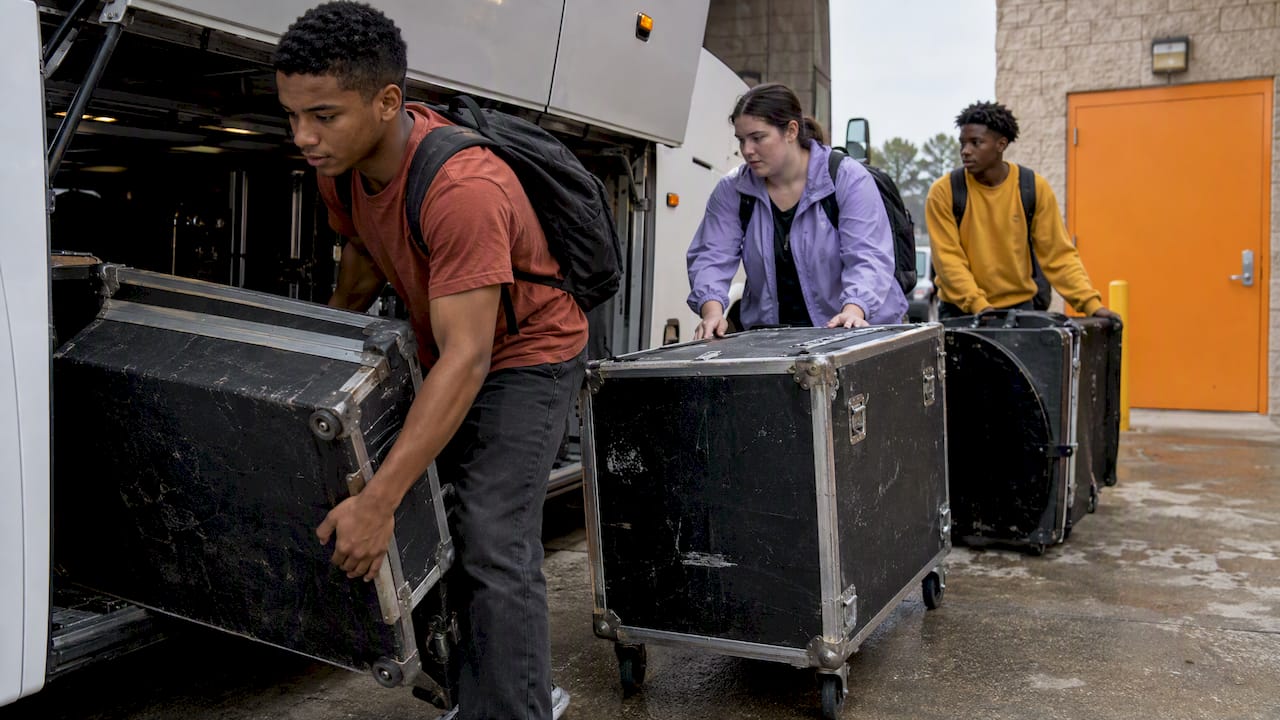
Another option is to leave some instruments at home and use instrument rental on tour (opens in a new tab). Renting a bass drum or a set of timpani at the destination removes the weight, the freight and the liability question in one step. Confirm brand, model and delivery time with the vendor well before you leave.
A director’s pre-flight checklist
- Count instruments by type and decide which ride in the cabin, which are checked, and which are shipped or rented.
- Measure every checked case against the 150 inch and 165 pound limits.
- Get written airline confirmation for any seat baggage tickets.
- Collect insurance details from families with valuable instruments.
- Choose non-stop flights where the budget allows.
- Schedule extra time at security and brief students on what to expect.
- Call TSA Cares at least 72 hours out for fragile items.
- Name one adult as the airline contact at the airport.
- Make sure travel forms are complete; our student travel forms guide (opens in a new tab) covers the paperwork.
Our perspective: instruments are the part of the trip you cannot improvise
We plan student and performance trips, and the same pattern repeats. Directors worry about flights, hotels and meals, but the thing that can sink a performance is an instrument that arrives late, damaged or not at all. A missing hotel room can be solved the same night. A missing tuba cannot.
So we treat instruments as their own workstream. Decide early what flies in the cabin, what is checked, what is shipped and what is rented, and put that decision on paper before families are told what to bring. Then give students a clear job: each one is responsible for their own case, and each section has a leader who counts cases at every handoff.
We also encourage directors not to carry the whole burden. A dedicated trip coordinator who handles airline questions, early boarding requests and transport vendors lets you stay with your students. That is the point of the service we build around performance tours (opens in a new tab): you teach and conduct, we handle the logistics.
— Donovan
Planning a performance trip with instruments?
If you are building a trip around a festival, a concert or a competition, our team can help you decide how instruments travel, coordinate vendors and keep families informed, with online registration and flexible payment plans on the logistics side. See our Performance Tours (opens in a new tab) page, or read our guide to music band travel (opens in a new tab) first. Our tips for organizing band tours (opens in a new tab) cover the rest of the schedule.
FAQ
Can I take a guitar as a carry-on?
Often yes. Federal rules require U.S. airlines to let you bring a small instrument on board if it fits in the overhead bin or under the seat and space is available when you board. The airline does not have to move other passengers’ bags to make room, so board early.
Do I have to pay extra for an instrument in the cabin?
An instrument that fits in the bin or under the seat travels as your carry-on item. A larger one that needs its own seat requires buying a ticket for it, if the airline offers that option. Check the carrier’s current baggage fee page for checked instruments.
How do I protect an instrument that is checked?
Use a hard case with no empty space inside, label it, photograph the instrument, and choose non-stop flights where possible. Also arrange separate instrument insurance, because airline liability is capped at $3,400 on domestic flights.
Does TSA let instruments through security?
Yes, but all instruments are screened, and carry-on instruments get a physical inspection. Newer CT scanners have smaller openings, so larger cases may need a hand check. Allow at least 30 extra minutes, and consider contacting TSA Cares 72 hours ahead.
Sources
- 14 CFR Part 251, Carriage of Musical Instruments (eCFR) (opens in a new tab)
- Flying with a Musical Instrument (U.S. Department of Transportation) (opens in a new tab)
- AFM Travel Kit (American Federation of Musicians) (opens in a new tab)
- What to Know Before You Fly with Your Instrument (International Musician) (opens in a new tab)
- What steps are taken to screen musical instruments? (TSA) (opens in a new tab)
Recommended
- Music Band Travel For School Directors: 2026 Guide (opens in a new tab)
- Tips For Organizing Band Tours: 10 Proven Strategies (opens in a new tab)
- 90 Day Band Performance Tour Playbook For School Directors (opens in a new tab)
- Band Trip Planning Guide: Organize Student Music Travel (opens in a new tab)