


When a student travel incident happens, call local emergency services immediately if anyone’s safety is at risk, then file a written incident report with your designated campus office as soon as the situation is stable. This response, urgent care first and documentation second, applies whether the incident happens on a school bus or overseas. Keep in mind that Clery Act obligations, embassy procedures, and the Smart Traveler Enrollment Program (STEP) all intersect with how and when you report.
TL;DR:
- Call local emergency services first when safety is at risk, then notify the designated campus contact and document names, times, witnesses, and actions promptly.
- Report stolen passports, unreachable students, medical crises, and behavior that creates a safety risk; a lost document or missed curfew alone may not require escalation.
- Overseas, call local responders first, then the nearest U.S. embassy; enroll students in STEP before departure and save the consular emergency numbers.
- Clery disclosure is not automatic for off campus incidents; institutions decide whether sponsored locations qualify, so follow written policy consistently and retain dated reports.
Table of Contents
- What counts as a reportable incident
- Who reports incidents and where they go
- Step-by-step: from the moment it happens to filing and follow-up
- Required fields and a sample checklist you can copy
- International incidents: what changes abroad
- Recordkeeping, Clery Act distinctions, and risk management
- Talking to parents and guardians after an incident
- Coordinator perspective: what actually makes reporting reliable
- How Group Travel Network takes reporting logistics off your plate
- FAQ
- Sources
What counts as a reportable incident
Not every bump in the road needs a formal report, but most coordinators err on the side of documenting too much rather than too little. A reportable incident is any event that affects student health, safety, behavior, or legal status while under your program’s supervision.
- Medical emergencies, injuries, or mental health crises requiring treatment
- Arrests, assaults, or sexual misconduct involving students or staff
- Missing or unaccounted-for students
- Property theft or loss, including passports and travel documents
- Natural disasters, civil unrest, or facility evacuations
- Behavioral incidents that create a safety risk for the group
Borderline cases trip people up. A lost passport is an administrative headache; a stolen passport is a police matter and a reportable incident. A student missing curfew might be a disciplinary note, while a student who doesn’t return and can’t be reached becomes a safety incident requiring escalation. Some reports stay internal for risk management purposes, while others, depending on location and institutional policy, may factor into Clery Act (opens in a new tab) crime statistics reviewed separately from your trip’s own files.
Who reports incidents and where they go
Responsibility for filing usually sits with whoever is present when the incident occurs, but the report needs to land with the right office fast.
- The program leader or trip coordinator files the initial report in most cases
- Faculty chaperones and on-site local staff can file when the coordinator is unavailable
- Students may self-report certain incidents, particularly harassment or safety concerns
- Campus study abroad offices or safety offices receive and log the report
Reporting channels vary by institution but typically include an online form, a daytime phone line for the study abroad or safety office, and a separate after-hours emergency number. Confirm before departure who holds the designated campus security authority role and save the on-call emergency contact in every chaperone’s phone. Universities such as the University of North Texas (opens in a new tab) publish exactly this kind of before-and-after-hours contact structure, which is worth mirroring for K-12 and youth group trips too.
Step-by-step: from the moment it happens to filing and follow-up
Incident response works best as a sequence, not a scramble. Following the same order every time reduces the chance of missing a step under stress.
- Call local emergency services immediately if the situation is life-threatening; address safety before paperwork.
- Notify your program’s emergency contact and, for school-sponsored trips, the after-hours campus line; note who you reached and when.
- Gather facts while they’re fresh: names of everyone involved, timestamps, witness contact information, photos, the treating medical facility, and any police report number.
- Complete the incident form with the required fields and attach supporting documents, keeping personally identifiable information limited to what the office requires.
- Confirm receipt of your submission, then preserve your own copy and notes in case of follow-up questions.
- Plan a debrief with your group and flag any students who may need continued support after the trip.
Pro Tip: Write down times and names the moment they happen, even in a phone notes app, rather than trying to reconstruct them later that night.
Skipping steps rarely saves time. A coordinator who files the form before confirming medical care, or who waits until returning home to write anything down, ends up redoing work and losing details that mattered.
Required fields and a sample checklist you can copy
Most institutional incident forms ask for the same core information, whether you’re filling out a university template or a program-specific version. Having these fields memorized speeds up reporting when adrenaline is still running high.
- Date and time of the incident
- Precise location, including building, city, or site name
- Names of everyone involved and any witnesses
- Incident type or category (medical, behavioral, criminal, safety, other)
- A clear, factual description of what happened
- Injuries sustained and any medical care provided
- Steps already taken to address the situation
- Reporter’s name and contact information
Representative forms from programs like NC State’s study abroad office (opens in a new tab) use nearly this exact field set, which makes it a reliable template to adapt for your own trip. Useful attachments include photos of the scene, medical paperwork, a police report number if one exists, and written witness statements. Keep a blank copy of your form printed and packed, since a spotty hotel Wi-Fi signal shouldn’t be the reason a report gets delayed.
International incidents: what changes abroad
An incident overseas follows the same first step, local emergency services, but your second call shifts from a campus office to the nearest U.S. embassy or consulate once the immediate danger has passed.
- Call local police, medical, or fire services first, exactly as you would domestically
- Contact the nearest U.S. embassy or consulate for consular assistance
- Confirm every student enrolled in the Smart Traveler Enrollment Program (STEP) (opens in a new tab) before departure, not after something goes wrong
- Keep the Bureau of Consular Affairs number accessible for the whole trip
The Bureau of Consular Affairs operates a 24/7 emergency line (opens in a new tab) at 1-888-407-4747 from the U.S. and Canada, or +1-202-501-4444 from elsewhere, connecting travelers to consular officers who can assist with victim support, emergency passport replacement, and evacuation coordination. STEP enrollment matters because it lets the embassy reach a student directly if they become separated from the group, rather than relying solely on the coordinator as the single point of contact.
Recordkeeping, Clery Act distinctions, and risk management
Internal incident reports and Clery Act crime statistics serve different purposes, and conflating them creates compliance headaches. The Clery Act requires institutions to issue timely warnings and disclose crime statistics for locations within their defined Clery geography, and institutions themselves determine which sponsored travel locations qualify.
- Document your institution’s written policy on what off-campus travel counts as Clery geography
- Apply that policy the same way for every trip, not case by case
- Keep a dated, timestamped file for every incident report, even minor ones
- Use the pattern of reports to inform future itinerary or policy changes
Many student travel incidents don’t automatically trigger Clery reporting, since the institution may lack legal control over the off-campus space, according to guidance from Goucher College (opens in a new tab). That distinction is exactly why internal risk management reporting matters on its own terms. A documented, date-stamped paper trail supports the kind of duty-of-care decisions described in ISO 31030 travel risk management (opens in a new tab) guidance, and it gives your program concrete evidence when deciding whether a destination, vendor, or itinerary needs to change.
Talking to parents and guardians after an incident
Parents and guardians need accurate information quickly, but speed should never come at the cost of accuracy. A short initial call or message confirming the student is safe and that staff are handling the situation buys time to gather complete facts before a longer conversation.
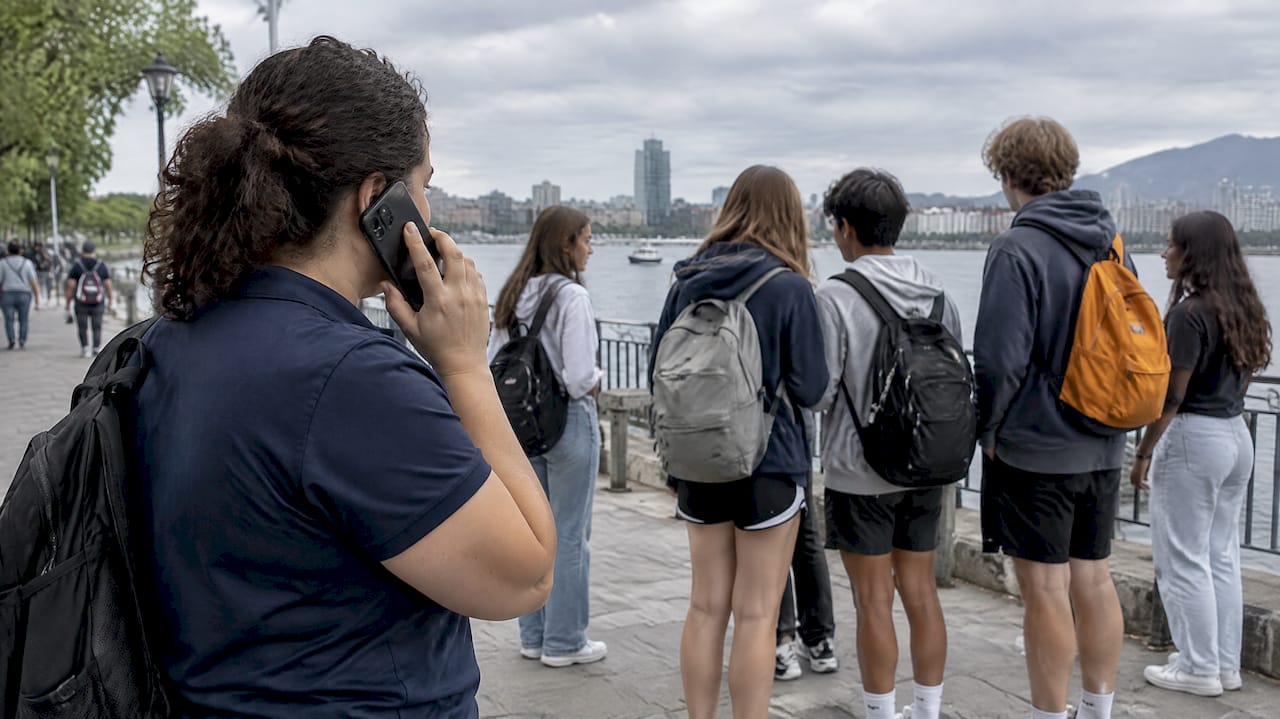
Decide in advance who makes that first call: the trip coordinator, a designated staff member, or the campus office, so parents aren’t contacted by multiple people with conflicting details. Share only confirmed information, avoid speculation about cause or fault, and give a realistic timeline for the next update rather than promising immediate answers you don’t have yet.
For incidents involving medical treatment, legal issues, or missing students, follow your institution’s policy on whether campus administration or legal counsel should be looped in before parents receive full details. Document every parent communication, including the time, who made contact, and what was shared, as part of the same record you’re keeping for the incident itself. Consistent, calm communication protects trust far more than fast but incomplete updates.
Coordinator perspective: what actually makes reporting reliable
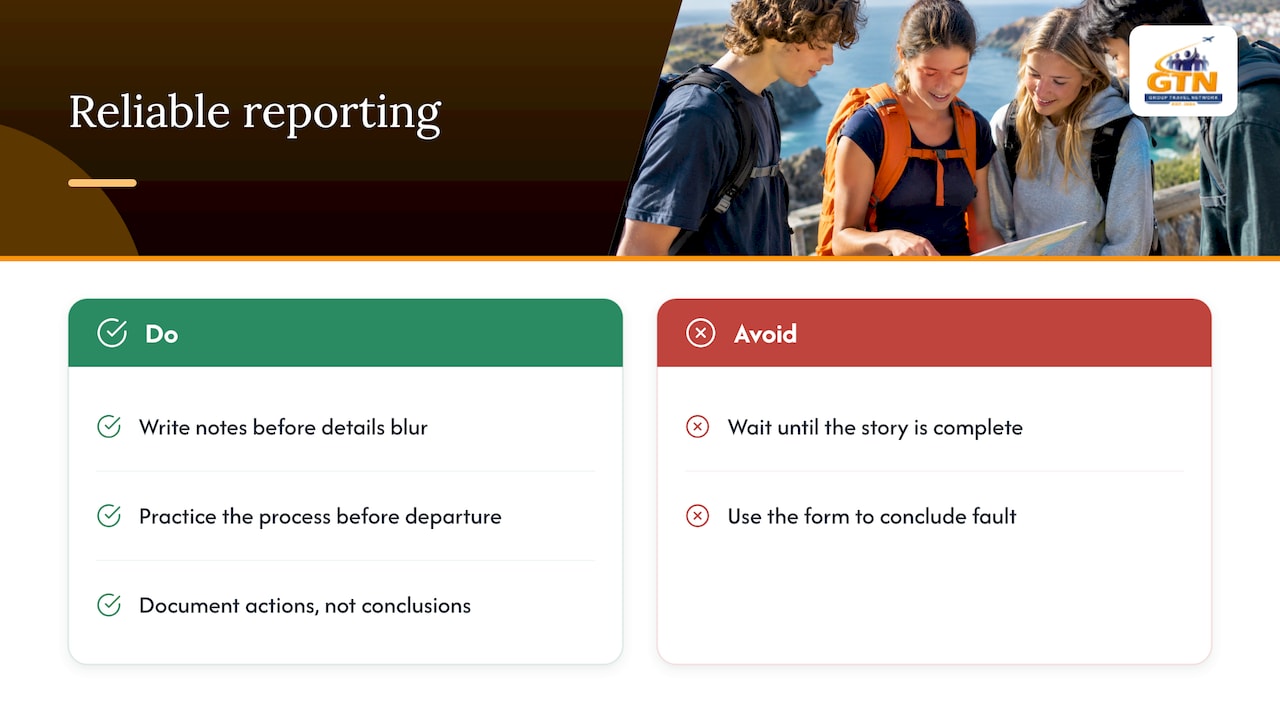
The biggest reporting failures I’ve seen described in program guidance come from delay, not dishonesty. Coordinators wait until they’re “sure” of the full story before writing anything down, and by then names and timestamps have blurred together.
Separate reporting from investigating. Your form documents what happened and what you did about it, not a conclusion about fault. Run through your reporting process before departure, printed checklist included, so the first time you use it isn’t during an actual emergency.
— Donovan
How Group Travel Network takes reporting logistics off your plate
Filing a clean incident report is easier when someone experienced is already on the ground with you. Our dedicated trip coordinators work alongside program leaders, helping manage emergency logistics while you focus on your students.

We also build travel protection options into our planning, so coordinators have support in place before a situation turns into a scramble for contacts and forms. If you’re planning an upcoming trip and want that kind of managed, on-trip support, start with our school group travel planning guide (opens in a new tab) to see how we structure the process from booking through return.
FAQ
What are the requirements for incident reporting in schools?
Schools generally require staff to notify a designated office promptly after any incident affecting student safety, health, or behavior, then submit a written report with details like date, location, people involved, and actions taken. Specific requirements vary by institution, but most follow a model similar to the NC State incident report fields.
What are the 8 types of reportable incidents?
Commonly reportable categories include medical emergencies, injuries, arrests, assault, sexual misconduct, missing students, mental health crises, and property theft. Institutions may define their own exact list, so checking your program’s policy for the specific categories it recognizes is worth doing before departure.
How do I make an incident report for a student trip?
Start with the required fields: date and time, precise location, names of those involved and witnesses, a factual description, injuries and care provided, and the reporter’s contact information. Attach supporting documents like photos or a police report number, then submit through your institution’s designated channel and confirm it was received.
What constitutes a reportable incident?
A reportable incident is any event during a trip that affects a student’s health, safety, legal standing, or behavior in a way that requires staff action or institutional awareness. This spans medical emergencies, safety threats, criminal activity, and significant behavioral issues, distinct from minor logistical hiccups that don’t involve risk.
Sources
- Reminder – Institution Responsibilities under the Clery Act | Knowledge Center (opens in a new tab)
- Abroad (opens in a new tab)
- Study Abroad Incident Report | Study Abroad (opens in a new tab)
Recommended
- Student Medical Forms For School Trips: Checklist And Templates (opens in a new tab)
- Student Pre-Trip Orientation Guide For Schools 2026 (opens in a new tab)
- Practical School Trip Risk Assessment Template, Before, During, After (opens in a new tab)
- How To Prepare Student Travel Forms: Step-by-Step (opens in a new tab)