

September 21, 2026
Compliant Teacher Travel Funding for School Leaders: 3 Models

Most districts and state ethics commissions restrict extra pay for chaperones and instead permit reimbursement of documented expenses like transportation, lodging, meals, and admissions. Paying teacher travel stipends outright often crosses into conflict-of-interest territory, especially when vendors or booster funds are involved. The safest default: reimburse real costs or fold staff coverage into per-student pricing, and confirm your district’s own policy plus board approval before any money changes hands.
TL;DR:
- Reimbursing actual documented expenses is the safest and most compliant way to cover chaperone costs, avoiding the conflicts linked to stipends or per-diem payments.
- Most districts require around one adult for every 10 students, with some setting stricter ratios and tighter supervision for trips involving students with disabilities.
- Out-of-state or international trips typically need district approval at least two months in advance to ensure proper budget, staffing, and liability coverage.
- Teacher stipends for trip supervision are usually prohibited unless explicitly negotiated in union agreements; otherwise, teachers are expected to volunteer or be reimbursed for actual costs only.
- Using booster or grant funds, building costs into per-student fees, or reimbursing expenses with receipts and caps are proven methods for funding trip chaperones responsibly and transparently.
Table of Contents
- District Policy vs. Reimbursement: What the Rules Actually Say
- Funding Approaches That Actually Work
- The Approval and Documentation Checklist
- Three Funding Models, With the Math Worked Out
- Where Group Travel Network Fits Into Compliant Planning
- How Stipends Interact With Teacher Pay and Contracts
- How Much Should a Stipend Actually Be?
- When to Start the Approval Process
- Do Teachers Pay Taxes on Travel Stipends?
- Fairness and Transparency Should Drive Every Decision
- Group Travel Network: The Managed Alternative to DIY Budgeting
- Sources
- FAQ
District Policy vs. Reimbursement: What the Rules Actually Say
Chaperone funding gets complicated fast because two different questions get tangled together: how many adults you need on a trip, and how (or whether) you pay them. Start with staffing, because it drives your budget before compensation even enters the picture.
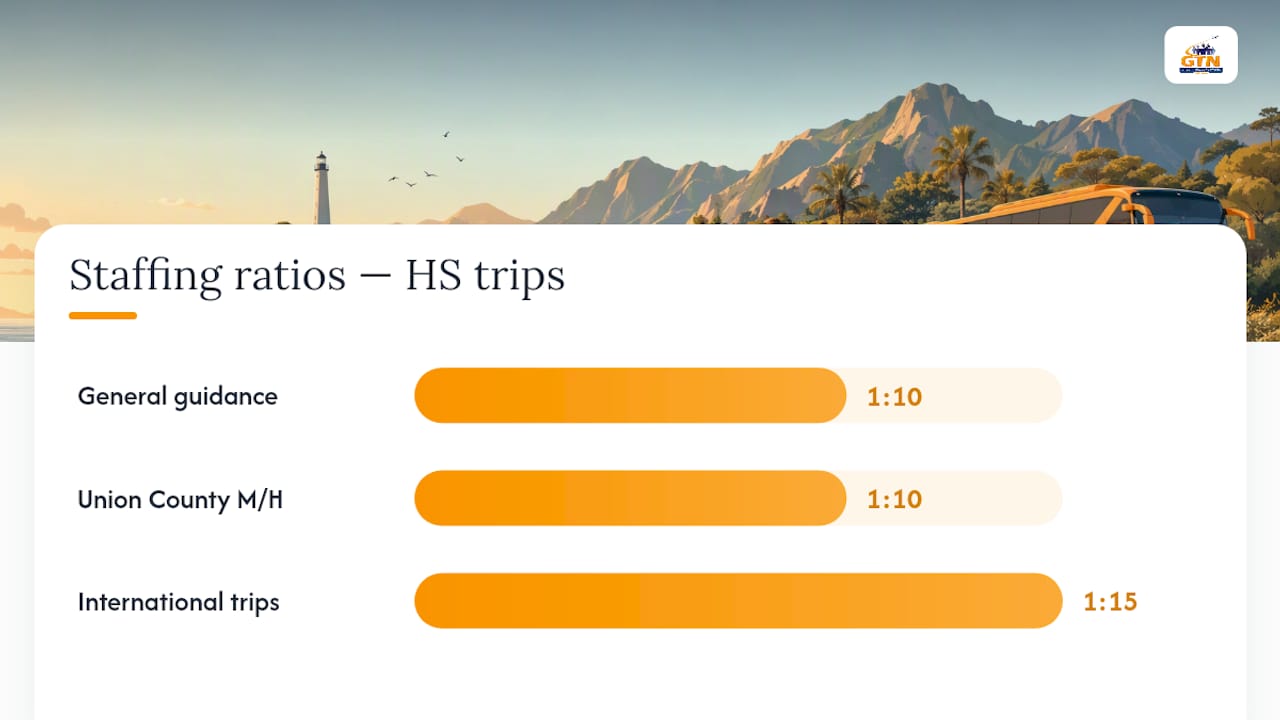
Most districts require roughly one adult for every 10 students, and many mandate at least two staff members on any trip regardless of group size, according to guidance from the Winters Joint Unified School District. Some districts get more granular. Union County Public Schools sets a 1:8 ratio for elementary trips with a quarter of chaperones required to be employees, a 1:10 ratio for middle and high school with 10% employee staffing, and a looser 1:15 ratio for international trips with its own staff percentage rules. Trips involving students with disabilities usually carry separate, tighter supervision requirements.
On compensation, the pattern across state guidance is consistent: extra remuneration beyond actual expenses is often prohibited outright. The Massachusetts State Ethics Commission restricts per-diem payments and stipends for public school staff, permitting only reimbursement of documented costs. The reasoning is straightforward: once a staff member profits from organizing or supervising a trip, especially one tied to a specific vendor, you have a conflict-of-interest problem regardless of intent.
Two categories worth separating in your own budget documents:
- Reimbursable expenses: transportation, lodging, meals, admission fees, and other costs a chaperone can document with a receipt.
- Stipends or per-diem pay: flat payments unrelated to actual spending, which many districts and ethics boards treat as prohibited compensation.
Funding Approaches That Actually Work
Once you accept that stipends are risky, the real question becomes how to cover chaperone costs without either violating policy or quietly shifting the burden onto families through a hidden line item — following practical group travel planning tips can help smooth this process.
Four approaches cover most situations:
- Build staff costs into per-student pricing. Divide the total chaperone expense (transportation, lodging, meals) across the traveling group so every family absorbs a small, disclosed share rather than one surprise fee.
- Draw from school, ASB, or booster funds. Many district policies route trip money through Associated Student Body accounts specifically so spending gets tracked and audited, per guidance from the Fremont Union High School District.
- Use grants or targeted fundraising. This keeps per-student cost down and avoids the appearance of families paying staff directly.
- Reimburse actual expenses only, with receipts and caps. This is the lowest-risk option and the one that survives an ethics review most easily.
Standard trip budgets typically include transportation, lodging, admissions, meals, staff costs, insurance, and a contingency line of 5% to 10%, based on planning guidance from K&S The Travel Crusaders. Don’t forget substitute teacher coverage back at school and background check fees for chaperones. Both belong in the same budget line as travel costs, not treated as afterthoughts.
Pro Tip: Decide your funding method before you announce the trip, not after. Families who learn about a chaperone fee two weeks before departure will assume something was hidden, even when nothing was.
The Approval and Documentation Checklist
Every dollar spent on chaperone travel should trace back to a specific approval and a specific piece of paper. Here’s the sequence that holds up under scrutiny:
- Get sign-off at the right level. Routine day trips typically need only principal approval; overnight or out-of-state trips usually require business office review and full board approval, per the Oxnard Union High School District.
- Submit early. Districts commonly require out-of-state or international trip requests two months ahead when district funds will cover staff expenses.
- Document everything. Keep itemized expense reports, ASB account records, and signed consent forms for every traveling adult.
- Confirm employment status. Volunteer chaperones and employee chaperones often fall under different insurance and liability rules, so the paperwork needs to distinguish between them.
- Publish selection criteria. Write down how chaperones get chosen before you choose them, so favoritism never becomes a fair question to ask.
- Disclose any staff benefit. If a chaperone’s trip is fully covered while others pay a share, that difference needs a paper trail and a policy citation.
Three Funding Models, With the Math Worked Out
Numbers make this easier to plan than principles alone. Here are three models built around a hypothetical 40 student trip with four required adult chaperones, based on a 1:10 ratio.
- Model A: Reimbursement only. Each chaperone submits receipts for mileage, meals, and lodging, capped at a preset amount, say $75 per day for meals and actual cost for lodging shared with another chaperone. No stipend changes hands; the district or ASB account simply pays back documented costs after the trip.
- Model B: Built into per-student pricing. If total chaperone costs run $3,200 for transportation, lodging, and meals across four adults on a three-day trip, dividing that across 40 students adds $80 to each student’s trip fee. This spreads the cost transparently and avoids any appearance of staff compensation, since the money funds the chaperone’s actual travel, not extra pay.
- Model C: Booster or grant-funded appreciation payment. Some booster clubs choose to fund a small, separate appreciation gift for chaperones, distinct from trip expenses and paid from booster funds rather than school district accounts. This carries real compliance caveats: it should never come from student trip fees, needs board or booster board approval, and should be disclosed as a gift rather than framed as compensation for services.
Most compliant trips end up blending Model A and Model B: reimburse what’s documented, and build the rest into the per-student price so nobody gets an unpleasant invoice after the fact. A detailed step-by-step school trip budget guide can help you run these calculations for your specific group size and destination.
Where Group Travel Network Fits Into Compliant Planning
Running these numbers manually for every trip gets tedious, and tedious is exactly when documentation gaps happen. A few resources make the compliance side easier without changing the underlying policy math:
- Dedicated trip coordinators who centralize registration and payments, so every family’s contribution and every chaperone’s coverage lives in one system instead of scattered spreadsheets.
- A school trip payment guide that breaks down what typically belongs in a per-student fee, useful when deciding how much of the chaperone cost to build in.
- Guidance on chaperone roles and staffing ratios to help you plan headcount before you plan the budget.
- Flexible payment plans and travel protection options that reduce the financial pressure on families when trip costs rise.
None of this replaces your district’s own approval process. It just removes the busywork around it.
How Stipends Interact With Teacher Pay and Contracts
Teacher contracts almost never mention chaperone stipends directly, and that gap is exactly where problems start. Base salary schedules cover instructional duties; anything beyond that, including supervising an overnight trip, technically falls outside the contracted workday unless your collective bargaining agreement specifically addresses extra duty pay.
Some districts and teacher associations have negotiated small extra-duty stipends for overnight or multi-day trip supervision, treated the same way as coaching or club advisor stipends: a fixed, board-approved amount tied to a specific role, not an open-ended payment. That distinction matters for compliance. A negotiated extra-duty stipend that appears in a collective bargaining agreement or board policy is fundamentally different from an informal payment a booster club or vendor hands a teacher directly.
If your district has no such provision, teachers who chaperone are typically volunteering their time beyond contract hours, with reimbursement covering their actual costs. That’s a legitimate model, but it should be stated plainly to staff before they agree to go, not discovered after the trip when a paycheck doesn’t reflect the extra days worked. Human resources and your teachers’ union representative should weigh in before any new stipend policy gets adopted, since it can set a precedent that applies to every future trip, not just the one currently being planned.
How Much Should a Stipend Actually Be?
Where extra-duty stipends do exist through collective bargaining, amounts tend to track other extra-duty pay scales already in place. A common benchmark is a flat daily rate, often in the same range as a coaching stipend per game or event, rather than an hourly wage that would balloon for a multi-day international trip.
Districts that allow any staff compensation beyond reimbursement usually cap it in one of three ways: a flat per-trip amount regardless of duration, a per-day rate with a maximum number of days, or a percentage of the teacher’s daily contracted rate. Whichever method your district uses, the amount should be set by board policy or bargaining agreement in advance, never decided case by case for a specific trip. Case-by-case decisions are precisely what invites the appearance of favoritism the ethics guidance warns against.
If your district has no stipend provision at all, don’t create one informally to solve a single trip’s staffing gap. Route the conversation through the same approval chain used for any compensation change, and treat the trip’s staffing costs as a reimbursement or per-student pricing question instead, exactly the models covered above. A one-off exception has a way of becoming an expectation for every trip that follows.
When to Start the Approval Process
Timelines vary by trip type, but the pattern across district guidelines is predictable. Routine, in-state day trips often move through principal approval within a couple of weeks. Overnight trips typically need three to six weeks for business office and administrative sign-off, partly to allow for insurance and transportation logistics.
Out-of-state and international trips take the longest. Districts commonly require submission to the superintendent and board at least two months before departure when district funds will pay for any staff travel expenses, per the Oxnard Union High School District’s field trip regulation. That window exists partly for budget verification and partly because board meetings run on fixed schedules, not on demand.
Build backward from your travel date. If departure is in April, an international trip needing board approval should hit the superintendent’s desk by February at the latest, with your budget, staffing plan, and chaperone list already finalized. Waiting until six weeks out to firm up chaperone funding is the single most common reason trips get delayed or scaled back at the last minute.
Do Teachers Pay Taxes on Travel Stipends?
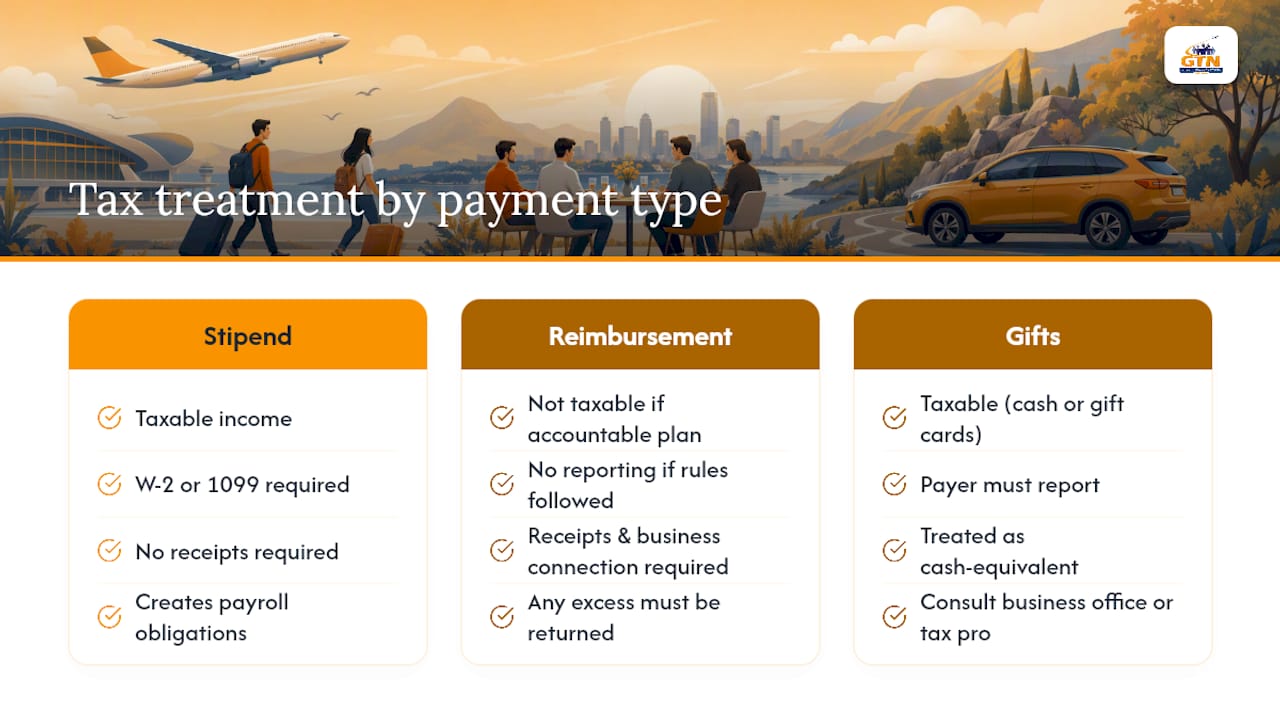
Any stipend paid to a teacher, as opposed to a reimbursement of documented expenses, is generally treated as taxable income by the IRS and should appear on the teacher’s W-2 or 1099. Reimbursements under an accountable plan, meaning the teacher submits receipts and doesn’t keep any excess, are typically not taxable.
This is one more reason reimbursement models are cleaner than stipend models beyond the ethics concerns already covered. A district that pays a flat $200 chaperone stipend has created taxable income and payroll reporting obligations. A district that reimburses $200 in documented meal and mileage receipts has not, assuming the accountable plan rules are followed: the expense must have a business connection, be substantiated with receipts, and any excess advance must be returned.
Booster club appreciation gifts, the kind mentioned in Model C above, carry their own tax wrinkle. Cash or cash-equivalent gifts (including gift cards) are considered taxable income regardless of amount or intent, according to standard IRS guidance on employee gifts. A district or booster club planning any kind of thank-you payment to chaperones should loop in the school’s business office or a tax professional before distributing anything, since the reporting obligation lands on the payer, not just the recipient.
Fairness and Transparency Should Drive Every Decision
Chaperone funding fights are rarely about money. They’re about families feeling blindsided or staff feeling used. Publish your cost breakdown and selection criteria before you need them, not after a parent asks a pointed question at back-to-school night. Favor reimbursement or a disclosed per-student fee over anything that looks like a quiet stipend, and keep every approval and expense report on file. A payment plan template or coordinator support won’t fix a bad policy, but it will keep a good one from collapsing under bad paperwork.
— Donovan
Group Travel Network: The Managed Alternative to DIY Budgeting
Building your own reimbursement models, tracking receipts, and chasing board approval deadlines works, but it takes real administrative hours away from actually running your program. Some travel agencies offer a service with a dedicated trip coordinator to handle registration, payment collection, and cost breakdowns to help document chaperone funding decisions accurately without manual spreadsheets.

This isn’t a replacement for your district’s approval process. It’s a way to walk into that approval process with a clean, itemized cost structure already built, flexible payment plans already set up for families, and travel protection options already on the table. For band directors and coaches juggling both the music or the roster and the budget, that’s hours back every trip cycle. If you’re planning a music, athletic, or academic trip this year, review the Performance Tours or Educational Endeavors pages to see how a coordinator-built itinerary and budget compares to what you’re assembling manually, and request a quote for your group’s specific dates.
Sources
- BP-AR 6153 School Sponsored Fieldtrip (WUSD)
- Mass
- Field Trip Administrative Guidelines (Union County Public Schools)
FAQ
Can Schools Legally Pay Teachers a Travel Stipend?
Most districts and state ethics commissions restrict flat stipends and permit only reimbursement of documented expenses, according to Massachusetts ethics guidance. Some districts allow negotiated extra-duty stipends through collective bargaining agreements, but that requires an explicit policy, not an informal arrangement.
What’s the Difference Between a Stipend and Reimbursement?
A stipend is a flat payment unrelated to actual spending, while reimbursement covers documented costs like transportation, lodging, and meals with receipts. Reimbursement under an accountable plan is generally not taxable; stipends usually are.
How Many Chaperones Does a School Trip Need?
Most districts require about one adult per 10 students, with a minimum of two staff members present regardless of group size, per field trip policy guidance. Ratios often tighten for elementary grades and loosen slightly for international trips, per Union County Public Schools.
How Far Ahead Should We Request Approval for a Trip?
Routine day trips often clear in a couple of weeks with principal approval, while out-of-state or international trips commonly need board approval at least two months before departure. Check your specific district calendar, since board meeting schedules vary.
Does Grouptravelnetwork Handle Chaperone Payment Logistics?
Grouptravelnetwork provides dedicated trip coordinators and payment plan tools that centralize family payments and cost breakdowns for a trip. Pricing for services like Performance Tours and Educational Endeavors is available by request through the site.
Recommended

Relax with our Student Travel Expertise .
We deliver stress-free student trips backed by an exceptional array of services you won’t find anywhere else:
- Stress-free, creative planning of customized itineraries
- Dedicated GTN Service host on every trip
- Extensive travel protection plan options
- Online, individual registration system
- Flexible payment plans and online payment options
- Bulk buyer discounts for great trips that cost less
Inclusion into #MyGTNFamily for life! (you don’t even have to remember our birthday!)
Spain
There is no place like Spain to offer a student performance opportunity or cultural student trip.
Myrtle Beach
All students love the beach! Especially a beach known for its 60 miles of pristine coastline.
Boston
Have your students experience colonial charm in the city that is considered the hub of New England.
London
Provide your student group with the “Royal” treatment! One of the world’s most recognized cities.
See What People Are Saying
“This was my first time using a company to plan our band trip. It was so easy working with Justin and Group Travel Network. We had to make several changes along the way, but they were accommodating changes and worked everything out for us. I would highly recommend using Group Travel Network.”
“What wonderful trip we had to NYC! Our group of 51 never missed a beat because of Group Travel Network and our wonderful guide, Tim. It was truly a theatre trip to remember! If you are looking for a travel company who really cares about the details, Group Travel Network is for you!”
“It has been my privilege to use Group Travel Network as the exclusive travel coordinator for my band for over 10 years. I can say, without doubt or hesitation, that GTN is, by far, the best travel company for student groups currently in existence. I have often said that I wouldn’t take my band across the street without GTN and that’s not far from the truth!”