


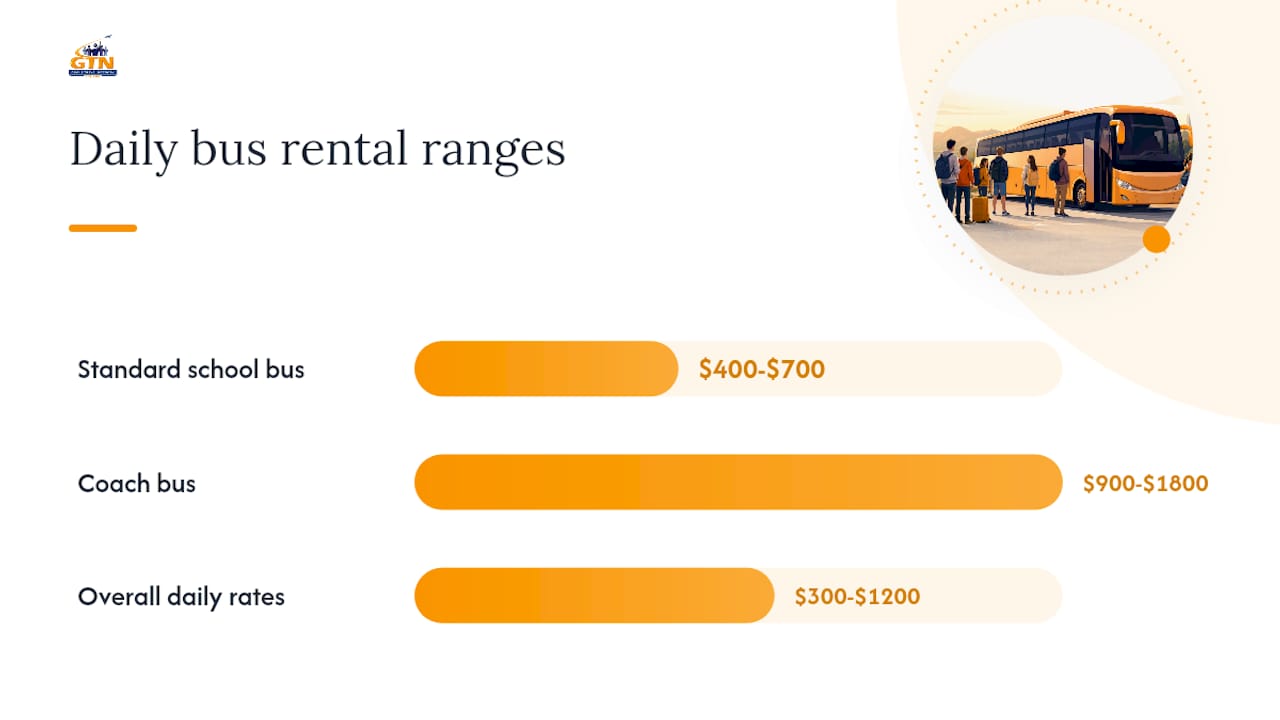
Expect to pay $55 to $125 per hour or $300 to $1,200 per day for a chartered bus, with the final number driven by three things: distance and mileage, the vehicle type (opens in a new tab) you book, and how far ahead you book it. A yellow school bus typically lands at the low end, while a full-size motorcoach with a restroom and reclining seats runs higher. Before you compare a single number, request itemized quotes from at least two operators and pull your district’s insurance and safety-documentation checklist. That single step prevents the two most common budgeting headaches: sticker shock on the final invoice and last-minute rejection during administrative approval.
- Hourly range: $55 to $125
- Daily range: $300 to $1,200 (regional and trip-length dependent)
- Top 3 cost drivers: mileage/distance, vehicle type, booking lead time
Quick fact: Multi-day trips typically add driver lodging and meal costs on top of the base rental rate, which is where many first-time coordinators get caught off guard.
Key Takeaways
Getting an accurate school group bus cost estimate depends on itemized quotes, correct vehicle sizing, and district documentation gathered before you compare prices.
| Point | Details |
|---|---|
| Know your range | Budget $55 to $125 per hour or $300 to $1,200 per day depending on vehicle type and region. |
| Size the vehicle correctly | One full-size bus usually beats two mini buses on per-student cost once headcount climbs. |
| Book 8 to 10 weeks out | Early booking avoids peak-season premiums and expands access to vetted operators. |
| Demand itemized quotes | Require tolls, gratuity, cleaning, and deadhead charges listed separately before comparing vendors. |
| Let Grouptravelnetwork manage it | Grouptravelnetwork coordinators handle itemized quotes, district documents, and flexible payment plans. |
Table of Contents
- How Charter Bus Companies Price School Group Bus Cost
- Sample Budget for a One-Day, 60-Student Trip
- When Should You Book to Avoid Peak Pricing?
- What Documentation Does Your District Require?
- Where Do Surprise Fees Come From?
- Why Most Bus Budgets Fail Before the Trip Even Starts
- Let Grouptravelnetwork Handle the Quote Comparison for You
- Sources
- FAQ
How Charter Bus Companies Price School Group Bus Cost
Charter operators don’t use one pricing model. Most combine an hourly rate with a daily minimum, then layer mileage charges on top for longer routes. Understanding which method your quote uses is the difference between an accurate budget and a surprise invoice.
- Hourly pricing applies mostly to short, local trips, like a same-day museum visit. Expect a minimum booking window (often 4 to 6 hours) even if your actual trip runs shorter.
- Daily pricing kicks in for full-day or multi-day trips and typically ranges from $400 to $700 for a standard school bus, or $900 to $1,800 for a coach (opens in a new tab) with amenities like restrooms and overhead storage.
- Mileage-based add-ons cover trips that cross regional lines, calculated from the operator’s garage to your destination and back, not just point to point.
Vehicle choice moves the number as much as distance does. A mini bus fits 20 to 30 passengers and costs less per hour, but if your group has 55 students, you need two mini buses instead of one full-size unit, which almost always costs more in total than a single larger vehicle. The math backs this up: per-student cost is usually lower when a group fills one full-size bus (opens in a new tab) rather than splitting across multiple smaller ones.
Two more line items to watch:
- Deadhead time: the miles and hours an operator spends driving from their garage to your pickup point, and back afterward. Some quotes bury this; others itemize it. Ask.
- Regional pricing gaps: urban markets like Chicago or Los Angeles run higher than rural routes, largely due to permit costs and traffic-related trip-time padding.
For a quick per-student estimate, use this formula: (bus rental + estimated fuel/mileage + tolls + gratuity) ÷ number of students = per-student cost. Run that math on every quote before you compare, since one operator’s “lower” hourly rate can hide a higher daily minimum.
Sample Budget for a One-Day, 60-Student Trip
Here’s a line-item budget for a typical single-day trip: two coach buses, roughly 120 miles round trip, six-hour rental window.
- Bus rental (2 full-size coaches, day rate): $1,600 ($800 each)
- Estimated mileage/fuel surcharge: $150
- Tolls and parking at destination: $60
- Driver gratuity (2 drivers, standard 15 to 20%): $240
- Contingency buffer (10% of subtotal): $205
Total trip cost: roughly $2,255
Divide that by 60 students and you land at about $37.60 per student. If your district or PTA covers a portion, that per-family number drops accordingly. A common approach: build the contingency line into the per-student price upfront, then refund any unused balance rather than sending a second collection request after the trip.
Quick fact: Adding a third bus for a larger group doesn’t scale costs proportionally. Once you clear the capacity of your existing buses, the incremental cost per student often drops, since fixed fees like driver gratuity and mileage surcharges get spread across more riders.
Upgrading from a standard school bus to a coach with restrooms and reclining seats can add $300 to $600 per vehicle per day. For a two-hour local trip, that upgrade rarely pays off. For a four-hour round trip with younger students, it often does. If you want a worksheet you can copy for your own numbers, Grouptravelnetwork’s step-by-step school trip budgeting guide (opens in a new tab) walks through the same math with blank fields.
When Should You Book to Avoid Peak Pricing?
Booking early is the single easiest lever you control. Requesting quotes 8 to 10 weeks before travel dates gives you access to a wider pool of vetted operators and avoids the premium pricing that comes with rushed, last-minute availability. Spring field trip season (March through May) and fall competition season for bands and athletic teams both compress operator availability fast.
A few negotiating angles worth raising before you sign anything:
- Ask about flexible pickup windows. Shifting departure by 30 minutes can avoid rush-hour surcharges in some markets.
- Consolidate pickup points into one or two locations instead of multiple stops across town.
- Ask whether multi-trip contracts (a spring trip plus a fall trip with the same operator) unlock a discount.
- Mention your school or nonprofit status directly. Some operators offer education-specific discounts that aren’t advertised upfront.
Pro Tip: Send your quote request to three or four operators the same day, with identical trip details. Side-by-side comparison only works when every vendor is pricing the exact same itinerary.
What Documentation Does Your District Require?
Most rejection headaches at the approval stage trace back to missing paperwork, not price. Districts generally want the same core set of proof points before they’ll sign off on a charter contract.
- Certificate of insurance (COI) naming the school district as an additional insured, matching your district’s specific coverage minimums.
- USDOT number for the operator, verifiable through FMCSA’s SAFER system.
- Safety rating confirmation showing the carrier isn’t flagged for out-of-service violations.
- Driver licensing and background-check confirmation, especially for trips involving overnight stays.
Before you submit anything to your district office, run through this quick sequence:
- Request the operator’s USDOT number and cross-check it on the FMCSA SAFER public database yourself, don’t just take their word for it.
- Confirm the COI language matches your district’s required minimum coverage exactly, not just “adequate insurance.”
- Get written confirmation of driver background-check status in the contract, not a verbal assurance.
- Establish a pre-trip handoff with the operator covering emergency contacts, on-bus behavior rules, and first-aid kit location.
For deeper safety context specific to student transport, Grouptravelnetwork’s guide to safe student bus travel (opens in a new tab) covers what to check beyond the paperwork.
Where Do Surprise Fees Come From?
Quotes often exclude auxiliary charges by default, which is exactly how a $2,000 estimate turns into a $2,400 invoice. The usual culprits: tolls, destination parking, cleaning fees for spilled snacks or muddy shoes, driver overtime if the trip runs long, driver lodging and meals on multi-day trips, deadhead mileage, and gratuity.
- Request a fully itemized quote that lists every possible charge, not a single bundled number.
- Ask the operator to cap overtime and cleaning fees in writing before you sign.
- Build a 10% contingency line into your budget from the start, as shown in the sample budget above.
Pro Tip: Ask specifically, “What’s NOT included in this quote?” Operators will usually answer that question more completely than “What’s included?”
Why Most Bus Budgets Fail Before the Trip Even Starts
The conventional advice, get three quotes and pick the cheapest, misses the actual failure point in most school trip budgets. Coordinators rarely lose money because they picked a slightly pricier operator. They lose money because they didn’t itemize the quote, so tolls, overtime, and cleaning fees showed up as surprises on the final bill. Or they submitted a COI that didn’t match the district’s insurance language, forcing a scramble two weeks before departure.
The fix isn’t finding a magic low price. It’s sequencing the process correctly: pull district documentation requirements first, request itemized (not bundled) quotes second, and only then compare numbers side by side. Skip that order and you’ll spend more time on rework than you saved chasing a cheaper hourly rate.
If there’s one number worth obsessing over, it’s per-student cost after every fee is included, not the headline bus rental figure. A $700 daily rate that hides $300 in deadhead and overtime costs more than an $850 rate that’s genuinely all-in.
Let Grouptravelnetwork Handle the Quote Comparison for You
Grouptravelnetwork is the alternative to chasing down individual operators and cross-checking paperwork yourself. Every trip gets a dedicated trip coordinator who pulls itemized quotes from vetted vendors, manages the insurance and USDOT documentation your district needs for approval, and flags hidden fees before they hit your invoice.

Beyond quote accuracy, Grouptravelnetwork offers flexible payment plans so families aren’t hit with one lump sum, plus travel protection options that cover the unexpected. That combination matters most for band directors and coaches juggling instrument storage, roster changes, and district sign-off deadlines all at once, not just a driver and a destination.
If you’re planning a trip for this school year, start with Grouptravelnetwork’s step-by-step group travel planning guide (opens in a new tab) to request a no-obligation cost estimate and get your district paperwork moving before peak season fills operator calendars.
Sources
- How Much Does It Cost to Rent a School Bus? Rates and Fees – LegalClarity (opens in a new tab)
- School Trip Bus Rentals & Shuttle Services | Buslane (opens in a new tab)
FAQ
How much does a school group bus cost per day?
Daily rates typically run $300 to $1,200, with standard school buses landing around $400 to $700 and coach buses with amenities running $900 to $1,800.
What’s the difference between hourly and daily bus rental pricing?
Hourly pricing suits short local trips and usually has a 4 to 6 hour minimum, while daily pricing applies to full-day or multi-day trips and often includes a mileage allowance.
What documents does a school district need to approve a charter bus?
Districts generally require a certificate of insurance naming the school as an additional insured, the operator’s USDOT number, a clean FMCSA safety rating, and confirmation of driver background checks.
How far in advance should we book a school bus for a field trip?
Booking 8 to 10 weeks ahead of peak travel season gives you access to more vetted operators and helps you avoid rushed, higher-priced last-minute bookings.
Can Grouptravelnetwork help lower our school group bus cost?
Grouptravelnetwork’s trip coordinators gather itemized quotes from multiple vetted operators and manage district paperwork, which helps you avoid hidden fees and rejected approvals that drive up total trip cost.
Recommended
- Group Transportation Logistics For Educational Trips In 2026 • Group Travel Network (opens in a new tab)
- How To Manage Group Travel Payments In 2026 • Group Travel Network (opens in a new tab)
- School Trip Payment Policy: 2026 Templates And Timelines (opens in a new tab)
- Student Bus Tours: Safe Educational Transportation Guide (opens in a new tab)