


TL;DR:
- Effective parent trip communication is a two-way process that builds trust and ensures safety during school trips. It involves timely, personalized updates using appropriate tools while complying with privacy laws to keep families informed and confident.
Parent trip communication is the structured, ongoing exchange of timely and accurate information between school trip coordinators and parents about every aspect of a student group trip. It covers safety protocols, itineraries, costs, supervision contacts, and emergency procedures. Done well, it replaces parental anxiety with confidence and turns a logistical challenge into a shared experience families actually support.
Table of Contents
- What is parent trip communication and why does it matter?
- Key objectives and benefits of communicating with parents about trips
- How to time and sequence your parent trip communication for best results
- How to personalize communication and build trust with parents
- Which tools and channels work best for parent trip updates?
- Legal and privacy considerations in parent trip communication
- Creating and distributing comprehensive trip itineraries and updates
- Feedback collection from parents post-trip to improve future communication
- Key Takeaways
- FAQ
What is parent trip communication and why does it matter?
At its core, parent trip communication is not a one-way broadcast. It is a tailored dialogue that keeps families informed, addresses their concerns, and builds the kind of trust that gets permission slips signed and students on the bus. For school administrators and trip coordinators, it is also a legal and ethical obligation.
Key components include:
- Trip details: dates, destination, costs, and transportation arrangements
- Safety protocols: supervision ratios, emergency contacts, and medical procedures
- Itinerary: a day-by-day schedule with locations and activity descriptions
- Expectations: student conduct, packing requirements, and chaperone roles
- Emergency procedures: who to call, when to call, and what silence means
Grouptravelnetwork’s approach to student group trips (opens in a new tab) treats parent communication as a foundation of every successful educational journey, not an afterthought.
Key objectives and benefits of communicating with parents about trips
Strong parent communication strategies serve multiple goals at once. Coordinators who get this right see fewer last-minute withdrawals, fewer panicked phone calls mid-trip, and smoother logistics overall.
- Informed consent: Parents who understand the trip purpose, risks, and supervision structure are far more likely to give genuine, confident permission.
- Reduced anxiety: Transparency about safety measures and supervisor contacts directly lowers parental worry before and during travel.
- Student readiness: When parents are engaged, students arrive better prepared, with the right gear, medications, and mindset.
- Legal compliance: Model Policies recommend notifying parents at least two weeks in advance and requiring written permission before any trip, covering itinerary, hazards, costs, and transportation details.
- Collaborative relationships: Parents who feel included become advocates, not obstacles.
How to time and sequence your parent trip communication for best results
Timing is where most coordinators stumble. Send everything at once and parents forget half of it. Wait too long and they feel blindsided. Trip coordinators advise timed, sequenced delivery with reminders to keep engagement high throughout the planning cycle.
A practical sequence looks like this:
- Initial announcement (8–12 weeks out): Share the destination, educational purpose, approximate cost, and a save-the-date. This builds excitement and gives families time to budget.
- Detailed information packet (4–6 weeks out): Distribute the full itinerary, supervision details, permission forms, and payment deadlines.
- Informational meeting or Q&A (3–4 weeks out): School district policies often allow parents to submit questions orally or in writing before departure, and holding a dedicated session addresses concerns before they become complaints.
- Pre-trip reminder (48–72 hours out): Confirm departure time, meeting location, packing reminders, and the emergency contact number.
- During-trip updates: Brief, scheduled check-ins via a designated channel keep parents calm without creating a flood of inbound calls.
- Post-trip follow-up: A thank-you message with highlights and a feedback request closes the loop.
Pro Tip: For international or extended trips, explicitly agree with parents on a “no news is good news” policy before departure. Communicating this expectation in advance prevents unnecessary alarm when updates are sparse.
How to personalize communication and build trust with parents

Generic mass emails do not build trust. Research from the Education Endowment Foundation confirms that two-way, audience-tailored communication is the standard for genuine parental engagement, not a nice extra.
Practical ways to personalize:
- Ask families their preferred communication channel at the start of the planning process: email, text, phone call, or printed letter.
- Translate key documents for families whose primary language is not English.
- Frame messages around benefits to the student, not just logistics for the school.
- Share real trip reflections (opens in a new tab) and photos from previous trips. Senior educators consistently find that peer voices and real experiences build parent confidence faster than any formal brochure.
- Designate a “parent ambassador,” ideally a family who traveled on a previous trip, to answer questions from hesitant parents.
A well-structured parent communication plan (opens in a new tab) gives coordinators a repeatable framework for personalizing outreach without reinventing the wheel each trip.
Which tools and channels work best for parent trip updates?
The biggest mistake coordinators make is letting critical information get buried in a group chat. Expert coordinators recommend separating logistics from social conversation using a clear communication architecture.
- Centralized digital portal or shared document: One single source of truth for the itinerary, emergency contacts, booking confirmations, and trip documents. Pin the link everywhere and train parents to check it first.
- Group messaging apps (WhatsApp, Remind, or similar): Reserve these for quick updates and real-time coordination, not for storing important information.
- Email newsletters: Best for formal communications, permission forms, and detailed information packets that parents need to read carefully.
- Phone calls: The University of Minnesota Extension (opens in a new tab) notes that personal contact, including phone calls and direct messages, is the most effective strategy for reaching uninvolved or hesitant families.
- In-person meetings: Nothing replaces a face-to-face Q&A for building confidence before a major trip.
- Multilingual support: For groups with diverse language backgrounds, structured communication systems with written decision logs and live translation support minimize confusion and keep every family included.
Legal and privacy considerations in parent trip communication
Every communication you send about a school trip carries legal weight. Written permission is required before any student participates in a field trip or off-campus activity. Beyond consent forms, coordinators must handle parent contact information, student medical records, and trip documents in compliance with FERPA (the Family Educational Rights and Privacy Act), which governs how schools collect, store, and share student data.
Avoid sharing student names, photos, or personal details in open group chats or public social media posts without explicit written consent. Store all signed permission forms and communication records in a secure, accessible location. When using third-party apps or platforms for trip updates, verify that they meet your district’s data privacy standards before distributing them to families.
Creating and distributing comprehensive trip itineraries and updates
A strong itinerary does more than list activities. It answers every question a parent might ask at 11 PM the night before departure. Include the destination address, check-in and check-out times, day-by-day schedule with locations, supervisor names and cell numbers, transportation details, and the local emergency number.
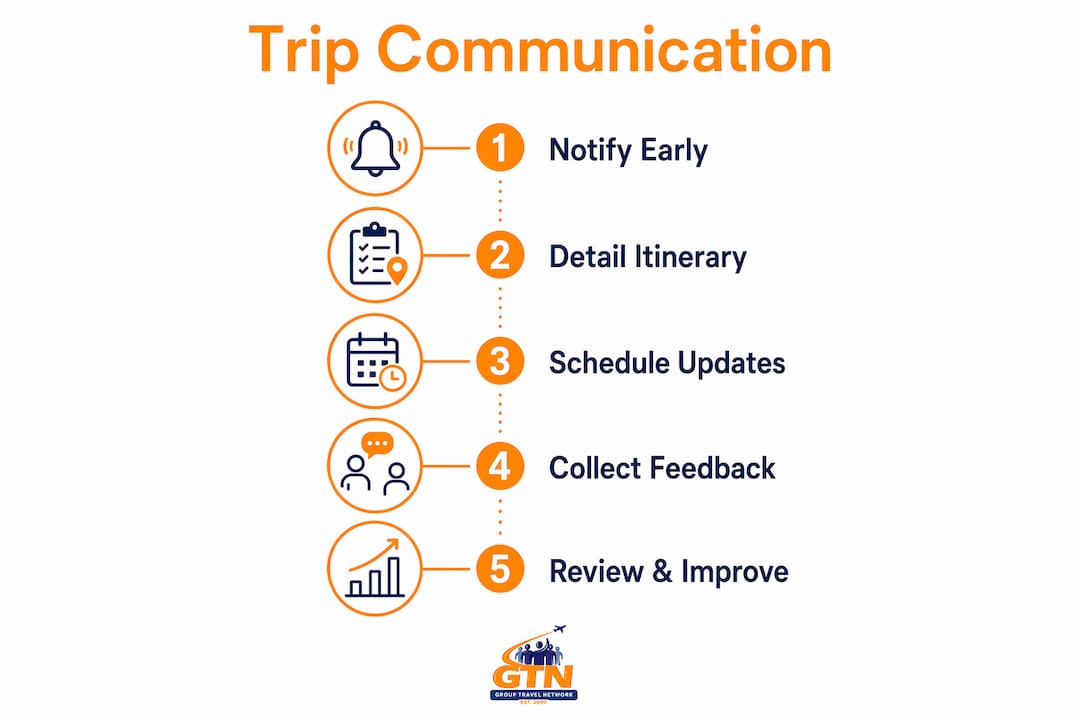
Distribute the itinerary in at least two formats: a digital version parents can access on their phones and a printed copy sent home with students. For school group travel (opens in a new tab), Grouptravelnetwork provides dedicated trip coordinators who help build and distribute these documents so nothing gets missed. Perform a final check 48–72 hours before departure to confirm all details are current and every family has access.
Feedback collection from parents post-trip to improve future communication
The trip is over, but the communication cycle is not. A short post-trip survey sent within a week of return captures honest impressions while the experience is fresh. Ask specifically about communication quality: Was the timing right? Were updates clear? What would parents want more of next time?
Use survey tools like Google Forms or a simple email questionnaire. Share a summary of the feedback with your team and, where appropriate, with parents themselves. Showing families that their input shapes future trips is one of the most direct ways to build long-term trust and increase participation year over year.
Grouptravelnetwork works with school administrators and trip coordinators to plan student group trips (opens in a new tab) that include built-in communication frameworks, dedicated coordinator support, and flexible payment options for families. If you are planning a 2026 educational trip and want expert guidance from start to finish, Grouptravelnetwork is ready to help.

Key Takeaways
Effective parent trip communication is a structured, two-way dialogue that builds trust, satisfies legal requirements, and keeps every family informed from the first announcement through post-trip feedback.
| Point | Details |
|---|---|
| Start communication early | Notify parents at least two weeks in advance, covering itinerary, costs, hazards, and supervision contacts. |
| Sequence your messages | Follow a timed cycle: announcement, information packet, Q&A meeting, pre-trip reminder, during-trip updates, and post-trip follow-up. |
| Separate logistics from chat | Use a centralized document as the single source of truth; reserve group messaging apps for quick updates only. |
| Personalize for every family | Ask for preferred channels and languages, and share real trip reflections to build confidence faster than formal materials can. |
| Close the loop post-trip | Collect parent feedback within one week of return and use it to improve communication on the next trip. |
FAQ
What is parent trip communication in a school context?
Parent trip communication is the structured exchange of information between school trip coordinators and families covering trip details, safety protocols, itineraries, and emergency procedures. Its purpose is to build transparency and trust throughout the entire trip planning and travel process.
How far in advance should coordinators notify parents about a school trip?
Model Policies recommend notifying parents at least two weeks before any field trip or off-campus activity, with written permission required before a student can participate.
What should a school trip itinerary include for parents?
A complete itinerary should cover the day-by-day schedule, destination addresses, supervisor names and contact numbers, transportation details, and the local emergency number, distributed in both digital and printed formats.
How do you handle parent communication during the trip itself?
Use a designated channel for brief, scheduled updates and establish a “no news is good news” policy for extended or international trips, communicated clearly to parents before departure to prevent unnecessary concern.
What is the best way to collect parent feedback after a school trip?
Send a short survey via Google Forms or email within one week of the trip’s return, asking specifically about communication timing, clarity, and what parents would want improved for future trips.
Recommended
- How To Organize School Tours: 2026 Planning Guide • Group Travel Network (opens in a new tab)
- Team Travel Coordination Tips For Schools In 2026 • Group Travel Network (opens in a new tab)
- Student Educational Travel: Ultimate 2025 Guide For Schools (opens in a new tab)
- Field Trip Organization Tips: A School Administrator’s Guide • Group Travel Network (opens in a new tab)