


TL;DR:
- Youth group travel planning in 2026 involves managing logistics, safety, and education to ensure meaningful experiences. It requires early destination selection, document checks, and safety protocols aligned with student needs and safety standards. Using human verification, pre-departure education, and flexibility enhances safety, engagement, and overall trip success.
Youth group travel planning is the process of organizing educational, safe, and memorable travel experiences for student groups by managing logistics, selecting destinations, and meeting safety protocols. For educators and youth leaders, 2026 brings both new opportunities and new responsibilities. Passport validity rules, emerging digital tools, and shifting student expectations all demand a more structured approach than ever before. Grouptravelnetwork specializes in exactly this work, supporting schools, bands, and youth organizations with customized itineraries, dedicated trip coordinators, and comprehensive travel protection. This guide covers every major decision point, from destination selection to pre-departure curriculum, so you can lead your group with confidence.
What does youth group travel planning in 2026 actually involve?
Youth group travel planning in 2026 covers far more than booking flights and hotels. It requires aligning educational goals with destination choices, managing group logistics across multiple vendors, and building safety protocols that protect every student. The industry term for this work is educational group travel, and it sits at the intersection of experiential learning and institutional risk management.

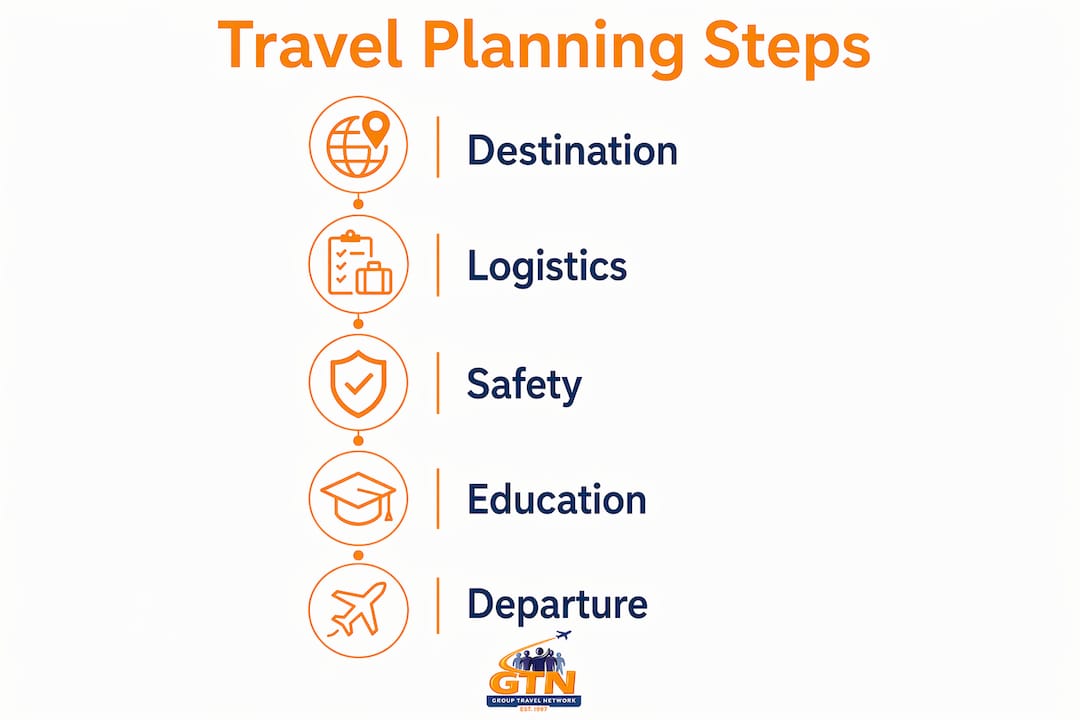
The core decisions fall into three categories: destination selection, logistical coordination, and safety planning. Each category connects to the others. A destination that lacks reliable medical facilities, for example, changes your entire risk management approach. A group of 35 students requires different dining and transportation arrangements than a group of 12. Getting these decisions right early saves significant time and money later.
Grouptravelnetwork positions itself as a full-service partner for this process, offering customized itinerary support (opens in a new tab) and vendor coordination so educators can focus on the educational mission rather than the operational details.
How do you choose the right destinations for student groups?
Destination selection for youth groups depends on four criteria: safety, accessibility, cultural relevance, and educational alignment with your curriculum. A history class benefits most from destinations like Washington D.C., Rome, or Athens. A performing arts group gains more from New York City or Vienna. Science programs often thrive in destinations with strong natural or research environments, such as Costa Rica or Iceland.
Popular youth travel destinations in 2026 (opens in a new tab) include:
- Washington D.C. for American history, government, and civic education
- New York City for performing arts, cultural diversity, and media studies
- Costa Rica for environmental science, biodiversity, and sustainability programs
- Rome and Athens for classical history, art, and architecture
- London for literature, theater, and British history
- Tokyo for technology, culture, and global studies programs
Each destination carries different logistical demands. International destinations require passport checks well in advance. Most countries require passports (opens in a new tab) valid at least six months beyond the planned departure date. That requirement alone means educators planning spring trips should begin document checks no later than the previous fall.
| Destination | Best curriculum fit | Key logistical note |
|---|---|---|
| Washington D.C. | Civics, history, government | Domestic travel, no passport required |
| Rome / Athens | Classical history, art | Passport + Schengen ETIAS required |
| Costa Rica | Environmental science | Passport, health and vaccination checks |
| New York City | Performing arts, media | Domestic, high group activity options |
| London | Literature, theater | Passport, UK entry requirements |
Pro Tip: Book destination-specific guided experiences at least four months out. Popular sites like the Colosseum or the U.S. Capitol fill group slots quickly, and last-minute availability is rare.
What are the logistical essentials for planning youth group trips?
Trip length is the first logistical variable to lock down. International high school programs (opens in a new tab) work best at 7–10 days. Trips shorter than one week rarely give students enough time to move past disorientation and engage meaningfully. Trips longer than 10 days require significantly more pre-departure preparation and parental coordination.
Group size shapes nearly every other logistical decision. Groups of 30 or more (opens in a new tab) require buffet-style dining and standardized itineraries to keep schedules on track. Smaller groups under 15 allow more personalized, host-led experiences and greater flexibility in daily programming. Knowing your group size early lets you negotiate better rates with hotels and activity vendors.
Transportation logistics require specific attention at airports. Pre-booking private transfers or dedicated motorcoach transport is the standard approach for maintaining group cohesion and safety on arrival. Relying on taxis at an unfamiliar international airport creates real risks: overcharging, vehicle shortages, and the possibility of students being separated from the group.
The key logistical steps, in order, are:
- Confirm trip dates and length (target 7–10 days for international trips)
- Verify passport validity for every student and chaperone
- Submit visa or pre-screening applications (such as ETIAS for Schengen countries) early
- Book group airport transfers before departure
- Confirm group size and communicate it to all vendors
- Finalize dining arrangements based on group size
- Distribute packing lists and health documentation requests to families
Pro Tip: Use a shared digital project management tool, such as Google Sheets or a dedicated trip planning platform, to track each student’s document status. A single missing passport can delay the entire group.
How do you manage safety and risk for youth group travel?
Safety planning for youth groups starts with human verification, not technology. AI and digital planning tools (opens in a new tab) now handle much of the itinerary creation and compliance tracking, but human-led verification of operator credentials and safety protocols remains the most critical step. No app replaces a direct phone call to confirm that a vendor holds proper licensing and insurance.
Payment planning is a specific safety issue that many educators overlook. Digital wallets like Apple Pay and Google Pay are widely accepted in most destinations, but physical cash reserves are non-negotiable for emergencies. Network outages, cash-only vendors, and card reader failures happen regularly in international travel. Seasoned travel planners recommend carrying multiple payment methods and a designated emergency cash fund for the group.
“Flexibility during the trip is essential. Planners should prepare for unavoidable changes without losing sight of educational goals.” This principle applies directly to safety: build buffer time into every day so that a delayed bus or a closed attraction does not cascade into a crisis.
Health and dietary management requires a centralized record system. Collect allergy information, prescription details, and emergency contacts from every family before departure. Share this information with chaperones and, where appropriate, with local guides and hotel staff.
Behavior expectations and student autonomy need to be set in writing before the trip. Graduated autonomy gives students supervised independence within predefined boundaries. This approach builds confidence and reduces behavioral incidents. A practical example: allow small groups of students to explore a market independently for 45 minutes, with a clear meeting point and check-in protocol.
Key safety checklist items include:
- Verify operator credentials and insurance directly
- Carry emergency cash alongside digital payment methods
- Centralize all student health and dietary records
- Set written behavior expectations before departure
- Plan graduated autonomy activities with clear boundaries
- Confirm emergency contact protocols with all chaperones
How can pre-departure education and technology improve the trip?
Pre-departure preparation works best when treated as a formal curriculum unit rather than a brief orientation session. Students who study the destination’s history, language basics, and cultural norms before they arrive engage more deeply once they get there. A history class visiting Rome, for example, benefits from spending two to three weeks on Roman history in the classroom before the trip begins. The trip then becomes a capstone experience rather than a field trip.
Technology supports this preparation in practical ways. The steps below reflect current best practice for integrating digital tools into youth group travel:
- Use AI-assisted itinerary tools to draft daily schedules and identify potential conflicts
- Build a shared digital folder with all student health records, consent forms, and emergency contacts
- Set up a group communication channel (such as a private group chat or school-approved app) for real-time updates during the trip
- Schedule two pre-departure team meetings: one for chaperones and one for students and families
- Conduct a document audit 60 days before departure to catch passport or visa issues early
The table below maps planning milestones to recommended timelines:
| Milestone | Recommended timing |
|---|---|
| Destination confirmed | 12+ months before departure |
| Passport and visa audit | 8–10 months before departure |
| Pre-departure curriculum unit begins | 6–8 weeks before departure |
| Chaperone briefing meeting | 4 weeks before departure |
| Student and family information night | 3 weeks before departure |
| Final document and health record check | 1 week before departure |
Common pitfalls at this stage include waiting too long to collect health records, underestimating visa processing times, and skipping the student orientation meeting. Each of these errors creates last-minute pressure that affects the entire group. Grouptravelnetwork’s educational trip planning resources (opens in a new tab) include planning timelines and checklists designed specifically for school administrators and band directors managing these milestones.
Key Takeaways
Effective youth group travel planning in 2026 requires locking down logistics, safety protocols, and pre-departure education well before departure day arrives.
| Point | Details |
|---|---|
| Trip length matters | International high school trips work best at 7–10 days for meaningful engagement. |
| Group size drives logistics | Groups of 30+ need standardized dining and itineraries; smaller groups allow more flexibility. |
| Pre-book all transfers | Dedicated motorcoach or private transfers prevent safety risks at international airports. |
| Carry cash alongside digital payments | Physical currency covers emergencies when networks fail or vendors are cash-only. |
| Treat pre-departure as curriculum | A formal classroom unit before the trip significantly improves student engagement and learning outcomes. |
What I’ve learned after years of watching youth trips succeed and fail
The most common mistake I see educators make is treating the trip as the whole experience. The trip is actually the final exam. Everything that happens before departure, the classroom preparation, the document audits, the chaperone briefings, determines whether students arrive ready to learn or arrive confused and disengaged.
The second mistake is over-relying on technology for safety verification. Digital tools are genuinely useful for itinerary management and compliance tracking. But I have seen groups arrive at a destination only to find that a vendor’s online profile was outdated and the actual service did not match what was booked. A phone call or email confirmation from a human being, not an automated system, is still the most reliable verification method.
The third thing I would tell any educator planning a group trip: build more flexibility into your schedule than you think you need. Not because things will go wrong, but because the best moments on youth trips are almost always unplanned. A street musician in Rome, an unexpected conversation with a local guide, a spontaneous detour through a neighborhood market. These are the moments students remember 20 years later. A schedule packed to the minute leaves no room for them.
Finally, graduated autonomy is not a risk. It is the point. Students who are given supervised independence within safe boundaries come home more confident, more curious, and more capable. That outcome is worth planning for deliberately.
— Donovan
Grouptravelnetwork’s resources for your next group trip
Planning a student group trip involves dozens of moving parts across months of preparation. Grouptravelnetwork works directly with school administrators, band directors, and youth leaders to manage that complexity through dedicated trip coordinators, flexible payment plans, and travel protection options built for educational groups.

Whether you are organizing a first international trip or managing a returning performance tour group, Grouptravelnetwork’s student educational travel guide (opens in a new tab) covers the full planning process from destination selection through post-trip follow-up. For groups with specific performance or cultural goals, the student group trips page (opens in a new tab) offers curated itinerary options with built-in educational alignment. Contact the Grouptravelnetwork team directly to discuss a customized plan for your group’s goals, timeline, and budget.
FAQ
What is the ideal length for an international youth group trip?
International high school trips work best at 7–10 days. Shorter trips do not give students enough time to adjust; longer trips require significantly more preparation.
How early should educators start planning a youth group trip?
Start at least 12 months before departure for international trips. Passport audits, visa applications, and vendor bookings all require lead time that most educators underestimate.
What payment methods should youth group leaders carry?
Carry both digital wallets and physical cash. Digital payments cover most transactions, but cash reserves protect the group during network outages or at cash-only vendors.
How does group size affect youth trip planning?
Groups of 30 or more require buffet dining and standardized schedules. Smaller groups under 15 allow personalized experiences and more flexible daily programming.
Why is pre-departure classroom preparation important?
Treating pre-departure preparation as a formal curriculum unit improves student engagement and turns the trip into a capstone learning experience rather than a standalone event.
Recommended
- Educational Group Trip Guide: Expert Planning For Schools • Group Travel Network (opens in a new tab)
- Group Travel Agencies: Complete 2025 Guide For Excellence (opens in a new tab)
- Youth Tour Essentials: Age-Appropriate Educational Journeys (opens in a new tab)
- Nonprofit Group Trip Guide For Youth Leaders 2026 • Group Travel Network (opens in a new tab)