

April 30, 2026
How to plan safe and impactful student group travel

TL;DR:
- Student travel is a mainstream educational practice involving millions of students annually with significant economic impact.
- Proper safety, compliance, and risk management frameworks, like those from SYTA, ensure safe and quality trips.
- Well-planned trips foster student growth, resilience, and community building beyond mere logistics.
Student group travel represents one of the most powerful tools in an educator’s toolkit, yet it’s also one of the most misunderstood. Many administrators assume the logistics are too complex, the risks too high, or the payoff too uncertain. The reality? U.S. tour operators alone handle over 800,000 students annually with direct spending exceeding $5.6 billion, and schools that follow proven planning frameworks consistently deliver safe, memorable, and educationally rich experiences for their students.
Table of Contents
- The modern landscape of student travel
- Organizing safe, compliant student travel: Key frameworks and standards
- Risk management essentials: Preventing problems before they arise
- Step-by-step guide: Planning and preparing for your next student trip
- The real opportunity: Why student travel is more than logistics and liability
- Get expert support for your next student group travel experience
- Frequently asked questions
Key Takeaways
| Point | Details |
|---|---|
| Know group sizes | Domestic trips average 65 students while international groups average 43, impacting how schools plan supervision and logistics. |
| Follow safety frameworks | Use trusted standards and ratios, like SYTA certification and proper chaperone assignments, to safeguard every trip. |
| Prevent risk proactively | Assess and rank travel risks before departure, prioritizing strong prevention and stakeholder communication. |
| Plan with a checklist | Structured pre-trip steps—like sharing details and securing insurance—are essential for smooth and safe travel. |
| Pursue learning outcomes | Student travel is more than logistics when it’s designed for engagement, leadership, and lasting impact. |
The modern landscape of student travel
To understand how to organize meaningful travel experiences, it’s essential to grasp the scale and typical formats of modern student travel. This isn’t a niche activity reserved for elite schools or well-funded districts. It’s a mainstream part of American education, touching millions of students every year across every grade level and subject area.
Group sizes and participation trends
One of the first things coordinators want to know is how their planned trips compare to what’s typical. According to industry data, domestic student groups average 65 students per trip, while international trips run smaller at an average of 43 students. That difference matters for budgeting, logistics, and chaperone planning.
Frequency of travel is equally telling. U.S. teachers organize an average of 1.7 trips per year for a combined total of roughly 60 students, and about 28% of students participate in multiple trips per year. These are not one-off events. For many schools, educational travel is a repeating, structured part of the academic calendar.
“Educational travel is not a luxury add-on. For tens of thousands of schools, it’s a core strategy for learning beyond the classroom.”
The economic footprint of student travel
Understanding the economic weight of student travel matters for two reasons. First, it signals that robust infrastructure exists to support your trips: vendors, operators, safety systems, and specialized expertise. Second, it reinforces that you are not starting from scratch. You are entering a well-developed ecosystem.
Here’s a snapshot of the industry’s key numbers:
| Metric | Data |
|---|---|
| U.S. student travel direct spend | Minimum $5.6 billion annually |
| Students handled by tour operators | 800,000+ per year |
| Average domestic group size | 65 students |
| Average international group size | 43 students |
| Average trips organized per teacher | 1.7 per year |
| Students taking multiple trips per year | 28% |
Exploring the benefits of student group travel helps you make the case internally, whether you are presenting to a school board or recruiting families to participate. The numbers above make a compelling argument that this industry has the depth, expertise, and scale to support your program reliably.
Organizing safe, compliant student travel: Key frameworks and standards
With the scale and importance established, let’s examine how schools maintain safety, quality, and regulatory compliance. This is where many first-time trip coordinators feel overwhelmed, but the frameworks are well-established and entirely manageable once you understand the structure.
The role of SYTA and professional certification
The Student & Youth Travel Association (SYTA) is the leading professional body for student travel providers in North America. SYTA establishes quality and safety standards, and certified members must meet strict benchmarks for competence, ethical conduct, and operational integrity. Choosing a SYTA-certified operator is not just a best practice. It’s one of the most reliable filters you have when evaluating vendors.
When you work with certified providers, you gain access to operators who have been vetted, trained, and held accountable for outcomes. That accountability is especially important for school administrators who bear responsibility for student welfare.
Chaperone ratios: What the standards actually require
One of the most consistent questions coordinators ask is about chaperone ratios. Requirements vary by trip type, destination, and district policy, but there are clear benchmarks to guide your planning.
For foreign travel specifically, official administrative procedures require a 1:5 ratio, meaning one chaperone for every five students. Equally important, at least half of all chaperones must be school staff members rather than parent volunteers. This ensures that trained adults with knowledge of school policies and student needs are always present.
School-led vs. operator-organized travel: A practical comparison
There are two primary models for running student trips. Each has real advantages depending on your school’s capacity, budget, and trip complexity.
| Factor | School-led trips | Operator-organized trips |
|---|---|---|
| Complexity handled | Simple, local or domestic | Complex, multi-destination or international |
| Vendor coordination | Managed internally | Handled by operator |
| Chaperone training support | School’s responsibility | Often provided by operator |
| Regulatory compliance support | School must navigate alone | Operator provides guidance |
| Cost control | Higher flexibility | Bulk purchasing power |
| Emergency support | Limited | Dedicated 24/7 support typical |
Here’s a step-by-step approach for evaluating providers:
- Confirm SYTA certification or equivalent professional membership.
- Request references from schools of similar size and trip complexity.
- Review their emergency protocols and insurance minimums.
- Verify staff training credentials for guides and support personnel.
- Ask how they handle medical situations, missing students, or itinerary disruptions.
Pro Tip: When coordinating safe school trips, always ask potential operators for their incident response rate and how many of their trips have required emergency interventions. A low incident rate, combined with a clear response process, tells you more than any brochure.
Reviewing the student tour group advantages of working with specialized operators can help you build a stronger internal proposal when seeking approval from district leadership.
Risk management essentials: Preventing problems before they arise
Knowing safety standards is only the beginning. Risk management puts these standards into practice and safeguards every trip from the planning stage through the final day of travel. This is where proactive coordinators separate themselves from reactive ones.
The risk matrix approach
Risk management for student travel uses a structured method called a risk assessment matrix. It works by scoring each risk on consequence and likelihood on a scale of 1 to 5. You multiply those scores to get a priority rating. A health emergency in a remote area might score 5 on consequence and 2 on likelihood, giving it a priority score of 10, which ranks it higher than, say, lost luggage scoring 2 on consequence and 3 on likelihood for a score of 6.
Here’s how a basic risk matrix might look for a student trip:
| Risk | Consequence (1-5) | Likelihood (1-5) | Priority score |
|---|---|---|---|
| Medical emergency abroad | 5 | 2 | 10 |
| Passport or document loss | 3 | 3 | 9 |
| Weather disruption | 3 | 4 | 12 |
| Student behavior incident | 3 | 3 | 9 |
| Vendor cancellation | 4 | 2 | 8 |
| Lost luggage | 2 | 3 | 6 |
High priority scores demand more detailed mitigation plans, more thorough communication with parents, and more specific training for chaperones.
Prevention is the priority
Strong risk management programs prioritize prevention over crisis response. That means proactively sharing information, thoroughly vetting all vendors and guides, and training staff before departure rather than relying on improvised responses during the trip.
Key prevention measures every coordinator should build into their process:
- Distribute detailed itineraries to all parents, administrators, and chaperones well in advance.
- Vet every guide, driver, and accommodation vendor through background checks and reference calls.
- Conduct a pre-trip orientation for chaperones covering emergency procedures, communication protocols, and student behavioral expectations.
- Map out each stakeholder’s role in the event of common risk scenarios.
- Create a single communication channel for emergencies so information doesn’t fragment.
Pro Tip: When preparing and planning group trips, use a stakeholder risk diagram. Simply draw out every person or entity connected to your trip, from the charter bus driver to the hotel concierge, and identify what risks each one introduces. This visual map often reveals gaps that a checklist alone would miss.
Step-by-step guide: Planning and preparing for your next student trip
Effective planning brings policies and best practices to life. Here’s how to cover every detail, every time, from the moment a trip is approved through the final boarding call.
The pre-trip planning workflow
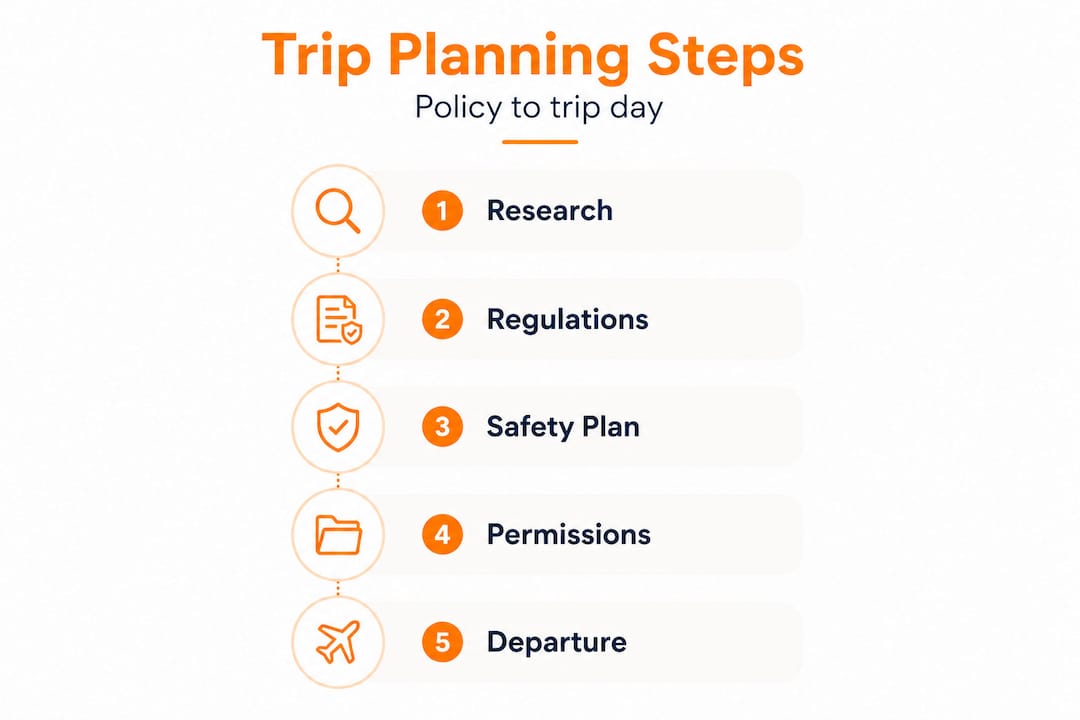
Think of trip preparation in four phases: research, administration, logistics, and final readiness. Working through each phase in sequence prevents the overlap and last-minute scrambles that cause problems.
Phase 1: Research and approvals
- Research U.S. Department of State travel advisories for all destination countries or regions.
- Identify all required permissions including parent consent forms, district approvals, and school board sign-offs.
- Select and confirm a SYTA-certified or equivalent qualified operator if using a third party.
- Lock in destination, dates, and a preliminary budget.
Phase 2: Administrative and compliance tasks
- Secure travel insurance covering medical emergencies, trip cancellation, and student-specific risks.
- Register with the STEP program (Smart Traveler Enrollment Program through the State Department) for international trips.
- Collect all student health documentation, allergy information, and emergency contact details.
- Confirm chaperone assignments and verify they meet the required 1:5 ratio with adequate school staff representation.
Phase 3: Communication and logistics
- Share the full itinerary with all participants, parents, chaperones, and school administration.
- Brief all chaperones in a dedicated training session covering emergency protocols.
- Coordinate all vendor confirmations, including transport, accommodations, and activity providers.
- Establish a clear technology policy and identify cyber-safe communication tools for student and chaperone use.
Phase 4: Final readiness checks
- Conduct a final headcount and document verification review 48 hours before departure.
- Confirm all emergency contact lists are current and accessible offline.
- Debrief with chaperones one final time to confirm roles and responsibilities.
This workflow aligns with what travel safety experts recommend as core pre-trip safety steps for any student travel program. Following each stage deliberately keeps your group protected and your administration confident.
Pro Tip: Build a shared digital document accessible to all chaperones that includes emergency contacts, student health notes, insurance policy numbers, and the local embassy address for international trips. Require every chaperone to download an offline version before departure so the information remains accessible without internet.
Your group trip planning guide for schools can serve as an additional reference as you build your own internal system.
The real opportunity: Why student travel is more than logistics and liability
Here’s a perspective that often gets buried under safety checklists and compliance paperwork. The best student travel programs are not the ones that merely avoid disaster. They are the ones that actively engineer transformative moments.
There’s a meaningful distinction in how schools and operators think about travel. Teachers tend to focus on simpler domestic trips, while tour operators take on complex international and multi-destination itineraries averaging 3.6 destination stops compared to 2.9 for teacher-led trips. More striking, 68% of operators predict demand growth in student travel. Students and families increasingly want richer, more customized experiences rather than standard field trip formats.
That shift in expectations is your opportunity.
Schools that treat travel purely as a compliance exercise miss the deeper value. Travel builds student agency. It teaches decision-making in real-world contexts, fosters resilience when plans change, and creates shared experiences that strengthen school community in ways that no classroom activity can replicate. The student who navigates a foreign transit system, communicates with a local vendor, or performs in front of an international audience returns to school with something intangible but genuinely powerful.
Our experience tells us that the schools with the strongest travel programs share one trait: they think about outcomes as much as operations. They ask not just “is this trip safe?” but “what will students carry with them from this experience five years from now?” That question changes how you select destinations, how you design itineraries, and how you debrief with students afterward.
The logistics and the learning are not separate concerns. Done well, they reinforce each other. A well-organized trip is a confident, engaged trip, and that confidence creates the conditions for real growth. Building community through travel is not a bonus outcome. For many students, it’s the most lasting one.
Get expert support for your next student group travel experience
Planning a student trip that checks every safety box while still delivering a genuinely memorable educational experience is a significant undertaking. You don’t have to manage it alone.

Group Travel Network specializes in creating student group travel experiences that handle the complexity so you can focus on the educational mission. From customized itineraries and vendor partnerships to dedicated trip coordinators and flexible payment plans, the platform is built specifically for school administrators, band directors, and educational event organizers who need organized, stress-free travel support. Whether you’re starting with a step-by-step travel planning approach or need a complete service package, the group trip planning guide offers practical next steps tailored to your group’s needs. Explore your options and take the first step toward your next great student trip.
Frequently asked questions
What are best practices for chaperoning student travel?
Best practices include maintaining the required 1:5 chaperone-to-student ratio for international trips, ensuring at least half of chaperones are certified school staff, and conducting thorough pre-trip briefings covering safety protocols, communication plans, and behavioral expectations.
How do schools mitigate risk on student trips?
Schools use risk matrices scoring consequence times likelihood to prioritize threats, then build prevention strategies around high-priority risks through vendor vetting, staff training, and proactive communication with parents and administrators.
Do student travel providers have to meet specific safety standards?
Yes. SYTA-certified providers adhere to strict competence, ethical conduct, and operational integrity benchmarks, making certification one of the most reliable indicators of a trustworthy student travel operator.
What key planning steps should be completed before departure?
Research travel advisories, share itineraries, register with STEP for international trips, secure comprehensive travel insurance, and train all chaperones in emergency procedures well before the departure date.
How often do students participate in educational trips?
U.S. teachers organize an average of 1.7 trips per year for approximately 60 students combined, and roughly 28% of students take part in more than one educational trip annually.
Recommended

Relax with our Student Travel Expertise .
We deliver stress-free student trips backed by an exceptional array of services you won’t find anywhere else:
- Stress-free, creative planning of customized itineraries
- Dedicated GTN Service host on every trip
- Extensive travel protection plan options
- Online, individual registration system
- Flexible payment plans and online payment options
- Bulk buyer discounts for great trips that cost less
Inclusion into #MyGTNFamily for life! (you don’t even have to remember our birthday!)
Spain
There is no place like Spain to offer a student performance opportunity or cultural student trip.
Myrtle Beach
All students love the beach! Especially a beach known for its 60 miles of pristine coastline.
Boston
Have your students experience colonial charm in the city that is considered the hub of New England.
London
Provide your student group with the “Royal” treatment! One of the world’s most recognized cities.
See What People Are Saying
“What wonderful trip we had to NYC! Our group of 51 never missed a beat because of Group Travel Network and our wonderful guide, Tim. It was truly a theatre trip to remember! If you are looking for a travel company who really cares about the details, Group Travel Network is for you!”
“This was my first time using a company to plan our band trip. It was so easy working with Justin and Group Travel Network. We had to make several changes along the way, but they were accommodating changes and worked everything out for us. I would highly recommend using Group Travel Network.”
“It has been my privilege to use Group Travel Network as the exclusive travel coordinator for my band for over 10 years. I can say, without doubt or hesitation, that GTN is, by far, the best travel company for student groups currently in existence. I have often said that I wouldn’t take my band across the street without GTN and that’s not far from the truth!”