

TL;DR:
- Well-planned school trips significantly enhance student learning, social skills, and character development.
- Overcoming cost and logistical challenges with early planning and inclusive practices makes trips accessible.
- Intentional design and purposeful reflection are key to transforming travel into meaningful educational experiences.
School trips are often dismissed as fun breaks from real academics, but that assumption couldn’t be more wrong. Research increasingly shows that well-planned group travel is one of the most powerful tools a school has for driving genuine student engagement, building character, and reinforcing classroom learning. Yet many administrators still struggle to justify the cost, navigate the logistics, or convince skeptical parents. This article walks you through the evidence behind educational travel, the social and emotional gains students make on the road, the real challenges you will face, and practical strategies for making every trip count.
Table of Contents
- What makes travel transformative for students?
- Social, emotional, and teamwork advantages
- Facing the challenges: Cost, logistics, and equity issues
- Modern trends: Virtual, extended, and special-need-focused travel
- A fresh perspective on making travel truly meaningful
- How to turn your school group’s travel plans into lasting educational experiences
- Frequently asked questions
Key Takeaways
| Point | Details |
|---|---|
| Deep academic impact | Experiential travel significantly enhances student achievement, practical skills, and critical thinking. |
| Teamwork and empathy | Group trips build emotional intelligence, social responsibility, and real collaboration far beyond the classroom. |
| Overcoming barriers | Addressing cost, logistics, and inclusivity can expand these benefits to all students. |
| Intentional design matters | Well-planned, curriculum-linked travel yields the greatest benefits—no matter the destination. |
What makes travel transformative for students?
There is something that happens when a student steps outside the school building and into a living, breathing version of what they have been studying. It is not magic. It is pedagogy in its most natural form.
Empirical research on educational outcomes (opens in a new tab) confirms significant effects on practical knowledge, self-awareness, academic achievement, and teamwork when students participate in structured group travel. These are not soft, unmeasurable wins. They are real, documented improvements that show up in student performance and behavior long after the trip ends.
What drives these outcomes? A few key mechanisms stand out:
- Contextual learning: Students retain information far better when it is tied to a physical experience. Visiting a historical site or natural ecosystem makes abstract concepts stick.
- Critical thinking in real time: When students navigate real environments, they are forced to analyze, question, and problem-solve without a textbook safety net.
- Self-awareness and resilience: Being away from home, managing schedules, and handling unexpected situations pushes students to understand their own limits and capabilities.
- Social responsibility: Exposure to communities different from their own broadens perspective in ways no classroom discussion fully can.
Think of it this way. A student can read about ecosystems for a semester, but standing in a forest and identifying species, understanding interdependence, and discussing conservation in context creates a different kind of knowing. That knowledge is durable.
“Students who participate in structured educational travel demonstrate measurable gains in both academic achievement and interpersonal skills, with effects persisting well beyond the trip itself.”
For administrators, this means trips are not a reward for good behavior. They are a legitimate instructional strategy. Exploring the top benefits of group travel makes it easier to build the case with school boards and parent committees.
Pro Tip: Before the trip, align activities to specific learning objectives from your current curriculum units. Share those objectives with students and parents. This simple step turns a fun outing into a measurable learning event, and it gives you documentation for future budget requests.
The student tour group advantages go well beyond academics. But let’s start here, because the academic evidence is the strongest argument you have when justifying any trip to decision-makers.
Social, emotional, and teamwork advantages
Group travel does something a classroom simply cannot replicate: it puts students in situations where cooperation is not optional. When your group needs to navigate a city, complete a service project, or perform in a new venue, students learn fast that their individual actions affect everyone else.
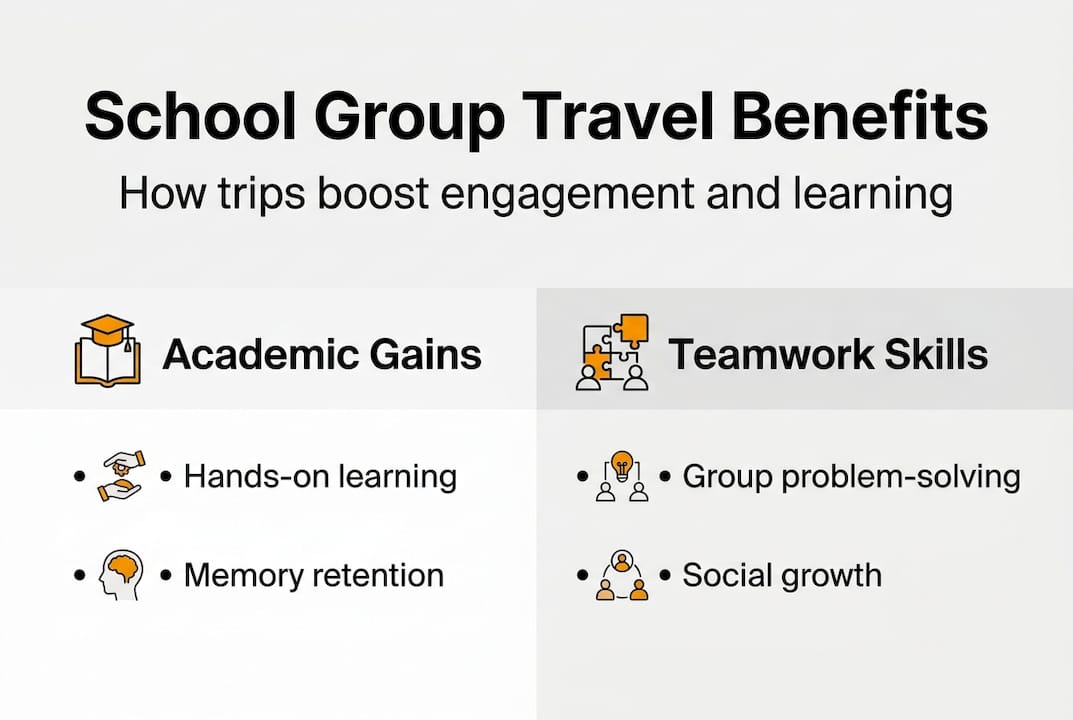
Travel increases teamwork, critical thinking, and social responsibility at measurable rates. Here is a practical breakdown of what those gains look like in practice:
| Skill area | What students practice on trips | Classroom equivalent |
|---|---|---|
| Teamwork | Coordinating tasks, shared problem-solving | Group assignments |
| Empathy | Interacting with diverse communities | Classroom discussion |
| Emotional resilience | Managing stress in new environments | Role-playing scenarios |
| Social responsibility | Service activities, community engagement | Volunteering programs |
The contrast is clear. Travel creates lived versions of skills that classrooms can only simulate.
Here are the most consistent social and emotional outcomes schools report after group trips:
- Students who struggled socially in school often find their footing in travel settings, where the social hierarchy is temporarily reset.
- Shared challenges, like a delayed bus or a rainy outdoor activity, create bonds that outlast the trip by years.
- Students exposed to service-learning components return with measurably stronger civic awareness.
- Interpersonal conflicts on trips, when handled well by staff, become powerful real-time lessons in communication and accountability.
The evidence around transformational group travel experiences consistently highlights that it is often the unplanned moments, not the curated itinerary, where the deepest growth happens. A student who talks through a misunderstanding with a peer in an unfamiliar city is practicing skills that no worksheet teaches.
Pro Tip: When assigning student roles for group tasks, mix social groups intentionally. Put the quiet student in a leadership role. Pair students who do not normally interact. The discomfort is temporary. The social growth is lasting. Resources on building community through adventure can help you design these moments on purpose.
Facing the challenges: Cost, logistics, and equity issues
Let’s be direct. Not every school can just pack up and go. The challenges are real, and ignoring them does a disservice to every coordinator trying to make this work on a limited budget.
Major challenges include logistical planning, travel expenses, (opens in a new tab) missed classes, and equity for low-income students. That last one matters most. If only the students who can afford it get to go, the trip reinforces inequality instead of addressing it.
Here is a practical comparison of common challenges and strategies to address them:
| Challenge | Impact | Strategy |
|---|---|---|
| High travel costs | Excludes low-income students | Tiered payment plans, fundraising |
| Missed class time | Academic disruption concerns | Align trip to curriculum units |
| Safety and liability | Parent and admin hesitation | Use vetted travel partners |
| Logistics complexity | Staff burnout, planning errors | Partner with specialized agencies |
Beyond the table, here are the most actionable steps for administrators:
- Start fundraising at least six months before departure to give families time to contribute and plan.
- Communicate early and often with parents, outlining costs, safety protocols, and educational goals upfront.
- Apply for district or state grants specifically targeting experiential learning.
- Work with a travel partner experienced in safely coordinating school travel to reduce the planning load on staff.
- Build in scholarship slots from the start, funded through group fundraising, so no student is turned away due to cost.
The logistics alone can feel overwhelming. Managing permissions, vendor contracts, dietary needs, and emergency protocols is a significant lift. That is exactly why using group travel agencies that specialize in school groups is one of the smartest decisions a coordinator can make. They have done the legwork hundreds of times over.
The goal is to make the trip accessible, safe, and purposeful. Those three things together are what separate a memorable educational experience from a liability headache.
Modern trends: Virtual, extended, and special-need-focused travel
The landscape of school group travel is changing. Administrators today have more options than ever, and understanding the trade-offs between each model is essential for making smart decisions.
Virtual vs. physical trips: Virtual field trips became more common after widespread school disruptions in recent years. They offer genuine access advantages, particularly for schools with tight budgets or students who cannot travel physically. However, virtual field trips show mixed outcomes compared to physical travel, often lacking the depth of engagement and real-world skill development that comes from being present in a location.
Physical trips, especially those tied to the curriculum, consistently outperform virtual alternatives in motivation and retention. Curriculum-linked journeys boost motivation (opens in a new tab) and measurable academic achievement, particularly when students understand the educational purpose of the experience before they leave.
Key considerations for modern trip models:
- Multi-day and overnight trips create deeper immersion but require more planning, parental consent, and financial commitment. They also generate the strongest long-term social bonds.
- Day trips are lower cost and logistically simpler, but may not provide the same depth of experience for complex learning objectives.
- Hybrid models combine virtual preparation with a physical culminating trip, stretching the learning window and reducing the cost of travel by doing more groundwork online first.
- Special needs inclusion requires proactive planning. Accessible venues, additional chaperones, clear communication with families, and individualized support plans are not optional add-ons. They are non-negotiables for running an equitable program.
For students with disabilities or learning differences, travel can be particularly powerful. New environments engage different strengths. But special needs require tailored support built into the trip from the planning stage, not added as an afterthought.
Pro Tip: If budget is tight, try a hybrid model. Use virtual content and pre-trip assignments to build student context over several weeks, then do a shorter, targeted physical trip that builds on that foundation. You get stronger outcomes at a lower cost per learning hour. Tools like making learning real with group travel can help you structure this effectively.
A fresh perspective on making travel truly meaningful
Here is something most planning guides won’t tell you: the destination matters far less than you think.
We see it consistently. Schools that pour resources into impressive locations but show up without a clear educational framework leave students entertained but not transformed. Meanwhile, a thoughtfully designed trip to a state park, a regional museum, or a nearby city can produce outcomes that a trip to another country sometimes cannot.
The real variable is intentional design. Trips that build in structured reflection time, assign project-based tasks tied to learning goals, and use social-emotional frameworks to process the experience consistently outperform trips that prioritize logistics and destination over purpose. The educational tour advantages most worth chasing are the ones you plan for deliberately.
This is not an argument against exciting destinations. It is an argument for not letting the destination do all the work. A well-designed experience anywhere beats a flashy but unstructured trip every time. Build the framework first. Then choose where to go.
How to turn your school group’s travel plans into lasting educational experiences
You now have a clear picture of what works, what doesn’t, and what obstacles to prepare for. The next step is putting it all together in a way that doesn’t drain your staff or your budget.
At Group Travel Network, we specialize in helping school administrators and trip coordinators build travel programs that are both safe and genuinely impactful. Whether you are starting your helpful planning for group travel or refining an existing program, our team handles the logistics so you can focus on the learning. Explore the essential benefits of group trips or connect with our coordinators to start building a trip that matches your goals, your students, and your community. We make safe coordination for school groups straightforward from day one.
Frequently asked questions
What are the educational benefits of travel for school groups?
Field trips boost learning, critical thinking, and social responsibility. Empirical research confirms that school group travel produces measurable improvements in practical knowledge, teamwork, and personal growth that extend well beyond the trip.
How can schools make trips accessible for all students?
Schools can address equity issues for low-income students through early fundraising, scholarship slots built into trip budgets, grant applications, and flexible payment plans that allow all students to participate.
Are virtual field trips a good substitute for real travel?
Virtual field trips increase access for students who cannot travel, but research shows mixed results. They often lack the depth of engagement and real-world skill development that physical travel provides.
How should schools support students with special needs on trips?
Effective support for students with special needs starts at the planning stage. Tailored support during trips includes accessible venues, individualized plans, sufficient staff-to-student ratios, and clear communication with families before departure.